Architecture
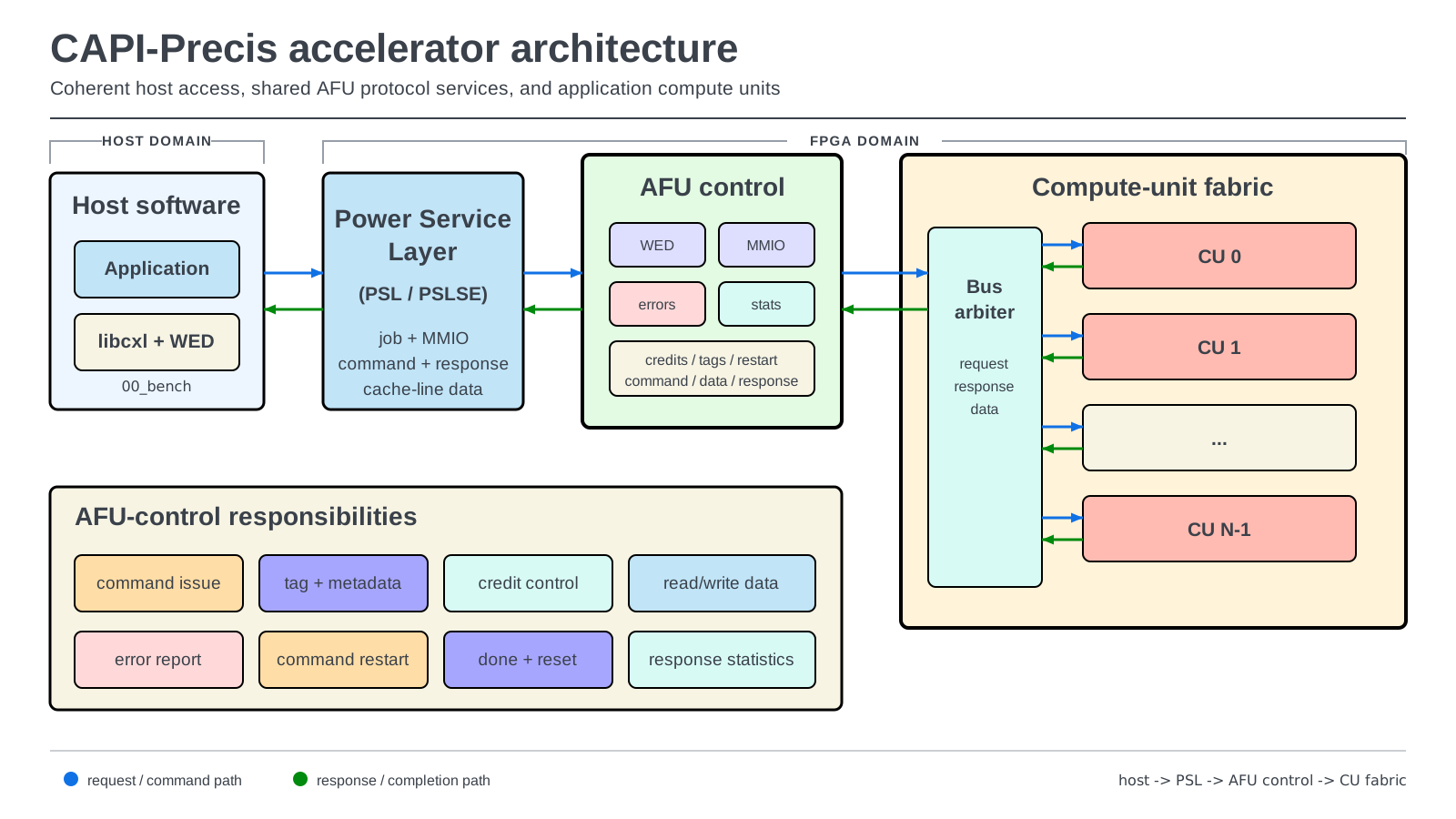
| Domain | Ownership |
|---|---|
| Host | Application/reference code, aligned buffers, WED construction, libcxl device attach, MMIO configuration, bounded completion wait, and result checking |
| FPGA | Power Service Layer, AFU control, MMIO/WED decode, command/credit/tag/data/response handling, compute units, progress, completion, and reset |
PSLSE emulates the host-facing CAPI transport during simulation. The AFU-control and compute-unit logic remains the FPGA-side design represented by the same interface boundary.
| Path | Responsibility |
|---|---|
00_bench |
Host applications, OpenMP references, CAPI launch code, tests |
01_capi_integration/accelerator_rtl/afu_control |
PSL command, response, credit, tag, data, error, and completion control |
01_capi_integration/accelerator_rtl/cu_control |
Application compute units and their read/write engines |
01_capi_integration/accelerator_verification |
Host contract tests, bound RTL monitor/tests, manifests, models, scripts, and simulation wave evidence |
01_capi_integration/accelerator_sim |
ModelSim design and PSLSE endpoint configuration |
01_capi_integration/accelerator_synth |
Quartus project generation and implementation |
01_capi_integration/accelerator_bin |
Platform images and implementation reports |
- The host allocates cache-line-aligned data and builds a 128-byte WED.
- libcxl attaches the WED to the selected AFU and maps big-endian MMIO.
- AFU configuration sets arbitration, credits, caching, and prefetch behavior.
- CU configuration selects engines, thread/CU count, and workload-specific arguments.
- CU commands enter AFU-control buffers and are issued to the PSL.
- Responses update running counters, error state, and the final completion registers.
- The host acknowledges completion, waits for CU reset, and compares output.
The bounded host protocol is defined in Accelerator verification.
| Block | Responsibility | Primary RTL |
|---|---|---|
| Host application | Allocates aligned data, builds the WED, configures MMIO, waits, and checks results | 00_bench |
| Power Service Layer (PSL) | Coherent command, response, data, MMIO, and job transport | Platform PSL / PSLSE |
| WED control | Fetches and decodes the 128-byte work descriptor | afu_control/wed_control.sv |
| MMIO | Receives AFU/CU configuration and publishes status, counters, errors, and completion | afu_control/mmio.sv |
| Command buffers | Separate WED, read, write, and prefetch request queues | afu_control/fifo.sv |
| Arbiter | Selects eligible command/data producers using fixed or round-robin policy | afu_control/*priority_arbiter*.sv |
| Credit control | Prevents requests from exceeding PSL credits | afu_control/credit_control.sv |
| Tag control | Allocates tags and preserves request metadata until response | afu_control/tag_control.sv |
| Command issue/restart | Issues PSL commands and replays restartable transactions |
afu_control/command_control.sv, restart_control.sv
|
| Read/write data | Routes cache-line data between PSL buffers and CUs |
afu_control/read_data_control.sv, write_data_control.sv
|
| Response/error | Classifies responses, reports protocol errors, and gathers statistics |
afu_control/response_control.sv, error_control.sv, response_statistics_control.sv
|
| Done/reset | Freezes final counters, requests CU reset, publishes completion, and waits for host ACK |
afu_control/done_control.sv, reset_control.sv
|
| Compute unit (CU) | Implements application-specific read, write, and compute engines | accelerator_rtl/cu_control |
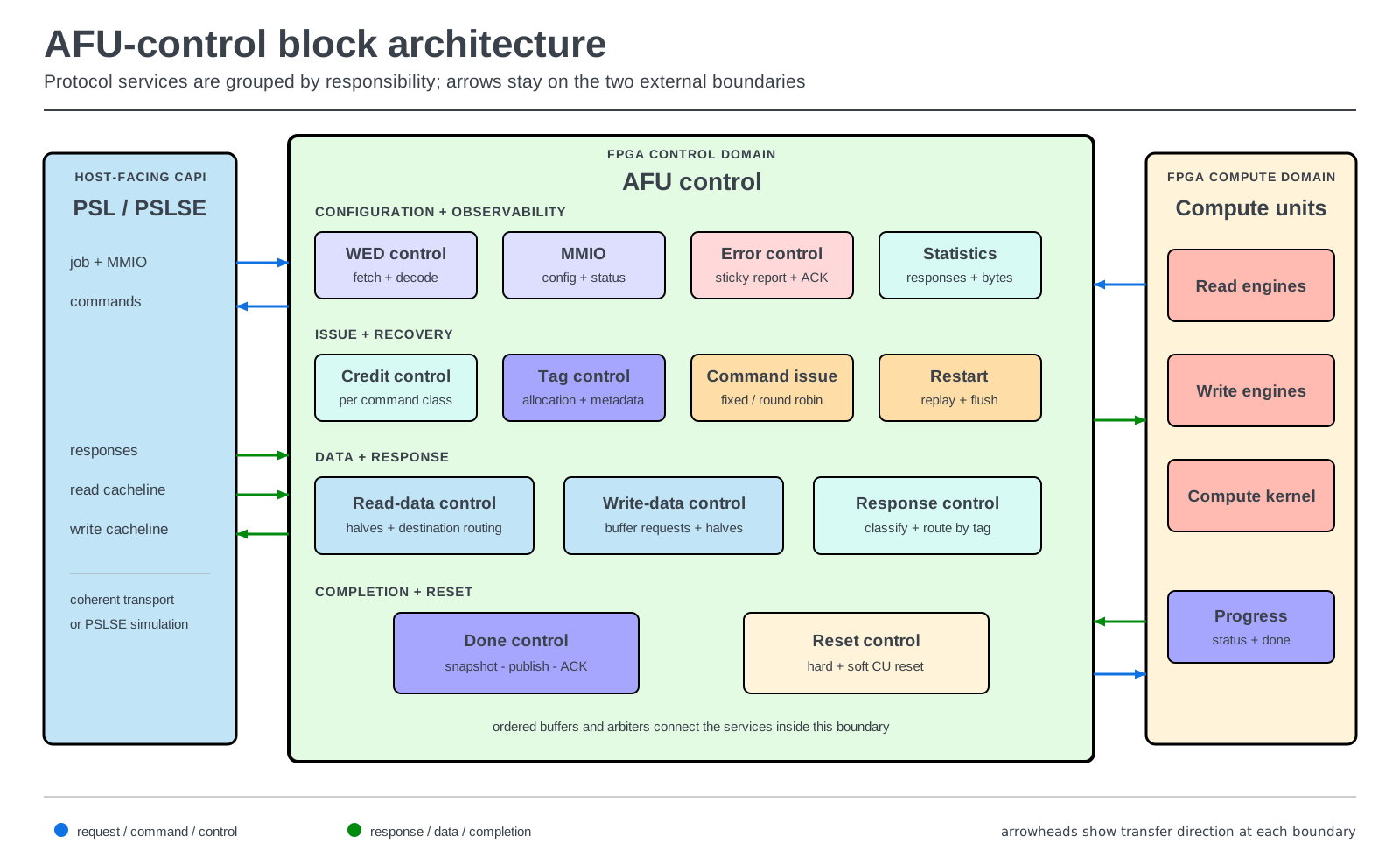
AFU control owns credit and tag management, command issue/restart, read and write data, WED loading, MMIO, error reporting, reset, and response statistics. Boundary-local arrows show interface direction without implying a direct wire between every internal block; the blocks are grouped by protocol responsibility.
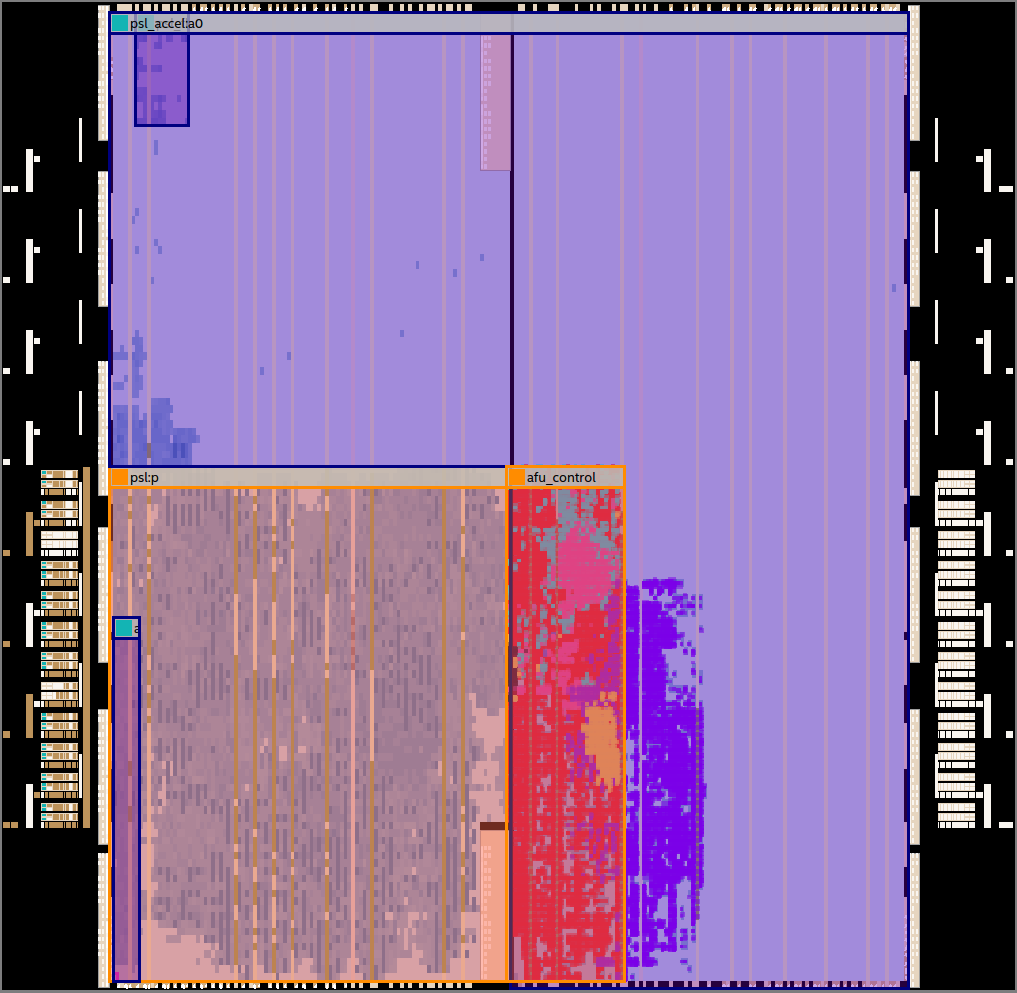
Simulation replaces the platform PSL and libcxl with PSLSE while keeping the
same WED and MMIO contract. Hardware uses the platform libcxl implementation and
a matching flashed .rbf image. A host binary, CU selection, and FPGA image are
one compatibility unit.