




Rust event sourcing library that gives every event a deterministic BLAKE3 identity. Append the same event twice: one row stored. Replay deterministically without a coordinator.
Events are identified by a deterministic BLAKE3 hash of (event_type, type_version, causation_id, CCE(payload)). Two identical events at the same causal position produce the same ID, giving idempotent append semantics without a distributed coordinator. Storage is a single SQLite file in WAL mode — no daemon, no network port, no separate server.
Current version: v1.8.3
Status: Active development
Fossic exists because coordinating six local AI services — each with their own event vocabulary — required a substrate that could remember events, version them, branch them, and replay them deterministically. NATS was evaluated and rejected (see ADR-002): JetStream adds retention but not content-addressed identity, no branchable stream model, and no reducer contract. The reflective twin architecture required building this directly.
use fossic::{Store, OpenOptions, Append};

let store = Store::open("store.db", OpenOptions::default())?;
store.declare_stream("my-app/events", "my-app", None)?;

let event_id = store.append(Append {
    stream_id: "my-app/events".into(),
    event_type: "ThingHappened".into(),
    type_version: 1,
    payload: serde_json::json!({ "key": "value" }),
    ..Default::default()
})?;
For Python, Node.js, and Tauri quick starts, see the binding READMEs:
| Crate | Path | Purpose |
|---|---|---|
fossic |
. |
Rust core library |
fossic-py |
fossic-py/ |
PyO3 Python bindings |
fossic-node |
fossic-node/ |
napi-rs Node.js bindings with TypeScript types |
fossic-tauri |
crates/fossic-tauri/ |
Tauri 2 IPC companion crate |
fossic-similarity-hnsw |
crates/fossic-similarity-hnsw/ |
HNSW-backed semantic search provider |
| Doc | What it covers |
|---|---|
docs/architecture.md |
System overview: Store internals, SQLite schema, threading model, append pipeline, subsystem map |
docs/operating.md |
How to use fossic: all major API patterns with working code, test commands, OpenOptions reference |
docs/gotchas.md |
Sharp edges: CCE identity collisions, dispatch channel backlog, subscription degradation, event ID ordering |
docs/history.md |
Development narrative: 8 inflection points from Lattica origin through v1.8.1 |
CHANGELOG.md |
Versioned release history |
Deep dives (one per non-obvious subsystem):
| Doc | Subsystem |
|---|---|
docs/deep-dives/identity-and-cce.md |
CCE encoding and BLAKE3 event ID derivation |
docs/deep-dives/storage-schema-concurrency.md |
SQLite schema, WAL mode, concurrency model |
docs/deep-dives/event-lifecycle.md |
Event lifecycle end-to-end |
docs/deep-dives/subscriptions-wal-watch.md |
Subscriptions, degradation mechanics, WAL watcher |
docs/deep-dives/branches.md |
Branch model and lifecycle |
docs/deep-dives/reducers-snapshots.md |
Reducers, snapshot lifecycle, auto-snapshot policies |
docs/deep-dives/cross-stream-queries.md |
Causation walk, correlation read, aggregate |
docs/deep-dives/schema-evolution-deletion-errors.md |
Upcasters, deletion, error catalogue |
docs/deep-dives/python-bindings.md |
PyO3 binding internals and patterns |
docs/deep-dives/failure-modes.md |
SR-10 failure mode analysis (17 findings, open triage) |
docs/deep-dives/extension-patterns.md |
Sibling crate author guide: SystemStreamWriter, BackgroundExecutor, TaskKind::Custom |
Implementation specs (for implementors of bindings or the CCE protocol):
docs/implement/CCE_SPEC.md— Canonical Content Encoding specification with test vectorsdocs/implement/FOSSIC_V1_SPEC.md— Full implementation spec (schema, threading, error catalogue, stream registry contract)docs/implement/AGENT_TRACE_VOCABULARY.md— Standard event vocabulary for agent trace recordingdocs/implement/POLICY_SCOUT_EVENT_VOCABULARY.md— Policy Scout event vocabulary
Decision records:
docs/adr/— ADRs: NATS rejection, Lattica platform origin, SQLite choice, workspace structure
Content-addressed IDs. event_id = BLAKE3("fossic-cce-v1\0" || CCE(event_type, type_version, causation_id, payload)). Stream, branch, and timestamp are excluded — appending the same event twice returns the same ID and stores only one row.
Stream registry. Streams must be declared before appending. declare_stream(id, declared_by, description) is idempotent; typos become errors at the point of mistake.
Subscription modes. Synchronous fires inside the write transaction before append() returns. PostCommit fires on a dedicated thread after commit, through a bounded channel. Queue overflow causes permanent degradation — subscribe to _fossic/system with include_system: true to detect it.
Reducers. Pure (State, Event) → State functions registered against glob stream patterns. read_state folds events through the reducer using the most recent snapshot as a starting point. Panics in apply return Error::ReducerPanicked rather than unwinding.
Branches. Lightweight pointer records — no event copying on branch creation. A branch diverges from a parent at a specific version and inherits all prior events via the ancestor chain.
Bounded reads. All major read operations have _bounded variants returning ReadOutcome<T> (Complete or Truncated { data, cursor, reason }). Pass the cursor back to resume. Streaming iterators release the read-pool connection between yields.
No async required. std::thread + crossbeam-channel throughout the core. No Tokio handle needed.
just test        # Rust + Python + Node (first run ~2 min, subsequent ~30 s)
just test-rust   # Rust workspace only
just test-py     # Python binding only
just test-node # Node binding onlyItems grounded in open findings, tracked TODOs, and documented gaps as of v1.8.1.
Planned (tracked in SR-10):
- A-1: CCE collision guard — configurable include-stream-id-in-hash mode to prevent silent cross-stream deduplication
- A-2: Bounded dispatch channel — capacity limit + back-pressure signal on the post-commit channel
- A-3: Subscription recovery path — drain-and-resubscribe helper with gap detection
- A-4: Synchronous subscriber timeout — configurable deadline to prevent slow sync subscribers from blocking append
- A-7, A-8, A-9, A-10: Snapshot and executor resilience improvements (see
docs/deep-dives/failure-modes.md) - A-12 through A-17: System stream reliability, recovery path completeness, and bounded-read cursor gaps
Planned (implementation gaps):
- Pre-built wheel distribution for
fossic-py— consumers currently require Rust installed locally - Aggregate
read_range_boundedcursor — truncation does not yet produce a resume cursor for fold operations - Logging framework adoption —
src/deletion.rsuseseprintln!; planned migration tolog::warn!ortracing::warn!
Under consideration:
- PyO3 bridge latency reduction —
read_stateadds ~47μs per replayed event; aggressive snapshot cadence partially mitigates this
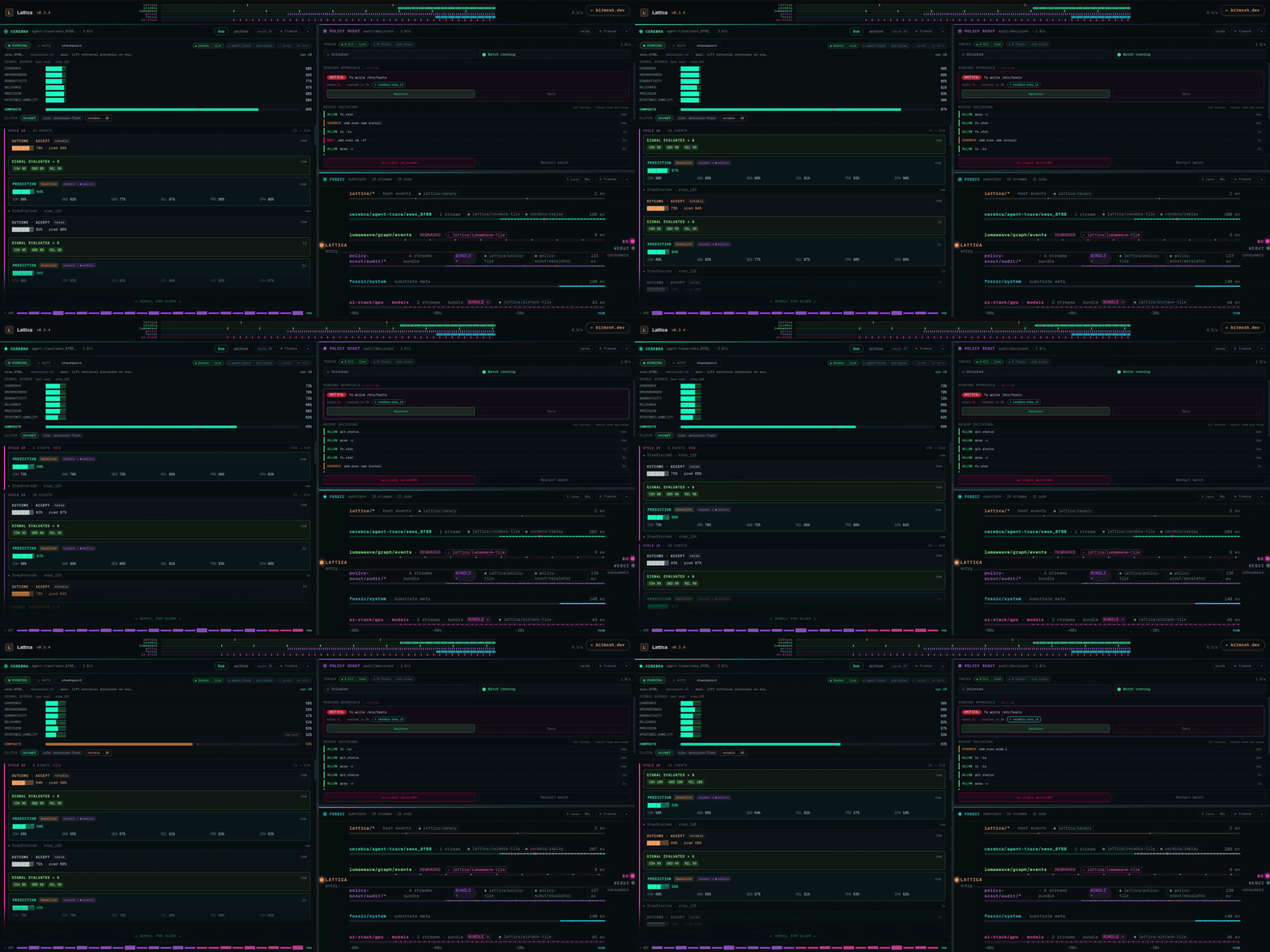
Fossic is the event substrate for Lattica, the local-first observability hub, alongside Cerebra (cognitive runtime), LumaWeave (graph visualization), and Policy Scout (safety harness).
Apache-2.0 — see LICENSE for the full text and NOTICE for attribution.