Khe Sanh Intel Assessment
Historical campaign material for Caucasus - Khe Sanh: Operation Niagara (Caucasus map, 21 January 1968). Unlike the Red Tide pack (Tom Clancy fiction), this is rooted in the real history of the Siege of Khe Sanh — real units, commanders, dates, and operations. Where DCS or the campaign build forces a departure from history, it is flagged, not invented around.
For the working brief-builder — friendly ORBAT, mission-brief template, package recipes, the AAA threat-defeat card — see the Campaign Briefing Handbook. Three pieces below:
- Intelligence Assessment — the history, order of battle, courses of action, target deck.
- Pilot's Threat Card — one-page kneeboard quick-reference.
- Five-Minute Spoken Brief — a read-aloud script for the mass brief.
🟢🟡 History vs. DCS — what's real and what's a concession. Everything in the assessment is drawn from the historical record of the siege (21 Jan – 9 Apr 1968). The campaign maps it onto the Caucasus terrain and makes a few gameplay concessions you should know are not historical: a token MiG-17 presence (the VPAF did not contest the air over Khe Sanh — it was far south, out of range, and the MiGs defended the North); SA-2/SA-3 only in the deep rear (SA-2s were a North Vietnam threat — there were none at Khe Sanh); and modern module stand-ins for the period types (AH-1W for the AH-1G, A-6E for the A-6A, F-4E for the F-4B/C/D, CH-53E for the CH-53A/CH-46, B-52H for the B-52D, and the OV-10 — which actually entered combat ~July 1968, so it stands in for the period O-1/O-2 Bird Dog FACs). The real threat to aircraft was AAA and small arms — not MiGs, not SAMs, and no MANPADS (the SA-7 didn't appear until 1972).
III Marine Amphibious Force / MACV — Combined Intelligence Period of report: opening of the siege, 21 January 1968 Subject: NVA forces investing Khe Sanh Combat Base; friendly situation; the air plan
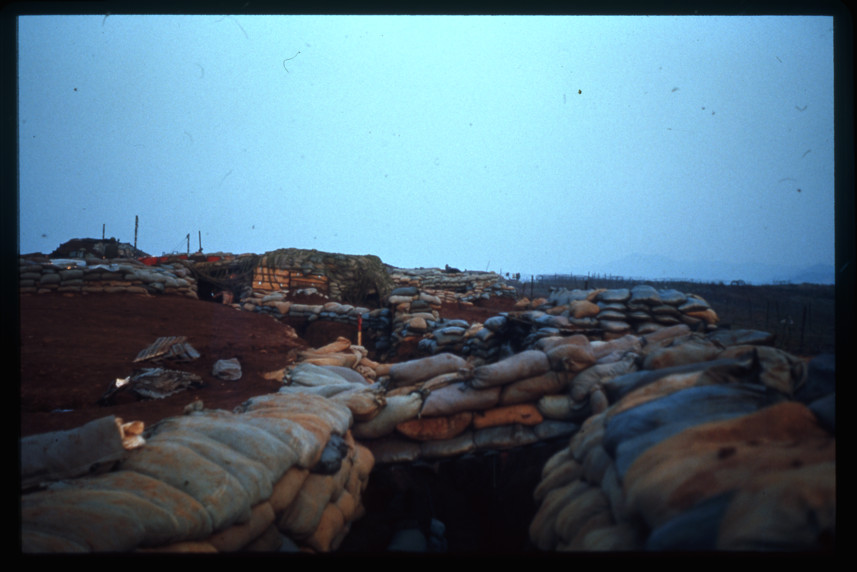 26th Marines in the perimeter trenches, Khe Sanh, 1968. USMC Archives (CC BY 2.0), via Wikimedia Commons; full image credits.
Two-plus NVA divisions have invested the Marine combat base at Khe Sanh in northwestern Quảng Trị, near the Laotian border and the DMZ. As of this morning the base is encircled and under artillery, rocket, and mortar fire — a pre-dawn barrage on 21 January detonated the main ammunition dump. The garrison can be supplied and supported only by air.
The plan is Operation Niagara: a round-the-clock air umbrella — B-52 Arc Light strikes, Marine/Navy/USAF tactical air, and aerial resupply — to hold the perimeter and destroy the besieging divisions from the air while they are massed. When the weather and the ground situation allow, the Operation Pegasus relief will reopen Route 9 from the east and break the siege.
The intent is deliberate. COMUSMACV (Gen. Westmoreland) means to hold Khe Sanh and let the enemy mass against it, so that American airpower and artillery can do to the NVA what the Viet Minh once did to the French at Dien Bien Phu — in reverse. The garrison's job is to hold the ground and the hills; our job in the air is to make the massing fatal.
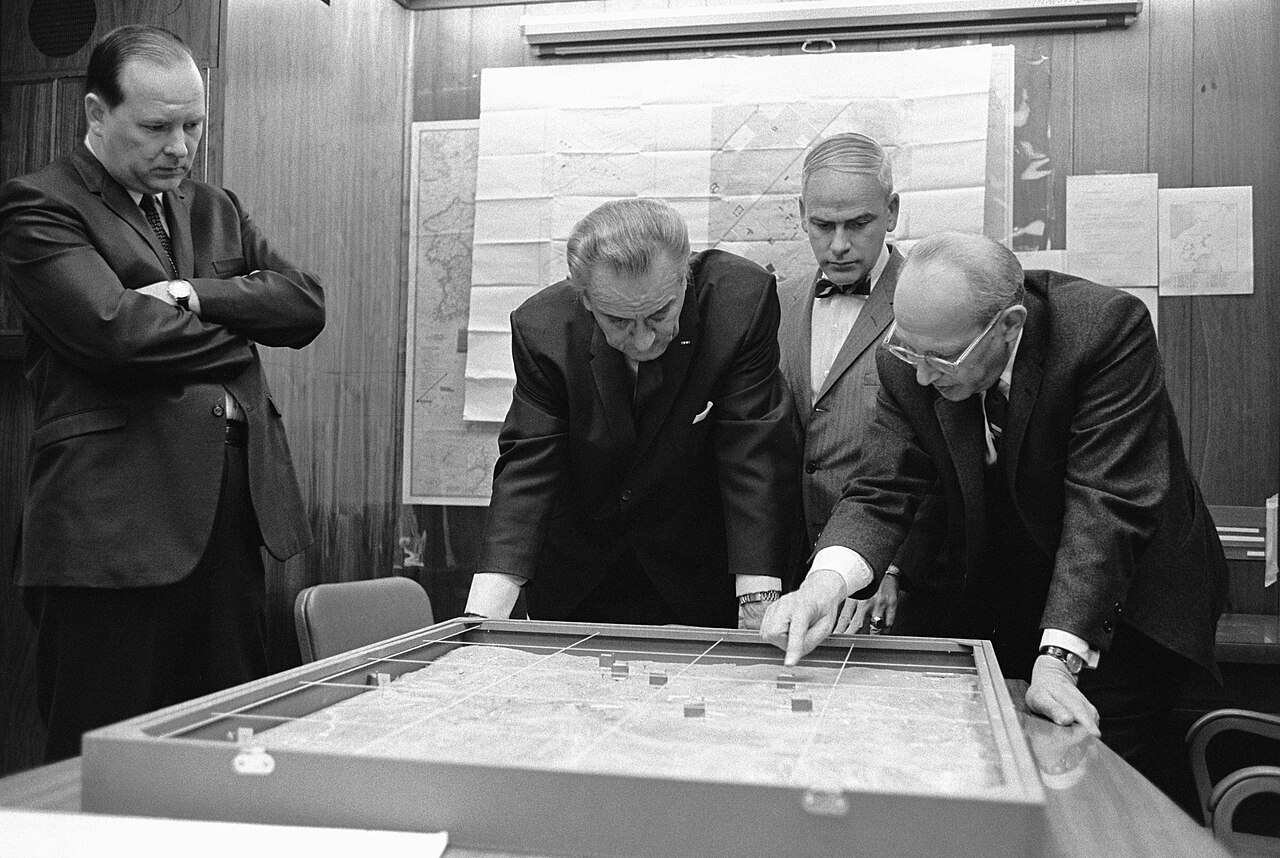 Washington watched it hour by hour: President Johnson briefed over a terrain model of Khe Sanh in the White House Situation Room — the "Dien Bien Phu in reverse" anxiety reached the top. White House photo by Yoichi Okamoto (public domain), via Wikimedia Commons.
Khe Sanh sits astride Route 9 and overlooks the NVA infiltration routes from Laos (the Ho Chi Minh Trail complex). Through late 1967 the NVA 304th and 325C Divisions moved into the hills around the base, with elements of the 320th and 324th and the 202nd Armored Regiment in support. By January 1968 an estimated 20,000–40,000 NVA ringed roughly 6,000 defenders.
The siege opened on 21 January 1968 — nine days before the nationwide Tet Offensive — with attacks on Hill 861 and the bombardment that blew the base ammunition dump. Whether Khe Sanh was a feint to draw forces away from the cities before Tet, or Tet was the feint for Khe Sanh, is debated to this day. It does not change the mission: hold, and bleed them from the air.
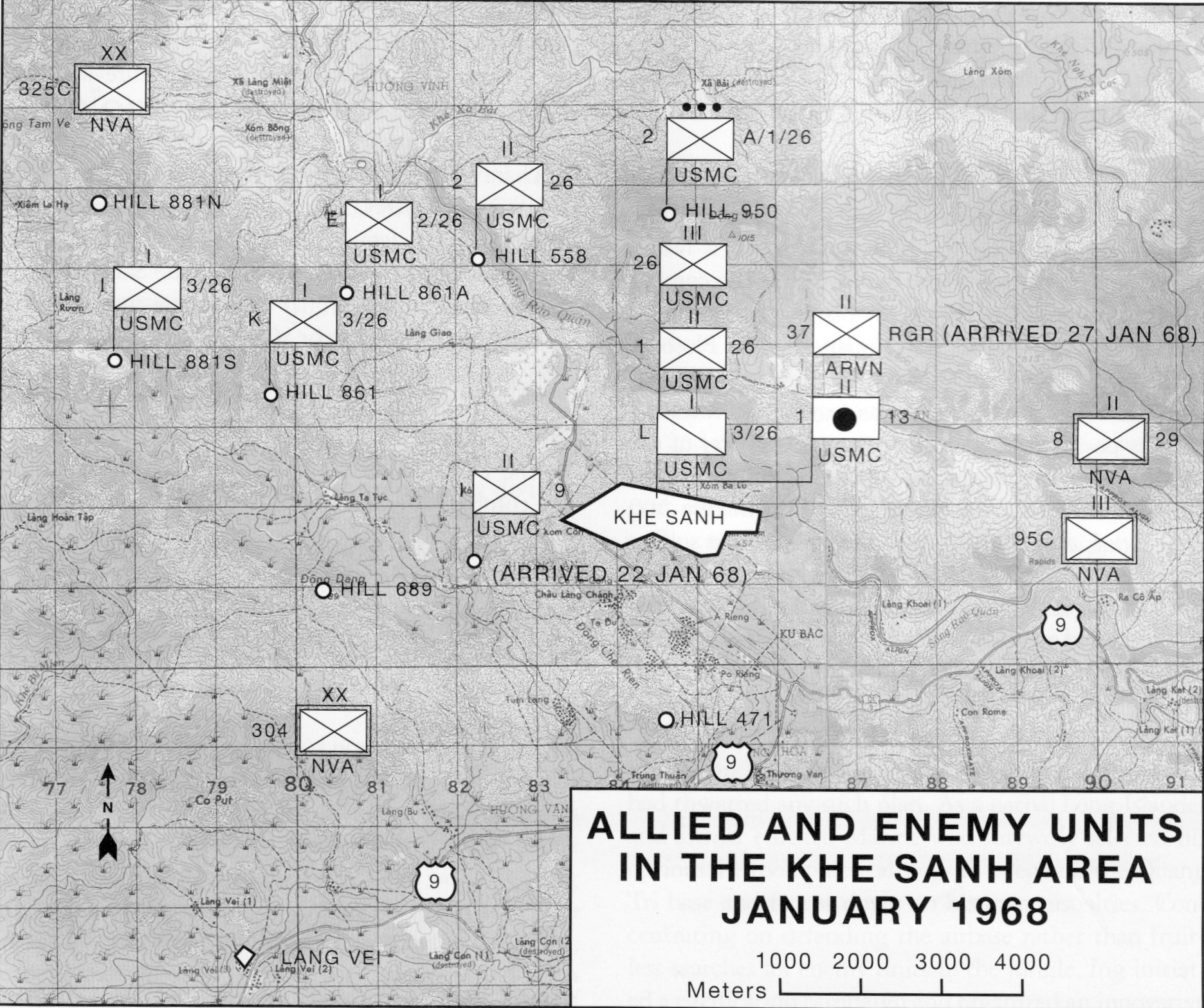 The siege in one map: the 26th Marines on the hills + ARVN Rangers at the base, ringed by the NVA 304th/325C/320th/95C divisions, January 1968. US Navy map (public domain); full image credits.
The NVA threat here is on the ground, not in the air.
- Infantry: the 304th Division (the Dien Bien Phu veterans) on the south and west; the 325C Division to the north among the hills; elements of the 320th / 324th. Sapper and engineer units dig approach trenches toward the wire — the same parallel-trench method used at Dien Bien Phu.
-
Armor — the signature threat: the 202nd Armored Regiment with PT-76 amphibious tanks.
(Historical: on the night of 6–7 February the PT-76 overran the Lang Vei Special Forces camp — the
first use of NVA armor in South Vietnam.) In the campaign this is the Lang Vei (Kobuleti) armor
group — PT-76 plus, as a DCS stand-in for heavier NVA armor, the
[CH]T-54. - Artillery — the long reach: 130 mm and 152 mm guns and rockets, the most dangerous emplaced on the Co Roc massif inside Laos, beyond effective counter-battery range of the base's own guns. Co Roc and the hill artillery can only be answered from the air. Rockets (122 mm) and heavy mortars range the base daily.
- Air defense — AAA, in quantity: 12.7 mm, 14.5 mm, 23 mm, 37 mm and 57 mm guns on the hills and along the approaches, plus small arms over every target. (In the campaign the NVA AAA includes the radar-directed ZSU-23-4 Shilka and ZSU-57-2 as DCS representations; the historical bulk was optically-aimed 12.7–57 mm.)
There is effectively no enemy air over Khe Sanh. The VPAF's MiG-17/19/21 force defended the North against Rolling Thunder; Khe Sanh was out of its reach and not its mission. No SA-2s are sited here — the surface-to-air missile threat was a North Vietnam problem.
🟡 DCS concession: the campaign fields a token MiG-17F flight (Senaki) and may place SA-2/SA-3 in the deep rear so the air-to-air and SEAD systems have something to do. Treat both as gameplay seasoning, not history. The MiGs are guns-only (their missiles are date-gated out), and any SA-2 belongs in depth, never over the perimeter.
- Ground: the 26th Marine Regiment (reinforced), Col. David E. Lownds commanding, plus the ARVN 37th Ranger Battalion. The defense rests on the hill outposts — 881 South (Capt. William Dabney, India 3/26), 881 North, 861, 861A, 558, 950 — holding the high ground that overlooks the base. The Lang Vei Special Forces camp (Det A-101, 5th SFG) screens the southwest along Route 9.
-
Air — Operation Niagara:
- B-52 Arc Light — saturation box strikes on massed NVA, walked progressively closer to the wire as confidence in accuracy grew.
- Tactical air — Marine (1st MAW), Navy (Task Force 77 carriers on Yankee Station), and USAF (7th AF) — A-4, A-6, A-1, F-4, F-8, F-100. Air control was consolidated under a single manager (7th AF, Gen. Momyer) over Marine objection.
- Radar bombing — the monsoon crachin (low cloud and fog) drove TPQ-10 (Marine) and MSQ-77 "Combat Skyspot" (USAF) ground-directed bombing so strikes could go in blind.
- Aerial resupply — C-130 and C-123 into the fire-swept strip using LAPES/GPES and parachute drops; the "Super Gaggle" — massed A-4 escort shepherding CH-46 resupply to the hill outposts through the weather and the flak.
The northeast monsoon owns January–March: low ceilings, fog, and crachin that routinely close the target. This is why radar bombing and the Super Gaggle exist. The terrain is hill and valley — the outpost hills dominate the base, and the Co Roc artillery shelters across the Laotian border. Route 9, the only road, is cut and ambush-laced.
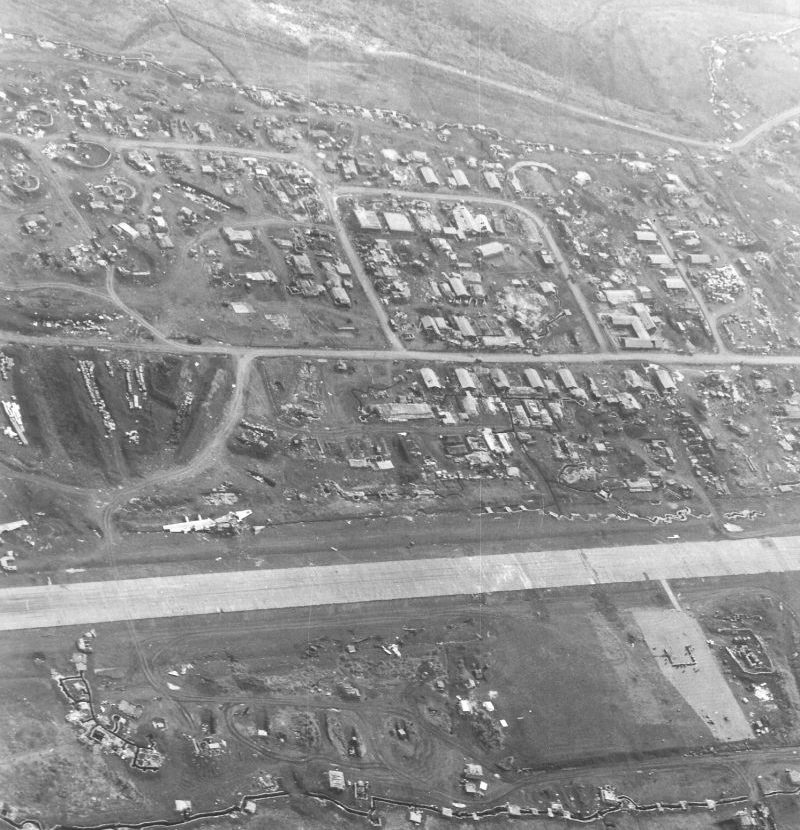 The Khe Sanh airstrip, 1968 — the deadliest gauntlet of all, ranged by NVA guns on the approach. USAF photo (public domain), via Wikimedia Commons.
Flak, not missiles. The killers are the automatic AAA (12.7–37 mm) low and the 57 mm reaching to medium altitude, plus small arms over every pass — concentrated on the hill targets and the airstrip approach, the deadliest gauntlet of all. There are no MANPADS (the SA-7 is four years away) and no SAMs at the base. The practical implication: medium altitude is relatively safe — work from it, vary every run-in, and don't make repeat passes.
MOST LIKELY (ENCOA): Strangle and grind. Sustain the bombardment (Co Roc + rockets + mortars), push the approach trenches toward the wire, interdict the airstrip to choke resupply, and probe the hills — converting the siege into attrition and waiting for weather to ground our air. Our answer: keep the airlift flowing and kill the guns and the diggers from the air.
MOST DANGEROUS (MDCOA): Mass assault with armor. Repeat the Lang Vei model at scale — a regimental assault behind PT-76/armor against a hill outpost or the main perimeter, timed to the weather. Our answer: the on-call CAS stack, the FAC, and Arc Light on the assembly areas.
- The artillery — especially Co Roc. The guns in Laos and on the hills do the killing; they are an air-only target. Highest priority.
- The armor at Lang Vei (Kobuleti). Kill the PT-76/T-54 before it can repeat Lang Vei against the wire.
- Massed infantry & assembly areas. The Arc Light target set — break the divisions while they are concentrated.
- The approach trenches & sapper works closing on the perimeter.
- The supply road (Route 9) & the trail feeders. Cut the bridges and the road to starve the siege (the campaign's destructible-bridge interdiction targets).
- The AAA on the hills — beat it down so the strikers and the resupply can work.
- Gen. William C. Westmoreland — COMUSMACV; chose to hold Khe Sanh and destroy the massing NVA by fire. Ordered the Niagara concentration; weighed (and shelved) more drastic options under the Dien Bien Phu shadow.
- Col. David E. Lownds — CO, 26th Marines; the man holding the base.
- Capt. William Dabney — India 3/26 on Hill 881S, the most-shelled outpost.
- Gen. William Momyer — 7th AF; the single-manager for air over Khe Sanh.
- Gen. Võ Nguyên Giáp — widely credited with the NVA design (his personal role is debated); the victor of Dien Bien Phu, reaching for a second one.
| Real place | Caucasus CP | Side |
|---|---|---|
| Khe Sanh Combat Base | Kutaisi (0.25 strength — besieged) | BLUE |
| Hill 881S outpost | Hill 881S FOB | BLUE |
| The hills (881/861/558) + NVA artillery | Sukhumi | RED |
| Route 9 / Pegasus axis | Senaki | RED |
| Lang Vei SF camp (PT-76 armor) | Kobuleti | RED |
| Da Nang (tac-air rear + relief staging) | Batumi | BLUE |
| Yankee Station carriers | Naval-1 / Naval-2 | BLUE |
| Deep rear (heavy jets, B-52, tanker) | Tbilisi-Lochini | BLUE |
| Threat | Where | Why it matters |
|---|---|---|
| 130/152 mm artillery (Co Roc) | Laos massif, the hills | The killer; air-only target |
| PT-76 / T-54 armor | Lang Vei (Kobuleti) | The Lang Vei assault threat |
| 57 mm AAA (S-60 / ZSU-57-2) | hills, approaches | Reaches medium altitude |
| 23 mm (ZU-23 / ZSU-23-4 Shilka) | everywhere, esp. low | Shilka is radar-directed — accurate |
| 12.7/14.5 mm + small arms | every target, the strip | Lethal low; the airstrip gauntlet |
| MiG-17F (token) | Senaki | 🟡 gameplay only; guns-only; no real MiG threat here |
| SA-2/SA-3 (depth) | deep rear | 🟡 gameplay only; none historically at Khe Sanh |
| MANPADS | — | None. No SA-7 until 1972. |
==============  KHE SANH (NIAGARA) — THREAT CARD  ==============
WE OWN THE AIR. THE ENEMY OWNS THE GROUND AND THE GUNS. KEEP THE BASE ALIVE.

THE THREAT IS FLAK — NOT MIGs, NOT SAMs, NO MANPADS (none exist in '68).
  57mm (S-60 / ZSU-57-2) .. reaches MEDIUM alt. Roll in from above it, dive, egress jinking.
  23mm ZSU-23-4 SHILKA .... RADAR-directed, accurate. Terrain-mask, re-attack new axis.
  23mm ZU-23 / 12.7-14.5 .. lethal LOW. Don't loiter low; one pass, vary heading.
  THE AIRSTRIP .......... the worst gauntlet — guns range the Khe Sanh approach.

GROUND TARGETS (this is the war)
  ARTILLERY (Co Roc 130/152mm, hill guns) ... #1 — air-only target, it does the killing
  ARMOR at LANG VEI (PT-76 / T-54) .......... kill before it hits the wire (Rockeye)
  MASSED INFANTRY / assembly areas .......... ARC LIGHT
  APPROACH TRENCHES, the supply road/bridges  interdiction

RULES TO LIVE BY (1968 tac-air)
  • No MANPADS — medium altitude is your friend. Use it.
  • Vary IP, axis, roll-in alt EVERY pass. One pass, haul ass when guns are hot.
  • Work the FAC (Bronco). A Willie-Pete mark turns a hidden gun into a target.
  • DANGER CLOSE near the wire — FAC clears, you read back. Don't drop uncontrolled.
  • Weather wins arguments — radar bombing (Skyspot/TPQ-10) when the crachin closes it.

AIR (minor)
  MiG-17F (token, Senaki) — GUNS ONLY. Keep energy, don't slow-fight. F-8/F-4 handle it.
===============================================================
Briefer's note: ~600 words, ~5 minutes. Historical — keep the facts straight.
Gentlemen. Twenty-one January, nineteen sixty-eight. Take a seat.
This morning, before first light, the NVA dropped the hammer on Khe Sanh. They walked artillery onto the base and put a round into the main ammo dump — fifteen hundred tons went up. Hill 861 took a ground assault. As of right now, two North Vietnamese divisions — the 304th and the 325C, the same 304th that beat the French at Dien Bien Phu — have six thousand Marines surrounded in those hills. The road is cut. The only way in or out is the way you're going: by air.
So understand what this is. General Westmoreland is not trying to avoid this fight. He wants it. For years we've chased these people through the jungle and never gotten them to stand still. Now they're standing still — dug in, massed, in the open, around one base. That is the one thing airpower was built to destroy. They're betting on a second Dien Bien Phu. We're going to give them the opposite.
That's the operation: Niagara. Round-the-clock air. Arc Light — the B-52s — on the massed infantry and the assembly areas. Tac air from Da Nang, from the carriers on Yankee Station, and from the Air Force in the rear, on the guns and the trenches. And the airlift — the C-130s — keeping the garrison fed, because if the resupply stops, the base dies. Every one of those is your job.
Here's the target list, in order. First, the artillery. The worst of it is on the Co Roc ridge, across the line in Laos, out of reach of our guns — which means it's yours, and nobody else's. The 130s and 152s are what's killing Marines on those hills. Find them, and kill them. Second, the armor. There are PT-76 tanks down by the Lang Vei camp. If they push armor onto a hill or the wire, it gets ugly fast — so we kill the tanks before they move. Third, the massed troops — that's the Arc Light set. Then the trenches and the road — they're digging toward the wire like it's 1954, and they're trucking supplies down Route 9. Cut the bridges, kill the diggers.
Now the part that'll save your life. The threat here is flak, not missiles. There are no MiGs over this base — the MiGs are up north defending Hanoi, and they're not coming. There are no SAMs here, and there are no shoulder-fired missiles — those don't exist yet. What there is is guns: twelve-seven, twenty-three millimeter, thirty-seven, fifty-seven, and small arms over every target. The radar-laid twenty-three — the Shilka — is the accurate one; if it's up, mask it and come back from a new direction. Because there are no missiles, medium altitude is your friend — the men who die here are the ones who dive into the small-arms and auto-cannon to admire the target, or who fly the same run-in twice and let the gunners learn them. Vary your heading. One pass. Don't get low and slow.
And the weather will fight you as hard as the NVA. The monsoon socks this place in. When it does, you bomb on the radar — Skyspot and the TPQ — and for the hills, we run the Super Gaggle: a pack of Skyhawks escorting the helicopters in through the muck. Work your FAC. The Bronco overhead will mark with Willie Pete and clear you hot — and near that wire, danger-close, you do not drop until he does and you read it back.
The Marines on those hills cannot leave. They are holding the high ground so the base lives, and they are counting on the sky over their heads being ours. It is. Keep it that way until Pegasus comes up Route 9 and we break this thing open.
Hold the line. Step out in ten. Good hunting.
Historical sources are the standard accounts of the Siege of Khe Sanh and Operation Niagara (21 Jan – 9 Apr 1968). DCS/campaign concessions (token MiGs, deep-rear SA-2, modern module stand-ins) are flagged above. Companion docs: Campaign Briefing Handbook · Visual Briefing · Role Cards · First Three Turns.
This page is the online copy of docs/campaigns/khe-sanh-intel-assessment.md in the repo. Edit that file; the wiki is mirrored from docs/wiki/ on merge to main.