electrode design
The size of the contact area is one aspect that determines the resulting sensation.
Small electrodes can have a very sharp feeling. Large electrodes feel less sharp, but can generate inconsistent sensations known as stinging. The occurs when the current not well-distributed over the electrode surface.
This can be caused by:
- Bad contact between skin and electrode, caused by:
- Hair, which is an isolator
- Sticky pads that peel off
- Rigid electrodes that are not pressed against the skin with sufficient force.
- Dry skin plus sweat
- Contamination on the electrode, particularly with conductive rubber
- Poorly constructed electrodes
- Placement near major nerve bundles
- Aggressive signals
To minimize stinging, ensure area is moisturized and free of hair. Contact pressure can be improved with bandages.
Specific electrode construction can also induce or reduce stinging, I will address some examples below.
Some electrodes, such as conductive rubber tubing, have a non-negligible internal resistance. At high currents, the skin resistance is low compared to the internal resistance of the electrode. This causes a current hotspot near the connector.
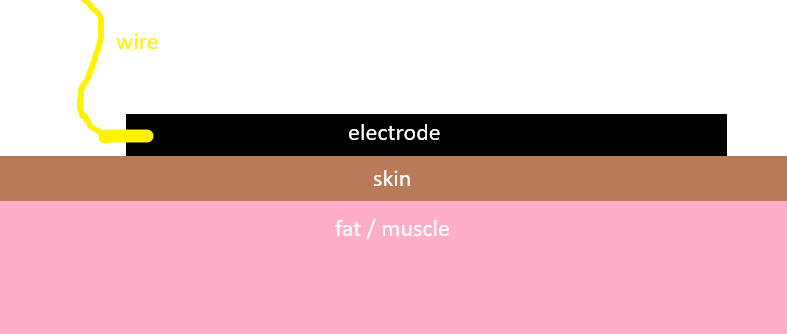
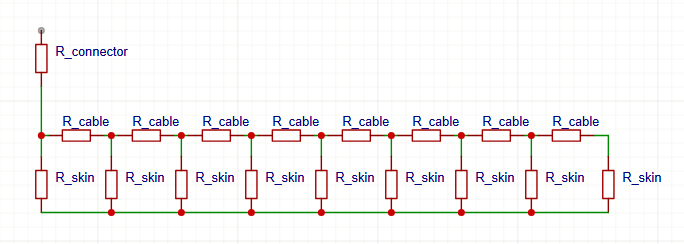
The simplest solution is to insert a metal wire in the tubing.
Even with perfect skin contact, highly conductive electrodes (i.e. metal) concentrate most current at the edges. As such the maximum current density depends on electrode circumference instead of area.
 image source: Bioelectrodes, Eric McAdams
Simulations available at
Estimation of current density distribution under electrodes for external defibrillation
Conductive rubber electrodes with metal core can be considered highly conductive.
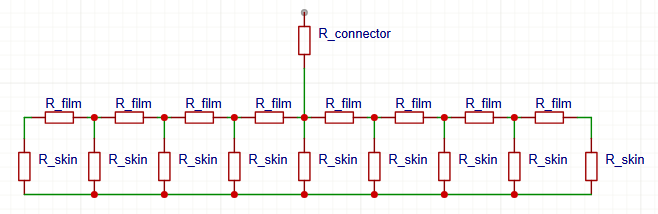
There are two solutions. One is to move the connector to the center and use a resistive backing film. Since the resistance increases towards the edges of the electrode, more current will pass through the center of the electrode which increases uniformity. Cheap sticky pads utilize this approach.
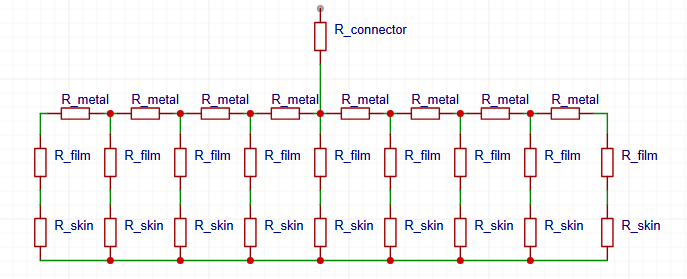
The second solution is to add a resistive film between the metal
backing and the skin. Values around
This approach also makes the sensation less sensitive to local variations in skin resistance.
It is thought that coating metal electrodes in oil achieves a similar effect. I believe this is an interaction between oil and skin, rather than between oil and metal.
Below is a 3D printed electrode made of 9 individual flexures of conductive filament, each one has a resistance of about 500ohm to a metal ring buried in the plastic. It is noticeably less stingy than conductive rubber electrodes placed at the same approximate location.