Repository navigation
Example
A small simulated dataset, bundled with BACoN, to check an installation and to see every output in a few
seconds. example/make_example.py
generates it (standard library only; the same files every time):
- a 30 kb circular reference ("organelle");
- four samples of about 50x of simulated Nanopore reads (1–20 kb, 1.5% errors), each mixed with 20% of reads from an unrelated sequence that baiting must remove;
- known SNPs: alpha is identical to the reference, beta has 6 SNPs, gamma has beta's 6 and 4 more, delta has 10 of its own.
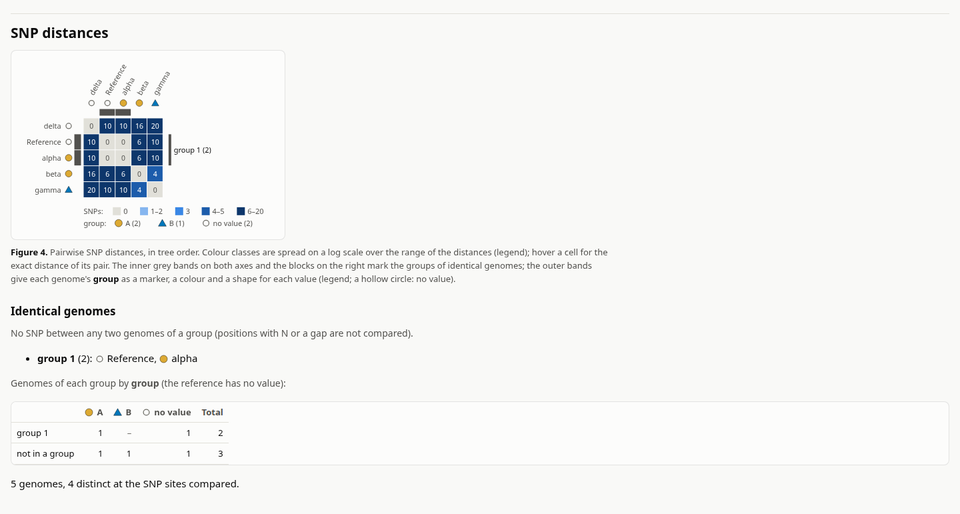
| Reference | alpha | beta | gamma | delta | |
|---|---|---|---|---|---|
| Reference | 0 | 0 | 6 | 10 | 10 |
| alpha | 0 | 0 | 6 | 10 | 10 |
| beta | 6 | 6 | 0 | 4 | 16 |
| gamma | 10 | 10 | 4 | 0 | 20 |
| delta | 10 | 10 | 16 | 20 | 0 |
conda activate BACoN
bash example/run_example.sh example_output      # optional: number of threads as a second argument
The script generates the data in example_output/data/, runs BACoN with the default settings into
example_output/bacon/, and compares the SNP distances with the table above:
OK: all 6 pairwise SNP distances match the truth (example_output/bacon/4_compared/ska/snp_distances.tsv)
Open example_output/bacon/report.html in a browser. The report of this example is also online:
view it
or download it.
(Local paths were removed from it before publication: the program paths start with $CONDA_PREFIX.)
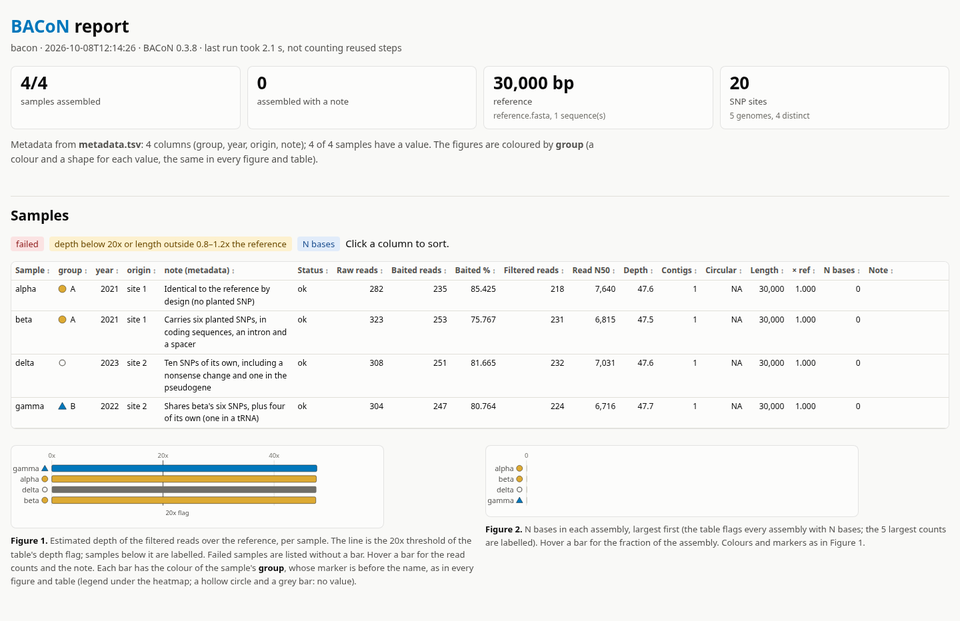
Overview and samples. All four samples assembled: about 250 of the 300 reads of each sample matched the
reference (the others are the off-target reads), and after filtering the depth is about 48x. The templated
assembly is 30,000 bp for each sample, as long as the reference, with no N base.
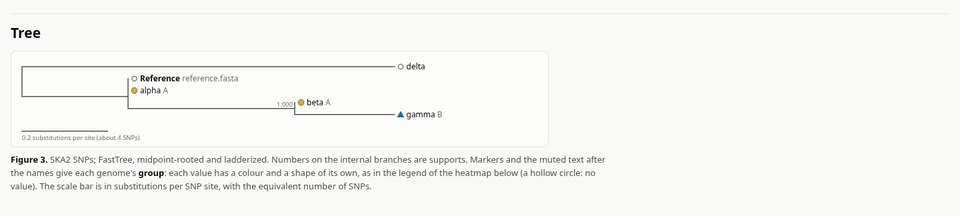
Tree. alpha sits with the reference; beta and gamma form a clade (their 6 shared SNPs); delta is on its own branch.
SNP distances. The heatmap, in tree order, shows the distances of the table above; the reference and alpha are listed as identical genomes.
VCF. example_output/bacon/4_compared/ska/snps.vcf lists the 20 planted SNPs at their positions in the
reference, with the genotype of each sample.
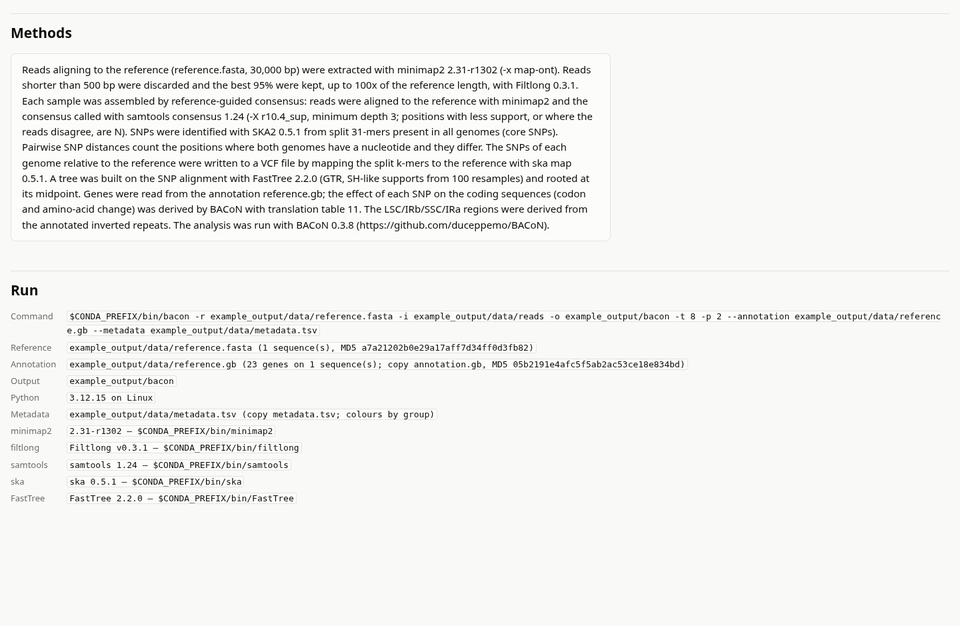
Methods and run. The methods paragraph describes what was run, with the program versions; the run section records the command, the reference's MD5 and every program used.
For real data, see the Tutorial (28 potato cultivars) and its report.