The efficient, reliable, and developer-friendly way to use the Apple App Store API on Apify, from Python or as an MCP tool in Claude and Cursor.
This is a quick-start for a three-part Apple App Store API suite. The actors chain together: search the store for apps, then pull full product details and user reviews for any result.
App Store Search API: apify.com/johnvc/apple-app-store-search - find apps by keyword, developer, or category. App Store Product API: apify.com/johnvc/apple-app-store-product-api - full product record for an App Store ID. App Store Reviews API: apify.com/johnvc/apple-app-store-reviews-api - user reviews for an App Store ID.
Each returns clean, structured JSON. Search results carry the app_id you feed into the Product and Reviews APIs to enrich any app. No HTML parsing, no captchas, predictable pay-per-event pricing. Built for App Store Optimization (ASO), competitor analysis, market research, review monitoring, and AI agent workflows.

- Python 3.11 or higher
- An Apify account and API key (get a free key here)
-
Clone the repository
git clone https://github.com/johnisanerd/Apify-Apple-App-Store-API.git cd Apify-Apple-App-Store-API -
Install dependencies with UV
# Install UV if you do not have it:
curl -LsSf https://astral.sh/uv/install.sh | sh

# Install project dependencies:
uv sync
-
Configure your API key
cp .env.example .env
# Edit .env and add your Apify API key
# Get your free API key at: https://apify.com?fpr=9n7kx3
-
Run the example
uv run python apple-app-store-api-example.py
The example runs the full chain: it searches for meditation apps, takes the top result's app_id, then fetches that app's full product record and its latest reviews. Inputs are kept small so your first run stays inexpensive.
A second script, apple-app-store-api-cookbook.py, is a catalog of every input plus multi-step workflows (competitor comparison, review-reputation snapshot, price across country stores). It runs one cheap scenario by default:
uv run python apple-app-store-api-cookbook.py                # search_basic
uv run python apple-app-store-api-cookbook.py reviews_critical
uv run python apple-app-store-api-cookbook.py competitor # a multi-step workflowexport APIFY_API_TOKEN="your_api_key_here"
uv run python apple-app-store-api-example.pyThree composable endpoints. Search returns ranked apps with rich metadata; Product returns the complete app record; Reviews returns user reviews. Each is useful alone and they chain through app_id.
Rich data, already structured. Ratings, developer, price, category, size, version history, privacy cards, screenshots, supported languages, and sample reviews come back as clean JSON, with no HTML to parse.
Search by name, developer, or category. Scope a search to app names or developer names, filter by category and country store, and exclude explicit apps.
Localized. The same App Store ID returns different price, availability, and localized text per country store, so you can compare across regions.
Reliable by design. API-backed, not browser-driven, so there are no captchas and no layout breakage.
Predictable pricing. Pay-per-event billing: a search page, a product record, or a page of reviews each cost a fixed, known amount.
Agent-ready. All three actors are available over MCP, so Claude and Cursor can call the Apple App Store API in natural language (setup below).
- App search by keyword, developer name, or category, across 50+ country stores
- Full product records: developer, description, price, ratings, version history, screenshots, in-app purchases, supported languages, privacy cards, and sample reviews
- User reviews with rating, title, text, author, version, dates, and helpfulness counts
- Single or batch product lookups (up to 100 IDs per run)
- Country and language targeting on every endpoint
- One app per row on search, one record per ID on product, one review per row on reviews
- Stable, consistent field names across every result
app_idon every search result for easy chaining- Localized price and metadata per country store
{
  "term": "meditation",
  "num": 5,
  "country": "us"
}{
"product_ids": ["324684580", "https://apps.apple.com/us/app/netflix/id363590051"],
"include_related_apps": true
}{
"product_ids": ["324684580"],
"sort": "mostcritical",
"max_reviews": 50
}| Parameter | Type | Required | Default | Description |
|---|---|---|---|---|
term |
str |
YES | - | Search query (e.g. meditation), or a developer name when property is developer. |
country |
str |
no | us |
Two-letter country store code. |
lang |
str |
no | en-us |
Language code in xx-yy form, e.g. fr-fr, ja-jp. |
num |
int |
no | 10 |
Apps per page (1-200). Each app returned is billed. |
device |
str |
no | desktop |
Device class to emulate: desktop, tablet, mobile. |
disallow_explicit |
bool |
no | false |
Exclude apps flagged explicit. |
property |
str |
no | (app names) | Set to developer to search developer names instead. |
category_id |
int |
no | - | Filter by category/genre ID (e.g. 6014 Games, 6017 Education). |
max_pages |
int |
no | 1 |
Pages to fetch; 0 = unlimited. |
| Parameter | Type | Required | Default | Description |
|---|---|---|---|---|
product_ids |
list[str] |
YES | - | App Store IDs or full App Store URLs (1-100 per run). |
country |
str |
no | us |
Country store; the same ID returns localized price and text per country. |
include_reviews_sample |
bool |
no | true |
Include the small sample of reviews Apple shows on the product page. |
include_related_apps |
bool |
no | false |
Include you_may_also_like and more_by_this_developer lists. |
| Parameter | Type | Required | Default | Description |
|---|---|---|---|---|
product_ids |
list[str] |
one of | - | Numeric App Store IDs to pull reviews for. |
app_name |
str |
one of | - | Resolve an app by name when you do not have the ID. |
country |
str |
no | us |
Country store (drives review locale). |
sort |
str |
no | mostrecent |
mostrecent, mosthelpful, mostfavorable, mostcritical (iOS only). |
max_reviews |
int |
no | 100 |
Maximum reviews per app. Each review returned is billed. |
include_macos |
bool |
no | true |
Set false to skip macOS apps. |
Search returns one app per row (the long description_text and release_notes are present but trimmed here):
{
  "position": 1,
  "app_id": 572966485,
  "title": "Mindfulness: Guided Meditation",
  "bundle_id": "com.gmeditations.audioguides",
  "developer_name": "Hector Rodriguez Fornies",
  "version": "5.14",
  "age_rating": "12+",
  "price_type": "Free",
  "rating_average": 4.67,
  "rating_count": 97,
  "genres": [{ "name": "Health & Fitness", "id": 6013, "primary": true }],
  "size_in_bytes": 135770112,
  "minimum_os_version": "15.0",
  "description_text": "<app description text>",
  "link": "https://apps.apple.com/us/app/id572966485",
  "search_timestamp": "2026-05-30T12:49:14"
}
Product returns one full record per ID (lists and long text trimmed):
{
  "app_id": 324684580,
  "title": "Spotify: Music and Podcasts",
  "developer_name": "Spotify",
  "category": "Music",
  "rating_average": 4.8,
  "price_text": "Get",
  "size_text": "271.4 MB",
  "age_rating": "13+",
  "description_text": "<app description text>",
  "version_history": [ "...25 entries..." ],
  "rating_distribution": { "5": "...", "4": "...", "3": "...", "2": "...", "1": "..." },
  "review_examples": [ "...sample reviews..." ],
  "privacy_cards": [ "...data categories..." ],
  "in_app_purchases": [ "...tiers..." ],
  "link": "https://apps.apple.com/us/app/id324684580",
  "lookup_country": "us"
}
Reviews returns one review per row (the review_text body is present in your run):
{
  "position_global": 1,
  "review_id": "6274377290",
  "review_title": "Use the App Daily",
  "rating": 5,
  "review_date": "Aug 03, 2020",
  "review_date_iso": "2020-08-03",
  "reviewed_version": "Version 4.31",
  "author_name": "C-lu1958",
  "product_id": "572966485",
  "app_platform": "ios",
  "app_country": "us",
  "sort_order": "mostrecent"
}You can load the Apple App Store API as an MCP tool so assistants call it for you. The MCP server URL preloads all three actors:
https://mcp.apify.com/?tools=actors,docs,johnvc/apple-app-store-search,johnvc/apple-app-store-product-api,johnvc/apple-app-store-reviews-api
Authenticate with OAuth in the browser when offered, or with your Apify API token (the same APIFY_API_TOKEN used by the Python example). Get a token at https://console.apify.com/settings/integrations and a free Apify account at https://apify.com?fpr=9n7kx3 .
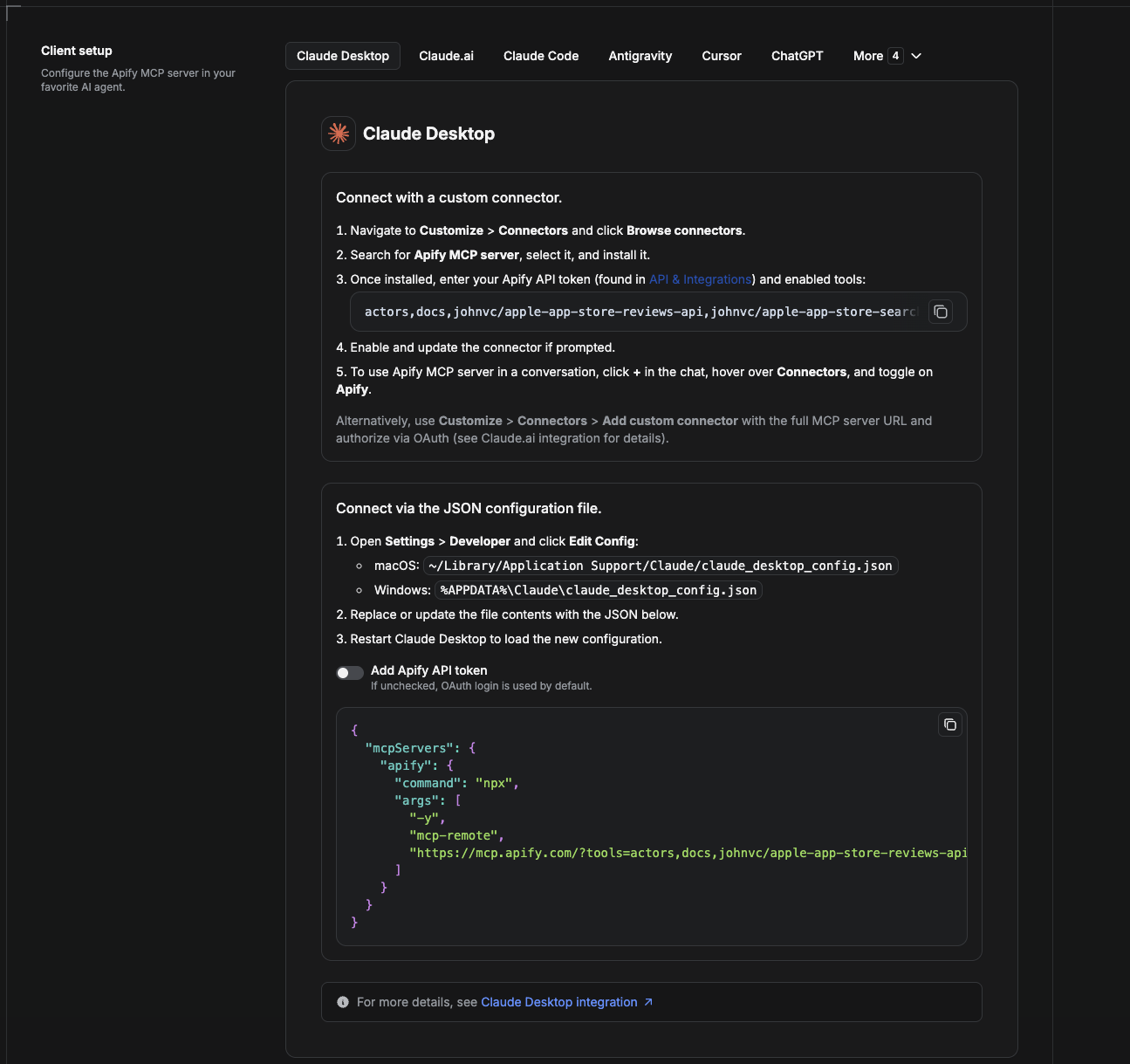
Cowork is the desktop app's automation mode. To give it the Apple App Store API as a tool, add the Apify MCP server as a connector.
- Open the Claude desktop app and go to Settings → Connectors (or Settings → Developer → Edit Config to edit
claude_desktop_config.jsondirectly).- macOS:
~/Library/Application Support/Claude/claude_desktop_config.json - Windows:
%APPDATA%\Claude\claude_desktop_config.json
- macOS:
- Add the Apify MCP server, preloaded with the three App Store actors:
{
  "mcpServers": {
    "apify": {
      "command": "npx",
      "args": [
        "-y",
        "mcp-remote",
        "https://mcp.apify.com/?tools=actors,docs,johnvc/apple-app-store-search,johnvc/apple-app-store-product-api,johnvc/apple-app-store-reviews-api"
      ]
    }
  }
}- Restart the app. When Cowork first calls the tool, complete the OAuth prompt in your browser, or add your Apify API token in the connector settings to skip OAuth.
- In a Cowork chat, confirm the tool is available and ask it to run the Apple App Store API.
Download the desktop app and start a free trial: https://claude.ai/referral/uIlpa7nPLg More help: https://docs.apify.com/platform/integrations/claude-desktop
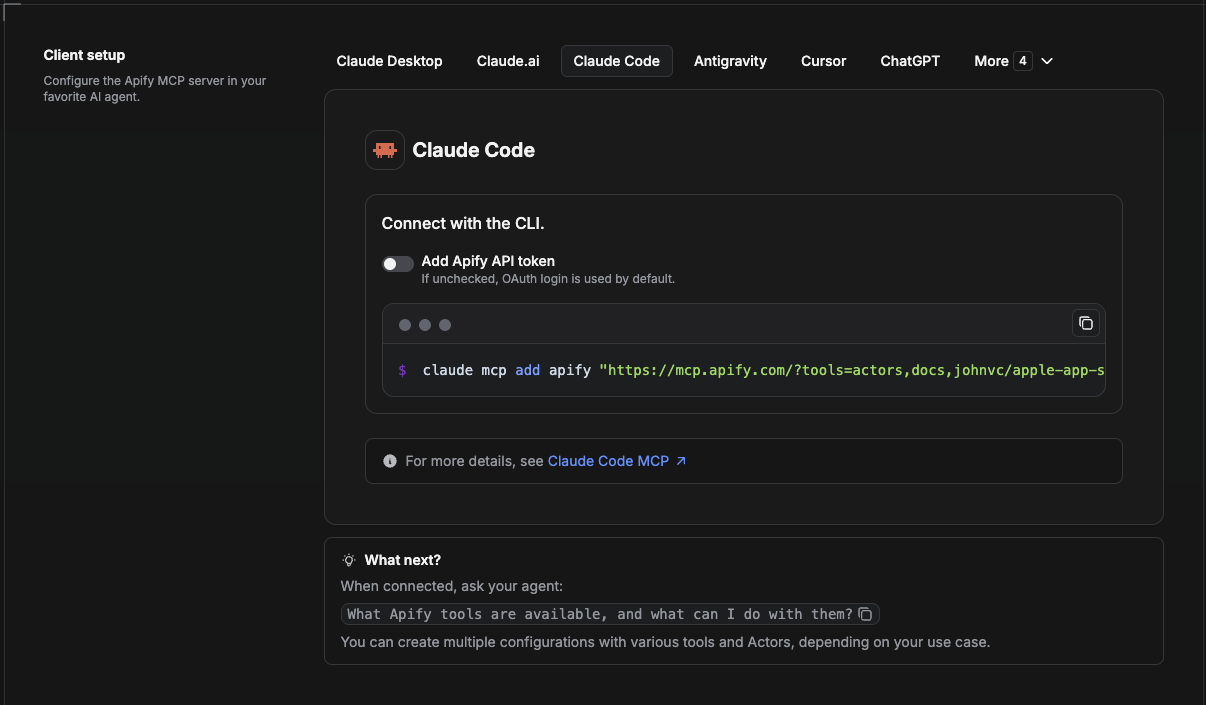
Claude Code is the command-line tool. Add the App Store API's MCP server with one command:
claude mcp add --transport http apify \
  "https://mcp.apify.com/?tools=actors,docs,johnvc/apple-app-store-search,johnvc/apple-app-store-product-api,johnvc/apple-app-store-reviews-api"
To use a token instead of browser OAuth:
claude mcp add --transport http apify \
  "https://mcp.apify.com/?tools=actors,docs,johnvc/apple-app-store-search,johnvc/apple-app-store-product-api,johnvc/apple-app-store-reviews-api" \
  --header "Authorization: Bearer YOUR_APIFY_TOKEN"
Then verify with claude mcp list, or run /mcp inside a session. Ask Claude Code to call the Apple App Store API.
Try Claude Code free: https://claude.ai/referral/uIlpa7nPLg Claude Code MCP docs: https://code.claude.com/docs/en/mcp
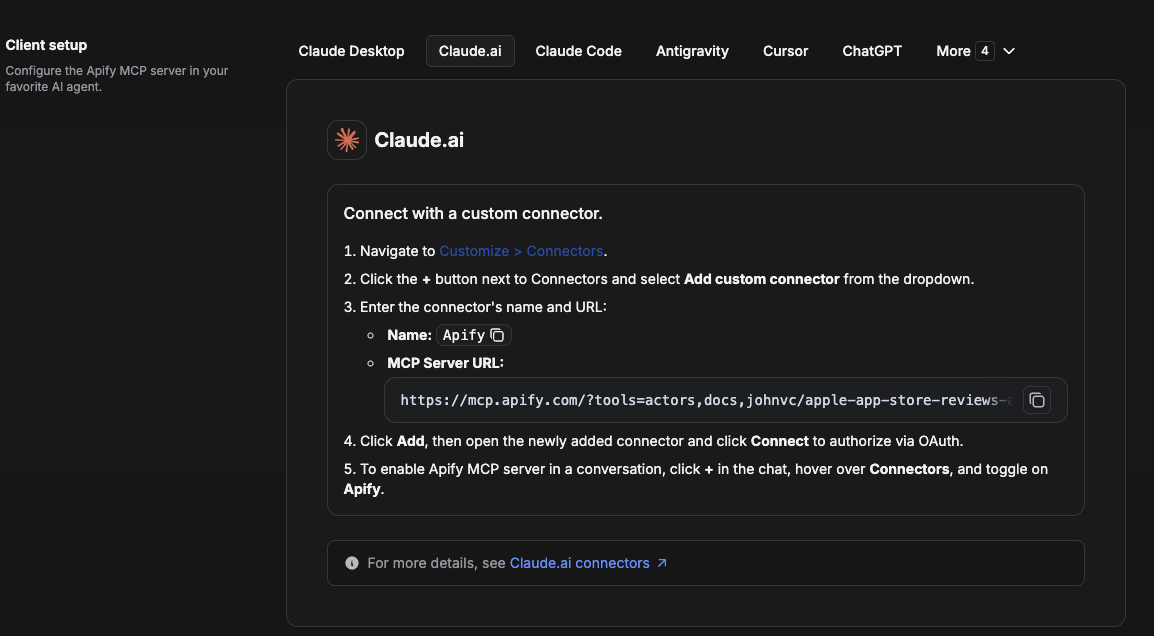
On claude.ai you add Apify as a connector, then enable the App Store API tools.
- Go to Settings → Connectors → Browse connectors and search for Apify MCP server. Install it (enable or update if prompted).
- When connecting, authenticate with your Apify API token, and enable the tools
johnvc/apple-app-store-search,johnvc/apple-app-store-product-api, andjohnvc/apple-app-store-reviews-api. - In any chat, open + → Connectors and turn on Apify.
- Alternatively, choose Add custom connector and paste the full MCP URL
https://mcp.apify.com/?tools=actors,docs,johnvc/apple-app-store-search,johnvc/apple-app-store-product-api,johnvc/apple-app-store-reviews-api, using OAuth when prompted. - Ask Claude to run the Apple App Store API.
Open Claude on the web: https://claude.ai
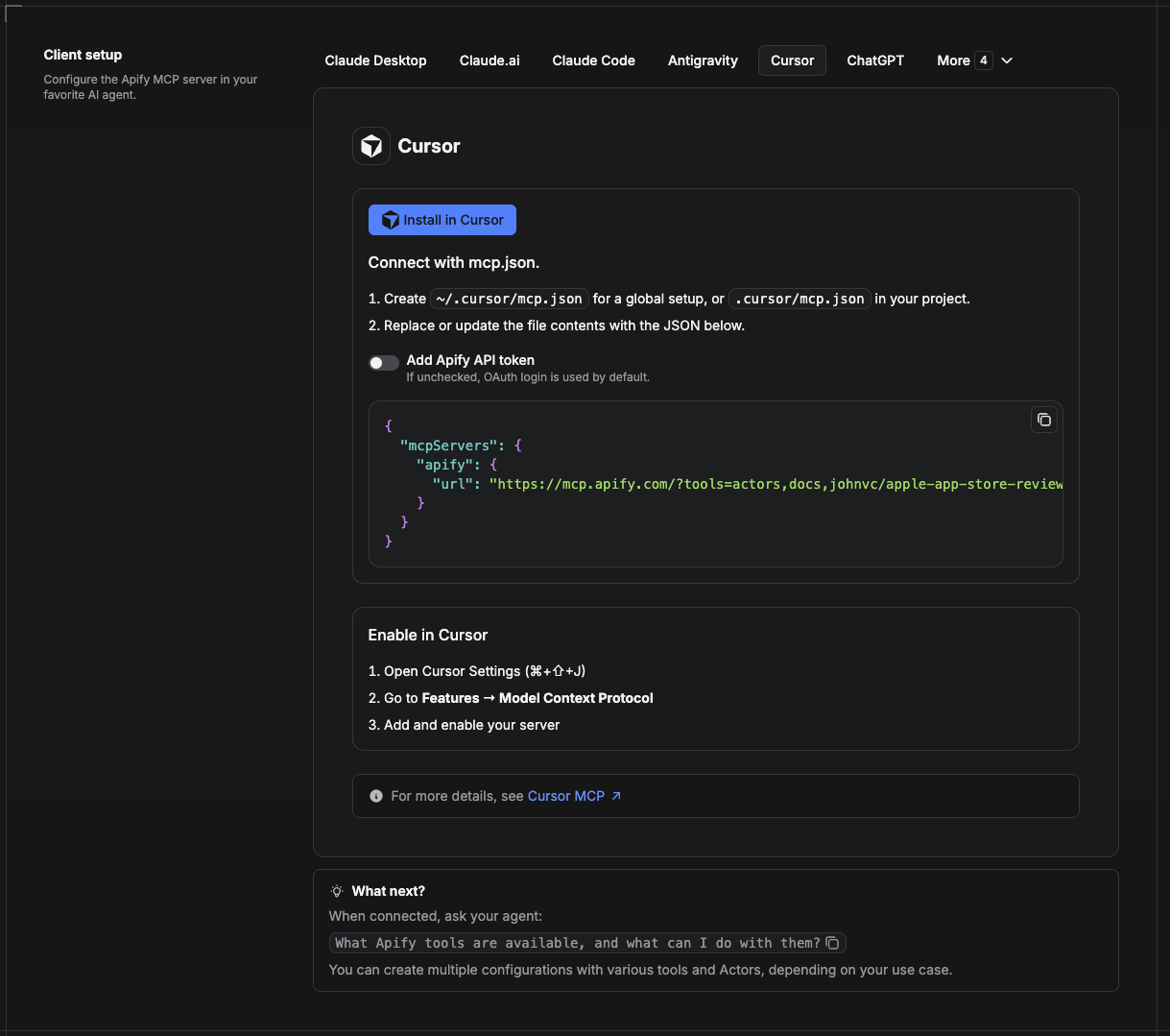
Cursor reads MCP servers from a project file at .cursor/mcp.json.
- In your project, create
.cursor/mcp.json:
{
  "mcpServers": {
    "apify": {
      "url": "https://mcp.apify.com/?tools=actors,docs,johnvc/apple-app-store-search,johnvc/apple-app-store-product-api,johnvc/apple-app-store-reviews-api"
    }
  }
}- If you prefer token auth over browser OAuth, add a header:
{
  "mcpServers": {
    "apify": {
      "url": "https://mcp.apify.com/?tools=actors,docs,johnvc/apple-app-store-search,johnvc/apple-app-store-product-api,johnvc/apple-app-store-reviews-api",
      "headers": { "Authorization": "Bearer YOUR_APIFY_TOKEN" }
    }
  }
}- Open Cursor → Settings → MCP and confirm the apify server is connected (green dot).
- In Composer or Chat, ask Cursor to call the Apple App Store API.
New to Cursor? Get it here: https://cursor.com/referral?code=XQP4VBLI3NNX
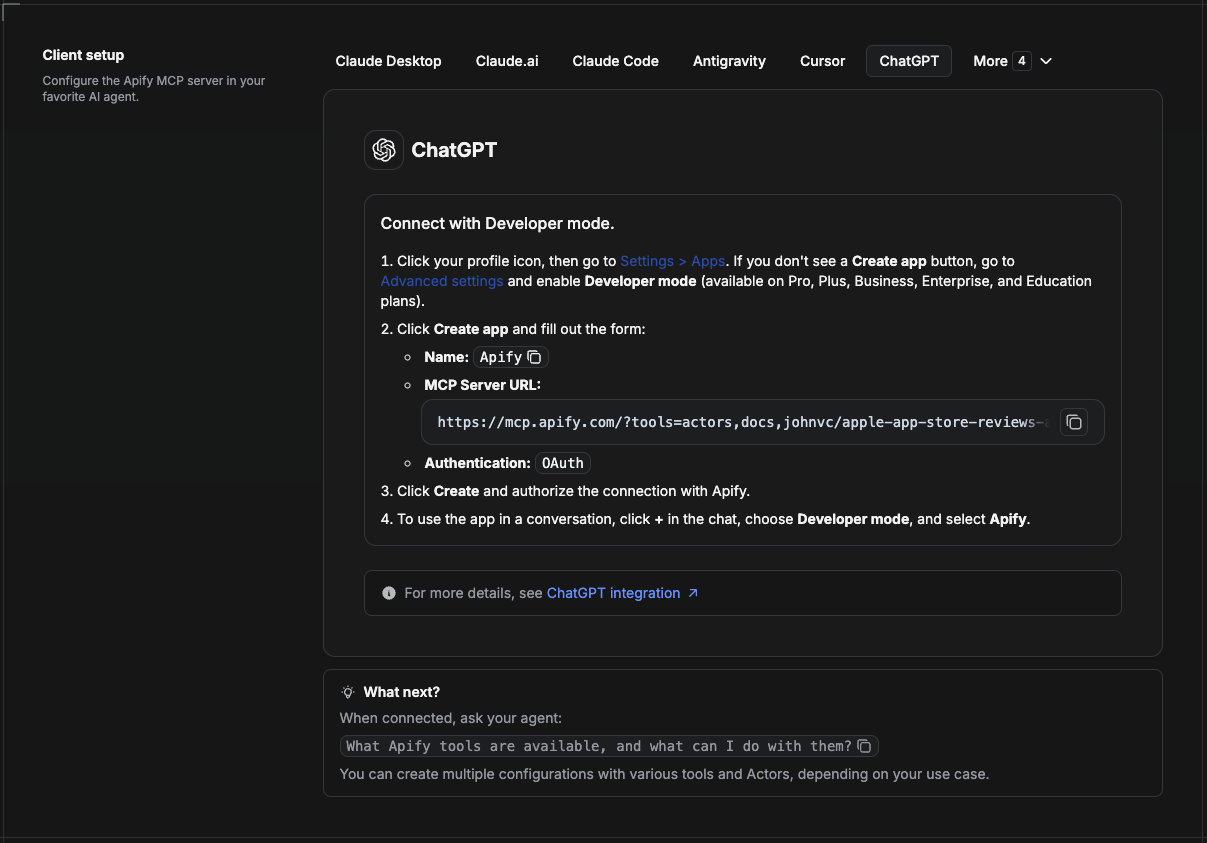
ChatGPT connects to the Apify MCP server through Developer mode (available on ChatGPT Pro, Plus, Business, Enterprise, and Education plans).
- Click your profile icon, then go to Settings > Apps. If you do not see a Create app button, open Advanced settings and enable Developer mode.
- Click Create app and fill out the form:
- Name: Apify
- MCP Server URL:
https://mcp.apify.com/?tools=actors,docs,johnvc/apple-app-store-search,johnvc/apple-app-store-product-api,johnvc/apple-app-store-reviews-api - Authentication: OAuth
- Click Create and authorize the connection with Apify.
- To use the app in a conversation, click + in the chat, choose Developer mode, and select Apify.
More help: https://docs.apify.com/platform/integrations/mcp
Use the Apple App Store API to power ASO, competitor analysis, market research, and review monitoring with reliable, structured results.
Last Updated: 2026.07.14