A trustworthy catalog for discovering quality open source modules for Mage-OS / Magento — a public website, an open JSON feed, and a Magento admin module, all built from one repository.
Requires PHP 8.1+ and Magento 2.4 / Mage-OS (magento/framework ^103.0). From the
Magento root:
composer require mage-os/module-extension-directory
bin/magento setup:upgrade
In production mode, finish with:
bin/magento setup:di:compile
bin/magento setup:static-content:deploy
bin/magento cache:flush
Then open System → Extensions → Extension Directory in the admin. There is nothing to configure — the module ships working defaults, and it never installs anything on your server. Admin roles other than the full-access one need the Mage-OS Extension Directory ACL resource (System → Permissions → User Roles).
To update, composer update mage-os/module-extension-directory and re-run the commands
above; to remove it, composer remove mage-os/module-extension-directory followed by
bin/magento setup:upgrade.
| Where | What |
|---|---|
service/ |
The directory service: a daily static pipeline, the catalog website, the versioned JSON feed (/api/v1/*), and the embeddable browse/search UI bundle (/embed/*) |
src/ |
MageOS_ExtensionDirectory — the Magento 2 / Mage-OS admin module (Composer package mage-os/module-extension-directory, packaged from this repository's root) |
There is no backend service. A scheduled GitHub Actions pipeline aggregates package data into versioned static JSON, and publishes it together with a prerendered catalog site. The JSON feed is the public API.
PackageMaven export ─┐
                     ├─→ daily pipeline → /api/v1/*.json → static site + embeddable UI
GitHub (READMEs/★) ──┤                                          │
                     │                                          └─→ Magento admin module
service/data/vendors/*.json (trust overlay, by PR) ─┘               (src/, this repo)
- PackageMaven is the structural data backbone: it indexes ~1,100 Magento modules and tests them against real Magento versions, producing quality tiers, PHPStan levels, build status, and verified compatibility. The directory's universe is PackageMaven's index, with full attribution and links back. Package metadata originates from Packagist.
- GitHub supplies READMEs and stars at build time (optional, failure-tolerant).
- Mage-OS vendor trust files — per-vendor JSON files in
service/data/vendors/, edited by pull request — add the trust layer: trusted-vendor badges, partner tiers, editorial picks, and warnings that derank or hide problem packages. - A transparent, config-tunable ranking blends trust, quality, freshness, and popularity into the default ordering, with the per-signal breakdown published in the feed.
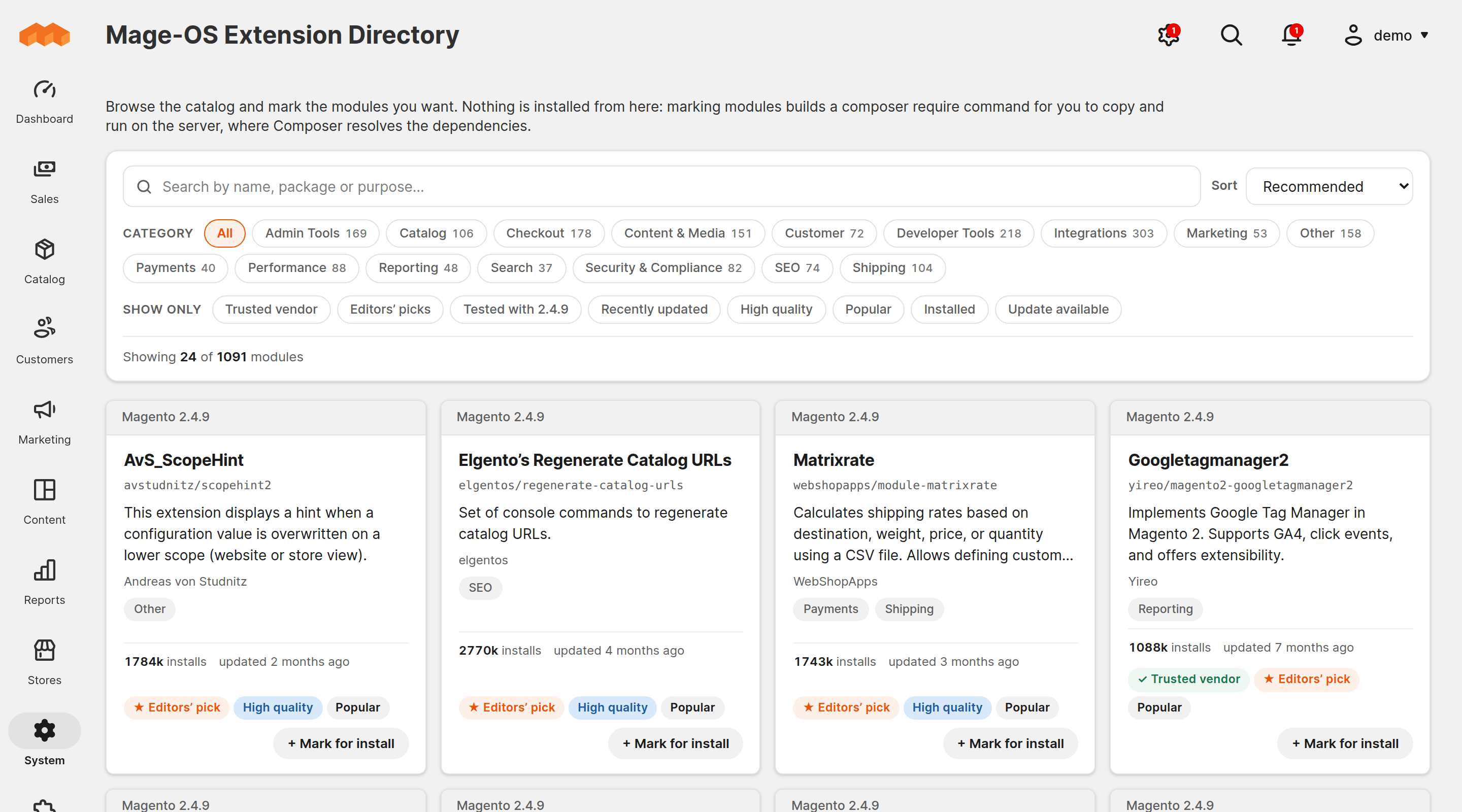
The module renders the same browse/search UI inside the Magento admin
(System → Extensions → Extension Directory) — one list with search, category chips,
one-click filters (trusted vendor, editors' picks, tested with your version, recently
updated, high quality, popular) and a page of cards at a time — enriched with what only
the shop knows:
its installed modules (read from composer.lock — never by shelling out) and its
Magento version, which drive installed/update badges and version pinning against
PackageMaven's test matrix. Package details open in an admin modal showing the
directory site's detail page; external links (Packagist, the repository,
PackageMaven) are followed only when clicked.
It never installs anything. Marking modules builds a
composer require vendor/module:^x.y command to copy and run on the server, where
Composer resolves dependencies. The list is kept per browser tab, so a reload or a look
at a module's details does not lose it.
Two settings, both under Stores → Configuration → Advanced → Admin. Extension
Directory → Mode: Direct (default — admin browsers load the UI bundle and catalog
straight from the directory host) or Proxy (the store's server fetches and caches
the feed, revalidating against the 200-byte manifest.json, and serves the UI copy
bundled with the module — fully same-origin for restricted networks or
privacy-sensitive admins). Dashboard → Show Extension Directory Tip (default on): a
short panel on the admin dashboard that points administrators whose role allows
everything at the directory; its own "Hide this tip" button turns the setting off for
everyone.
The Composer package is this repository's root; .gitattributes strips everything
except composer.json, LICENSE, README.md, and src/ from dist archives, and CI
guards both the archive contents and that the vendored UI bundle in
src/view/adminhtml/web/js/ is byte-identical to what service/ builds.
- Read-only in production — no installs from any UI; "install" means a copyable
composer requirecommand. - Trust signals over completeness — a curated, quality-tested universe rather than all of Packagist.
- Static and simple — no servers to run; the whole system is a build artifact, and every trust-data change is a pull request.
- Untested is never incompatible — PackageMaven's matrix is empirical; a missing test result is shown as untested, never as a failure, and never blocks anything.
# Service (Node 22)
cd service && npm install
npm test            # schema, ranking, pipeline, embed-contract tests
npm run dev         # pipeline on fixture data + the site on localhost

# Module (PHP 8.1+, no Magento credentials needed)
composer install --working-dir=dev/tests/unit
composer test       # hermetic unit suite against committed framework stubs
After changing service/src/ui/**, rebuild and re-vendor the bundle
(cd service && npm run build:ui && cp public/embed/directory-ui.iife.js ../src/view/adminhtml/web/js/) — CI fails on drift. See
CONTRIBUTING.md and docs/updating-the-bundle.md.
- Architecture — data flow, the PackageMaven API and its field mapping, pipeline, feed schema, vendor trust file format, ranking model, site/UI design and the embed contract, hosting, standing risks.
- Decision log — what was chosen, why, and what was rejected.
- Trust policy — who gets badges, how warnings work, how disputes and malicious-package reports are handled.
- Updating the vendored UI bundle — the rebuild procedure and the checks CI cannot make.
- Original discussion: mage-os-lab discussion #3
Quality and compatibility data is sourced from package-maven.com, operated by Tribound Creative s.r.o. Package metadata originates from Packagist. Every package view links back to its Packagist page. The data is empirical test output provided "as is".
OSL-3.0