Atovaquone
Atovaqoune, a naphthoquinone, potently inhibits the cytochrome bc1 complex of the mitochondrial electron transport chain within mitochondria of the parasites. This drug disrupts the pyrimidine biosynthesis, alters mitochondrial membrane potential, and consequently leads to parasite death.
- Atovaquone treatment failures are commonly linked to Y268S/N/C mutations in cyt B gene (Siegel SV, et al, 2017, bioRxiv; Siregar JE, et al, 2008, Parasitol Int).
- In vitro atovaquone pressure selects several different types of cyt B mutations: M133I, M133V,L144S, F267V, L271F, K272R, P275T, G280D, L283I, V284K (Korsinczky M, et al, 2000, Antimicrob Agents Chemother; Schwobel B, et al, 2003, Malar J; Bopp SE, et al, 2013, PLoS Genet).
- Mitochondrial heteroplasmic polymorphisms have been proposed as a mechanism of atovaquone resistance, suggesting that the extremely low frequency of mutant alleles should be attentively investigated (Siegel SV, et al, 2017, bioRxiv).
Sequence data from Version 6.0 of MalariaGEN Plasmodium falciparum Community Project did not show any mutation in cyt b gene across all samples. We have also analysed the read counts for all samples and we have not found any evidence in this data set supporting low frequency mutants as suggested by Siegel SV, et al., 2017, bioRxiv.
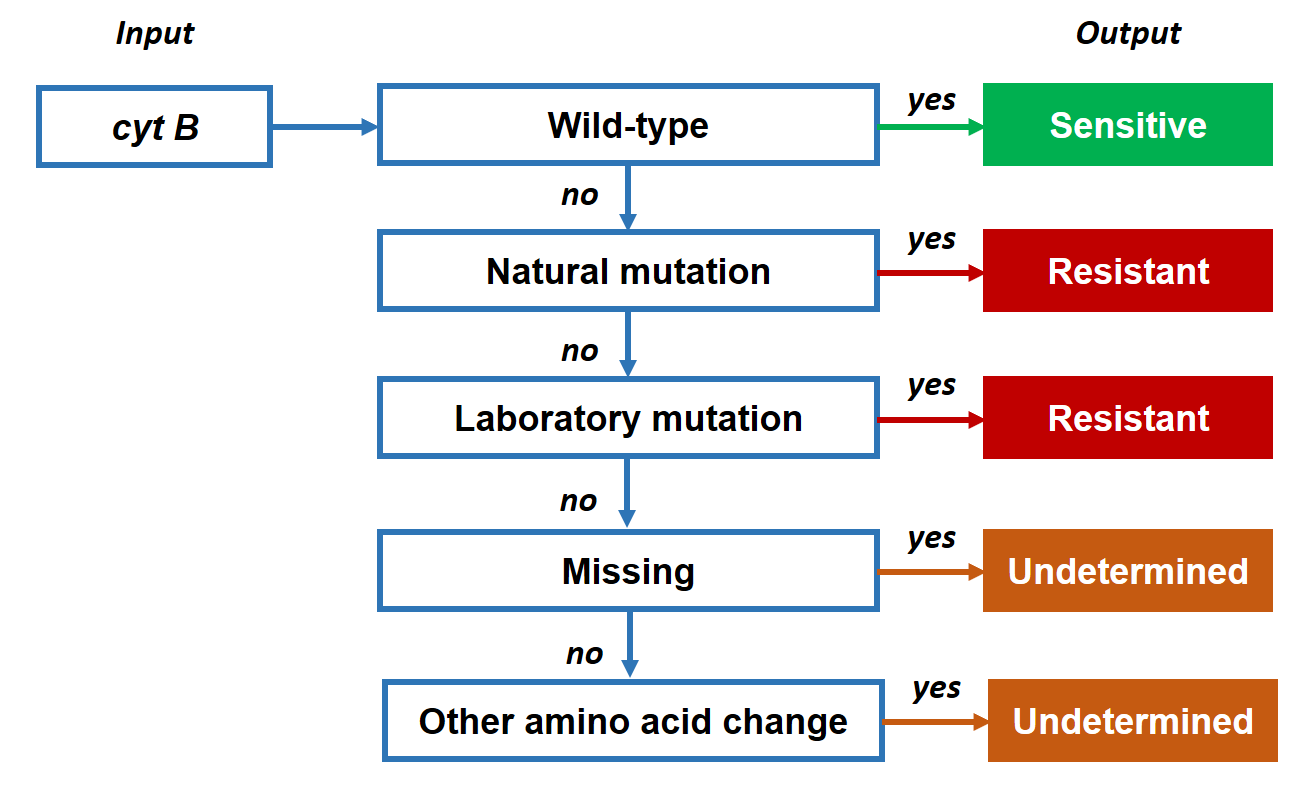
- Locus utilized: mal_mito_3 (cyt B)
| Amino acid change | Coding | Interpretation | Phenotype |
|---|---|---|---|
| None | cytB == "WT" | Wild-type | Sensitive |
| Missing | cytB == “-” | Missing | Undertermined |
| Y268S, Y268N, Y268C | cytB %in% c("Y268S", "Y268N", "Y268C") | Natural occurring mutation | Resistant |
| M133I, M133V, L144S, F267V, L271F, L271V, K272R, P275T, G280D, L283I, V284K, V284F | cytB %in% c("M133I", "M133V","L144S", "F267V", "L271F", "L271V", "K272R", "P275T", "G280D", "L283I", "V284K", "V284F") | Laboratory selected mutation | Resistant |
| Other amino acid change | Otherwise | Unknown mutation | Undetermined |
| Reference | Method | Location/Sample size/Genetic background | Finding summary |
|---|---|---|---|
| Plucinski MM, Huber CS, Akinyi S, Dalton W, Eschete M, Grady K, et al. Novel Mutation in Cytochrome B of Plasmodium falciparum in One of Two Atovaquone-Proguanil Treatment Failures in Travelers Returning From Same Site in Nigeria. Open Forum Infect Dis. 2014;1(2):ofu059. | - Mitochondrial genomes were amplified by PCR and were sequenced by Sanger method - Polymorphisms were assessed by fragment size analysis. |
- 2 American falciparum patients who visited Nigeria during 2012-2013. The infections recurred after receiving >30 days atovaquone-proguanil treatment. | - pfcytb of parasites from both patients mutated from wild-type allele at Day 0 to I258M in Patient 1 and Y268S in Patient 2 at Day 34. |
| Ingasia LA, Akala HM, Imbuga MO, Opot BH, Eyase FL, Johnson JD, et al. Molecular characterization of the cytochrome b gene and in vitro atovaquone susceptibility of Plasmodium falciparum isolates from Kenya. Antimicrob Agents Chemother. 2015;59(3):1818-21. | Polymorphisms at amino acid residue 268 were analyzed by using PCR-RFLP assay. | - 227 clinical samples from Kenya during 2008-2012 | - Median atovaquone IC50 of the parasites with Y268 wild-type allele (3.0 nM) was 1.9-fold lower than that of the parasites with 268S mutation at cytochorme b gene (5.7 nM). - 22% of parasites carried mixed genotype of cytocheome b and their atovaquone IC50 values were higher than those of wild-type allele: WT/268S (4.7 nM) and WT/268S/258N (5.0 nM). |
| Siegel SV, Rivero AV, Adapa SR, Wang C, Manetsch R, Jiang RH, et al. Mitochondrial heteroplasmy is responsible for Atovaquone drug resistance in Plasmodium falciparum. bioRxiv. 2017. | - This study assessed the frequency of Y268S cyt B mutation in clinical isolates (upon admission and recrudescent) - Selection of atovaquone resistance parasites in vitro was performed using 10x EC50 concentration. - The extremely low frequency of mutant alleles were detected by deep sequencing using Ilumina Hiseq platform with 10,000-30,000x coverage of mitochondrial DNA. - Global mitochondrial diversity was analyzed using 1,279 P. falciparum genomes. |
- Admission and recrudescent parasites were obtained from patients in Phase II clinical trials. | - Several P. falciparum isolates habors extremely low frequency of Y286S cyt B mutant alleles. - Parasites with cryptic Y268S alleles readily evolve into highly resistant parasites with >95% frequency of Y268S under in vitro ATO selection. - Mitochondrial heteroplasmic polymorphisms were >3-fold more prevalent than homoplasmic SNPs globally - Southeast Asian isolates had higher rate of mitochondrial heteroplasmy and higher variation of mitochondrial DNA copy number. |
| Reference | Method | Location/Sample size/Genetic background | Finding summary |
|---|---|---|---|
| Korsinczky M, Chen N, Kotecka B, Saul A, Rieckmann K, Cheng Q.Mutations in Plasmodium falciparum cytochrome b that are associated with atovaquone resistance are located at a putative drug-binding site. Antimicrob Agents Chemother. 2000;44(8):2100-8. | - Selection of atovaquone-resistant parasites was performed under >IC90 concentrations. - Mutations of cyt B residue 268 were analyzed by PCR-RFLP |
- Plasmodium falciparum K1-1D4 line, a clone of K1 line (Thailand), was used as a parental line in drug selection experiment. - TM93-C1088 line (clinical isolate from recrudescent patient) was also included for susceptibility testing. |
- Parasites developed M133I, M133I/P275T, M133I/K272R, M133I/G280D and L283I/V284K. - IC50 values of mutated parasites were 25-897 folds higher than the parent line. - TM93-C1088 line (with Y268S cyt b mutation) had up to 9,353 fold higher atovaquone IC50 than K1-1D4 line (wild-type cyt b). |
| Schwobel B, Alifrangis M, Salanti A, Jelinek T. Different mutation patterns of atovaquone resistance to Plasmodium falciparum in vitro and in vivo: rapid detection of codon 268 polymorphisms in the cytochrome b as potential in vivo resistance marker. Malar J. 2003;2:5. | - Selection of atovaquine-resistant parasites was perform under atovaqoune concentration of 2 × 10⁻⁸ to 2 × 10⁷ M. - Mutations of cyt B residue 268 were analyzed by PCR-RFLP. |
- K1 line (Thailand) was used as a sensitive parental line. | - The survived parasites developed M133I, M133I/G280D and M133I/L271F mutations in cytochrome b gene. |
| Bopp SE, Manary MJ, Bright AT, Johnston GL, Dharia NV, Luna FL, et al. Mitotic evolution of Plasmodium falciparum shows a stable core genome but recombination in antigen families. PLoS Genet. 2013;9(2):e1003293. | - Parasites were propagated asexually under atovaquone pressure. - Whole genome sequencing was performed using Illumina Genome Analyzer II platform. - Mutations in cytochrome b gene were confirmed by using Sanger sequencing. |
- Plasmodium falciparum 3D7 was used as the initial line. | - The survived parasites developed M133I, M133V, F267V and M133I/L144S mutations in cytochrome b gene. |
| Siregar JE, Syafruddin D, Matsuoka H, Kita K, Marzuki S. Mutation underlying resistance of Plasmodium berghei to atovaquone in the quinone binding domain 2 (Qo(2)) of the cytochrome b gene.Parasitol Int. 2008;57(2):229-32. | - Atovaquone resistance stains were selected and confirmed by sequencing. Atovaqoune susceptibility was evaluated by using 50% effective dose. - The correlation coefficient was calculated from the growth rates. |
- P. berghei ANKA strains. | - All of the mutations found are located in the quinone binding site of cytochrome b gene. - Y268N mutantation showed the highest degree of atovaquone resistance (ED50 80 mg/kg). - Others mutantions were Y268C, L271V+K272R, M133I+L271V. |
| Siregar JE, Kurisu G, Kobayashi T, Matsuzaki M, Sakamoto K, Mi-ichi F, et al. Direct evidence for the atovaquone action on the Plasmodium cytochrome bc1 complex. Parasitol Int. 2015;64(3):295-300. | - Atovaquone-resistant isolates were used to measure the inhibitory effect of atovaquone. IC50 were determined by measuring DHO-cytochrome c reductase activity. | - P. berghei ANKA strains. | - IC50 of P. berghei atovaquone resistant clones were higher (1.5 up to 40 nM) than those of the sensitive strains (0.132-0.465 nM). - Mutations in the resistant strains were Y268C, Y268N, L271V, M133I, V284F, L144S. |
| Birth D, Kao WC, Hunte C. Structural analysis of atovaquone-inhibited cytochrome bc1 complex reveals the molecular basis of antimalarial drug action. Nat Commun. 2014;5:4029. | - X-ray structure of mitochondiral cyt bc1 binding with atovaquone was described to assess the interaction between atovaquone and cyt bc1 complex. - Mitochondrial cyt bc1 of Saccharomyces cerevisiae was crytallized with atovaquone. |
- Mitochondrial cyt bc1 from Saccharomyces cerevisiae | - Key residues responsible for atovaquone binding are Tyr279 (Pf = Try278), Met139 (Pf = Met133) His181, Ile269, Val146 and Leu275. |