Sulfadoxine
Sulfadoxine has been used as an antimalarial drug. It is a competitive inhibitor of dihydropteroate synthase (DHFS) and disrupts the folate biosynthetic pathway of the parasites. Polymorphisms of Plasmodium falciparum DHPS have been associated with reduced susceptibility to antifolate treatment.
-
A437G mutation associates with sulfadoxine-resistant Plasmodium falciparum isolates (Wang P, et al, 1997, Mol Microbiol) and causes increased sulfadoxine IC50 (Triglia T, et al, 1998, EMBO).
-
K540E and A581G mutations significantly alter sulfadoxine susceptibility in parasites with A437G background (Triglia T, et al, 1998, EMBO).
- Data from the Version 6.0 of MalariaGEN Plasmodium falciparum Community Project suggested that mutations at residues 540 and 581 are significantly associated with mutation at residues 437 (see Table 4 and Table 11 in pfdhps ). We can imply that presence of K540E and A581G mutations are the predictors of sulfadoxine-resistant marker A437G mutation.
-
Few study demonstrated the association between double mutation of S436F and A613T/S and sulfadoxine resistance (Brooks DR, et al, 1994, Eur J Biochem; Wang P, et al, 1997, Mol Microbiol).
In addition, pfdhps K540E mutation has been used as a predictive marker for quintuple mutation (mutations in pfdhfr residues 81, 59, 108 and mutations in pfdhps residues 437 and 540), and sulfadoxine-pyrimethamine (SP) treatment failure in Africa. The prevalence of K540E mutation is required for a decision on implementing the Intermittent preventive treatment in infancy (IPTi) with SP (World Health Organization, 2010).
- Locus utilized: PF3D7_0810800 (pfdhps)
- Codon: 437
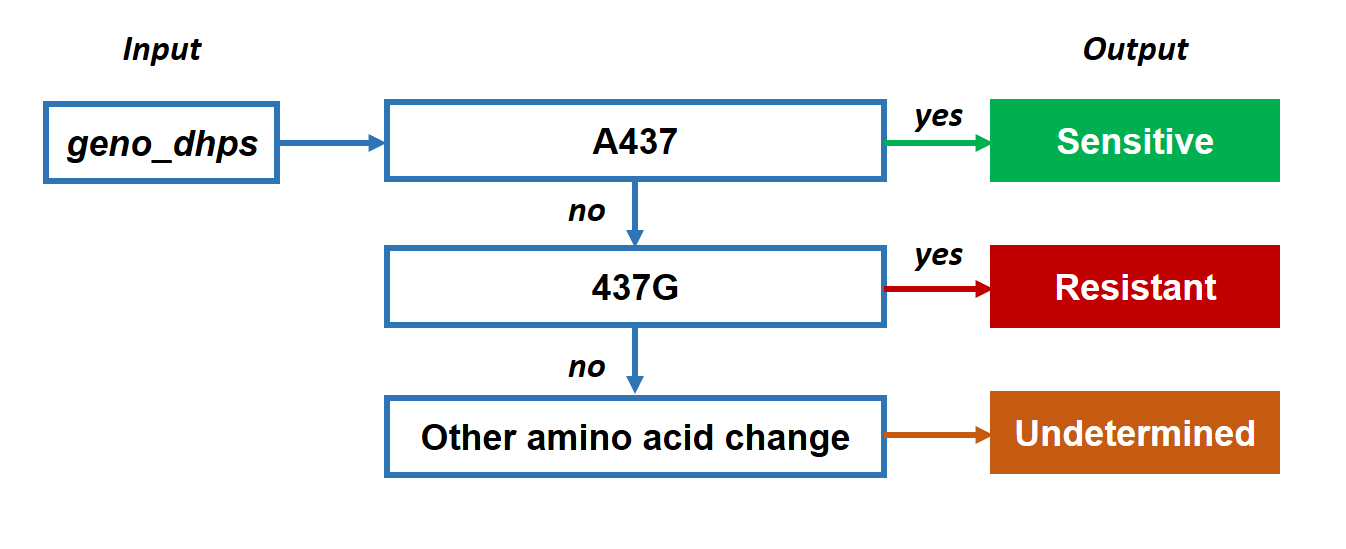
- Field utilized : geno_dhps_437
| Amino acid change | Coding | Interpretation | Phenotype |
|---|---|---|---|
| None | geno_dhps_437 == "A" | Wild-type | Sensitive |
| A437G | geno_dhps_437 == "G" | Mutant | Resistant |
| Missing | geno_dhps_437 == "-" | Missing | Missing |
| Other amino acid change | Otherwise | Other mutant | Undetermined |
| Reference | Method | Location/Sample size/Genetic background | Finding summary |
|---|---|---|---|
| Brooks DR, Wang P, Read M, Watkins WM, Sims PF, Hyde JE. Sequence variation of the hydroxymethyldihydropterin pyrophosphokinase: dihydropteroate synthase gene in lines of the human malaria parasite, Plasmodium falciparum, with differing resistance to sulfadoxine. Eur J Biochem. 1994;224(2):397-405. | - Pfdhps gene was amplified by PCR and sequenced by double stranded sequencing and Sequence enzyme (USB Corp). - Drug susceptibility was assessed by hypoxanthine incorporation assay. |
- K1, V1/S, W2, SL/D6, 3D7, Tak 9/96, It.G2.F6, M24, FCR3, K39 and It.D12 lines. | - Parasite lines with single A437G mutation and double mutations S436A/A437G did not show elevated sulfadoxine IC50. - Parasite lines with double mutation at codons 436 and 613 (S436F/A613S, S436F/A613T) showed 20 to 70-fold higher sulfadoxine IC50 than that of the parasites with wild-type haplotype. - Parasite lines with double mutations A437G/A581G showed 60-fold higher sulfadoxine IC50 than that of the parasites with wild-type haplotype. |
| Wang P, Read M, Sims PF, Hyde JE. Sulfadoxine resistance in the human malaria parasite Plasmodium falciparum is determined by mutations in dihydropteroate synthetase and an additional factor associated with folate utilization. Mol Microbiol. 1997;23(5):979-86. | - In vitro drug susceptibility was evaluated by hypoxanthine incorporation assay. - Polymorphisms in pfdhfr were determined by DNA sequencing. |
- Dd2, HB3, 3D7, Tak9/96, FCR3, K1, M24, and FCB lines |
- 3D7 with single A437G mutation showed 10 to 20-fold higher IC50 than that of the parasite lines with wild-type pfdhps haplotype (HB3, M24, FCR3 lines). - Additional 581G mutation in K1 line and 436F+613G mutations in Dd2 lines caused 60 to 1100-folds higher sulfadoxine IC50 than that of the parasites with wild-type haplotype. |
| Reference | Method | Location/Sample size/Genetic background | Finding summary |
|---|---|---|---|
| Triglia T, Menting JG, Wilson C, Cowman AF. Mutations in dihydropteroate synthase are responsible for sulfone and sulfonamide resistance in Plasmodium falciparum. Proc Natl Acad Sci U S A. 1997;94(25):13944-9. | - Full-length of Plasmodium falciparum PPPK-DHPS was transformed and expressed in E. coli. - Kinetic Constant (Km) of DHPS activity and Inhibitory Constant (Ki) for Sulfadoxine of different constructed PPPK-DHPS genes were measured. |
- Full-length of PPPK-DHPS genes of D10 (SAKAA), 3D7 (SGKAA), Tak9/96 (AGKAA), K1 (SGKGA) and W2mef (FGKAS) lines were introduced and expressed in E. coli. | - D10-C from the sensitive parasites yielded the lowest Ki. The enzyme from resistant parasites showed up to 811-fold higher Ki value than that of D10-C. - Single A437G mutation in 3D7-C caused 10-fold higher Ki than that of wild-type enzyme from D10-C. - A437G mutations was found in all of the DHPS form sulfadoxine resistant parasites, suggesting this mutation is the first mutation under sulfadoxine pressure. - Introducing single A581G into D10-C showed only 4-fold elevated Ki value, suggesting this single mutation in DHPS plays a small role in sulfadoxine resistance. |
| Triglia T, Wang P, Sims PF, Hyde JE, Cowman AF. Allelic exchange at the endogenous genomic locus in Plasmodium falciparum proves the role of dihydropteroate synthase in sulfadoxine-resistant malaria. EMBO J. 1998;17(14):3807-15. | - Transgenic parasites were created by allelic exchange approach - In vitro susceptibility was evaluated by using hypoxathine incorporation assay. |
- dhps alleles of D10 (SAKAA), 3D7 (SGKAA), K1 (SGKGA), Tak9/96 (AGKAA), PR145 (AGKAA) and W2mef (FGKAS) lines was introduced into D10 parasite line. | - A437G mutation caused 4.8-fold higher sulfadoxine IC50 (614 ng/ml) than that of the parasites with wild-type haplotype (129 ng/ml). - Additional mutations caused up to 24-fold increase in sulfadoxine IC50. |
| de Beer TA, Louw AI, Joubert F. Elucidation of sulfadoxine resistance with structural models of the bifunctional Plasmodium falciparum dihydropterin pyrophosphokinase-dihydropteroate synthase. Bioorg Med Chem. 2006;14(13):4433-43. | - The possible structure of Pf DHPS was modeled from the structure of DHPS from S. cerevisiae. - Interaction between pf DHPS and sulfadoxine was assessed by superimpose sulfadoxine into pABA at the active site of DHPS. |
- Modeling of Pf DHPS was derived from the structure of DHPS from S. cerevisiae. | - Sulfadoxine predominantly interacts with _Pf_DHPS through hydrophobic interactions. - The structure model showed that S436F mutation causes sterical clashes between sulfadoxine and phenylalanine at residue 436. - A437G mutation causes a loss of hydrophobic interaction between DHPS and sulfadoxine. |