
Turn a product requirements doc into working backend and UI code with an eight-agent swarm. Drop in prd/current.md, run /ship-prd, and specialized subagents decompose, design, implement, and QA — including browser-driven visual checks for every UI story.
Works as a plugin for Cursor and Claude Code. Sibling of the backend-only agent-swarm plugin, extended with ui / fullstack tracks, UX design, and visual QA.
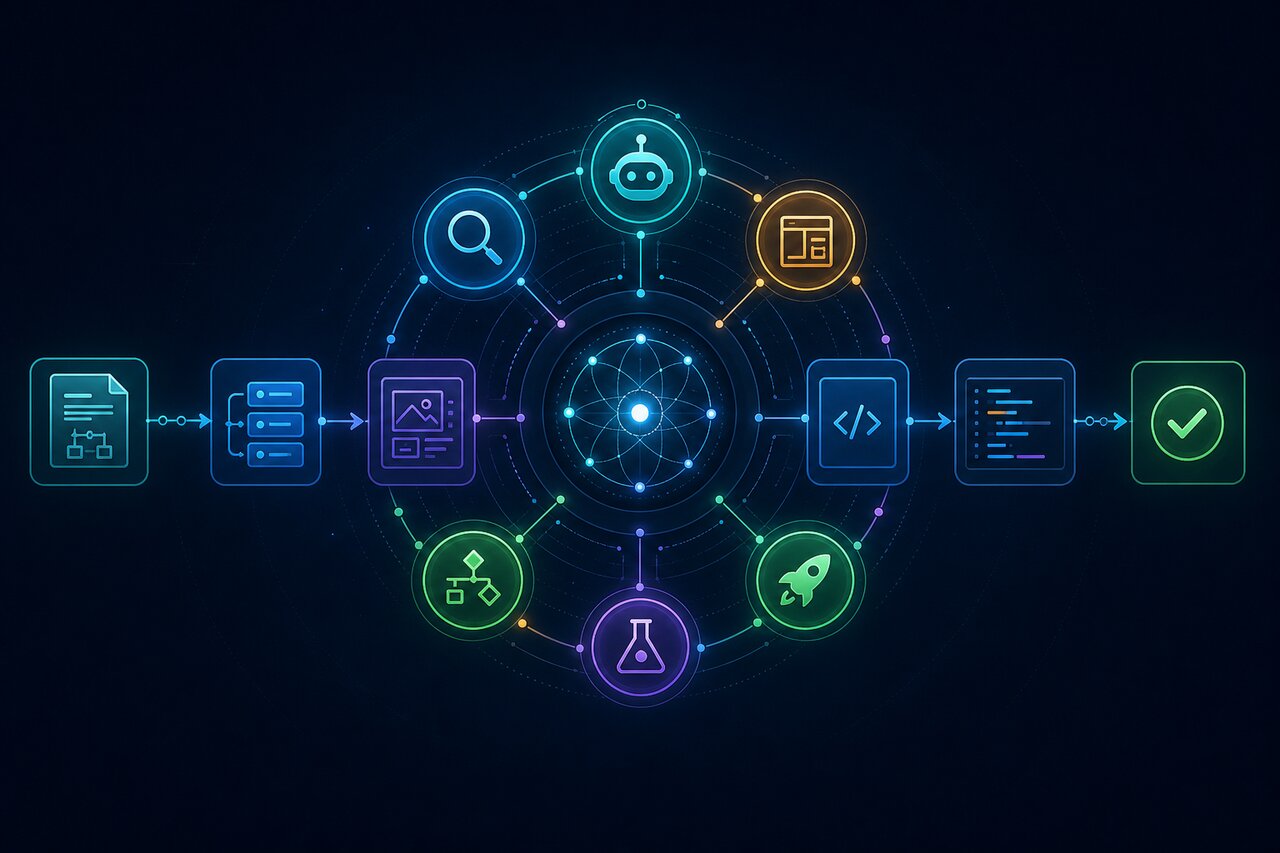
Most agent setups dump everything into one context window. fullstack-swarm keeps a typed status machine in the main session and dispatches one specialized subagent per stage. Subagents never call each other — every handoff goes through the orchestrator — so you get clear artifacts (stories/, design/, src/, web/, tests/) and a queue you can inspect with /status.
Cursor (recommended for local try-out)
git clone git@github.com:mandarzope/fullstack-swarm.git
mkdir -p ~/.cursor/plugins/local
ln -s "$(pwd)/fullstack-swarm" ~/.cursor/plugins/local/fullstack-swarm
Restart Cursor (or reload plugins). Then open any project and continue with step 2.
Claude Code — from GitHub
claude plugin marketplace add mandarzope/fullstack-swarm
claude plugin install fullstack-swarm
Use the plugin name fullstack-swarm, not the repo path.
Claude Code — from a local clone
git clone git@github.com:mandarzope/fullstack-swarm.git
cd fullstack-swarm
claude plugin marketplace add "$(pwd)"
claude plugin install fullstack-swarm
Session-only (no install):
claude --plugin-dir /path/to/fullstack-swarmIn the target repo (fresh or existing):
/swarm-init
This creates prd/, stories/, design/, src/, web/, tests/, CLAUDE.md, .claude/agents/, and .cursor/rules/orchestrator.mdc. Safe to re-run; skips existing files unless you pass --force.
# write requirements
$EDITOR prd/current.md
Then in the agent:
/ship-prd
Watch progress anytime:
/status
Resume after a stop or human gate:
/next
| Command | What it does |
|---|---|
/swarm-init |
Scaffold dirs, agents, orchestrator rules |
/ship-prd |
Decompose prd/current.md and run the pipeline |
/status |
Read-only queue table + next dispatch |
/next |
Keep dispatching eligible stories until DONE / BLOCKED / stuck |
| Subagent | Tracks | Job |
|---|---|---|
project-manager |
all | PRD → atomic, track-tagged stories |
solution-architect |
all | HLD + ADRs |
tech-lead |
all | LLD + confirmed track |
ux-designer |
ui, fullstack | UX spec + design tokens (no code) |
developer |
backend | Implement + tests under src/ |
frontend-developer |
ui, fullstack | Implement + tests under web/ |
qa-engineer |
all | Functional QA report |
visual-qa |
ui, fullstack | Live browser checks + screenshots |
Tracks: backend skips UX and visual QA. ui / fullstack go through both.
Statuses:
DRAFT → READY_FOR_ARCH → READY_FOR_LLD → (READY_FOR_UX_DESIGN →) READY_FOR_BUILD → READY_FOR_QA → (READY_FOR_VISUAL_QA →) DONE
with FAILING_QA / FAILING_VISUAL_QA / BLOCKED as branch points. Full rules live in CLAUDE.md.
| Path | Role |
|---|---|
.cursor-plugin/ |
Cursor plugin manifests |
.claude-plugin/ |
Claude Code plugin manifests |
agents/ · commands/ · skills/ · rules/ |
Installable plugin surface |
.claude/agents/ · CLAUDE.md · scaffold dirs |
What /swarm-init writes into a project |
See CONTRIBUTING.md for how to change agents, skills, and manifests in sync.
By participating, you agree to the CODE_OF_CONDUCT.md.
Security reports: SECURITY.md.
MIT © mandar-zope