
| EVOProtocol | Embededd Volumetric Optionality Protocol | v1.0.0+0 |
|---|
EVO Protocol is a dynamically adjusting ERC-compatible protocol that adjusts based on volume
EVO tokens are minted and burned on-demand by deposit and withdraw operations directly via the contract.
Initiated Protocol Operations
- Deposit
- Withdraw
- Transfer
These operations contribute to transfer rates.
Transfer rates are tracked both in aggregate and individually (i.e. per address).
The period of time for tracking is the last 25 days.
V2 Upgrade will include upgrading the time and date to a new libray
Time and Period should be defined on a per market basis. Meaning you should choose what is computed to be the optimal time period based on historical analysis.
Multiples of 4,6, etc are suggested
- For Example
25days has36000 minutes, which divided byblock_time=4gives9000
GasEVO is determined both in aggregate (dynamically) and individually for each address based on transactional (i.e. volumetric transactional information) stored and updated through the smart contract during the previous transactions.
All three operations such as deposit, withdraw and transfer can equally contribute to the transfer rates that are tracked totally and individually(as per holder) by the smart contract for the period of the last 25 days.
The token price is determined dynamically(and individually for each holder) based on the information stored or updated in the smart contract during previous transactions:
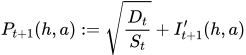
Note: This is specific to the implementation based on the reference specification , as described in the whitepaper (./latex/*/.tex)
Given enough liquidity, GasEVO has a way to compute the exchange rate towards the base instrument (ETH).
Like this, movements of the bigger or significant volumes can be interpreted as market trends (i.e. gwei pricing.)
By utilizing small volume movements and disincentivizing the larger ones without compensation to holders every exceeding bulge bracket trade of the token is tracked by the smart contract and higher "transactional" fees are applied (re: withdraw, or 'consumption').
Note: We describe
transactionalfees sometimes as aninterestfee. This language is marked as depreciated as this confers and/or implies a rate of return that is somewhat deterministic, this however is not the case per se as it is entirely possible that all trades could be below thetransfer rateduring a period/epoch.
Transference of funds below daily volume threshold does not impose any interest fee.
When the threshold has been exceeded some percentage of tokens gets burned, for the transfer, for deposit or for withdraw of the base instrument (ETH).
Thresholds are tracked individually per address as the average rate and have a function by which they operate on.
[time=Wed, Oct 7, 2020 4:07 AM]
[TOC]
EVO tokens are minted and burned on-demand by deposit and withdraw operations directly via the contract.
- Deposit
- Withdraw
- Transfer
These operations contribute to the transfer rates. Transfer rates are tracked both in aggregate and individually (i.e. per address). The period of time for tracking is the last 25 days
25 days has
36000 minutes, which divided byblock_time=4gives9000
GasEVO is determined both in aggregate (dynamically) and individually for each address based on transactional (i.e. volumetric transactional information) stored and updated through the smart contract during the previous transactions.
All three operations such as deposit, withdraw and transfer can equally contribute to the transfer rates that are tracked totally and individually(as per holder) by the smart contract for the period of the last 25 days.The token price is determined dynamically(and individually for each holder) based on the information stored or updated in the smart contract during previous transactions:
{equation.gasevo}
The above equation will compute the price for a holder EVO tokens in exchange for a base deposit in ETH/WETH at the given discrete time - ETH in the smart contract at previous time - point and EVO tokens so far.
The first component with the token - base ratio $a$.
Ergo, the component $$a$$.
Higher interest payouts can slow down, deaccelerate, the price movement. Interest rate determines how fast, or accleration, such price can change depending on the market demand & supply pressure for EVO-based tokens. Interest[#] is computed individually for each EVO holder.
Note that all interest payments are contributed to the same common deposit Dt on the smart contract, which is supporting the indicative price. This means that interest is shared by all holders that choose not to trade their tokens at the moment.
An ERC20 smart contract will contain the information about the balance of every address,
In addition to the individual balances, GasEVO contract keeps track about how much each holder has transferred in the last epoch (i.e. 25days)
More formally calculation of the individual interest rate as well as the applied ownership discount can be described in following steps:
For:
block time then we resolve the interest rate;
thereby applying the ownership ratio for discount
whereas %$$I$$ is the discount*, thereby computing the discounted interest as,
Price dynamics of equation (1) depends on the transactions volume conducted by all of the involved market participants and bounded by
Therefore it can be expected that the demand for EVO Protocol based tokens like GasEVO will be able to represent the demand for the value storage, whereas GasEVO represents the value of storage as a derivative function of the underlying asset, Ethereum (i.e. gwei, or as a fixed unit of account for contracting)
informative 525600 / 4 = 131400 131400 / 25 windows = 5256
P_(t+1)(h,a):=sqrt((D_(t))/(S_(t)))+I_(t+1)^(')(h,a)
appendix scenario: Firesale
A constructed mechanism for facilitation of efficient and effective contract$^[1]$ trading
:::info Find this document incomplete? Leave a comment! :::
please contact: <mailto: sam@manifoldfinance.com>for bugs/security issues, thank you.
SPDX-License-Identifier: SSPL-1.0