
English | 简体中文 | 繁體中文 | Español | Français | Bahasa Indonesia | 日本語 | 한국어 | Русский | Tiếng Việt






Important
Free, open source, non-profit — a personal agent for all. nanoMuse is a community project, free for good: sign in with a phone number or an e-mail and the model comes with a free allowance, paid by the developer; when it is gone, bring your own key. Messages are not stored unless you choose to contribute them; nothing is sold; delete the account whenever you like. Try it in the browser, or download the app.
nanoMuse is an open-source personal agent for every device you own: one agent with a name and a look of its own, like Meta's Muse, that does things instead of answering questions, keeps working while the app is closed, remembers you, and stops to ask before anything you could not undo. The Android app runs the whole agent on the phone: a Linux root file system, a shell, a browser, MCP, skills and scheduled tasks inside the APK, with a model you bring. It has hands for the apps that never had an API — the phone's own screen, with your permission — and reaches your computer: say it on the phone, it gets done there. The desktop app and the web version ship too; iOS and glasses come next. Your own key or a starter allowance from an open relay, GPL-3.0 — and a base you can build your own Muse on.

- 2026-10-02 · 0.1.26 “Window” — The phone in the browser takes the web version's place: nanomuse.cn/web opens on a simulated phone with a private Muse on it, talking with DeepSeek V4 Pro, after a sign-in to nanoMuse Cloud (the account is yours in the apps too), with a plain word that it is a demo and where the app is; the desktop lays itself out the way Muse's does — a rail of icons, the chats beside it, settings with their sections down the left — with a quick-chat shortcut, Start with the computer, and the developer side behind one switch; the README says where the project is and what it is after, in ten languages under
docs/readme/; the Linux desktop app works again and Windows machines that intercept their own loopback are told so. - 2026-10-01 · 0.1.25 “Mirror” — One name and one face for the account: a rename or a new look on any device is on the others within a moment (relay 0.7); a Stop button on the desktop stage while the hands work; the avatar studio draws in the phone's seven styles on the web and the desktop; light by default everywhere, with Appearance to choose; the runtime opens its port first and the desktop shell tells a slow start, a bad
config.tomland an old glibc apart; the relay's certificate verified with a bundle the macOS runtime has, so a computer is no longer "refused"; the sign-in page fits a landscape window; your own key one step after sign-up and a row in Settings; pictures queued at the relay instead of refused with a 429; fewer words on every screen. Release notes. - 2026-10-01 · 0.1.24 “Signal” — A phone number is a way in on every platform (the code by SMS; a password for either); the face moves on the web and the desktop — the dragon's four clips, and clips for a new face from the studio where there is a video model; the hub is the one way a computer joins, the local-network script gone, and the phone says which account it uses when a computer is missing; a signed-in runtime with no key uses the relay; a slow start says where it is on both sides; the Linux runtime on glibc 2.31; the hands findable when off; a plainer front door with GitHub as the default download source and the password way in on nanomuse.cn/web. Release notes.
- 2026-09-30 · 0.1.23 “Welcome” — The version before we tell people about it: one allowance that lasts (the account page says how much and how it grows) and three ways on when it is spent, with a step-by-step guide to your own key; two short steps after a new account; the avatar studio on the web and the desktop; a desktop app laid out like one; a computer that joins by signing in with the same account; a download mirror at nanomuse.cn/dl for China; the operator's page with the site's visits and downloads counted without addresses; Discussions open. Release notes.
- 2026-09-30 · 0.1.22 “Commons” — Easier to trust, cheaper to run, simpler to join: the free / open-source / non-profit notice first everywhere; a daily allowance with picture and clip models five times cheaper and a cost check before a face is drawn; a friend invited brings credit and more clips; sign-in by e-mail; the calls gone and a microphone back on the web and the desktop; Contribute conversations, off by default, for a model the community trains itself; the desktop app installing on macOS and Windows; a light running round the stage. Release notes.
- 2026-09-30 · 0.1.21 “Footing” — Nothing new to demonstrate, a great deal more to trust: a pass over the runtime, the relay, the web app, the desktop, the phone and the docs. Failures said in one sentence with the detail folded away; nanoMuse Cloud offered by name as a model; a refused request or a retried clip counted once; the relay's admin token compared in constant time and its picture fetches kept to the provider's hosts; the phone's pairing tokens in the encrypted store and out of backups; the web app connecting, retrying and keeping your draft; the desktop app restarting a runtime that died, with About and Check for updates; a
pipx/Docker runtime noticing a newer release; the docs describing the app you download. Release notes. - 2026-09-30 · 0.1.20 “Presence” — Call your Muse, by voice or with the camera on, and it answers in its voice while you are still talking; your Cursor, Codex and Claude Code sessions seen and steered from the phone, the browser or another computer; the account at the front door of every app with a password, its sign-ins and its history, and usage by kind and by model; one design language — the phone's — on the web, the desktop, the console and the operator's page, and a finer stage over the screen while the hands work. Release notes.
- 2026-09-30 · 0.1.19 “Ensemble” — Every device, and the browser when you have none of them: a desktop app for Windows, macOS and Linux shaped after the phone app with the runtime inside (a face, chats, Devices, approvals, hands on the computer's screen with the stage over it, a global Stop); the computer on the hub both ways, so the phone and the PC ask each other for things and an approval asked on one is answered on the one you hold; and nanoMuse Web at nanomuse.cn/web — sign in with an e-mail or a phone code and get a nanoMuse of your own on the project's server, nothing to install. Release notes.
- 2026-09-29 · 0.1.18 “Open” — Sign-up is open to everyone: an e-mail address, a code, and about ¥25 a day of model use, free (community members: no cap). What each request cost is shown in ¥ and $ in the app and the admin console. A new first run — welcome, the notice above, e-mail sign-in first, the Hands permissions up front and skippable, then the first conversation. Approvals come in three tiers now; a payment can be remembered for one app with the screen lock, and Settings → Permissions lists what you remembered, by tier. Hands no longer stops at 25 steps. Models that never declared their modalities (qwen3.8-27b) no longer claim they cannot see pictures. Release notes.
- 2026-09-26 · 0.1.16 “Palette” — Image and video models picked from what your key can use; drawing on Model Studio through its native endpoint; Wan video models beside MiniMax-H3. Notes.
- 2026-09-25 · 0.1.12 – 0.1.15 — Hands: the phone's screen as a hand, with a capsule and Stop; Reach: the phone drives your computer; Stage: watching the hands work. Notes.
Older versions are in the table below and the CHANGELOG.
Four things define the project.
| Muse-style | One agent, not a toolbox: a name and a look of its own, a first conversation, a feed written for you, goals worked on in the background, memory you can read and edit, an approval before anything you could not undo. |
| Fully open | GPL-3.0-or-later, the whole repository. No closed component, no account or server you have to use, no model you have to use — the optional nanoMuse Cloud relay is in the repository too, and anyone can run one; every release is built from its tag and installed by hand. Muse, 豆包 and 千问 are products you are given; nanoMuse is one you own — and a base to build your own Muse on: rename it, redraw it, rewrite its personality, wire in your own models and tools. |
| Any app, API or not | Most of a day in China runs through apps that never had an API. The agent climbs a ladder — a skill, a CLI or an MCP server first, then a page fetched with your login, then the in-app browser, and, when you allow it, the device's own screen, looking and tapping the way you would — with the same approvals before paying, sending or deleting. Off by default. |
| Every device | One agent, and every device you own is a pair of hands and a front door: say it on the phone, it happens on your PC; say it to your glasses, it happens on both. The phone drives your computer already, the desktop app and the web are here; iOS and glasses follow. |
How this compares with Muse and with OpenMinis, the runtime the app is built on: below. The plan and its reasoning: docs/roadmap.md.
A first look with nothing to install: nanomuse.cn/web opens on a simulated phone in the browser with a nanoMuse of its own, after a sign-in with a phone number or an e-mail and a code — a demo, a long way from the apps; for the real thing, the phone app and the desktop app below, with the same account. For your own devices — the downloads: the Android APK, the desktop app for Windows, macOS and Linux (nanoMuse-Desktop-<version>-…), the terminal binary (nanomuse-desktop-terminal-<version>-…), or pipx install "git+https://github.com/nano-muse/nanoMuse" with Python 3.11+; GitHub's own downloads are the fastest source from China too in our measurements; if they fail where you are, the same files are on the project's mirror at nanomuse.cn/dl (synced within fifteen minutes of a release, SHA-256 checked); docs/desktop.md and docs/every-device.md say how they meet. On the phone:
- Download
nanoMuse-<version>-arm64.apkfrom the latest release — Android 8.0 or newer, a 64-bit phone. Verify withsha256sum -c nanoMuse-<version>-arm64.apk.sha256if you like. - Open it. Android asks once to allow the install; every version is signed with the same key, so updates install over the previous one and keep your data.
- Connect a model. Sign in — free: a phone number (the code comes by SMS) or an e-mail address, and the agent has a free allowance on nanoMuse Cloud — no key needed, nothing to pay; the account page says how much is left and how it grows. When it is gone, bring your own: Alibaba Cloud Bailian in about two minutes, any OpenAI-compatible endpoint with your key, or one of the OAuth sign-ins the app ships with. Then, if you like, the two permissions that let the agent use your phone's apps (skippable), and the first conversation, which asks what to call you and lets the agent pick its own name.
- Optional — Settings → Image & video models: an image model (qwen-image-3.0 on Alibaba Cloud Model Studio, gpt-image-1, or any provider with the OpenAI images endpoint) lets the agent change its look and draw pictures; a video model (wan2.2-i2v-flash on Model Studio) makes the look move. Muse has these built in; nanoMuse uses your own, and the agent tells you when one is missing.
The app checks this repository's releases for updates. Release notes for each version are in docs/releases/ and the CHANGELOG.
| Does things | A Linux shell, a browser, MCP servers, skills in the Agent Skills format, and — when you switch Hands on — the apps on your phone through their screens: a screenshot, one action, another screenshot, with a ladder that tries APIs first, a take-over for logins and the same approvals (0.1.12). The agent picks the hand the job needs and shows each step as a card you can open. |
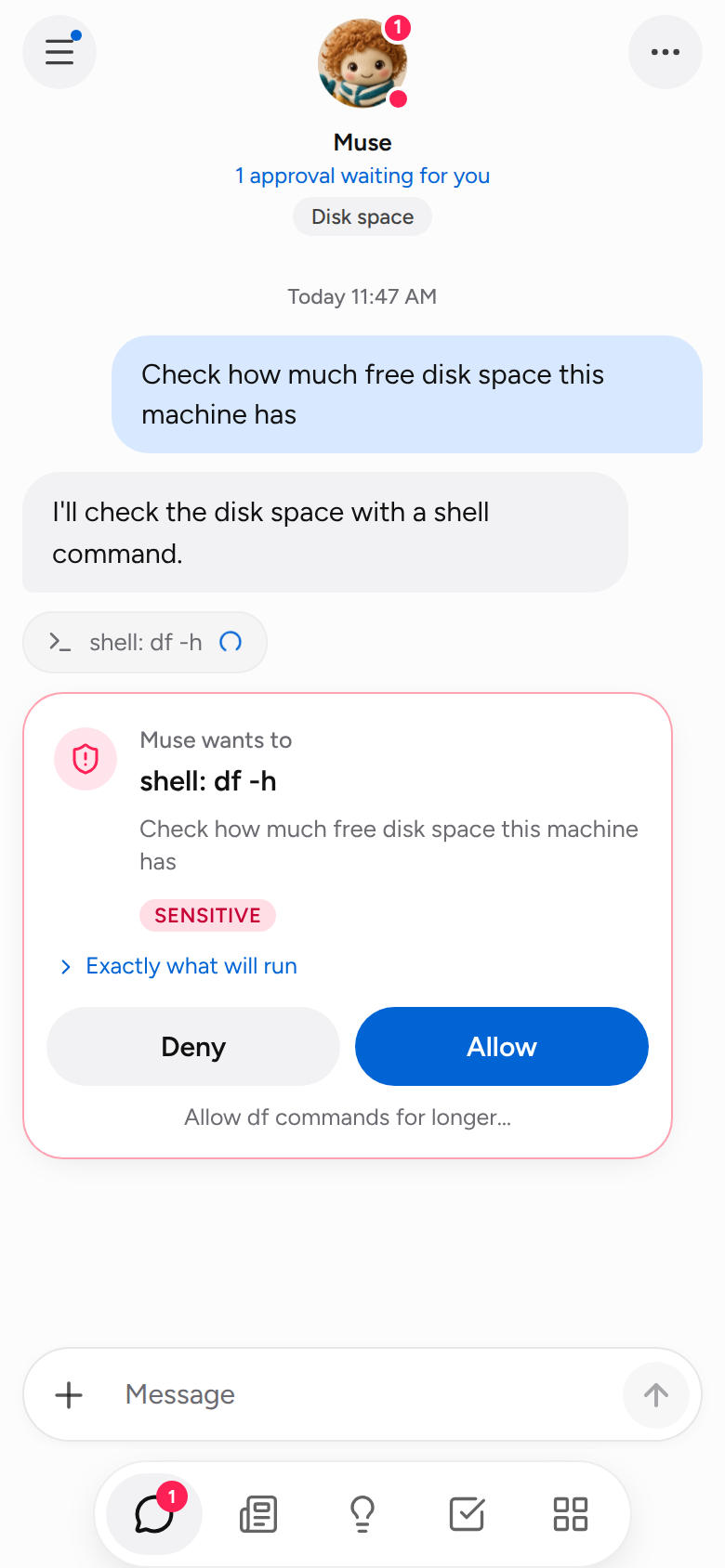
| Asks first | A stop before deleting, sending or paying — in the shell and in the browser — with an approval you scope to once, this chat, or always for this recipient, domain or folder, and can revoke under Permissions. Passwords and verification codes are always yours to type. |
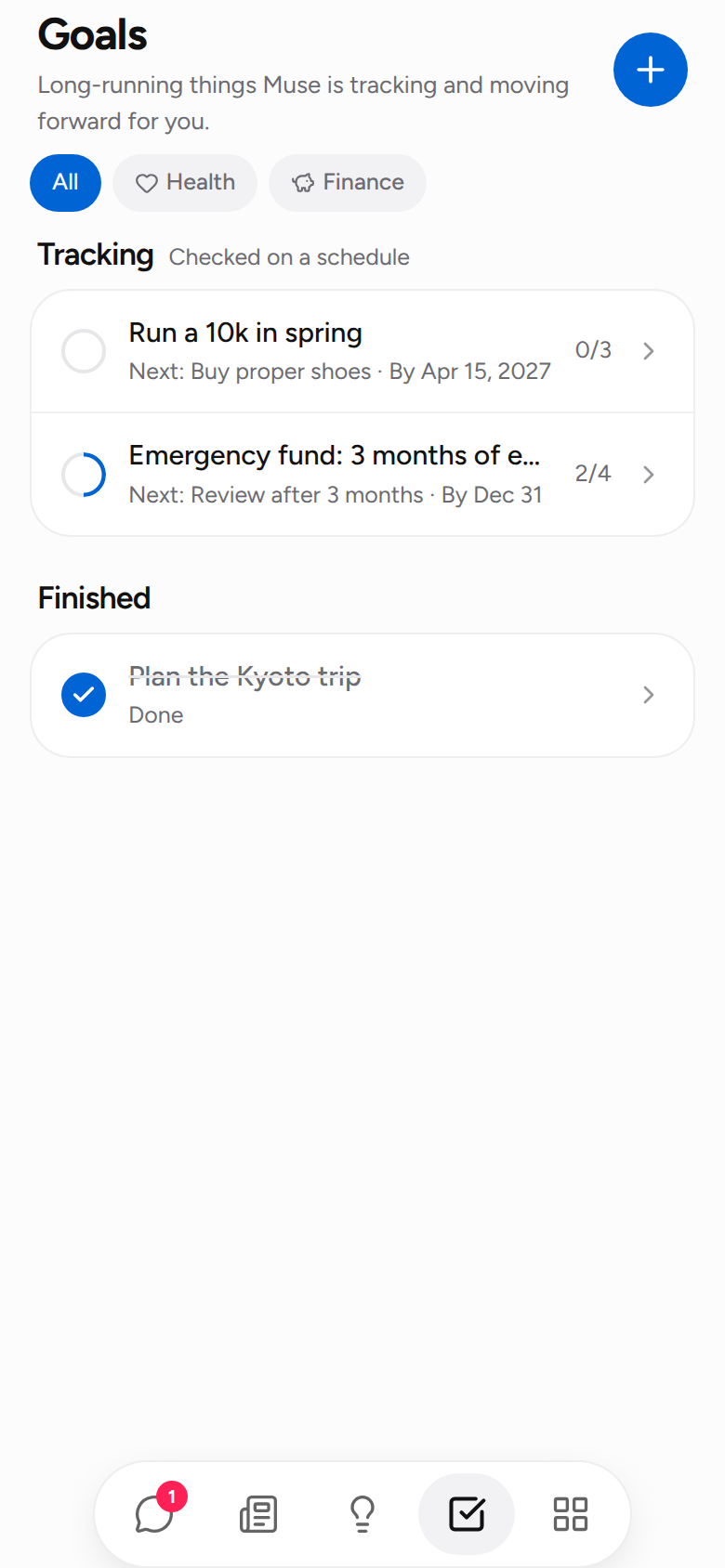
| Keeps going | Goals are shaped in the chat and checked on a schedule in their own conversation; routines run while the app is closed; the screen stays on while it drives the phone; at 200 steps it asks "continue?" instead of wrapping up early. |
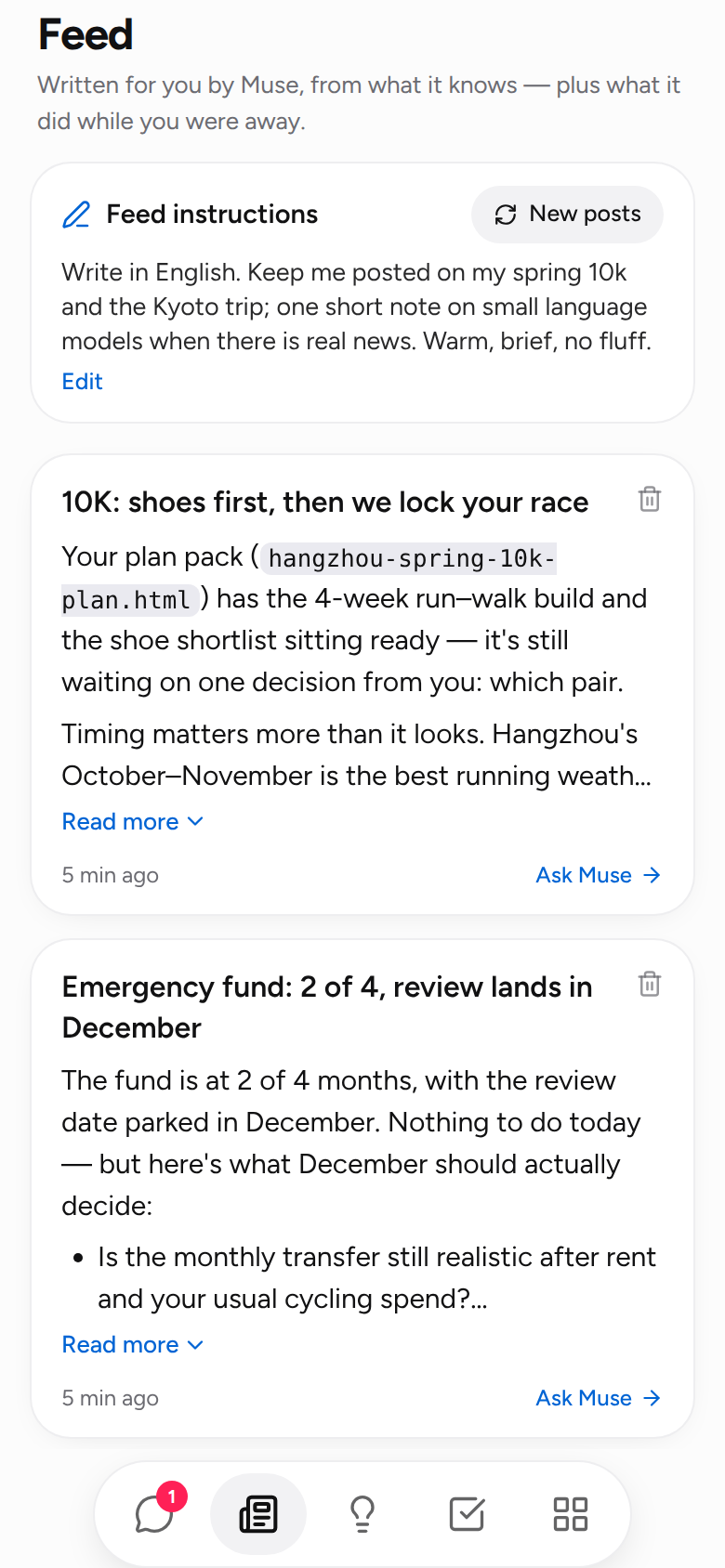
| Writes you a feed | Every morning, three to six short posts from what it knows about you and what you asked it to follow, as cards you can like, discuss in a side chat, or delete. One sentence steers it. |
| Remembers you | Who it is (SOUL.md), what it knows about you (USER.md), what it remembers (GLOBAL.md and a diary) and when it wakes (HEARTBEAT.md) are files you can read and edit in the app. Bring what another assistant knew with Import memory. |
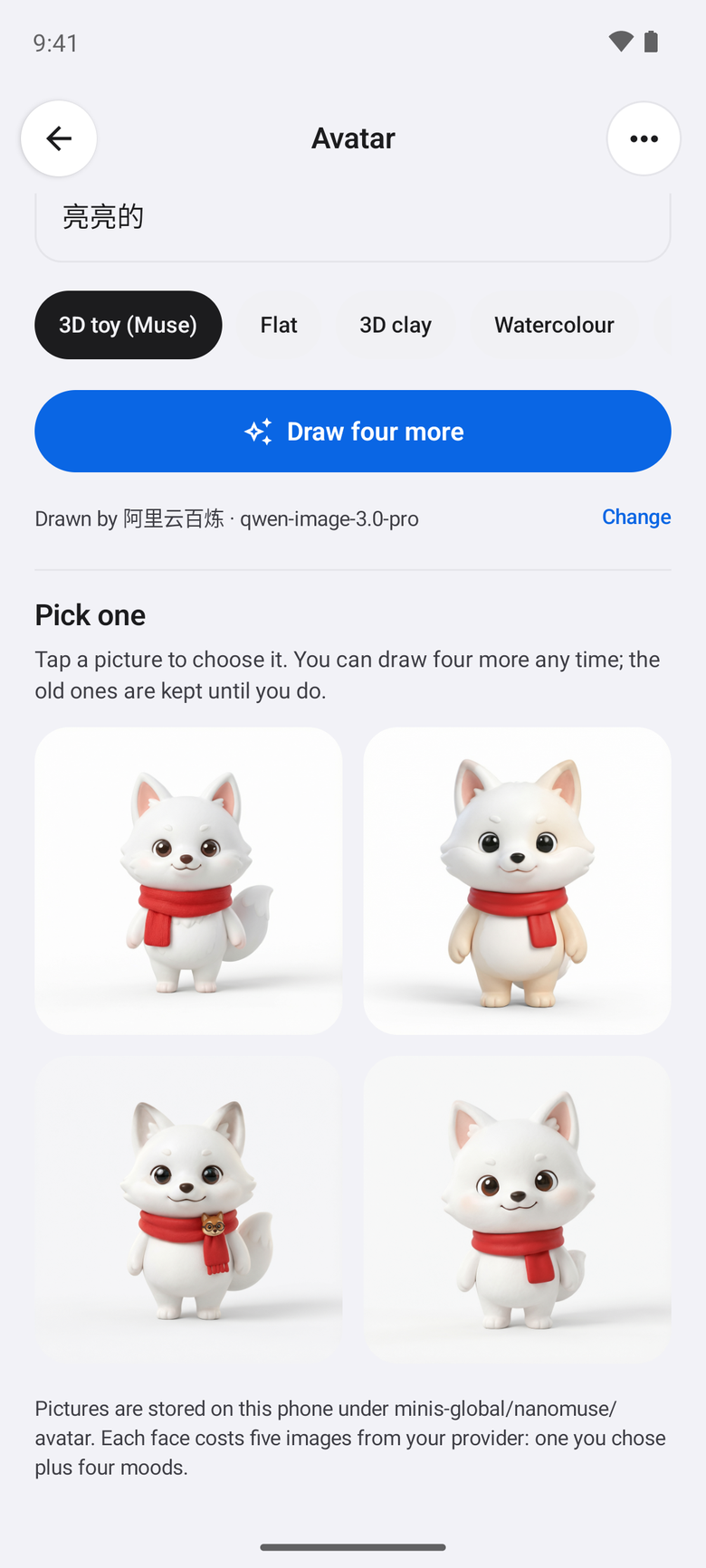
| A look of its own | Describe one in a sentence; your image model draws it; you pick the one you like. The app poses it for every state — working, waiting, pleased, sorry — and it breathes, bobs, tilts, pops and shakes with what the agent is doing; with a video model, each state is a short looping clip. A small pale-yellow dragon, stills and clips included, is the default. |
| Ideas and Library | Things to ask next, from your goals and memory; and everything it made, with previews. |
All of it runs on the phone; the rest of OpenMinis — the terminal, the in-app browser, MCP and skill management, model groups, token usage, the accessibility executor, shared folders — is kept and reachable from the same menus.
The app is OpenMinis 1.13, modified: a complete on-device agent — Alpine Linux under proot, a shell, a WebView browser, MCP, skills, scheduled tasks, an accessibility executor, any OpenAI-compatible model — imported into android/ with git subtree so upstream releases can still be merged. What nanoMuse adds lives in io.github.nanomuse.*:
| Package | What |
|---|---|
ui/home, ui/header |
The home shell: one main chat, side chats in a drawer, the Feed · Ideas · Goals · Library bar, the header with the avatar, the name pill and the status line |
guard |
ShellGuard and BrowserGuard classify commands and page actions; RiskGate stops the tool call and shows the approval card; grants are remembered per scope |
goals, ideas, library |
Goals as scheduled conversations with a plan and a check-in; ideas from memory and goals; the library of what it wrote |
feed, sysfiles |
The morning routine that writes ```nanomuse-feed blocks into minis-global/nanomuse/feed/, the cards, the steering sentence; the system-files pages and memory import |
avatar, ui/avatar |
ImageGen on top of OpenMinis' image endpoints (images/generations, images/edits, DashScope's native edit), the studio, AvatarStore, and the animated AgentAvatar |
status |
The two-level status (tool title under the avatar, action chips on the cards), KeepAwake, the last browser frame per step |
cloud, ui/cloud |
NanoMuseCloud: sign-up by phone/e-mail code against the relay in cloud/, provisioned as an ordinary OpenAI-compatible provider; the sign-in and account screens (docs/cloud.md) |
Edits to upstream files are marked // nanoMuse:; scripts/rebrand.py re-applies the branding after every subtree pull. Building from source: CONTRIBUTING.md. Your messages go only to the model you configured — or through the relay, which forwards them and keeps none; files, memory and the avatar's pictures stay under the app's private storage.
One small version per stage, each a GitHub release with an APK. The plan and its reasoning: docs/roadmap.md.
| Version | Codename | What it added |
|---|---|---|
| 0.1.1 | Foundation | OpenMinis as nanoMuse: icon, name, brand colours, About / feedback / update source, GPL notices, one signing key |
| 0.1.2 | Identity | The red panda and a Muse-style header; a first conversation that names the agent; the name and face on every notification |
| 0.1.3 | Home | Opens on a chat, not a list; side chats in a drawer; Ideas, Goals and Library; goals shaped in the chat and checked on a schedule |
| 0.1.4 | Guardrails | Approvals with scope before deleting, sending, paying; passwords always yours |
| 0.1.5 | Memory | The feed; SOUL / USER / MEMORY / HEARTBEAT readable and editable; memory import; the screen stays on; "continue?" |
| 0.1.6 | Avatar | A face you describe, your image model draws, you choose, posed for every state and animated; pages cross-fade, cards settle, hearts pop |
| 0.1.7 | Welcome | The first run: a welcome screen with the three steps — provider, the models it serves, meet the agent |
| 0.1.8 | Polish | The shell finished: the type scale, the composer pill, only the name under the face, grey reply bubbles, the settings pages restyled to match |
| 0.1.9 | Portrait | Changing the face from the chat: "change your avatar to…", four takes to pick from, poses, a share card; the agent's page behind the face; five avatar sizes; the name pill re-measured |
| 0.1.10 | Motion | The three models named — chat, image, video — in Settings → Image & video models and in what the agent knows; with a video model the avatar gets a looping clip per state; pictures and clips on request; the agent explains a missing model instead of a fixed message |
| 0.1.11 | Hatch | The built-in dragon — stills and looping clips in the APK; the first conversation read by the chat model: a detour is answered and the name asked again later, its own names proposed in your language; one Model Studio key for all three models, or a provider per model |
| 0.1.12 | Hands | The phone's screen as a hand: the agent looks at a screenshot — never the accessibility tree — and taps, types and swipes in the apps that have no API; a skill, CLI, MCP server or the browser is tried first; a floating capsule with Stop; you take over for logins and codes; the same approvals before paying, sending or deleting; off by default |
| 0.1.13 | Reach | The phone drives your computer: run one Python file on the PC and pair it from the app by code, and a sentence on the phone runs there — the shell, the files, the browser, a look at the screen — with the results and the approvals back on the phone; one way, phone to computer, for now |
| 0.1.14 | Home | A fix: coming back to the app — from a notification, the tool capsule or Hands finishing a run — lands in its own home again, not on the OpenMinis chat screen |
| 0.1.15 | Stage | Watching the hands: a glow along the edges while they work, a turning ring with the action's name where they are about to tap, a ripple as they land, the ring riding along a swipe — after UI-TARS-desktop's ScreenMarker; the capsule lets every gesture through and steps aside; the app-icon quick actions open in the home |
| 0.1.16 | Palette | Image and video models picked like the chat model — from what the key can use, the recommended one marked; drawing on Model Studio through its native endpoint (the 404 is gone); Wan video models beside MiniMax-H3 |
| 0.1.18 | Open | Sign-up open to everyone with about ¥25 a day of model use, free; costs in ¥ and $; a new first run with the community notice, e-mail sign-in first and the Hands permissions up front; approvals in three tiers, payments rememberable per app with the screen lock; Hands without a step cap; undeclared modalities no longer read as text-only |
| 0.1.19 | Ensemble | Every device: a desktop app for Windows, macOS and Linux with the runtime inside, the terminal binary, and nanoMuse Web at nanomuse.cn/web with nothing to install; phone and computer ask each other for things, both ways, with approvals where you are; a Stop on any device stops the hands everywhere |
| 0.1.20 | Presence | Calls with the Muse — voice and video, in real time, through the account or your own key; the coding agents on your computer steered from any device; the account first, with a password, sign-ins, history and usage by kind and model; the phone's design on the web, the desktop, the console and the operator's page; a finer stage |
| 0.1.21 | Footing | A pass over every part: failures in one sentence, the Cloud as a named model, money counted once, admin token and picture fetches hardened, secrets on the phone encrypted and out of backups, a web app that connects, retries and keeps drafts, a desktop app that restarts its runtime with About and Check for updates, a runtime that notices a newer release, docs that describe what ships |
| 0.1.22 | Commons | The notice first; ¥15 a day with cheaper picture and clip models and a cost check before a face; invitations worth ¥3 and clips; e-mail sign-in; calls removed, a microphone on the web and the desktop; opt-in contributed conversations; the desktop app installing on macOS and Windows; a running light round the stage |
| 0.1.23 | Welcome | One allowance for good (¥10, +¥5 an invitation, +¥10 for co-creation) and three ways on when it is spent; password and co-creation steps after sign-up; the avatar studio on the web and the desktop; the desktop laid out like a desktop app; a computer joins by signing in; the download mirror for China; the operator's site statistics; Discussions |
| 0.1.24 | Signal | Phone-number sign-in everywhere (SMS code, password for either); the face moves on the web and the desktop, the studio makes clips; the hub the one way a computer joins, the host script gone; the relay as the model for a keyless account; start-up diagnostics on both sides; the Linux runtime on glibc 2.31; a plainer front door |
| 0.1.25 | Mirror | The agent's name and look follow the account to every device; Stop on the desktop stage; seven avatar styles on the web and the desktop; light by default with Appearance; the port opened first and a desktop error box that names the cause; the relay's certificate verified on macOS; a landscape sign-in page; your own key a step after sign-up; pictures queued, not refused; fewer words everywhere |
| 0.1.26 | Window | The phone in the browser replaces the web version, with a Cloud sign-in and DeepSeek V4 Pro; the desktop in Muse's layout with a quick chat and the developer side behind a switch; the README in ten languages under docs/readme/ with a word on where the project is; the Linux desktop app and the Windows loopback guard fixed. |
| 0.2.0 | Beta | Polish from the first weeks of use across devices; iOS; the first beta |
After that, in order: iOS; the web version on a machine of your own — a VM, a home server — with the same gateway; glasses. Each device you add is one more pair of hands and one more front door for the same agent. The Python line this project started with — the agent and its Sentinel, the web app, the simulated phone — is frozen at tag pre-openminis with its docs under docs/, and is the base of the desktop and web front doors.
| Meta Muse | OpenMinis | nanoMuse | |
|---|---|---|---|
| What it is | A personal agent as a service: iOS, Android, web, WhatsApp and Mac clients of one cloud VM per user | An on-device agent app for iOS and Android: a Linux sandbox, a browser, device tools, skills, memory, workspaces | A Muse-style agent on OpenMinis' on-device runtime, as free software, headed for every device you own |
| Where the agent runs | Meta's cloud VM | The phone it is installed on | The phone; a sentence there runs on a computer of yours; wherever you say, later |
| Shape | One agent with a name and a look of its own, a feed, goals, a Sentinel | Sessions, tools and settings — a workbench | One agent, a name and a look of its own, a first conversation, a feed, goals on a schedule, memory you can edit |
| Before something irreversible | The Sentinel model approves | Per-tool permissions | RiskGate stops the call: allow once, this chat, always for this recipient / domain / folder, or deny; passwords and codes are never typed by the agent |
| Apps without an API | Out of reach — the VM has a browser, never your phone | An accessibility CLI (android-a11y-cli) the model can call on Android |
The screen as a first-class hand: screenshots only, a ladder that tries APIs first, a take-over for logins, the same approvals — since 0.1.12 |
| Other devices | Many clients of one VM; the VM does not touch your devices | The one device it is installed on | One agent across your devices: install the desktop app, sign in with the same account, and the phone drives the PC from any network — and every device the others, both ways |
| Avatar | A plush figure that changes pose while it works | — | A look your image model draws and poses, a looping clip per state from your video model; a small dragon, already moving, by default |
| Models | Meta's | Bring your own | Bring your own — a chat, an image and a video model, or one Model Studio key for all three; the OAuth sign-ins OpenMinis ships with stay |
| Licence | Closed | GPL-3.0 | GPL-3.0-or-later, built on OpenMinis — with thanks; upstream releases can still be merged |
nanoMuse 0.1 is a preview. The agent, the phone, the desktop, the web and the relay all work, every day, for the people building them — and every one of them has rough edges we know about and more we do not, so what breaks for you, and what you wish it did, is the most useful thing you can send us. The apps are made for anyone to pick up; the developer side — your own models and providers, the shell, MCP, skills, the harness, the runtime's API — is there, in the settings and the docs, when you turn it on. The product, the runtime's surfaces and the skill and plugin interfaces will keep moving quickly for a while and settle as they go; the CHANGELOG says what changed and the roadmap what comes next.
What we are after is bigger than one app: a personal agent that belongs to the person who runs it, built in the open on infrastructure anyone can reuse and recombine — the runtime, the relay, the phone's hands, the hub between devices — and a shared answer to how far such an agent can go. We look forward to finding it out with users and developers everywhere: bring an idea and make it real here, as a skill, a connector, a model, a device or a translation, and help the ecosystem around nanoMuse grow.
Report a bug, ask for a feature, send a pull request — every one brings a personal agent within everyone's reach: open an issue · ask or show in Discussions · star the repo. How the free allowance, your own key and your data work: docs/cloud.md · docs/own-key.md · docs/privacy.md.
Use it for a real task, report what broke, then pick something focused. CONTRIBUTING.md has the build setup (android/BUILDING.md and the toolchain scripts in scripts/android/), the conventions (com.openminis.app stays, new code in io.github.nanomuse.*, // nanoMuse: on upstream edits, Signed-off-by on commits) and how releases are cut. The iOS app is built from the same tree and handed to TestFlight by CI — docs/ios.md. Issues · Pull requests.
nanoMuse stands on other people's work; THIRD_PARTY_NOTICES.md has the terms.
- OpenMinis — the on-device agent the app is built on: proot Linux, shell, browser, MCP, skills, scheduled tasks, the accessibility executor.
- proot (via nano-muse/proot) and Alpine Linux — the sandbox inside the APK.
- MobileGym, MemGUI-Bench, PhoneHarness, CopilotKit/OpenMuse, Open-AutoGLM, ClawGUI — the phone operator, the traces and the product ideas of the Python line.
nanoMuse is an independent community project. It is not affiliated with, endorsed by, or derived from Meta Platforms, Inc. or its Muse product; Muse is a trademark of Meta Platforms, Inc. The dragon is the project's own.
GPL-3.0-or-later. The Android app is based on OpenMinis 1.13 (GPL-3.0), modified since 2026-09-24; see NOTICE and THIRD_PARTY_NOTICES.md. Earlier versions of the Python line were released under MIT (tag pre-openminis).