Stable, efficient, and reusable robot self-evolution in complex real-world environments.
English | 简体中文



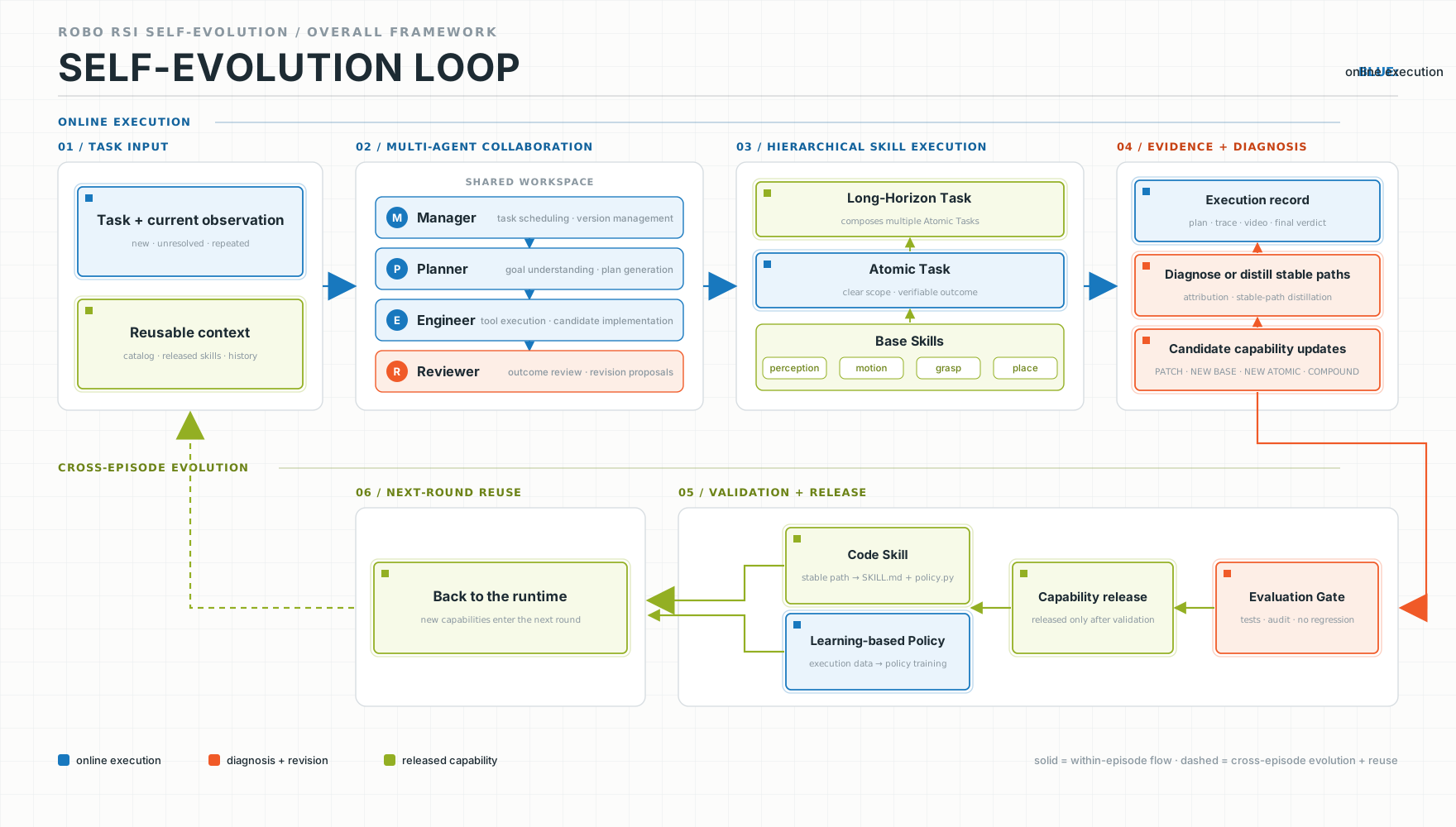
RoboRSI is a multi-agent harness for robot self-evolution. A Manager decomposes tasks, a Planner writes executable plans, an Engineer drives skills against the live environment, and an independent Reviewer diagnoses the visible trace. Top-down Skill Refinement (TSR) keeps every capability in a task–skill tree: online exploration finds a solution, stable workflows consolidate into code, execution data can train a learning-based policy, and failures return to the earliest responsible node.
Project page: https://lab.noematrix.ai/blog/2-roborsi-research-preview/

Real-robot full task chain (16× timelapse) — full video with exact tool traces on the project page
| Metric | Result | Scope |
|---|---|---|
| LIBERO cumulative task pass rate | 95/120 | Cross-release adaptive coverage; ten sequential rounds moved 32/120 → 83/120 |
| LIBERO-PRO cumulative task pass rate | 80/120 | Five adaptive releases, 43 → 80 cumulative task coverage |
| LIBERO-Plus perturbation-instance pass rate | 398/840 adaptive Pass@2 | 840 = 7 perturbation categories × 120 instances; fixed release 261/840; +16.3 points |
| Matched Code-on / Code-off episode pass rate | 174/600 vs 129/600 | 120 tasks × 5 initial layouts per group; +7.5 points |
| Matched efficiency panel (118 tasks) | tokens −29.4% · VLM calls −27.2% · wall time −17.0% | Median Code-on vs Code-off |
| RoboTwin cumulative task pass rate | 36/50 | Planner + Engineer + Reviewer; single-role baseline 9/50 |
| Corrective learning-based policy case | 1 matched task success | 304-frame corrective trajectory → 2,432 samples → 1,000-step fine-tune |
Cumulative task pass rates count tasks passed at least once across evolving releases; they are not frozen-policy scores or fixed-method Pass@k. Full calibers, videos, and exact tool traces are on the project page.
long_horizon/<task>/   task family: user instruction → ordered atomic sequence
        ▼
atomic/<task>/         atomic task: clear scope, verifiable outcome; stable
        ▼              paths consolidate into code (e.g. visual_pick_place)
base/<robot>/<prim>/   base skills: perception, motion, grasp, place —
                       callable by atomics and exposed to the agent as tools
Manager ──► Planner ──► Engineer ──► Reviewer
task queue   plan.md    tool loop    root cause + revision proposal
When a task keeps failing, the Reviewer locates the earliest responsible node and proposes a skill change; a no-regression gate on a real simulator task must pass before the change is committed. Every applied change is an ordinary git commit, so the history stays auditable.
Evaluation (roborsi eval / eval-suite) runs the same role chain against a
frozen release with self-evolution and persistent write-back disabled.
Success is decided only by the simulator's own predicate after the agent
loop ends; journals are append-only, and roborsi eval-audit recomputes
scores independently.
git clone https://github.com/nssmd/RoboRSI.git && cd RoboRSI
export OPENAI_API_KEY="..."   # any OpenAI-compatible Responses endpoint
scripts/reproduce_libero_pro.sh
The script creates an isolated environment, installs RoboRSI, clones
LIBERO-PRO, downloads the official perturbation assets from
zhouxueyang/LIBERO-Pro,
configures and health-checks the backend, starts the PyRoKi IK/trajectory
service, launches a frozen code-on Pass-1 campaign, and audits the journal.
It is idempotent and resumable. A fresh campaign evaluates the current
frozen release; it does not replay the cumulative results above
(see docs/EVALUATION.md).
See docs/INSTALLATION.md and docs/DOCKERINSTALLATION.md.
pip install -e ".[libero]"
git clone --depth 1 https://github.com/Zxy-MLlab/LIBERO-PRO.git
hf download zhouxueyang/LIBERO-Pro --repo-type dataset --local-dir ./LIBERO-PRO-assets
roborsi libero configure \
  --root ./LIBERO-PRO \
  --bddldir ./LIBERO-PRO-assets/bddl_files \
  --initdir ./LIBERO-PRO-assets/init_files
roborsi libero doctor --backend libero --task libero_object/0 --reset
roborsi web # evolution dashboard :8787 · Manager cockpit :8795Scan to join the WeChat user group (the QR code is refreshed periodically):

@misc{noematrix2026roborsi,
  author       = {{Noematrix Team}},
  title        = {RoboRSI: Stable, Efficient, and Reusable Robot Self-Evolution in Complex Real-World Environments},
  year         = {2026},
  month        = sep,
  howpublished = {Research Blog},
  url          = {https://lab.noematrix.ai/blog/2-roborsi-research-preview/}
}