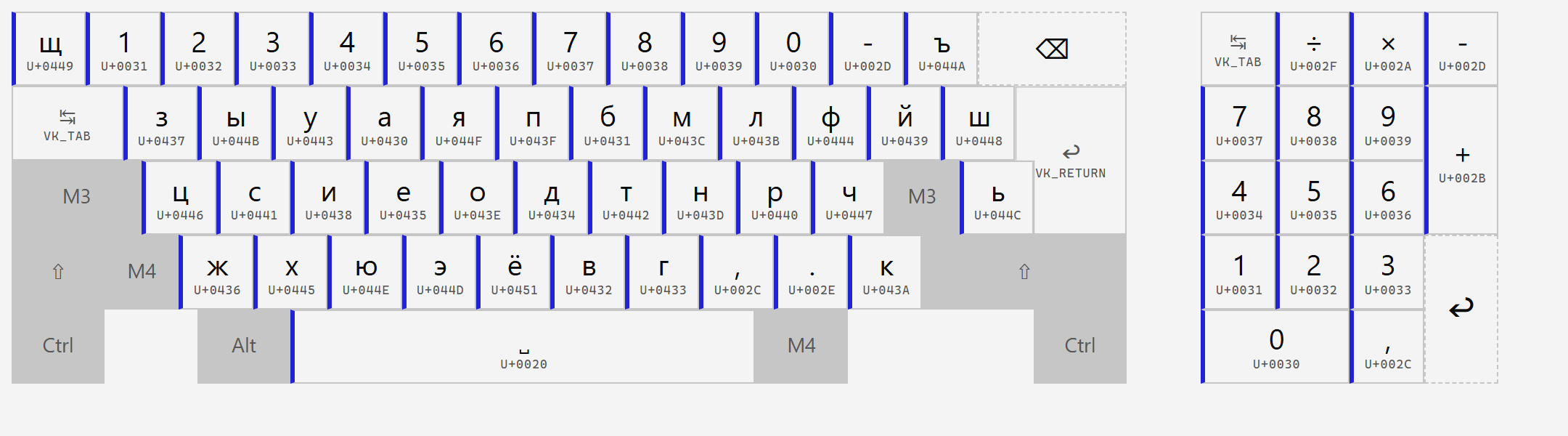
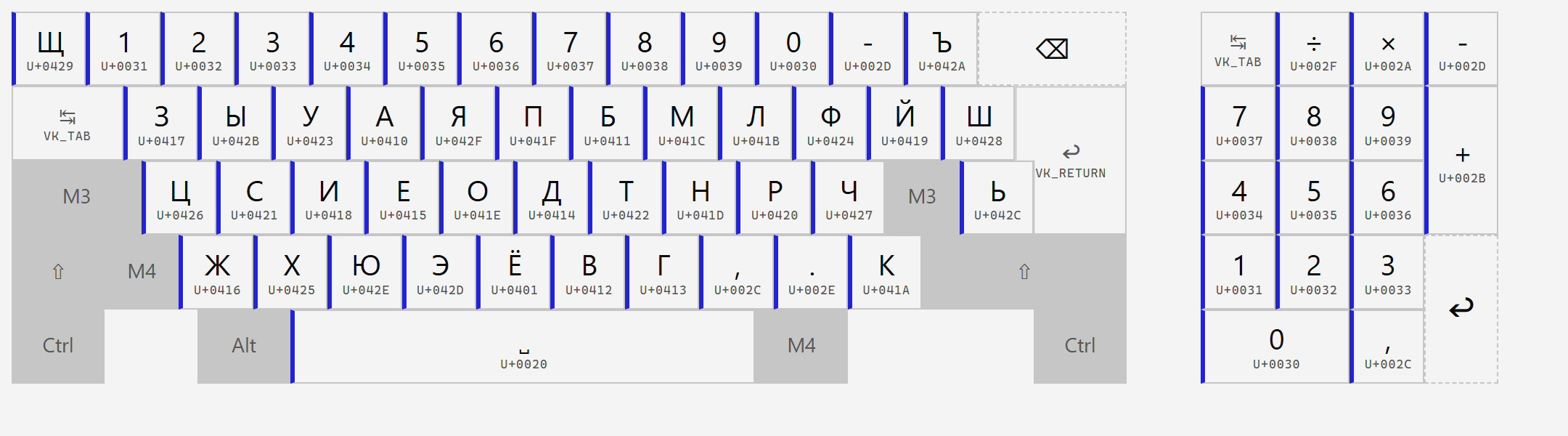
Layers 15 16 Cyrillic
Lock with M3+F5. Release with the same chord or with M3+Esc. Hold Shift for the capitals.
| Layer | Held | Contents |
|---|---|---|
| 15 | – | lower case, all 33 letters of modern Russian |
| 16 | Shift | upper case, on the same positions |
All 33 letters of the modern Russian alphabet are here. Macedonian, Serbian and Ukrainian are not laid out directly – their additional letters come from the compose module cyrillic, which ships by default and became reachable for the first time with this block: its sequences start with Cyrillic characters, and until there was a Cyrillic layer, no key produced one.
Phonetically and mnemonically, the same principle as Greek: the letter sits on the Latin key it sounds like. а on a, б on b, д on d, к on k, м on m, п on p. Where German and scientific transliteration disagree, German wins, because that is the keyboard your fingers are on: в sits on w, and й on j.
Both the ЙЦУКЕН standard order and a strict transliteration mapping were considered and dropped. Either would have meant learning a second arrangement.
Seven letters have no obvious Latin key. They follow convention where one exists, system where none does:
| Key | Letter | Reason |
|---|---|---|
q |
я | the convention of phonetic layouts |
v |
ж | convention, in both the YaZHERTY family and the German reference layout |
h |
ч | English transliteration ch |
ß |
ш | a sharp sch on the sharp s |
^ |
щ | the remaining dead-key position |
` |
ъ | hard sign on the grave – the hard of the pair |
´ |
ь | soft sign on the acute; its scholarly transliteration is ʹ |
The two signs are placed as a pair on the two accent positions, which is why they are memorable together rather than each on its own.
а е о р с у х к look exactly like Latin a e o p c y x k in almost every font. The rendering proves nothing here – if a cell had been filled with the Latin letter by mistake, the layout sheet, the on-screen keyboard and the typed text would all look correct. The only way to check is by code point, in an editor that can show them.
For this reason the test suite asserts that every one of the 33 letter keys produces a character in the Cyrillic block U+0400–U+04FF on both layers, rather than checking individual letters. A Latin lookalike slipping in would fail that assertion, which is not something a human proofreader can be relied on to do.
Digits, comma and full stop keep their ordinary behaviour on both layers, as do the keypad, the space bar and the function keys. Russian needs no separate punctuation – the «» quotation marks are already on layers 2 and 3.
Cyrillic has no +Mod3 or +Mod4 layer. Holding either inside the locked block falls back to layer 1.