Layers 5 8 Maths
Lock with M3+F2. Release with the same chord or with M3+Esc. Once locked, hold Shift, Mod3 or Mod4 for the other three layers.
| Layer | Held | Contents |
|---|---|---|
| 5 | – | operators, relations, set theory |
| 6 | Shift | the related variant of each |
| 7 | Mod3 | superscript |
| 8 | Mod4 | subscript |
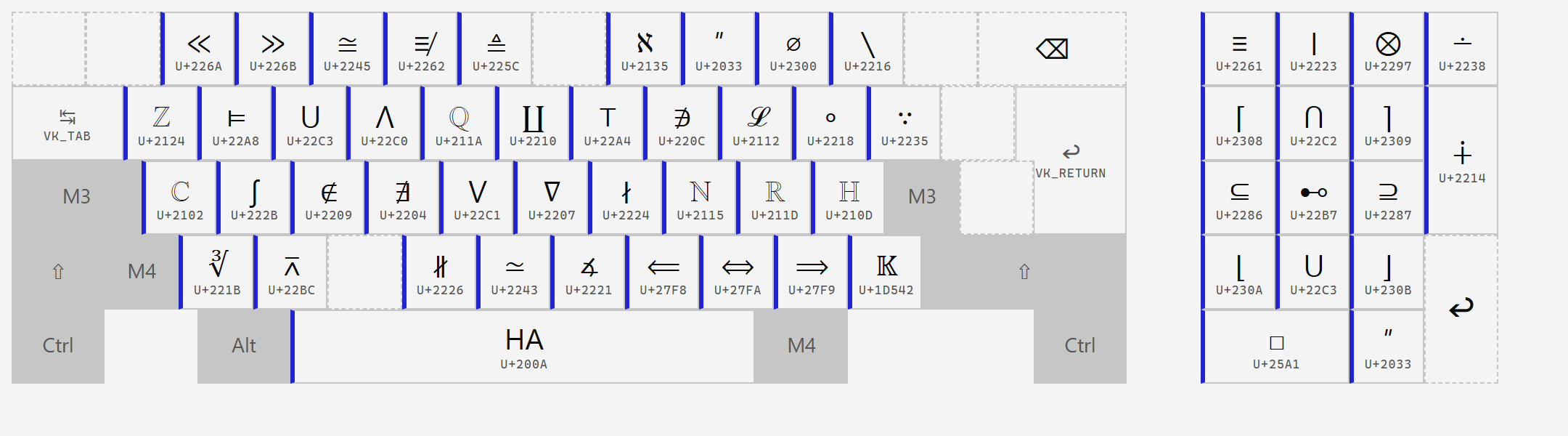
The principle is mnemonic: the character sits on the letter it recalls, and Shift gives the related variant. a is ∀ and Shift makes it ⋀; e is ∃ and Shift makes it ∄; s is ∑ and Shift makes it ∫; n is ∩ and Shift gives ℕ. Where a symbol has a negation, Shift is the negation; where it has a big-operator form, Shift is the big operator; where a letter names a number set, Shift is the double-struck letter.
That rule is what makes the block learnable without a chart. It is not perfect – some keys had to take what was left – but it holds for most of the layer, and it is the same rule the typography block follows.
The keypad and the arithmetic keys are the exception to the rule that a block leaves them alone: on layers 5 and 6 they carry mathematics too – set operations, brackets for floor and ceiling, per mille.
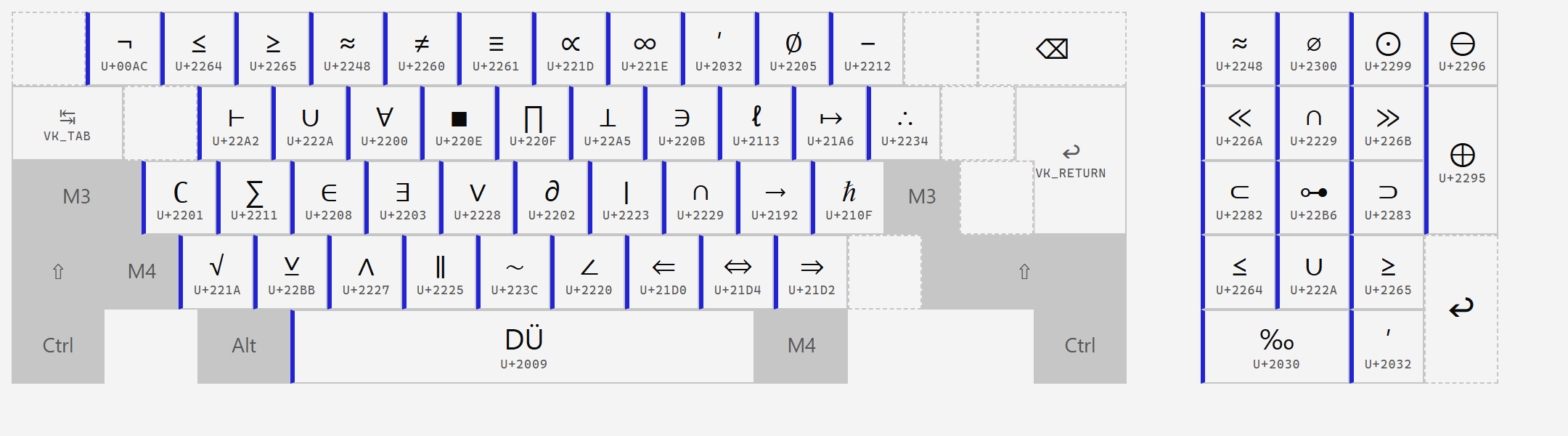
Note 𝕂 on the k key. The other double-struck letters – ℂ ℍ ℕ ℚ ℝ ℤ – come from the Letterlike Symbols block and live in the Basic Multilingual Plane. 𝕂 does not exist there; it exists only at U+1D542, beyond the BMP. It was missing for as long as a key could only hold a single UTF-16 unit, and it is here now because that limit is gone. Adding it pushed the bottom mathematics row one key to the left on both layers 5 and 6.
Superscript and subscript are not individual keys here – they are what the whole layer means. Layer 7 (+Mod3) is superscript, layer 8 (+Mod4) is subscript, and the same key gives you the raised or lowered form of what it normally types: the digit row gives ¹²³⁴⁵⁶⁷⁸⁹⁰ and ₁₂₃₄₅₆₇₈₉₀, w gives ⁺ and ₊ because w carries + on layer 3, l gives ⁼ and ₌ for the same reason, n and i give the index letters ⁿ ⁱ and ₙ ᵢ.
Treating it as a layer rather than as keys is what makes it complete without eating a key per character. The rest of layers 7 and 8 is reserve.
For a raised or lowered character that is not on this layer – any letter, and everything beyond the arithmetic set – use the compose modifiers ˣ and ₓ instead. They cover the full Unicode repertoire: 70 superscript and 37 subscript characters. That division is the general rule described under Compose: the layer carries the grip, the tree carries the derivation.
Note that ¹²³ also sit on layer 3 of the same keys. The duplication is deliberate: a complete row beats uniqueness.
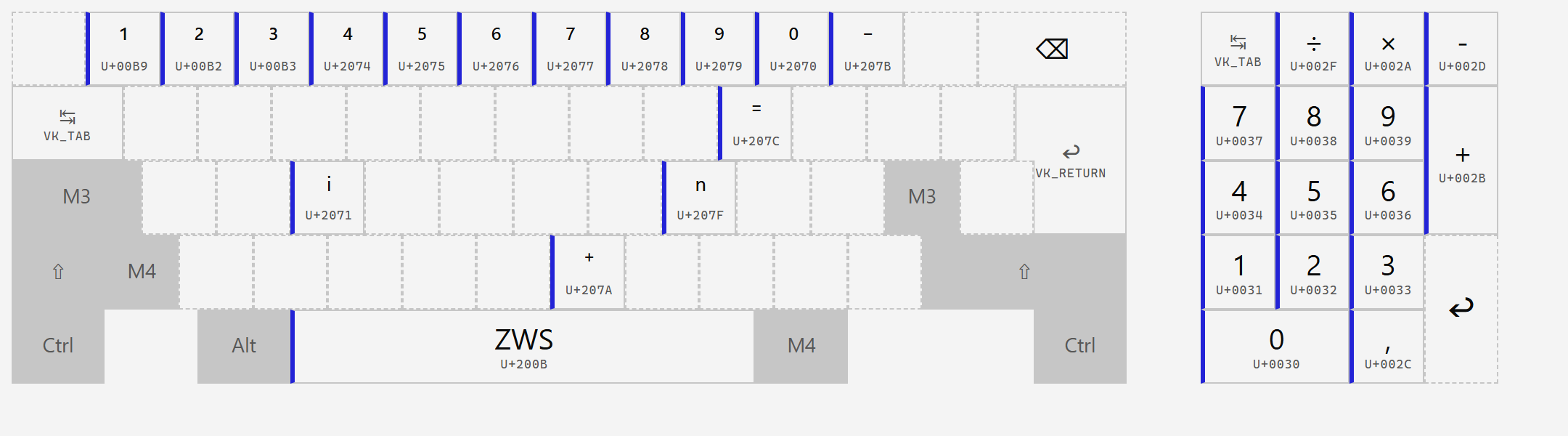
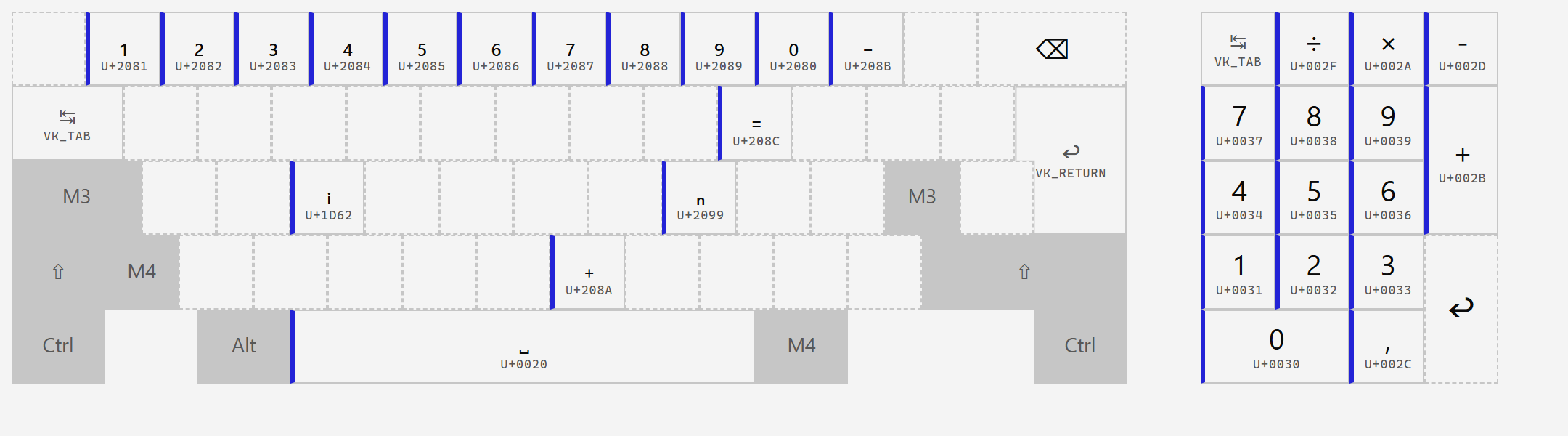
Layers 5 to 7 are where the space-bar hierarchy runs through its narrow end: thin space, hair space, zero-width space. If you need an ordinary space inside locked maths, +Mod4 (layer 8) has one.