
Your HubSpot portal, in one binary.



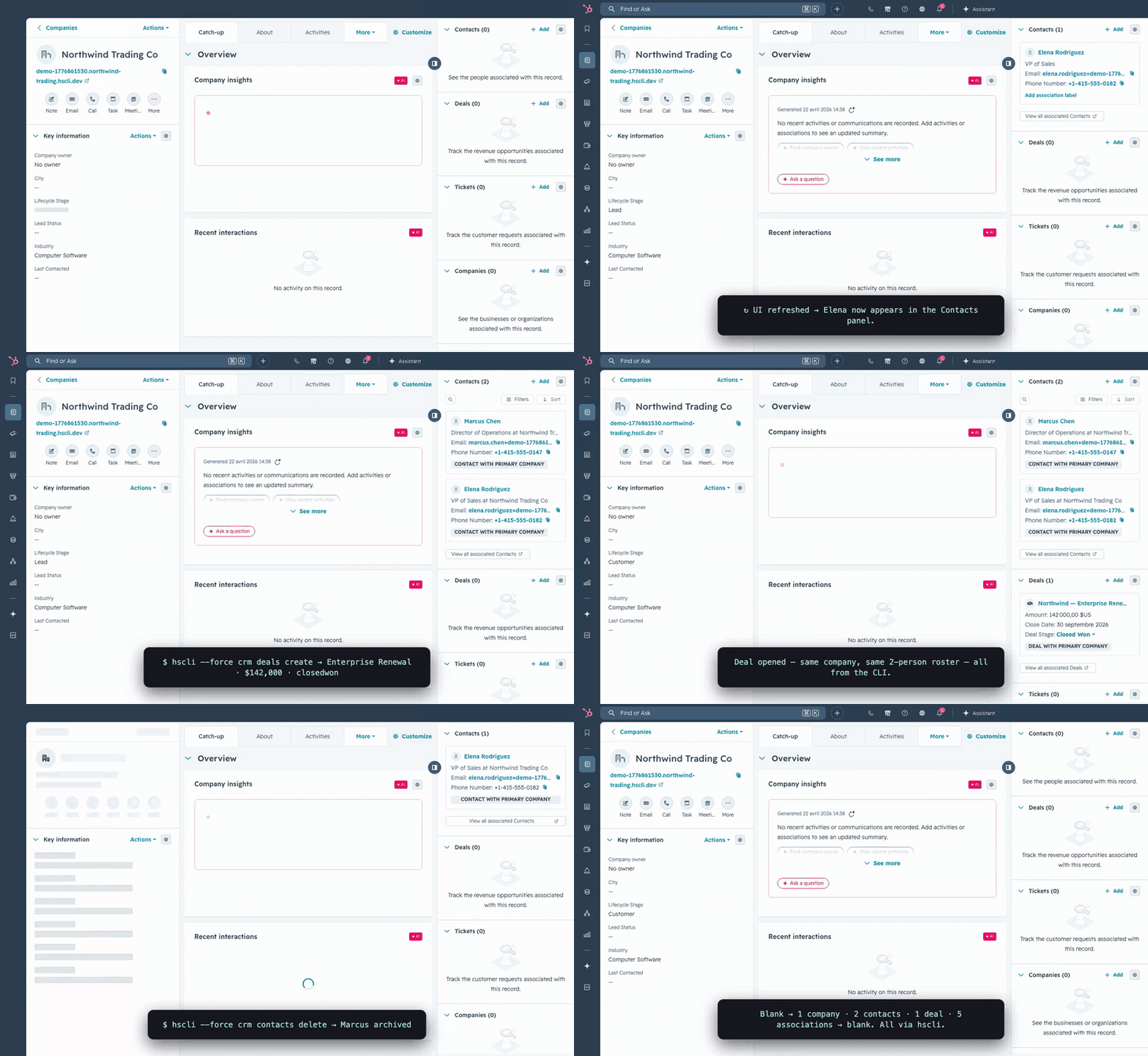
↳ Live tour · terminal writes, HubSpot reflects · ~60s on a real portal.
1,180 HubSpot endpoints, one TypeScript binary. Every write blocked unless you explicitly --force it. Every request auditable. Token stays on your machine. MCP-ready for Claude Desktop, Cursor, and any agent that speaks the protocol.
No SaaS middleman, no proprietary dashboard, no "download the CLI, then also install the desktop app". Just a CLI that respects production.
npm install -g @revfleet/hscli
printf '%s' 'pat-eu1-XXXX-XXXX-XXXX' | hscli auth login --token-stdin
hscli crm contacts list --limit 5
Create a Private App token at Settings → Integrations → Private Apps → Create private app in your HubSpot portal.
# Blocked — writes need explicit intent
hscli crm contacts create --data '{"properties":{"email":"jane@acme.com"}}'
# → WRITE_CONFIRMATION_REQUIRED

# Preview what the call would look like
hscli --dry-run crm contacts create --data '{"properties":{"email":"jane@acme.com"}}'

# Execute — with an Idempotency-Key baked in automatically
hscli --force crm contacts create --data '{"properties":{"email":"jane@acme.com"}}'
Policy file + change-ticket enforcement for ops teams:
hscli --force --policy-file ./policy.json --change-ticket CHG-123 \
crm contacts delete 123Drop hscli into any MCP client — Claude Desktop, Cursor, Claude Code, or your own agent runtime.
hscli mcpFor Claude Desktop, add to claude_desktop_config.json:
{
  "mcpServers": {
    "hscli": {
      "command": "hscli",
      "args": ["mcp"],
      "env": { "HSCLI_MCP_PROFILE": "default" }
    }
  }
}
The MCP server exposes three tool families:
- Per-object tools —
crm_contacts_list,crm_deals_create,crm_custom_records_search, … - HubSpot Remote MCP compat — same tool names as
mcp.hubspot.com(search_crm_objects,manage_crm_objects, …) so agents built for HubSpot's hosted MCP drop in without changes - Extension surface — workflows, files, forms, webhooks, HubDB, conversations, and more, all with the same
--force+ policy gates as the CLI
Every MCP tool call goes through the same safety rails as the CLI. Token redaction is enforced on every response. HSCLI_MCP_PROFILE locks the stdio server to one auth profile to prevent cross-tenant access.
hscli trace start                          # start recording every request
hscli --force crm contacts create …        # → appends to the trace JSONL
hscli trace stop

hscli trace stats ./trace-*.jsonl          # p50/p95/p99 latency, method breakdown
hscli trace diff  ./run-a.jsonl ./run-b.jsonl   # spot reproducibility drift
hscli audit writes --since 24h             # who wrote what, when
hscli audit by-tool                        # per-MCP-tool call count + error rate
Every request hscli makes is append-only JSONL. Pair trace with audit for full "who did what when" provenance — no extra infrastructure required.
Surface coverage — click to expand
- CRM — contacts, companies, deals, tickets, leads, quotes, products, line items, orders, carts, discounts, fees, taxes, invoices, subscriptions, payments, goals, communications, users, custom objects, properties, pipelines, associations v4, owners, imports, exports, engagements, sync, describe/validate, timeline, CRM Cards
- Marketing — emails (v3 + legacy v1), campaigns, ads, social, SEO, landing pages, transactional, subscriptions, events, behavioral events, forms
- Sales — sequences, meetings, calling, scheduler, sales extensions
- Service — conversations, feedback, chatflows, knowledge-base, ticket pipelines, visitor-identification
- CMS — site/landing/blog pages, HubDB, URL redirects, source-code, domains, SEO audit
- Settings — users, teams, business units, currencies, GDPR, audit-logs, communication preferences
- Operations — lists, reporting, exports, workflows (v4 + legacy), automation, webhooks, timeline
- Commerce Hub — quotes, products, line-items, invoices, subscriptions, payments, orders, carts, taxes
- Developer Platform — feature flags, CRM cards, integrators timeline, media bridge, extensions
- Legacy v1/v2 — every pre-v3 surface preserved for portals that still need them
- Raw API command with path-scope controls + full OAuth flow support
Enterprise defaults: --dry-run, --force, policy files, change tickets, capability probing, rate-limit intelligence, token redaction, path scope allowlisting, idempotency keys on every write.
hscli covers ~all of HubSpot's documented public API endpoints — a CLI subcommand or MCP tool per endpoint, verified against an automated scrape of HubSpot's developer documentation. A small residue stays out of reach because it's UI-only, deprecated, or requires a developer-app auth model rather than a private-app bearer token; see docs/CAPABILITY_LIBRARY.md for the ❌/
Even within the reachable set, actual 2xx responses on your portal depend on:
- Tier/plan gates — hundreds of endpoints are locked to Marketing/Sales/Service/CMS/Ops/Commerce Pro/Enterprise or add-ons.
- Scope gates — the private-app token must carry the right scopes; some scopes have no public endpoint surface.
- Auth-model gates — a subset (developer-platform, app-install) require a Developer Account +
appId+ developer API key, not a bearer token. - Deprecated surfaces — HubDB v2, CMS performance, legacy ecommerce bridge, accounting extension, marketing calendar etc. are shipped for continuity but HubSpot may 4xx them.
- UI-only surfaces — chatflow decision trees, SLA policies, quote e-signature, social-inbox reactions, scoring formulas and similar authoring flows have no public endpoint (covered in the library as ❌ hard-locks).
HubSpot's own tier map, projected onto hscli's surface:
| Portal profile | Reachable endpoints |
|---|---|
| Free | ~550 / 1,180 (47%) |
| Starter | ~640 / 1,180 (54%) |
| Professional | ~890 / 1,180 (75%) |
| Enterprise (all hubs) + Commerce + Ops | ~1,140 / 1,180 (97%) |
Exact endpoint → tier mapping in docs/TIERS.md.
- CLI-first, MCP as a peer. Every MCP tool has a matching
hsclicommand — same write gates, same redaction, same capability probing in both. - Self-hosted, token-sovereign. Your HubSpot private app token stays on your machine. No telemetry, no phone-home.
- Safe by default. Mutations are blocked unless
--forceis explicit.--dry-runpreviews every write. Idempotency-Key on every mutation. - HubSpot-native. Reads
X-HubSpot-RateLimit-*headers, throttles proactively, caches capabilities byportalId + scopes, validates payloads offline.
hscli --json crm companies list --limit 3          # JSON envelope
hscli --format csv crm contacts list --limit 5     # CSV
hscli --format yaml crm deals get 123              # YAML
hscli --format table crm contacts list --limit 5 # table (default)The HubSpot-UI recording at the top shows the outcome. Here's the cause — the same fixture built and torn down entirely from the shell:

Source script · recording config · how the recordings are made
Under HSCLI_HOME (default: ~/.revfleet):
auth.json— profile tokens (0600, in a 0700 directory)auth.enc— optional encrypted vault whenHSCLI_VAULT_PASSPHRASEis setcapabilities.json— portal/tier capability cacheschema-cache.json— CRM schema cache for describe / validatetrace-session.json+trace-*.jsonl— active trace + recorded sessions
- docs/COMMAND_TREE.md — full command surface
- docs/COMPARISON.md — MCP tool families, CLI groups, coverage, safety, observability
- docs/MCP.md — MCP server tool catalog
- docs/ARCHITECTURE.md · docs/SAFETY_MODEL.md · docs/WHY_HOW_WHAT.md
- docs/ROADMAP-DATE-BASED-API.md — HubSpot's
/YYYY-MM/migration plan - docs/PLUGIN_GUIDE.md — writing plugins
- docs/COOKBOOK.md — recipes
- docs/PUBLISHING.md — release runbook (maintainers)
- CONTRIBUTING.md · SECURITY.md · CHANGELOG.md
Domain setup guides: PORTAL · CMS · Commerce · Marketing · Sales · Service · Operations · Reporting · Integrations & Notifications
Tutorials: secure agent writes · audit portal writes · trace + replay
Issues and PRs welcome — see CONTRIBUTING.md for the workflow, coding standards, and live-portal contract tests.
MIT — see LICENSE.