Cardano Staking In The Nutshell
- Special Offer for big-delegator
- Follow the instruction How to become a VNA delegator
- VNA Pool never require your private key or seed phrases
- Delegate ADA does not require to transfer or send any ADA amount to Stake Pool
- Your key, your coin never share your key.
Cardano Network use Delegation Proof of Stake (DPoS) consensus protocol named Ouroboros. Block production oppurtunity is allocated to Stake Pool Operators(SPO) base on their stake(total amount of delegated ADA in pool).
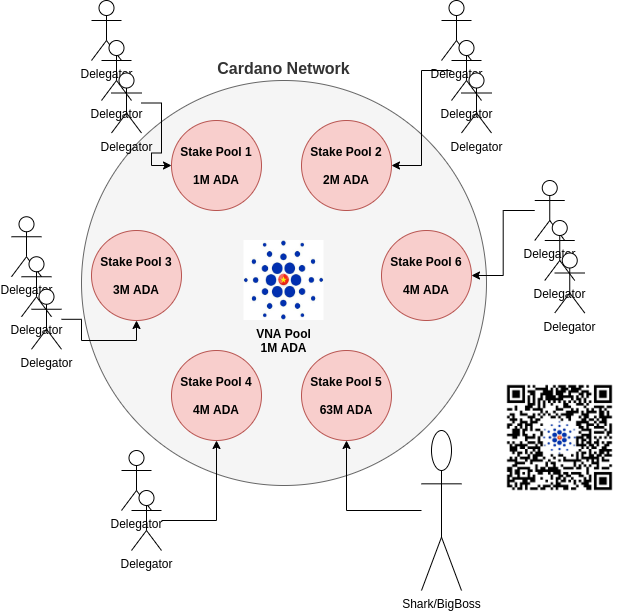
The higher the staked ADA, the higher the chance to produce a block
In order to increase the chance to produce a block, SPO try their best to increase the staked amount or get the delegation from others.
However, there are several parameters to avoid over-centralized or too-big-to-fall SPO.
- Pledge the minimum amount of ADA in which the SPO must keep in Stake Pool
- Saturation the ratio of staked ADA over the Pool Saturation limit 63M (network predefined the saturation)
- Fixed Cost the fixed amount of ADA which SPO always take from the reward (network predefined minimum value is 340 ADA)
- Margin the ratio of ADA SPO take from reward after Fixed cost deduction
For example:
- VNA Stake Pool luckily produce a block in a epoch and get the reward about 1340 ADA
- VNA Stake Pool take 340 ADA fixed cost -> the remain is 1000 ADA
- VNA Stake Pool has no Margin -> the main is 1000 ADA - (1000 ADA * 0%) = 1000 ADA
- Assume that there are 5 delegators (including SPO) with the same staked ADA mount -> each delegator has 1000 / 5 = 200 ADA reward
Notes:
- High pledge pools offer higher reward, however, the different is not much
- High stake pools offer stable reward, low stake pool cannot offer stable reward
- In the long run, 1 year or more, the reward will approach 5% APY
- In the short run, small stake pool with fewer delegator may have higher ROA due to the reward division
- Over-Saturation pools performance are lower than others
SPO reward come from Fixed Cost , Margin and delegation reward.
Delegator reward come from delegation reward only based on the Stake Pool Performance.
- A Slot is 1 second
- A Epoch contain 5 days -> 432000 Slot
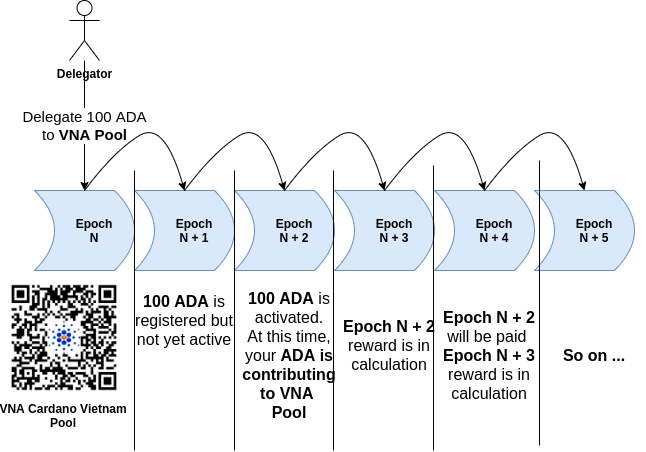
Reward is received after 2 epoch
There is no 100% guarantee about reward, it depend on SPO performance and Luck
- Small Stake Pool (< 1M ADA staked) may not produce block every week.
- Luck play important role in small pool at the initial time -> show very high ROA -> attract more delegators
In order to produce a block, the Stake Pool must be selected to be a Slot Leader.
Slot Leader produces blocks in their 1-second-slot
Each stake pool has:
- Stake pool key ("VRF key")
- Total active Stake amount in ADA
- Slot number in each Epoch (network predefined 432000 slots)
- Unique epoch id - random number announced 1,5 day before the epoch ends
Rolling the dice
- There are 432000 slot ticket per epoch.
- For each 175k ADA active staked -> get one time to roll a dice
- A dice has only one face having "Win a slot", there is about 17% to win per rolling
A summary of block producing statistic:
Blocks per epoch = active stake divided by 1,000,000. Examples:
- 20m active stake: 20m/1m = 20 blocks each epoch
- 1m active stake: 1m/1m = 1 block each epoch
- 1k active stake: 1k/1m = 0,001 block each epoch -> 1 block every 14 years.
- Competitive Margin (0% for now)
- Support to build Cardano community in Vietnam
- Expertise in operating High Availability System
- Informative channel and wiki
