
Any LLM. Any continuously running system.
Brain teaches once. System remembers forever.
SCP is not just for robots. Any system that runs continuously and occasionally needs an LLM to intervene can use SCP. Game NPCs. Robot arms. Web backends. Simulation agents. Animation rigs. If it runs in a loop and pushes state, SCP connects it to any LLM.



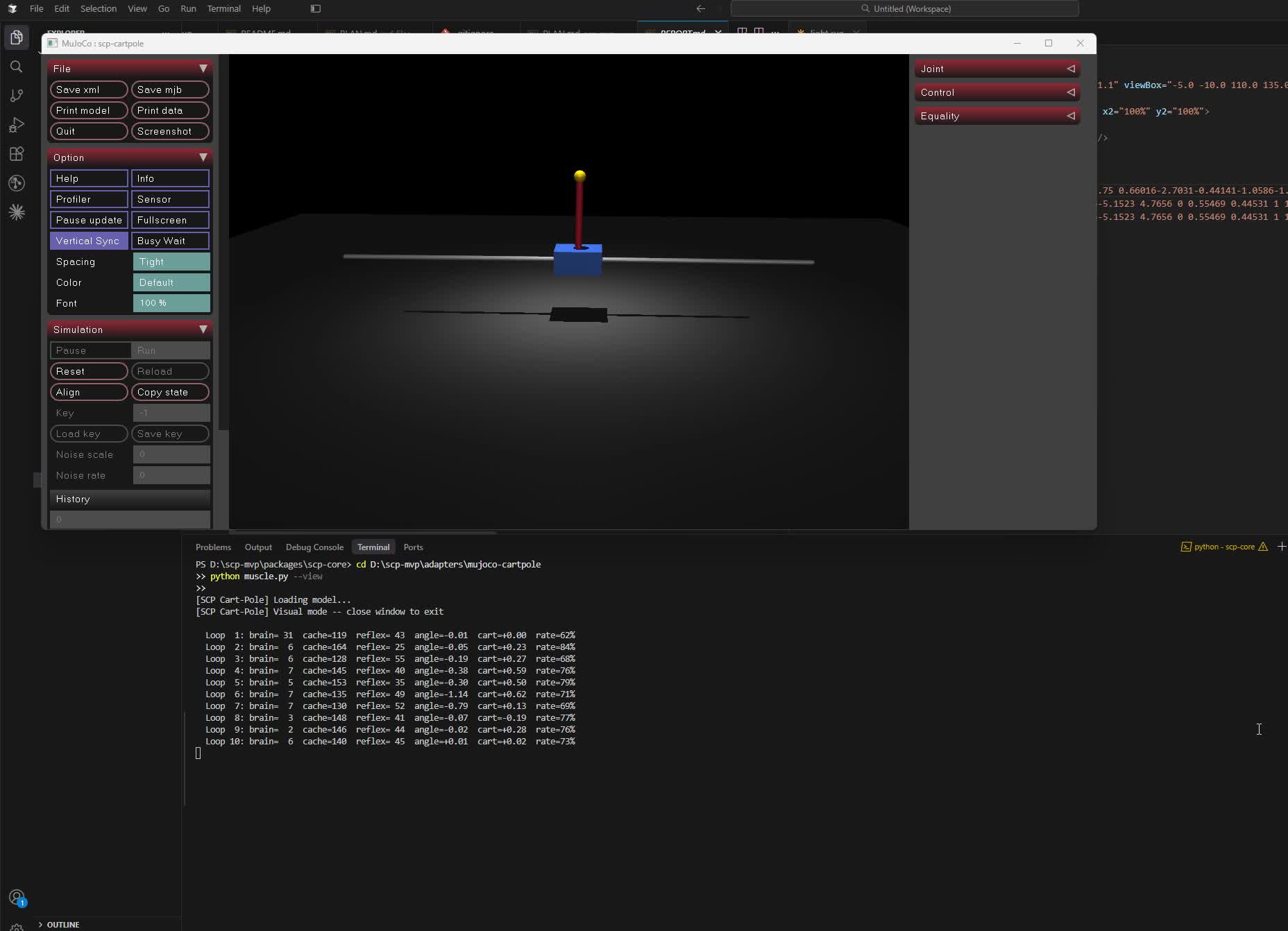
Real MuJoCo physics. The brain is asked on every cache miss; brain decisions are then cached locally so familiar situations no longer wake it. Novel situations always wake the brain. Cost is proportional to novelty.
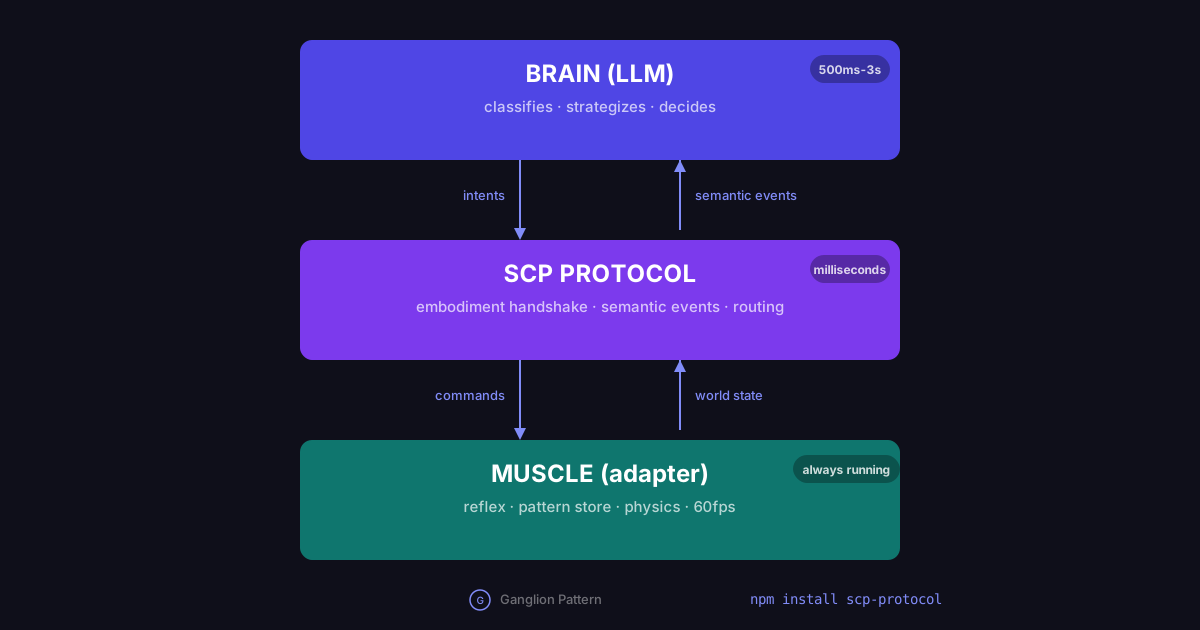
An SCPBody runs a tick loop and owns a four-layer decision stack. Only the top layer calls the LLM; the lower three never leave the process.
1. Reflex            hard rules in the body           0-5 ms
2. PatternStore      exact / very-similar cache       0.1 ms
3. AdaptiveMemory    similarity-scored generalizer    1-5 ms
4. LLM brain         novel situations only            500 ms+
Every LLM decision is written back to layers 2 and 3, so layer 4 gets quieter over time.
npm install scp-protocolNode >= 18. One production dependency: better-sqlite3 (for pattern persistence). LLM bridges and network transports are optional peer deps, installed only when you use them.
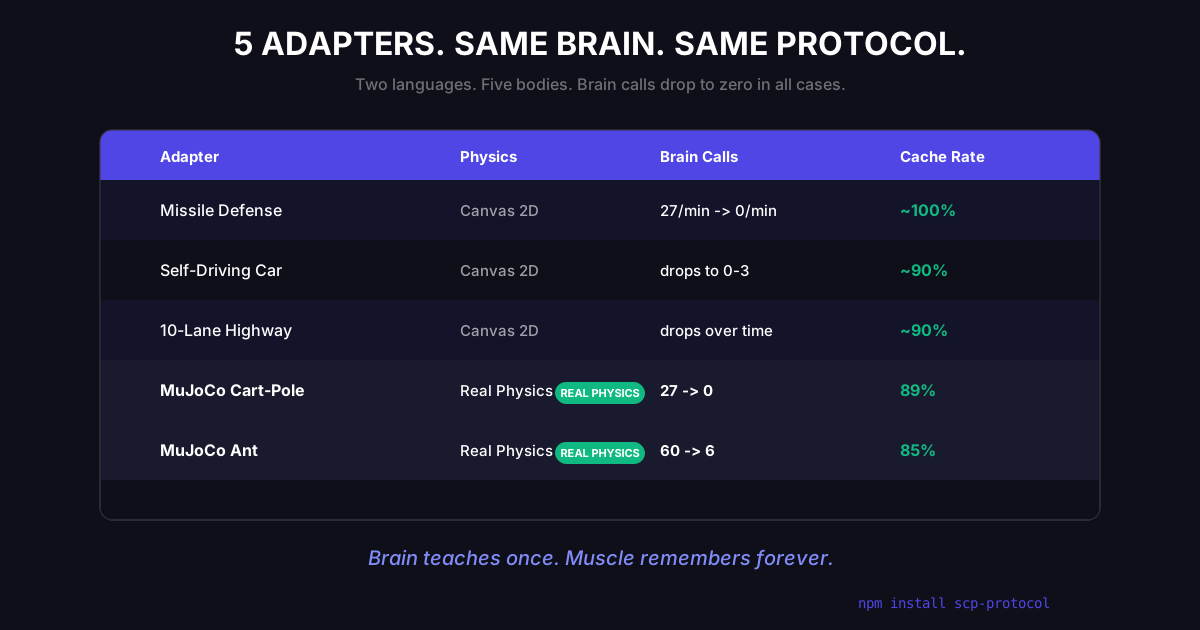
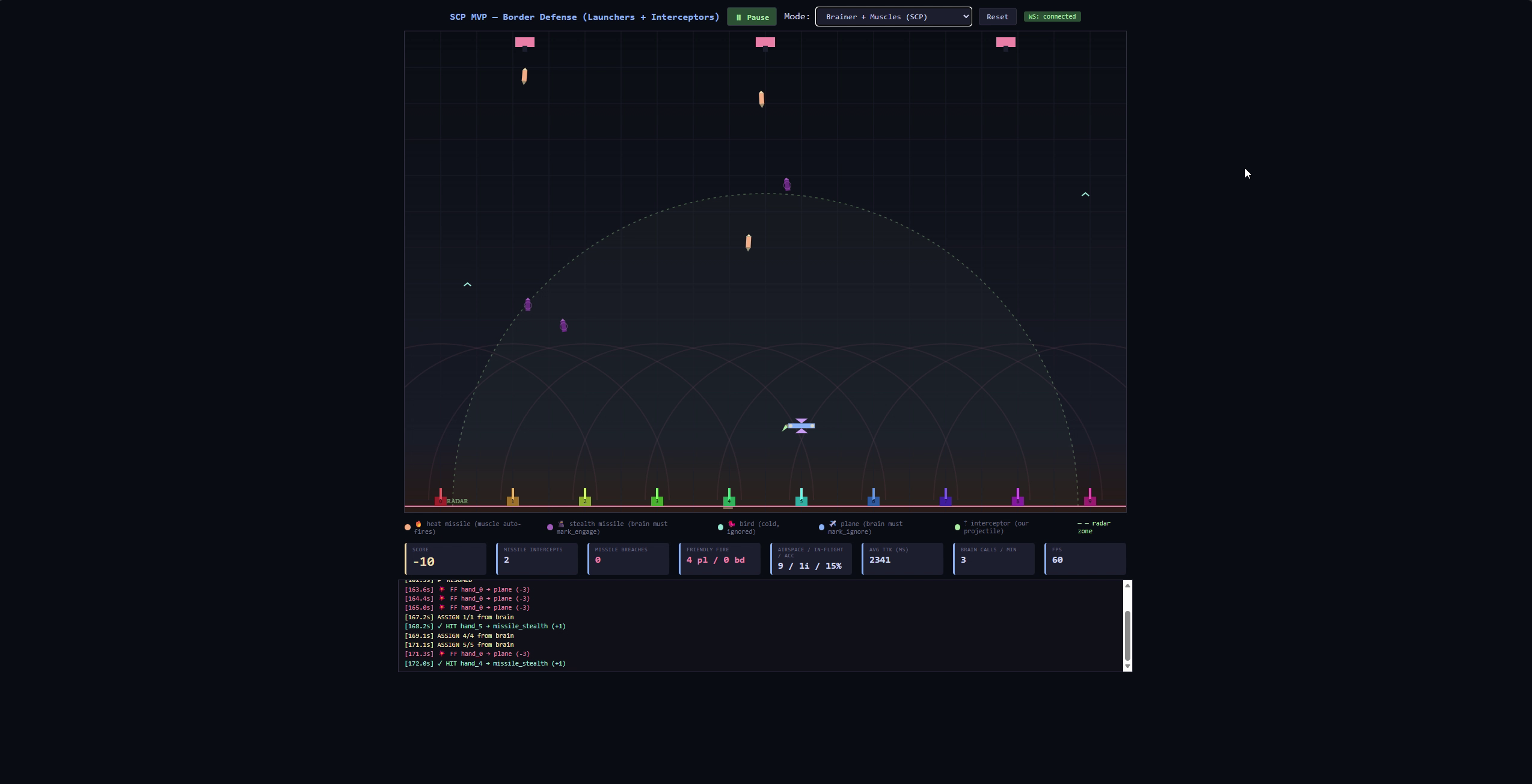
Missile defense -- 10 launchers, brain classifies stealth |
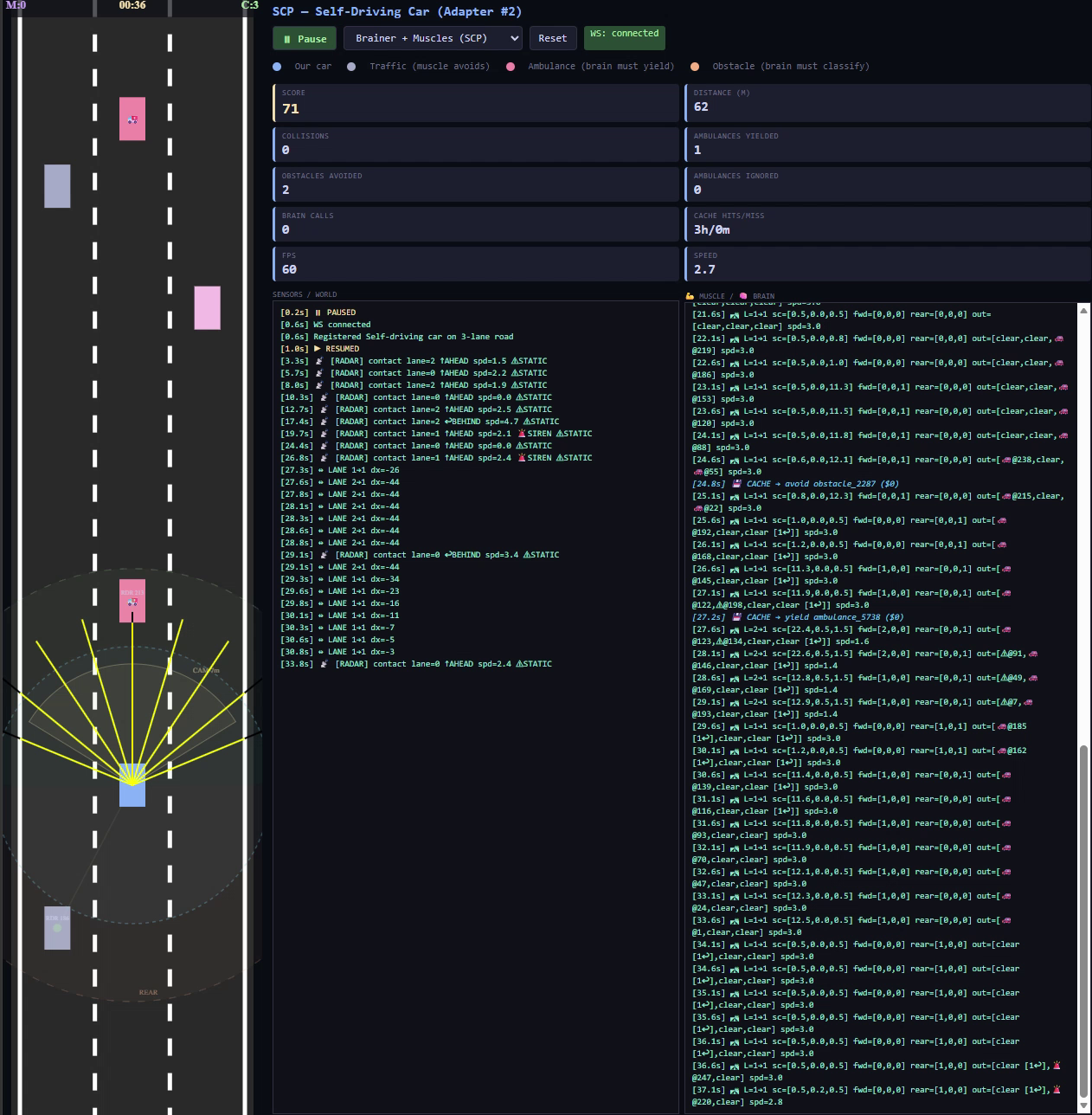
Self-driving car -- ambulance yield, obstacle avoidance |
SCP gives a continuously running system the ability to call an LLM only when it cannot answer locally. The body runs in a loop, holds its own decision cache, and the LLM advises only on novel situations. Brain decisions are then cached locally for next time.
It works for any system that ticks and pushes state, not just robots:
- Game AI. An NPC behavior loop that calls the LLM the first few times it sees a new player tactic, then handles the same tactic locally forever after.
- Robotics. Physical actuators at 60 fps with a slow LLM as the strategic layer.
- Simulation. A policy that learns from LLM decisions without retraining a model.
- Web backends. A server that asks the LLM how to react to a new error pattern, then handles the same pattern from cache on subsequent occurrences. See examples/web-backend.
The body decides when the brain wakes based on confidence thresholds in the pattern store and adaptive memory. When cached decisions are confident enough the brain stays silent. When confidence drops below threshold the brain is called. Default thresholds are conservative. Tune them per use case.
It does not ship an agent framework, a planner, or a safety layer. It is a caching layer around LLM tool calls, with a tick-loop body contract.
npm install scp-protocolOptional peer dependencies, install only if you use them:
npm install ws                                # for WebSocketTransport
npm install @aws-sdk/client-bedrock-runtime   # for BedrockBridge
Ollama and OpenAI bridges use only node:http/node:https and require no extra packages.
const { SCPBody, PatternStore } = require("scp-protocol")
const { OllamaBridge }          = require("scp-protocol/bridges/ollama")

class PatrolBody extends SCPBody {
  static bodyName = "patrol"
  static tools = {
    halt:    { description: "stop motion",  parameters: {} },
    advance: {
      description: "move forward",
      parameters: { speed: { type: "number", min: 0, max: 1, required: true } },
    },
  }

  async halt()              { /* drive hardware */ }
  async advance({ speed })  { /* drive hardware */ }
}

const store = new PatternStore({
  featureExtractor: (entity) => ({ kind: entity.kind, close: entity.distance < 5 }),
  failureThreshold: 3,   // auto-invalidate a cached pattern after 3 consecutive failures
})

const body = new PatrolBody({ patternStore: store, brain: new OllamaBridge({ model: "llama3.2" }) })

// After every action resolves:
store.report(entity, succeeded)   // true or false
That is the full surface the body code touches. Pattern lookup and brain fallback happen inside the body.
A feature-keyed cache for brain decisions.
| Operation | What it does |
|---|---|
lookup |
Exact-hash match, falls back to k-NN similarity over numeric/string/bool fields. Returns { decision, confidence, source } where source is "exact" or "similar". |
learn |
Store a decision against an entity's feature vector. Bumps count on repeat. |
report |
Record outcome for the last served pattern. Tracks consecutive failures. |
save/load |
Persist via localStorage (browser) or SQLite (Node, via better-sqlite3). |
Tunables: similarityThreshold, explorationRate (epsilon-greedy), maxPatterns (LRU-ish eviction by hit count), failureThreshold.
Emits: pattern_invalidated when a pattern crosses the failure threshold.
stats() returns: hits, misses, explorations, corrections, invalidations, totalReports, totalSuccesses, totalFailures, averageSuccessRate, lowConfidencePatterns, hitRate.
A similarity-scored decision store that generalizes from brain decisions when the PatternStore misses. Plain JavaScript; no neural network.
const { AdaptiveMemory } = require("scp-protocol")

const mem = new AdaptiveMemory({
  threshold: 0.8,
  k: 5,
  maxHistory: 500,
  storage: "sqlite",
  storageKey: "scp_adaptive.db",
})

mem.store(features, decision)          // record a decision
const hit = mem.lookup(features)        // returns { decision, confidence } or null
mem.report(features, success)           // reinforce / penalize; auto-purge at N failures
Scoring: weighted euclidean distance in normalized feature space, blended with the fraction of top-k neighbors that agree on the decision. Weights are per-feature and configurable.
Confidence decays on failure and recovers on success. After failureThreshold consecutive failures an entry is purged; an entry_purged event fires.
stats() returns: entries, hits, misses, hitRate, avgConfidence, successReports, failureReports, purged.
A body is a class with a static tools map and one async method per tool.
class Arm extends SCPBody {
  static bodyName = "arm"
  static transport = "inprocess"   // default. Set "http" to run the body in another process.
  static tools = {
    grasp:  { description: "close gripper", parameters: {} },
    move:   {
      description: "move end-effector",
      parameters: {
        x: { type: "number", required: true },
        y: { type: "number", required: true },
      },
    },
  }

  async grasp()        { /* ... */ }
  async move({ x, y }) { /* ... */ }

  async tick() {
    // sensor read loop, called by whoever drives the body
    await super.tick()
    this.setState({ pose: readJointAngles() })
  }

  // Override to auto-report outcomes after every tool call.
  evaluateOutcome(state) {
    return state.pose_error < 0.01
  }
}
invokeTool(name, params) calls the method, records an outcome against the last cached entity, and returns the result.
const body = new Arm({
  patternStore:    new PatternStore({ featureExtractor: (e) => ({ kind: e.kind }) }),
  adaptiveMemory:  new AdaptiveMemory({ threshold: 0.8 }),
})

// In your tick / decide loop:
const local = body.decideLocally(entity)
if (local) {
  // Pattern or adaptive memory had a confident answer.
  execute(local.decision)
} else {
  const fromBrain = await brain.call(entity)
  body.learnFromBrain(entity, fromBrain)   // writes to both cache layers
  execute(fromBrain)
}
decideLocally(entity) returns { decision, confidence, source } where source is "exact", "similar", "adaptive", or null on miss. learnFromBrain(entity, decision) stores in both the PatternStore and AdaptiveMemory.
body.installShutdownHandlers() // saves patternStore + adaptiveMemory on SIGINT / SIGTERM| Mode | Who calls the LLM | Pattern store | Reflex |
|---|---|---|---|
| standalone | the body | local | local |
| managed | an orchestrator (Plexa) | local | local |
In managed mode the body still consults its local cache on every decision it makes. It notifies the orchestrator of local decisions; it does not defer to the orchestrator for them.
| Bridge | Package needed | Models |
|---|---|---|
OllamaBridge |
none (uses node:http) |
any local ollama model |
OpenAIBridge |
none (uses node:https) |
gpt-4o, gpt-4o-mini |
BedrockBridge |
@aws-sdk/client-bedrock-runtime |
Nova Micro, Claude via Bedrock |
All bridges extend SCPBridge, which tracks call count, total time, average latency, and errors.
| Transport | Package needed | Purpose |
|---|---|---|
| (default, none) | — | Body methods are called directly (zero HTTP). |
HTTPTransport |
none | Body exposes /emit, /poll, /health over HTTP. |
WebSocketTransport |
ws |
Full-duplex stream between body and controller. |
A body declares static transport = "http" and a static port to opt into a transport. Otherwise it is in-process.
Drop an SCPBody into a Plexa Space to put one LLM in front of several bodies:
const { Space } = require("@srk0102/plexa")
const { SCPBody } = require("scp-protocol")

class Arm    extends SCPBody { /* ... */ }
class Camera extends SCPBody { /* ... */ }

const space = new Space("pick_and_place")
space.addBody(new Arm())
space.addBody(new Camera())
await space.run()
Each body keeps its own pattern store and decides at muscle speed; Plexa handles brain-tier calls and cross-body coordination.
npm test145 tests across 10 suites. Built-in node:test, no test framework dependency.
| Suite | Tests |
|---|---|
| pattern-store | 23 |
| success-rate | 28 |
| adaptive-memory | 28 |
| adapter | 14 |
| bridge | 10 |
| bridges | 10 |
| transports | 10 |
| managed-mode | 8 |
| integration | 7 |
| persistence | 5 |
persistence.test.js requires better-sqlite3 to be compiled; it skips gracefully otherwise.
persistence.test.js is skipped automatically if better-sqlite3 fails to build on the host.
So you do not have to go looking:
- No multi-body orchestrator. See
@srk0102/plexafor safety gates, approval hooks, cross-session vertical memory, lateral body-to-body events, and LLM brains with cost tracking and retry. - No Python client. SCP bodies written in Python coordinate via
HTTPTransportand expose/discover,/health,/state,/events,/tool. - No CRDT or cross-body shared state.
- Source: https://github.com/srk0102/SCP
- npm: https://npmjs.com/package/scp-protocol
- Orchestrator: https://npmjs.com/package/@srk0102/plexa
MIT