
One brain. Many systems.
Coordinate any number of continuously running systems under one LLM brain.
Built on scp-protocol.




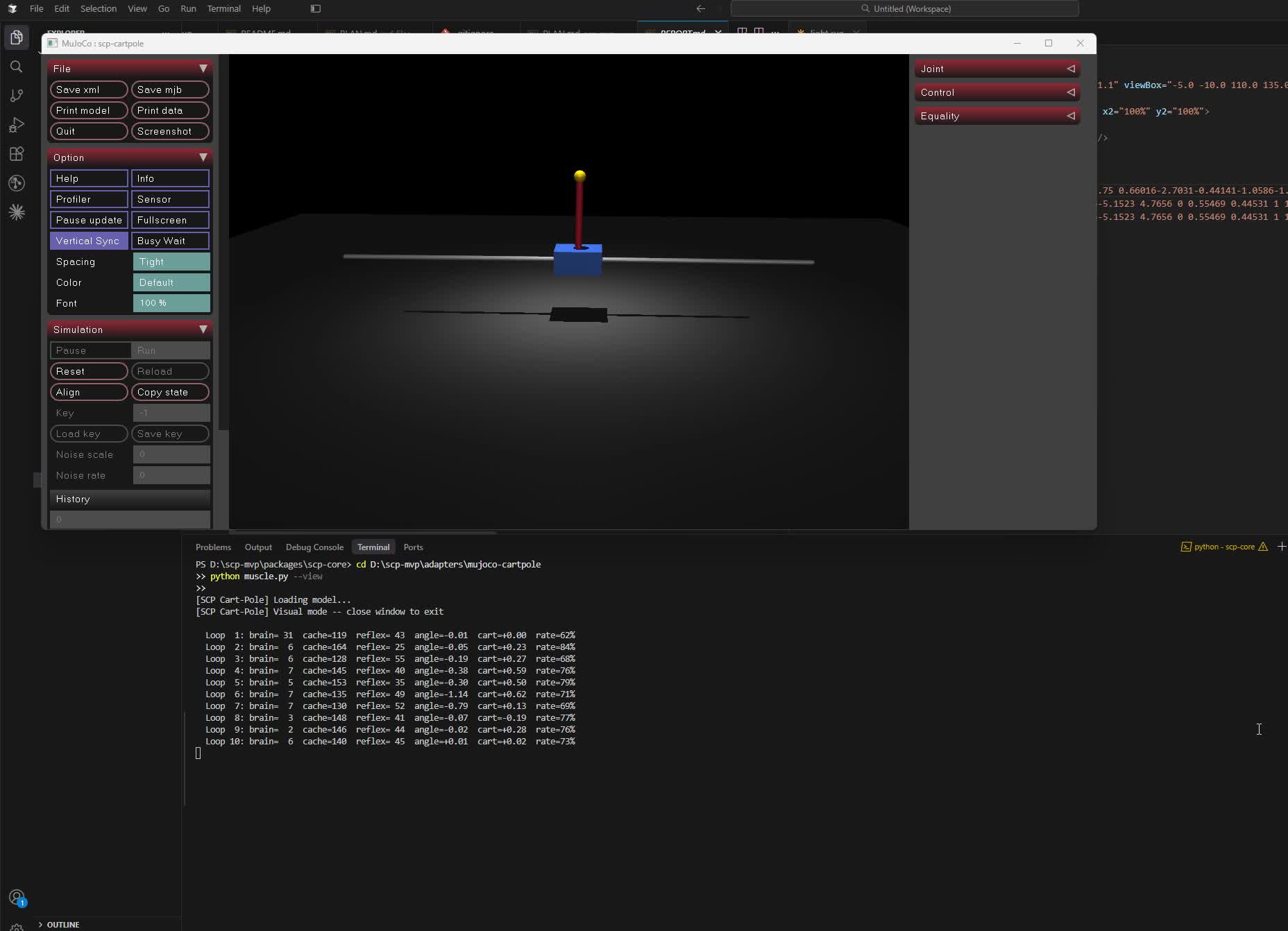
Plexa ticks the body at 60Hz, the body consults its local pattern cache first, and the LLM brain is called only when the cache misses. Brain decisions are then cached locally so familiar situations no longer wake the brain. Novel situations always wake the brain. Cost is proportional to novelty.
Plexa runs a single-process tick loop, aggregates every body's state into a brain prompt, dispatches the brain's tool intent as a direct async method call on the body, and owns the cross-session memory that makes the LLM quieter every run.
Sensor
  -> Reflex        (in-body, 0 ms)
    -> PatternStore      (scp-protocol, layer 2)
      -> AdaptiveMemory  (scp-protocol, layer 3)
        -> VerticalMemory  (plexa, cross-session)
          -> LLM brain     (Ollama / Bedrock / Anthropic)
              |
              Safety Rules -> Approval Hook -> body.invokeTool
              Body A  <--(lateral events, zero-latency)-->  Body B
Plexa is built on scp-protocol. Use scp-protocol directly when you have one body. Use Plexa when you have several bodies and want one LLM to coordinate them.
npm install @srk0102/plexaNode >= 18. One production dependency: scp-protocol. Plexa's own core has no other runtime packages; everything else is node:* built-ins.
- Runs a 60Hz reactor loop that ticks every registered body each frame.
- Aggregates each body's state and events into a prompt that fits a configurable token budget (default 2000), trimming by event priority.
- Consults
VerticalMemorybefore calling the brain so repeat situations skip the LLM entirely. - Calls a brain (Ollama / Bedrock / Anthropic / your subclass) at most every
brainIntervalMs. Brain base class handles retries on 5xx / 429 / network errors with exponential backoff and tracks per-call cost. - Runs a hard safety gate (sync rules, cannot be bypassed) and an optional human-in-the-loop approval hook before dispatch.
- Validates the brain's tool intent against the body's declared schema, then dispatches as a direct async method call on the body.
- Auto-wraps a
static transport = "http"body in aNetworkBodyAdapterthat polls/state+/eventsand POSTs tool calls to/tool. Ifstatic toolsis empty Plexa calls/discoverand registers them. - Routes lateral body-to-body events directly (no brain, no broadcast) via
space.link(from, to, [types]). - Sanitizes sensor payloads for prompt-injection patterns before they reach the LLM.
- Saves
VerticalMemoryand every body's pattern store onstop()and onSIGINT/SIGTERMwheninstallShutdownHandlers()is called. - Exposes an HTTP introspection server on port 4747 for the
plexaCLI (status, bodies, logs).
It is a sequencer with gated dispatch and cross-session memory, not a planner. The brain chooses the tool; Plexa validates, gates, and dispatches it.
npm install @srk0102/plexaconst { Space, BodyAdapter, VerticalMemory } = require("@srk0102/plexa")
const { OllamaBrain } = require("@srk0102/plexa/bridges/ollama")
class Cart extends BodyAdapter {
static bodyName = "cart"
static tools = {
apply_force: {
description: "push to balance",
parameters: {
direction: { type: "string", enum: ["left", "right"], required: true },
magnitude: { type: "number", min: 0, max: 1, required: true },
},
},
}
async apply_force({ direction, magnitude }) { /* drive hardware */ }
async tick() { await super.tick(); this.setState({ pole_angle: readAngle() }) }
}
const space = new Space("balancer", {
verticalMemory: new VerticalMemory({ spaceName: "balancer", dbPath: "./plexa.db" }),
})
space.addBody(new Cart())
space.setBrain(new OllamaBrain({ model: "llama3.2" }))
space.addSafetyRule((cmd) =>
cmd.tool === "apply_force" && cmd.parameters.magnitude > 0.9
? { allowed: false, reason: "magnitude too high" }
: { allowed: true }
)
space.installShutdownHandlers()
await space.run()That is a real, reviewable, persistable robot control loop. 60Hz body tick, local pattern-store muscle, cross-session memory, safety gate, an LLM brain that retries on 429 and tracks cost.
npm install @srk0102/plexaThis pulls in scp-protocol as its sole dependency. No AWS, no API keys, no external services required to run the examples.
To use a real LLM, install and run Ollama:
ollama pull llama3.2If Ollama is not running, the bundled examples fall back to a stub brain so npm run hello still works end-to-end.
const { Space, BodyAdapter, Brain } = require("@srk0102/plexa")
const { OllamaBrain } = require("@srk0102/plexa/bridges/ollama")

class CartpoleBody extends BodyAdapter {
  static bodyName = "cartpole"
  static tools = {
    apply_force: {
      description: "push the cart to balance the pole",
      parameters: {
        direction: { type: "string", enum: ["left", "right"], required: true },
        magnitude: { type: "number", min: 0, max: 1, required: true },
      },
    },
    hold: { description: "apply no force this frame", parameters: {} },
  }

  async apply_force({ direction, magnitude }) { /* physics */ }
  async hold()                                { /* no-op */ }

  async tick() {
    await super.tick()
    // sensor read; populate body state visible to the brain prompt
    this.setState({ pole_angle: readAngle() })
  }
}

const space = new Space("balancer", { tickHz: 60, brainIntervalMs: 1500 })
space.addBody(new CartpoleBody())
space.setBrain(new OllamaBrain({ model: "llama3.2" }))
space.setGoal("balance the pole upright")
await space.run()
Tools are methods. Bodies default to in-process; there is no port and no HTTP call between Plexa and a body in the same process. To run a body in another process, mark it static transport = "http" and give it a port.
git clone https://github.com/srk0102/plexa.git
cd plexa
npm install

node examples/hello-world/index.js     # one body, one tool loop
node examples/two-bodies/index.js      # cartpole + light, one brain
node examples/inprocess-demo/index.js  # cartpole physics, full stats
Each example prints brain calls, tools dispatched, and final stats. All three run without Ollama by falling back to the stub brain.
                 brainIntervalMs
                       |
   body.tick() --> aggregator --> brain --> translator --> body.invokeTool()
   body.tick()        (state +        |         (schema        (direct
   body.tick()         events)        |          check)         async call)
       ^                              |
       +------------------------------+
                 tickHz loop
Single thread. setTimeout-based tick. No locks. The brain call is async and non-blocking; body ticks continue while the brain is in flight. If the brain is still running when the next brain window opens, it is skipped.
When a body is added to a Space it is in managed mode. Managed does not mean the body is dumb.
| Mode | Who calls the LLM | Body's pattern store | Body's reflexes |
|---|---|---|---|
| standalone | the body | used | fire |
| managed | Plexa | still used | still fire |
In managed mode the body continues to resolve decisions locally via its own scp-protocol pattern store and fires a body_decision event to Plexa for each one. Plexa observes; it does not override.
VerticalMemory lives at the Space level and remembers what the brain decided for a given world state. On the next brain tick Plexa searches memory first; a confident match skips the LLM entirely.
const mem = new VerticalMemory({ spaceName: "robot", dbPath: "./plexa.db", hitThreshold: 0.85 })
const space = new Space("robot", { verticalMemory: mem })
Storage: SQLite when dbPath is given (requires better-sqlite3), otherwise in-memory only. Similarity is Jaccard across bodies + tools + events + goal. Stats in space.getStats().verticalMemory and space.stats.memoryHits / memoryMisses / memoryHitRate.
Bodies communicate directly, without the brain, without broadcast:
class LeftArm extends BodyAdapter {
  async onPeerEvent(from, type, payload) {
    if (type === "grip_slip") await this.compensate(payload.force)
  }
}

space.link("right_arm", "left_arm", ["grip_slip", "balance_shift"])
await rightArm.sendToPeer("left_arm", "grip_slip", { force: 3 })
Direct async method call in-process. Zero latency. Plexa not in the routing path. Self-links are silently ignored.
space.addSafetyRule((cmd) =>
  cmd.tool === "fire" ? { allowed: false, reason: "never fire" } : { allowed: true }
)

space.addApprovalHook(async (cmd) => {
  if (cmd.tool === "move" && cmd.parameters.speed > 0.8) {
    return { ...cmd, parameters: { speed: 0.5 } }  // modify
  }
  return true  // or false to reject
})
Safety rules run first, cannot be bypassed, and the first blocker wins. The approval hook runs after safety and may approve, reject, or return a modified command.
space.setConfidenceThresholds({
  autoApprove: 0.9,   // act silently
  monitor:     0.6,   // act and emit "confidence_warning"
  escalate:    0.0,   // emit "confidence_escalation"
})
Decisions reported by bodies via decideLocally carry a confidence score. Plexa classifies each one and exposes per-body averages in stats.avgConfidenceByBody.
Brain base class tracks per-call input + output tokens and accumulated USD cost using a built-in table (Nova Micro, Claude Haiku, GPT-4o Mini, and local models at $0). Access via brain.stats() or space.getStats().estimatedCostUSD and costSavedByCacheUSD.
Retry defaults: maxRetries: 2, retryDelayMs: 1000 with exponential backoff on 429. Network errors and 5xx retry; 4xx (except 429) do not.
The aggregator strips role prefixes (system:/user:/assistant:/human:), chat template tokens (<|...|>), Anthropic \n\nHuman: markers, and known jailbreak directive phrases from body-supplied strings before they reach the brain. Tool definitions are preserved unchanged. Hits increment stats.injectionHits and a security_event fires.
Opt out per space: new Space(name, { sanitizeInjection: false }).
Declare transport on the body class and Plexa auto-wraps it:
class MuJoCoCart extends BodyAdapter {
  static bodyName = "cart"
  static transport = "http"
  static tools = { /* or leave empty to discover at runtime */ }
}
space.addBody(new MuJoCoCart({ port: 8002 }))
await space.ready()   // waits for /discover if tools were empty
Remote body contract:
GET /discoverreturns{ tools: { ... } }GET /healthreturns{ ok: true }GET /statereturns{ data: { ... } }GET /eventsdrains a queue of{ events: [{ type, payload, priority }] }POST /toolreceives{ name, parameters }and returns the tool result
A brain response must be valid JSON matching:
{
  "target_body": "cartpole",
  "tool": "apply_force",
  "parameters": { "direction": "left", "magnitude": 0.4 },
  "priority": 3,
  "fallback": "hold"
}
The translator rejects intents for seven reasons: unknown body, unknown tool, missing required parameter, wrong type, value out of range, value not in enum, or malformed response. Each rejection is counted in space.getStats().translator.byReason.
Bodies emit events with one of four priorities: CRITICAL, HIGH, NORMAL, LOW. The aggregator walks a seven-step reduction cascade when the prompt approaches the token budget: float compaction, string truncation, drop stale body fields, drop LOW events, drop NORMAL events, drop HIGH events, and finally drop bodies. CRITICAL events are preserved at every step.
Installed globally or via npx:
npx @srk0102/plexa version     # version string
npx @srk0102/plexa status      # running space, tick, brain stats
npx @srk0102/plexa bodies      # connected bodies and tool lists
npx @srk0102/plexa logs        # live tail of body events and tool calls
npx @srk0102/plexa start ./space.js
The CLI reads from an HTTP server on port 4747. To expose it from your app:
const { Space, attachIntrospection } = require("@srk0102/plexa")
const space = new Space("robot")
attachIntrospection(space)   // localhost:4747/plexa/{status,bodies,logs,health}
await space.run()
No dependencies beyond node:http. No bearer-token auth yet: treat the port as localhost-only.
npm test181 tests across 40 suites. Built-in node:test, no test framework dependency.
| File | Tests |
|---|---|
| plexa.test.js | 82 |
| managed-mode.test.js | 10 |
| bridges.test.js | 8 |
| safety-approval.test.js | 15 |
| injection.test.js | 10 |
| network-body.test.js | 9 |
| confidence-lateral.test.js | 13 |
| vertical-memory.test.js | 11 |
| cost-retry.test.js | 13 |
| integration.test.js | 10 |
integration.test.js exercises scp-protocol and plexa together end-to-end: in-process full lifecycle, pattern-store + space, adaptive-memory reducing LLM calls, safety block, approval modify, lateral event with no broadcast, confidence escalation, cost tracking, vertical memory cross-session, network body via mock HTTP server.
What works:
- Four-layer decision stack end-to-end (reflex / pattern / adaptive / brain).
- In-process bodies. All three bundled examples run end to end.
- Network bodies with auto-wrap,
/discover, polling, and POST tool dispatch. - Safety gate, approval hook, prompt-injection sanitizer, confidence gating.
- Vertical memory with SQLite persistence and cross-session reuse.
- Lateral body-to-body events, zero-latency in-process.
- Cost tracking + retry + exponential backoff in Brain base class.
- Ollama, Bedrock, Anthropic brains. Claude Haiku default for Anthropic.
- Graceful shutdown:
space.installShutdownHandlers()saves everything.
What exists but has a caveat:
- Introspection server is unauthenticated. Bind to localhost only.
better-sqlite3must compile on the host. Without it,VerticalMemoryandAdaptiveMemorysilently fall back to in-memory only.
What is not implemented:
- CRDT or shared state between bodies.
- Process isolation per body. Bodies share the Node process.
- Python SDK. Python bodies still use raw HTTP against the network body contract.
- Godot / Unity plugins.
- Source: https://github.com/srk0102/plexa
- npm: https://npmjs.com/package/@srk0102/plexa
- SCP protocol: https://npmjs.com/package/scp-protocol
MIT