Lightweight fully generated next gen Vulkan bindings for Rust — focused on zero overhead and natural Rust ergonomics.


- Generated from
vk.xml&video.xml— complete Vulkan 1.0 through 1.4 coverage - Full Vulkan Video support
- Commands dispatch from the handle they belong to
- Extensions are just methods — enable them in
CreateInfo, call them directly - Zero-cost handles — a vtable pointer and nothing else
-
Result-returning commands - No hidden runtime cost


Device, PhysicalDevice, Instance, Queue, CommandBuffer — every handle knows its commands directly. There is nothing to construct beyond the handle itself:
// physical device queries
let caps = physical_device.get_surface_capabilities(surface)?;
let formats = physical_device.get_surface_formats(surface)?;
let props = physical_device.get_properties();

// device commands
let swapchain = device.create_swapchain(&create_info, None)?;
let images = device.get_swapchain_images(swapchain)?;

// queue
queue.submit(&[submit_info], fence)?;

// command buffer
command_buffer.bind_pipeline(PipelineBindPoint::Graphics, pipeline);
command_buffer.bind_vertex_buffers(0, &[vertex_buffer], &[0]);
command_buffer.draw_indexed(index_count, 1, 0, 0, 0);Enable an extension in CreateInfo and its functions are immediately available on the handle. No separate objects, no extra allocation:
let extensions = [surface::NAME.as_ptr(), wayland_surface::NAME.as_ptr()];

let create_info = vk::InstanceCreateInfo {
    enabled_extension_names: extensions.as_ptr(),
    enabled_extension_count: extensions.len() as u32,
    ..Default::default()
};
let instance = vk::Instance::create(&create_info, None)?;

// surface and debug functions are already on instance
let surface = instance.create_wayland_surface(&surface_info, None)?;
instance.destroy_surface(surface, None);
Same for device extensions — khr::swapchain, khr::acceleration_structure, anything:
let device = physical_device.create_device(&create_info, None, &instance)?;

// no SwapchainDevice::new(), just call it
let swapchain = device.create_swapchain(&swapchain_info, None)?;
device.destroy_swapchain(swapchain, None);Every handle is a raw Vulkan handle plus a single pointer to its vtable — nothing else. No Arc, no reference counting, no allocation. Calling a method is one pointer dereference, identical to calling the function pointer directly.
let images = device.get_swapchain_images(swapchain)?;  // Vec<Image>
let devices = instance.enumerate_physical_devices()?;  // Vec<PhysicalDevice>

// count/pointer pairs become slices
command_buffer.bind_descriptor_sets(
    PipelineBindPoint::Graphics,
    layout,
    0,
    &descriptor_sets,
    &[],
);Complete generated bindings for video:
use pyronyx::vk::video::*;

let profile = VideoProfileInfoKHR {
    video_codec_operation: VideoCodecOperationFlagsKHR::DecodeH264,
    ..Default::default()
};Use base.next(ext) to insert ext into the start of the pointer chain attached to base.
let mut features11 = vk::PhysicalDeviceVulkan11Features {
    shader_draw_parameters: vk::TRUE,
    ..Default::default()
};

let create_info = vk::DeviceCreateInfo {
    enabled_extension_names: extensions.as_ptr().cast(),
    enabled_extension_count: extensions.len() as u32,
    // ...
    ..Default::default()
}.next(&mut features11);Ash has been effectively unmaintained a good time now. Beyond that, its model requires a separate loader struct per extension — khr::Swapchain::new(&instance, &device), ext::DebugUtils::new(&entry, &instance) — which you then carry alongside your device for the lifetime of your program. Command buffer commands live on Device rather than CommandBuffer because that is where the loader is.
Device is just the huge struct that you need everywhere
Pyronyx does not have that distinction. Enable an extension, call its functions on the handle, done.
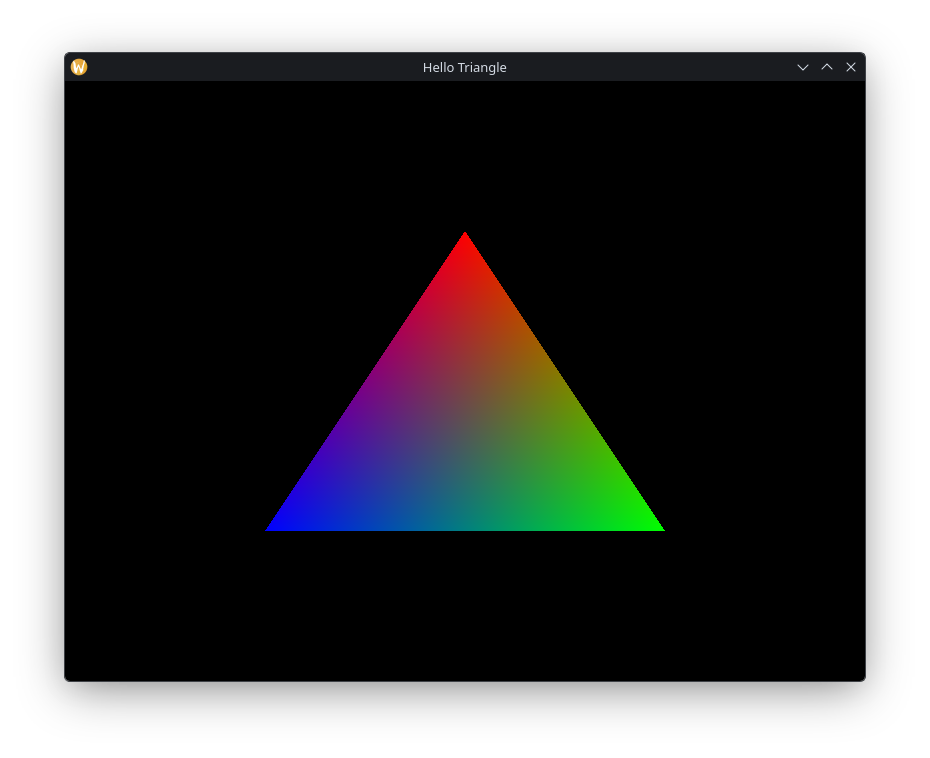
Hello Triangle: pyronyx Triangle
MIT