FMessageBody
The local message context: an FGMPExtra plus the helpers a listener-side implementation needs.
Declared in Plugins/GMP/Source/GMP/GMP/GMPStruct.h:500
struct GMP_API FMessageBody : public FGMPExtra
{
    template<typename... Ts>
    static const FArrayTypeNames& MakeStaticNamesImpl()
    {
        static FArrayTypeNames Ret{GMP_TYPE_META(Ts)::GetFName()...};
        return Ret;
    }

    template<typename Tup, size_t... Is>
    static const FArrayTypeNames& MakeStaticNames(Tup*, const std::index_sequence<Is...>&);

    FORCEINLINE auto GetSigSource() const { return Source.TryGetUObject(); }
};
The static type-name table. MakeStaticNamesImpl<Ts...>() builds one FArrayTypeNames per parameter
pack — a function-local static, so it is constructed once and shared by every dispatch of that signature.
This is what FGMPExtra::TypeNames points at, and why carrying type names costs a pointer rather than an
allocation per send.
GetSigSource() narrows the tagged FSigSource back to a UObject*, returning null when the source
is not one. Use this rather than casting the source yourself.
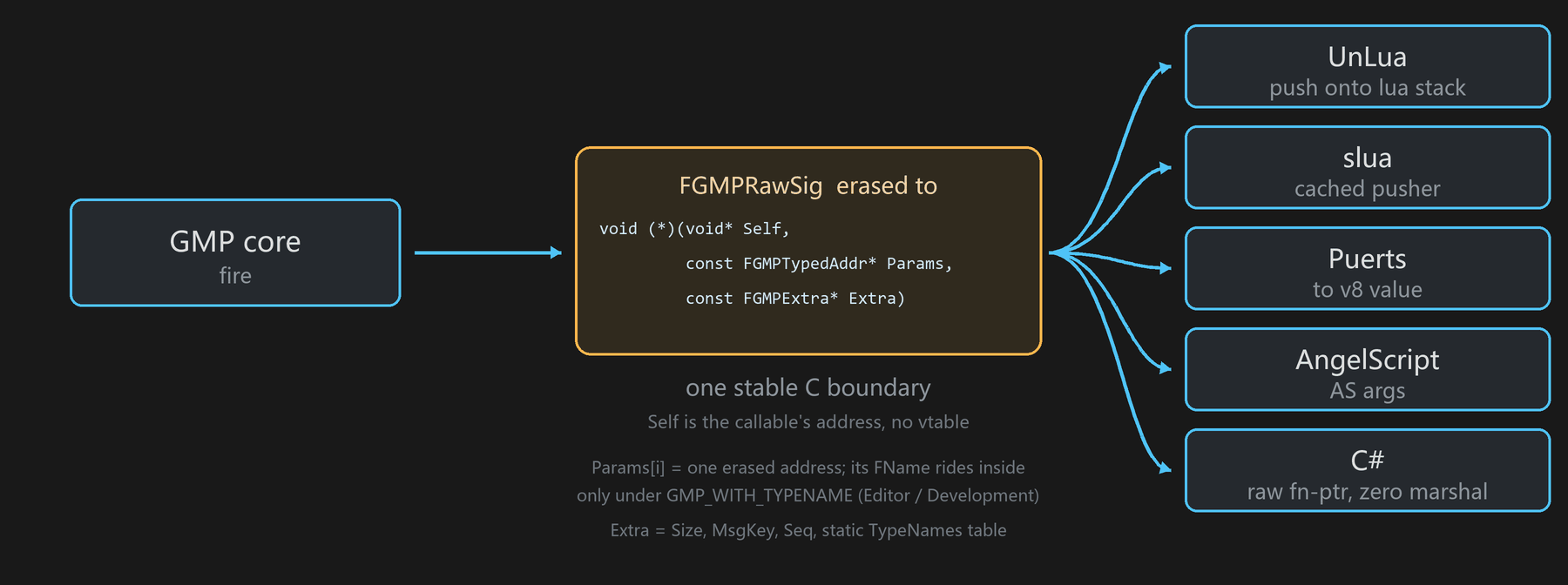
It is the body a listener-side adapter receives. Backends and bridges use it; C++ listeners do not, because the thunk has already decoded the arguments into typed parameters by the time your lambda runs.