Key baking
How a string written at a call site stops being a string before the program runs.
"Common.Action" -> FName -> TMap hash lookup -> signal store -> dispatch
Messages are a high-frequency path — hundreds or thousands per frame is ordinary — and the string is already known when the compiler sees it.
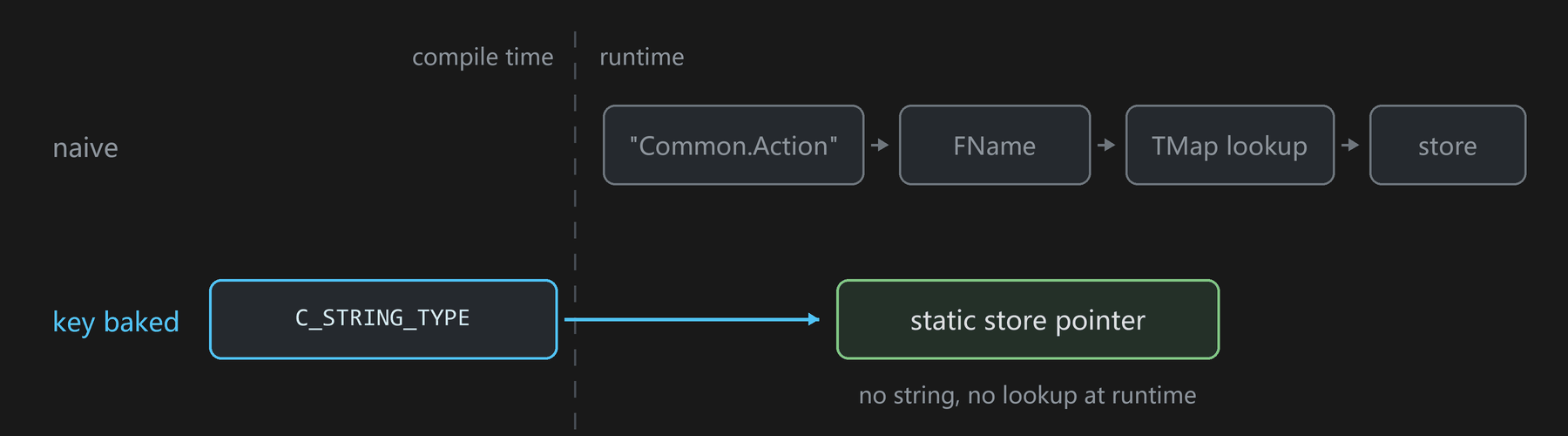
C_STRING_TYPE("Common.Action")   // characters become a compile-time type
GetKeySlot<KeyT>().GetStore()    // the one static store for that type, in this process
Because the key is a type, the store can be a static bound to that type. No hashing, no name.
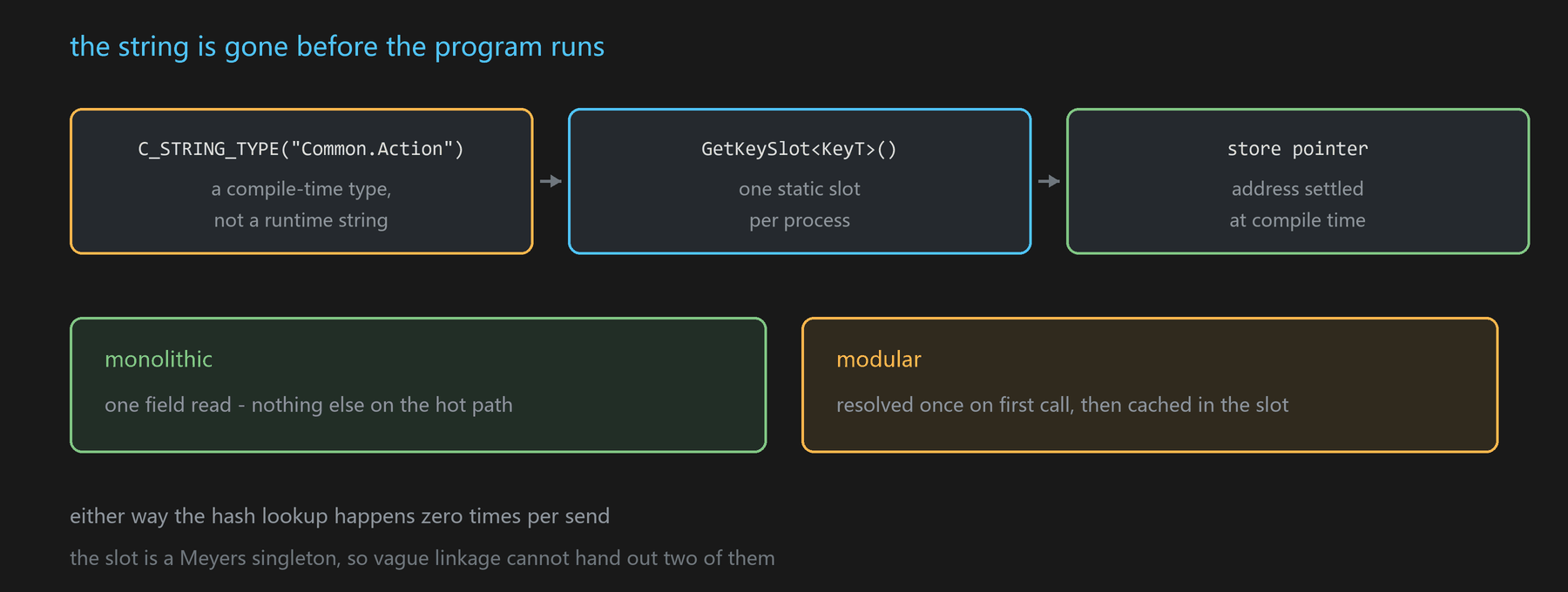
| Build | What GetStore() compiles to |
|---|---|
| monolithic | a direct field read |
| modular | resolved once on the first call, then cached in the slot |
Either way the hash lookup happens zero times per send.
A function-local static with vague linkage: every translation unit that instantiates the template refers to the same object, and the initialisation is thread-safe. Without that guarantee two modules could each get their own store for the same key, and listeners registered through one would be invisible to sends through the other.
Nothing, if you use MSGKEY(...) with a literal. The typed direct path is on by default
(GMP_WITH_DIRECT_SIGNAL). What is not on by default is inlining the dispatch loop itself — see
Build switches.
Using a runtime-assembled string instead of a literal opts you out silently: it cannot become a type, so it takes the lookup path.
See Build switches for the frame-count table and the reproduction commands.