Transparent rewrite
How a generic call written in script becomes a typed, key-baked call without the script being edited.
NotifyObjectMessage(self, "Player.Hurt", dmg, causer)A generated per-tag function with the key already baked and typed argument decoding.

The hook point is wherever that toolchain can be reached before execution:
| Backend | Stage | Mechanism |
|---|---|---|
| UnLua | load time, on the text | FUnLuaDelegates::CustomLoadLuaFile |
| slua | load time, on the text | setLoadFileDelegate |
| AngelScript | before compilation | preprocessor hook (OnPostProcessCode) |
| Puerts | during compilation | AST transform inside tsc
|
| C# | not rewritten | statically typed already; generic MsgTag<T...> pins types at compile time |
The two lua backends share one rewriter — same lexing problem, so the same implementation handles both.
The generic entry point has to look the tag up by name and unpack arguments dynamically, because it cannot know which tag it is. A generated function knows, so both costs disappear. Rewriting is what lets the script author keep the readable generic form while the binary gets the specific one.
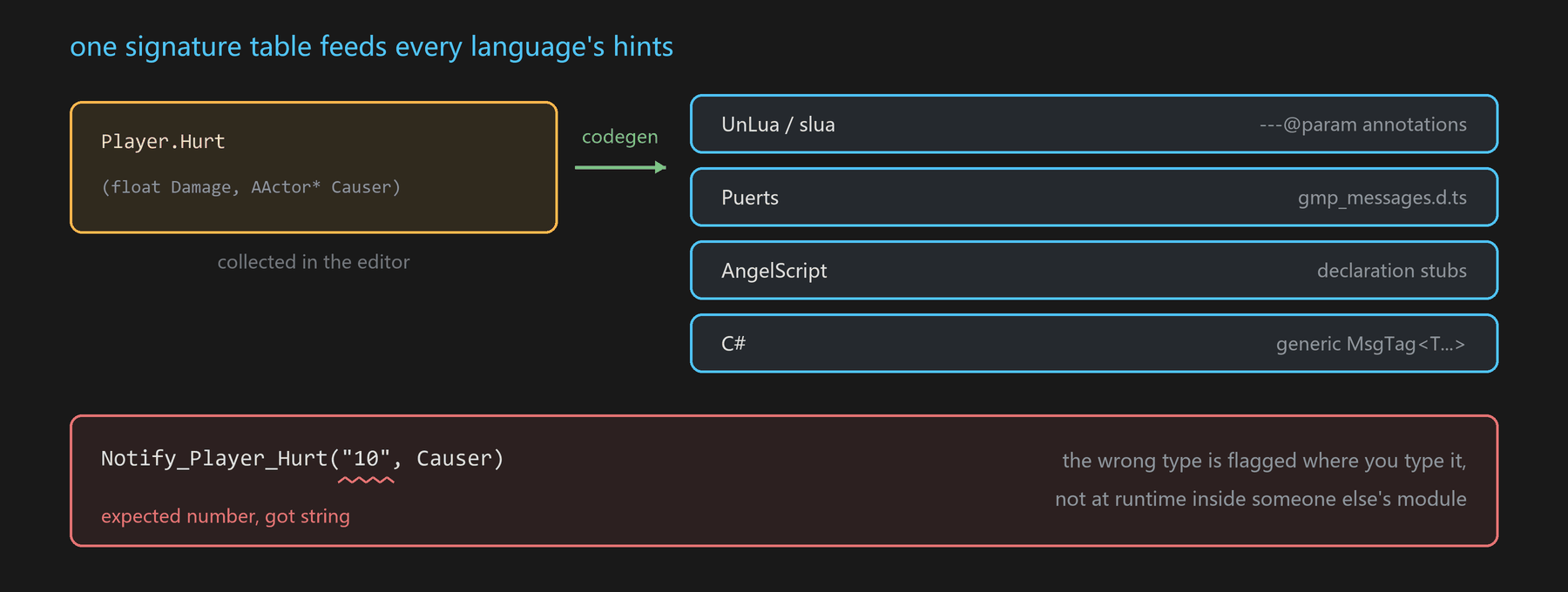
| Backend | Emitted |
|---|---|
| UnLua / slua | EmmyLua ---@param annotations |
| Puerts | gmp_messages.d.ts |
| AngelScript | declaration stubs |
| C# | generic MsgTag<T...>
|
- The rewriter matches call syntax. A call assembled dynamically — the function fetched into a variable first, or the tag built by concatenation — is not rewritten. It still works, on the generic path.
- Static binding per backend is behind its own switch (
GMP_SLUA_STATIC_BIND,GMP_UNLUA_STATIC_BIND,GMP_PUERTS_STATIC_BIND,GMP_CSHARP_STATIC_BIND), all default0.
Key baking · Signature inference · Build switches · FGMPRawSig