EWCv3.3 Non‐ESPEC F4T Setup Guide
[TOC]
This document outlines the steps to configure ESPEC Web Controller (EWC) to connect to a non-ESPEC chamber with F4T for control and instrumentation. TCP/IP is the default communication interface between EWC and the F4T. A USB-to-Serial interface is available as an option if a communication module is installed in the F4T. EWC is shipped already configured to use TCP/IP for communication with the F4T.
EWC is an embedded computer with two dedicated Ethernet ports, labeled as ETH-0 and ETH-1, each with specific assigned function (see diagram in the following section). ETH-0 is for joining EWC to the main network; ETH-1 is for internal network communication between EWC and F4T. A PC will be used to access EWC via a Web browser to control and operate the chamber.
EWC was shipped barebone (see diagram below) to be installed in the chamber electrical box (Ebox).

Proceed to install EWC in the Ebox and leave the barrel jack (power cable) unplugged.
Complete the following steps to set up a static network protocol on the F4T.
-
Set the main power breaker in the ON position. NOTE: This only supplies power to the chamber and F4T. The barrel jack is still unplugged on the EWC.
-
Press the Menu button on F4T to access its Main Menu.
-
From the Main Menu, press Settings
-
Press Network
-
Press Ethernet to access IP Address Block, as depicted in the following figure.
-
Press DHCP in the IP Address Mode (depicted the above figure).
-
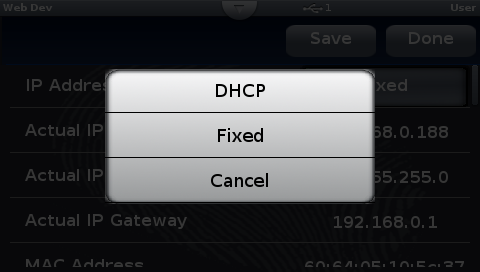
On the pop-up window, as depicted in the following figure, press Fixed to set the IP Address Mode from DHCP to Fixed.
-
Swipe the screen upward to get to the IP Fixed Address block and enter the following numbers in Part 1-4, as depicted in the following figure.
- Part 1: 10
- Part 2: 30
- Part 3: 200
- Part 4: 242
-
Swipe the screen upward to get to the IP Fixed Subnet block and enter the following numbers in Part 1-4, as depicted in the following figure.
- Part 1: 255
- Part 2: 255
- Part 3: 255
- Part 4: 240
-
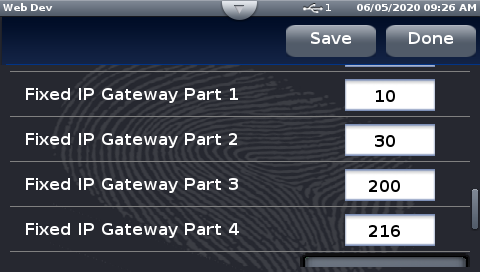
Swipe the screen upward to get to the IP Fixed Gateway block and enter the following numbers in Part 1-4, as depicted in the following figure.
- Part 1: 10
- Part 2: 30
- Part 3: 200
- Part 4: 216
-
Swipe the screen upward to the Modbus configuration section and set parameters as shown in the following figure.
-
Press Save to save the settings.
-
Press Done to exit the network configuration and return to the Main Menu.
-
Reboot the F4T to ensure the new settings are applied. This power cycling allows the F4T to broadcast its new IP address to be picked up by EWC V3.
-
Proceed to Section 1.2 to complete the network connection between EWC and F4T.




Complete the following steps to establish an internal network between EWC and F4T.
-
Set the main power breaker in the OFF position before servicing.
-
Plug the barrel jack (power cable) into the EWC power port (see diagram below).
-
Plug the Ethernet cable into the F4T TCP/IP port. Plug the other end of the cable into the ETH-1 port of EWC (see diagram below).
-
Proceed to Section 2 to complete the network setup.

EWC can be set up to operate on a DHCP or static network. EWC is shipped configured using DHCP for its network connection.
- For DHCP setup, proceed to Section 2.1. Recommended for initial setup.
- For static setup, proceed to Section 2.2.
This setup affords the benefit that EWC can be accessed from any computer on the network to control and operate the chamber by an authorized user. Complete the following steps to connect EWC to your DHCP network.
-
Confirm that the main power breaker is still in the OFF position (from Section 1.2).
-
Plug the Ethernet cable to the ETH-0 port of EWC (see diagram below).
-
Plug the other end of the Ethernet cable into an open port on the main network router. Refer to the following diagram for a complete network setup.
-
Set the main power breaker in the ON pisition. Chamber/F4T will power on and EWC will also boot. Boot process of EWC will complete within 2-3 minutes.
-
Launch a Web browser on the control PC (see diagram above) and navigate to http://especSN#.local/ to access EWC, where SN# is the chamber serial number found on the Start here... sheet included in the shipment.
Example: http://espec06TC124948.local/
If access fails, try the default hostname: http://espec-default.local/
If access still fails, contact Customer Service.
-
The user interface of EWC appears in the Web browser, as depicted in the following figure.
-
Proceed to Section 3 to complete the initial setup of EWC and begin operating your chamber.


There are two types of static network setup: (1) Static network configured by your IT, (2) static network for a direct connect between EWC and a PC. Option (2) is not really a static network setting per se; EWC simply uses its default fallback IP address (192.168.0.83) based on Class C network protocol. If you prefer to use (or your IT requires) a static IP address for EWC, refer to Section 4.
This section outlines the steps in option (2) to set up a Class C static network between EWC and your PC. This setup affords the benefit that EWC does not have to be part of a network. A PC directly connected to the EWC can access EWC directly to control and operate the chamber.
Complete the following steps to set up a static network between EWC and your PC.
-
Set the main power breaker in the OFF position.
-
Plug the Ethernet cable to the ETH-0 port of EWC (see diagram below).
-
Plug the other end of the Ethernet cable (from ETH-0) directly into the Ethernet port on your PC (marked ETH-A). This connection establishes a direct communication between EWC and your PC. Note: Modern devices can connect directly to each other with a standard CAT 5/6 cable without the need for a cross-over cable.
-
Apply main power to the chamber. Boot process of EWC will complete within 2-3 minutes.
-
Proceed to Section 2.2.2 to configure a static IP address on your PC in order to access EWC.


EWC is preconfigured to use a Class C static network protocol with the following settings:
     IP Address:  192.168.0.83     (called fallback static IP)
     Subnet Mask: 255.255.255.0
     Gateway:     192.168.0.1
This protocol occurs when EWC is connected directly to a computer or a network hub without DHCP service.
In order for the PC to communicate with EWC, it must also use a Class C static network protocol configured as follows:
     IP Address:           192.168.0.84  (recommended IP)
     Subnet Mask:          255.255.255.0
     Gateway:              192.168.0.1
     Preferred DNS server: 8.8.8.8
     Alternate DNS server: 8.8.4.4
Complete the following steps on MS Windows 8/10/11:
-
Hold down the Windows key and press R to launch the Run Command dialog box.
-
Enter ncpa.cpl into the Open box field and press Enter or click .
-
Point and Right-Click the “Local Area Connection” icon, then click Properties from the drop-down menu (see the following figure). Verify that the correct Ethernet port is selected, if your PC has multiple ports.
-
In the “Local Area Connection Properties” window, confirm or place the check mark in front of “Internet Protocol Version 4 (TCP/IPv4)”(see Figure below).
-
Click to highlight “Internet Protocol Version 4 (TCP/IPv4)” and then click Properties in the lower-right corner.
-
In the “Internet Protocol Version (TCP/IPv4) Properties” window, turn on the radio button for “Use the following IP address:” and enter these settings (see Figure below for detail):
IP Address: 192.168.0.84 Subnet Mask: 255.255.255.0 Gateway: 192.168.0.1 -
In the “Use the following DNS server addresses:” section, enter the following settings (see Figure below):
Preferred DNS server: 8.8.8.8 Alternate DNS server: 8.8.4.4 -
Turn on “Validate settings upon exit” with a check mark and click OK.
-
Click OK to close “Local Area Connection Properties” window.
-
Close out the Network Connections window.
-
Open a Web browser and navigate to: http://192.168.0.83/ to access EWC.
-
The user interface of EWC appears in the Web browser as depicted in the following figure.
-
Proceed to Section 3 to complete the initial setup of EWC and begin operating your chamber.


When EWC is powered on for the first time, it presents a Setup Wizard for post installation that includes e-mail alert and/or password recovery, password reset and network settings.
IMPORTANT NOTE: If you click SKIP on any of the following Setup Wizard pages, they will reappear every time you restart and log into EWC.
Enter username and password:
   username: admin
   password: admin
and click ACCEPT to log in.
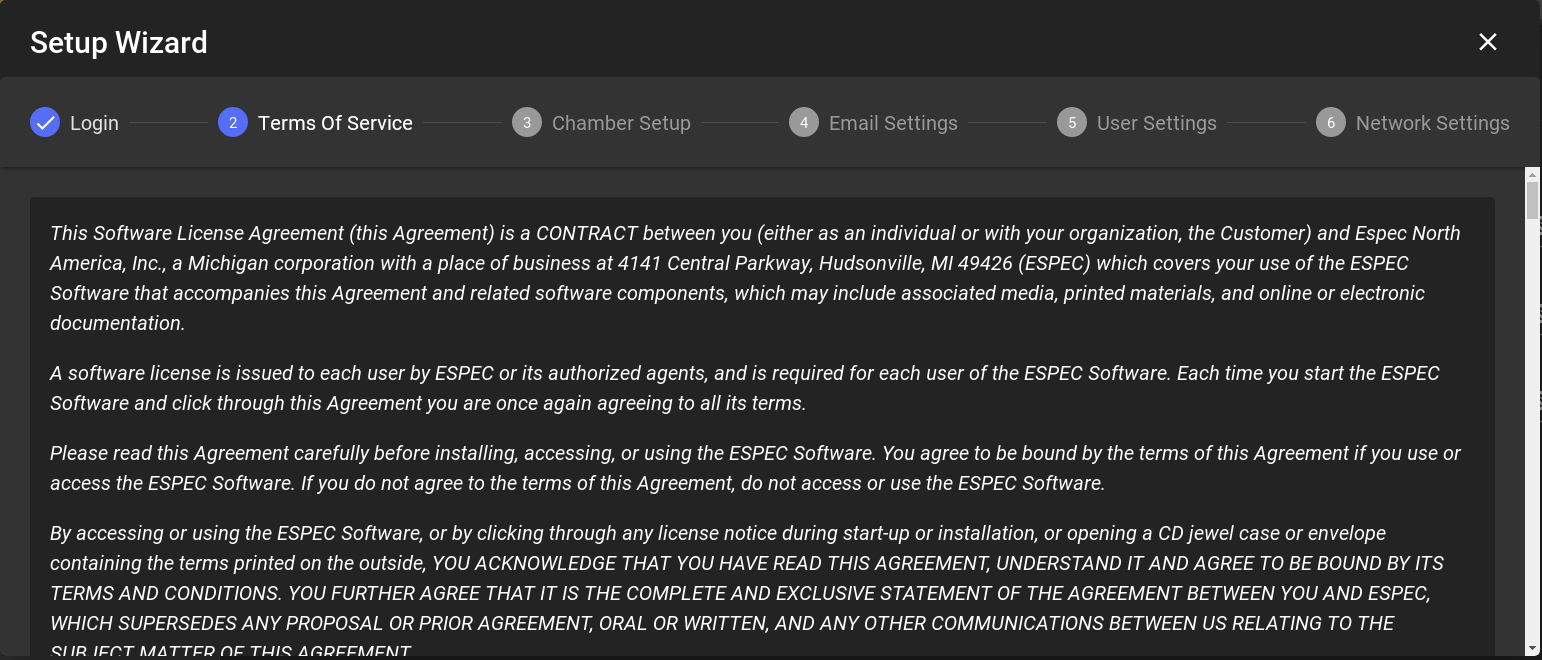
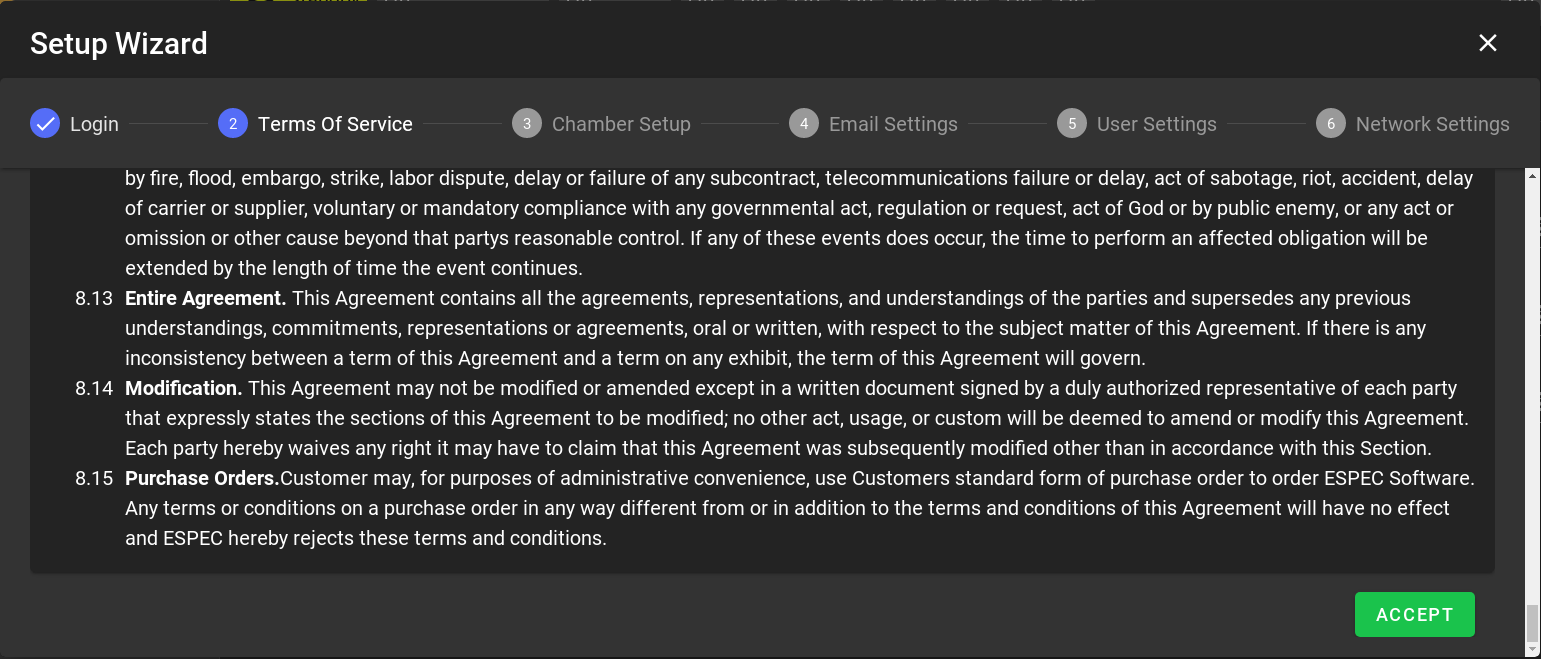
Apply the scroll bar to read through the Terms of Service, then click to accept the terms.
Scroll down the page and enter your email address in the Account Recovery E-Mail field to help recover the Admin password on EWC. Click ACCEPT in the Figure to continue.

For a standalone system, this setup page can be left with its default setting. Click in Figure [email-setting] to continue.
It is imperative that the admin password be changed to something secure to protect both your chamber and EWC. The following figure presents a first chance to reset the admin password.
-
Enter current password: admin
-
Enter new password twice.
-
Click ACCEPT.

NOTE: An error message, as depicted in Figure below, will be displayed if the admin password has not been reset. You can still use the factory password but you will put your system at high risks of security breach. This admin password can be reset later via the Settings menu.

The Network Settings page displays hostname and network protocol (DHCP or static) and fallback static IP settings assigned to the ETH-0 port of EWC (called eth0), as depicted in the following figure.

The DHCP box is checked by default such that EWC is ready to use DHCP when it detects one. The IP address leased by a DHCP server to EWC can be found under the Network Settings submenu (under Settings in the menu bar). If DHCP is not detected (or not available), EWC uses its fallback static IP address (192.168.0.83) as shown in [network-info]. The DHCP box is still checked when EWC uses its fallback static IP settings.
-
Click to continue.
-
The Setup Wizard is complete. EWC now displays its home page in Overview mode and is ready for chamber operation. Single-User or Multi-User:
-
If multiple operators need to control and operate the chamber, they each should have a separate account on the system. Consult our ESPEC Web Controller User’s Manual which can be found in Section 5 for detail on how to create different accounts and privileges for these operators.
Users may begin to log into EWC to operate the chamber as soon as their account has been created.
-
If this is a single-user system, EWC is now ready for operation. Refer to Section 5 for detail on how to access the online wiki manual or the embedded PDF manual under the About menu.
A static network other than a Class C type can be set on EWC. The configuration of such static network can be done by using either static or DHCP in Section 3 as a starting point. If your IT requires that each device on the main network must use a static IP address (even on DHCP network), the best approach would be to start from Section 3.
Complete the following steps:
-
Obtain the complete IP information from your IT. Refer to following figure as a example.
-
Log in as admin.
-
Click Settings (in the menu bar).
-
Click Network Settings (in the submenu bar).
-
Uncheck the DHCP box.
-
Edit the IP address field (replacing 192.168.0.83 with a new value). Refer to Figure below as an example.
-
Enter the appropriate values for Net Mask, Gateway, DNS1 and DNS2.
-
Click Save in upper-right corner.
-
Open a new Web browser and navigate to EWC with the new IP address.

Warning! To revert EWC to use DHCP protocol and its preconfigured static network setting, you must check the DHCP box and also enter 192.168.0.83 in the IP address field (and save the settings) before you reboot and connect EWC back to a DHCP or Class C static network. If you failed to apply these settings, EWC will still be using the custom static IP address as its fallback static network protocol.
The Operation Manual for ESPEC Web Controller is available in two formats, embedded PDF and online wiki.
-
Embedded PDF: The embedded PDF is accessible from the MANUAL tab under the About menu, as depicted in the following figure. To view the PDF manual, access the buttons according to the numbered labels in the figure.
-
Online Wiki: The EWC online wiki manual is freely available and accessible at GitHub:
