Termite RS232 User Guide
This guide provides instructions for configuring Termite to communicate with and control ESPEC chambers equipped with GL, P300, SCP220, and ES102 controllers using an RS-232C serial connection. Termite is a free software for personal or commercial application. This guide shows how to install and use Termite on MS Windows.
The following procedure outlines the steps to download and install Termite on your PC or execute it from the download folder.
Procedure:
-
Open a web browser.
-
Go to the official CompuPhase Termite webpage:
-
Under Downloads & license, select one of the following:
- Termite version 3.4 – complete setup (recommended). Note: To install on your PC, select this one.
- Termite version 3.4 (program only). Note: Termite does not require installation; you can simply execute and use it from within the folder. Although, it is more convenient to install it on your PC (first option), in case the download folder is accidentally removed.
-
Download the file. Note: As of this writing, Termite Version 3.4 was the latest available release; newer versions may be downloaded if released.
-
If you downloaded the complete setup:
- Double-click the downloaded .exe file.
- Follow the installation prompts.
- Accept the default installation settings unless changes are required.
-
If you downloaded the program only ZIP archive:
- Right-click the ZIP file and select Extract All.
- Open the extracted folder.
- Double-click Termite.exe to launch the program.
- No installation is required.
To determine which communications port (COM port number) the host operating system (OS) assigns to the RS-232-to-USB adapter, use the Windows Command Prompt or PowerShell with the chgport command. This command simply lists the COM port(s) being assigned to each device currently connected to the system. The mode command may be used to list the connection parameters available to each device.
Procedure:
-
On Windows 10/11, enter "cmd" in the Search bar and press Enter; on Windows 8, press the Windows key and type "cmd" and press Enter.
-
At the command prompt, issue:
chgportand study the list in the output. The following figure shows the first output with COM3. -
Plug in your RS232-to-USB adapter, then issue
chgportagain and study the new list in the output. A new COM? (where ? is the new number) in the output is the one assigned to the RS232-to-USB adapter. The following figure shows the second output with COM4 added to the list, which is assigned to my RS232-to-USB adapter. This COM4 will be used in the Termite setting (in the following section).

The COM port number identified in the previous section will be used in the Termite serial port settings. Other communication parameters can be configured as required.
Procedure:
-
Launch Termite. Its UI is depicted as follows:
-
Click the Settings button to open the Serial Port Settings dialog box (see the arrow in the figure below). Select the COM port number identified in the previous section. In this example, COM4 is used. Configure the Baud rate, Data bits, Stop bits, Parity, Flow control and Forward as shown in the figure. Under the Transmitted Text section, make sure Append CR-LF is selected. For best results, configure all settings exactly as depicted in the figure. Note: This example uses no handshaking; therefore, None is selected for Flow Control. If hardware flow control is required, select RTS/CTS.
-
Click OK (see arrow)


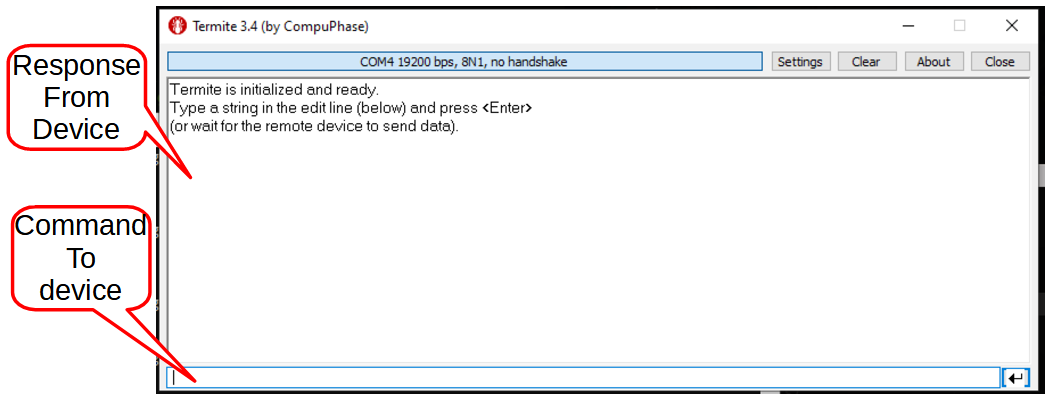
The command prompt at the bottom of the Termite UI is used to send commands to the controller. Responses returned by the controller are displayed in the main buffer at the top (see figure below).
Procedure:
-
Enter command: To read the chamber's ROM information, enter the command ROM? and press Enter. The following figures illustrate how to enter the command and how the chamber's response is displayed in the terminal window.
-
Commands may be entered using either lowercase or uppercase letters. The following figures show how to read the chamber temperature, vibration and operating mode.
Refer to the P300 Communications Manual for details on interpreting the chamber's response and how to issue other commands.


