Termite RS232 User Guide
This guide provides instructions for configuring Termite to communicate with and control ESPEC chambers equipped with GL, P300, SCP220, and ES102 controllers using an RS-232C serial connection. Termite is a free software for personal or commercial application. This guide shows how to install and use Termite on MS Windows.
The following procedure outlines the steps to download and install Termite on your PC or execute it from the download folder.
Procedure:
-
Open a web browser.
-
Go to the official CompuPhase Termite webpage:
https://www.compuphase.com/software_termite.htm
Under Downloads & license, select one of the following:
- Termite version 3.4 – complete setup (recommended). Note: To install on your PC, select this one.
- Termite version 3.4 (program only). Note: Termite does not require installation; you can simply execute and use it from within the folder. Select "Termite version 3.4 (program only)" for this option. Although, it is more convenient to install it on your PC, in case the download folder is accidentally removed.
- Download the file. Note: As of this writing, Termite Version 3.4 was the latest available release; newer versions may be downloaded if released.
-
If you downloaded the complete setup:
- Double-click the downloaded .exe file.
- Follow the installation prompts.
- Accept the default installation settings unless changes are required.
-
If you downloaded the program only ZIP archive:
- Right-click the ZIP file and select Extract All.
- Open the extracted folder.
- Double-click Termite.exe to launch the program.
- No installation is required.
To determine what communications port (COM port) number is assigned to your RS232-to-USB interface by the host operating system (OS), apply the following steps.
Procedure:
-
Open an MS DOS command prompt. On Windows 10/11, enter "cmd" in the Search bar and press ; on Windows 8, press the Windows key and type "cmd" and .
-
At the command prompt, issue:
chgportand study the list in the output. -
Plug in your RS232-to-USB cable and issue
chgportand study the new list in the output. A new COM? (where ? is the new number) associated with the RS232-to-USB interface will be listed. As shown in the following figure, COM4 has been assigned to my RS232-to-USB cable. This COM? will be used in the Termite setting (in the following step).

Launch Termite and configure communication settings as follows:
Procedure:
-
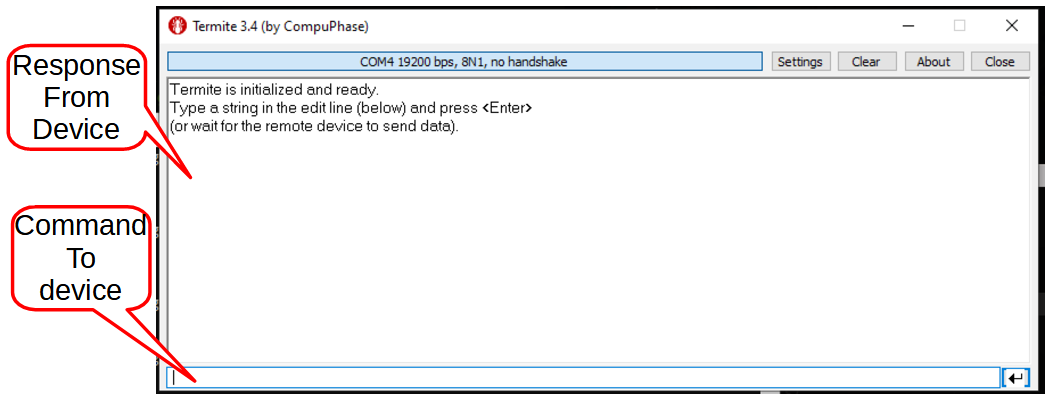
Launch Termite. Its UI is depicted as follows:
-
Click the Settings button to open the Serial port settings pop-up window (see figure below). Select COM port number that your host OS is using (in the previous step). The figure shows my COM4 as an example. Select baud rate, data bits, stop bits, parity, flow control and forward according to the figure. Make sure to select and check Append CR-LF under the Transmitted text column. Simply follow all the settings depicted in the figure.
-
Click OK


Issue commands to the chamber: Termite command prompt is at the bottom of the UI. Responses returned by the chamber will be displayed in the main buffer, as shown in the following figure.
Procedure:
-
Enter command: To read the ROM information of the chamber, issue ROM? and press :
The following figure shows how command is entered and Figure [6] shows how the response from the chamber is diaplayed. The display shows both the command and the response.
-
Commands can be issued in lower-case or capital letter. The next several figures and illustrate how to read temperature and probe chamber operating mode.
Refer to the P300 communication manual to decipher the response from the chamber.


