Repository navigation
Visual Notes
Observations from the three images in Reference Screenshots and how they compare with the NtBA proof of concept (320x200, 16 colours, whole court on screen). Written by us; add to it.
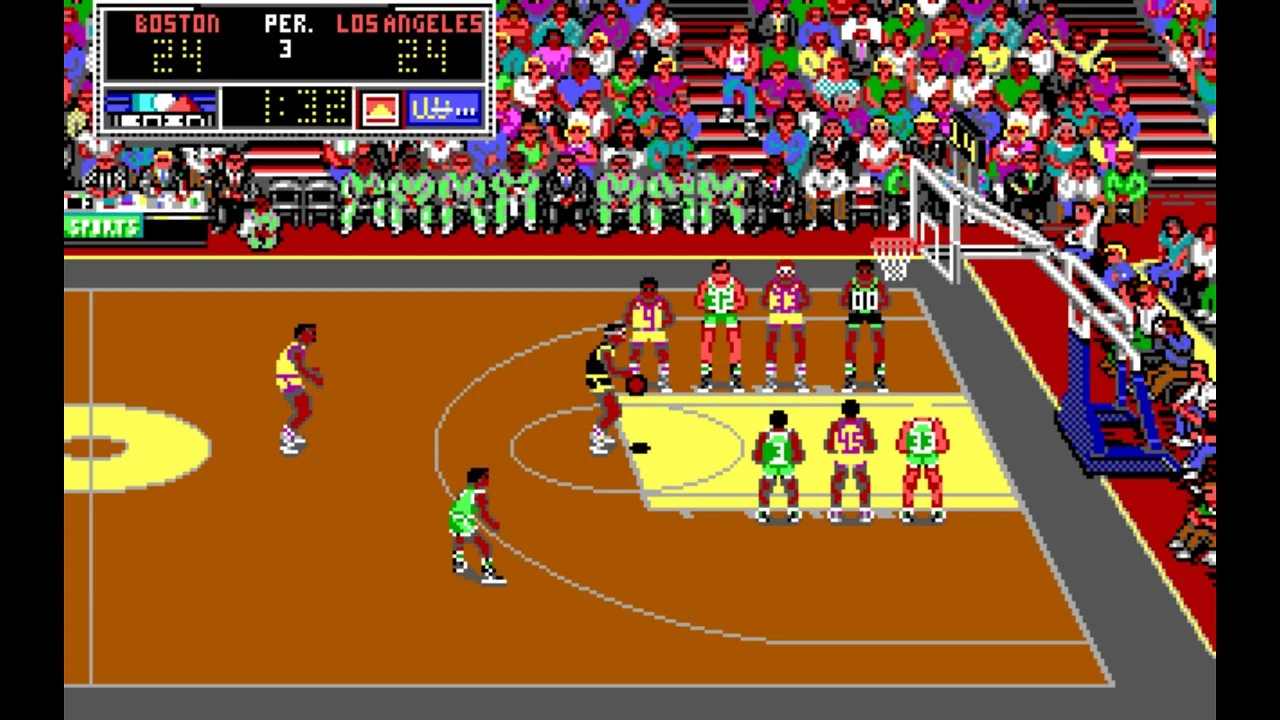
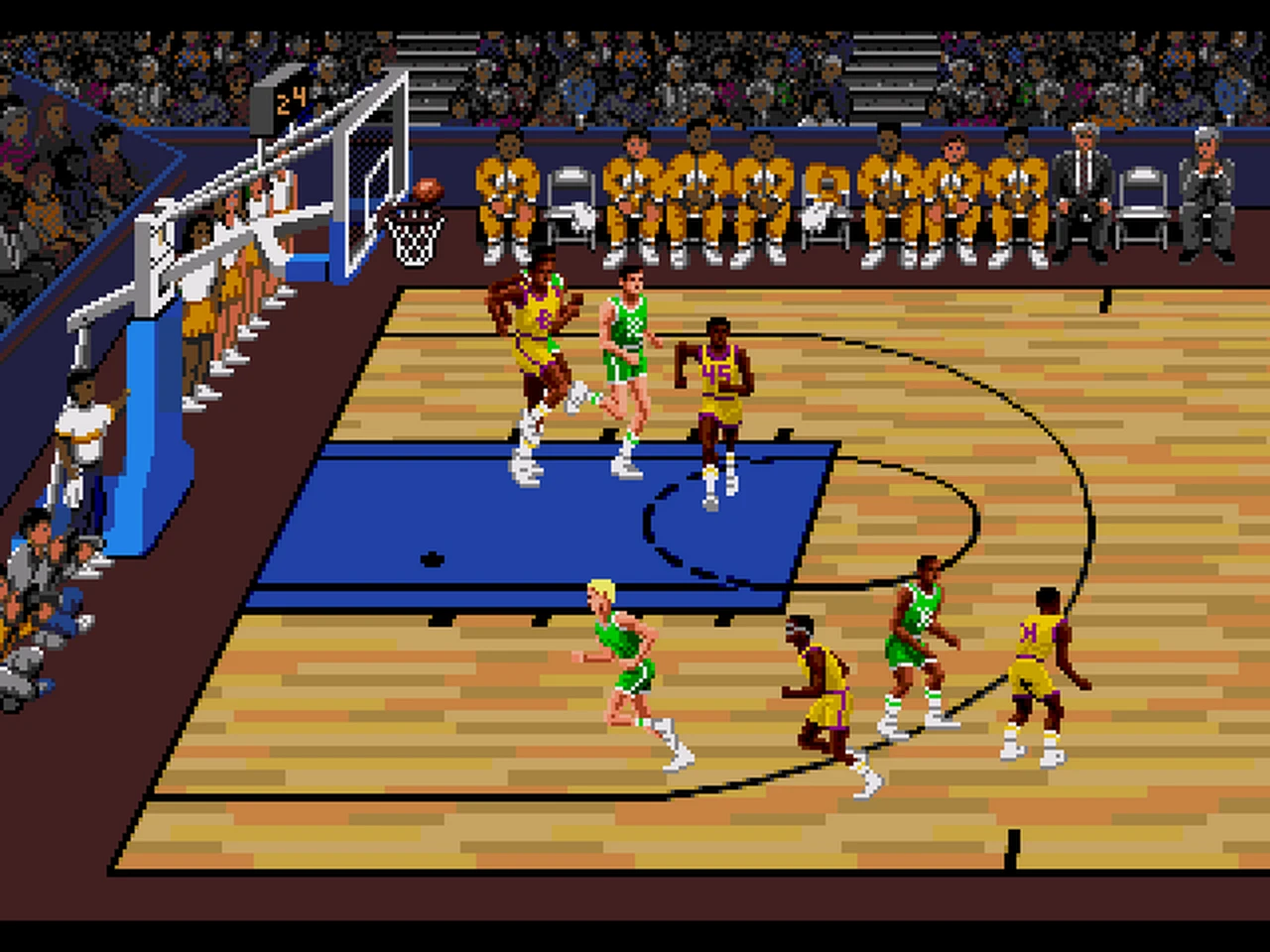
Camera
- Neither version shows the whole court. The view scrolls horizontally to follow the ball and shows roughly half the court at a time, so sprites can be large (about 1/6 to 1/9 of the screen height) and readable. (Tip-off screen: centre court is centred, both benches visible.)
- It is a raised sideline view with an oblique end: the baseline and the lane are skewed on a diagonal toward the basket rather than being drawn square-on (Genesis gameplay shot, DOS shot). Sidelines stay horizontal.
Court
- DOS: flat orange-brown court, thin light lines, a yellow lane/free-throw area and yellow centre circle, grey out-of-bounds apron, red surround. Only EGA colours.
- Genesis: hardwood drawn as horizontal planks in several alternating tan/orange shades with random breaks; thick black lines; a blue painted lane and a blue centre circle with a logo; free-throw circle and three-point arc clearly drawn; short tick marks on the sidelines.
- The lane is a different colour from the floor in both versions (yellow DOS, blue Genesis).
Hoop
- Drawn as a real object, not a marker: backboard seen in 3/4 perspective with a steel arm and padded stanchion, rim and white net, a shot-clock readout mounted on the stanchion (Genesis). The ball visibly drops through the net.
Arena
- Crowd in tiered stands behind the far sideline, with individually drawn spectators and a few waving arms; red/dark seating bands on DOS, a dark crowd on Genesis.
- Both benches are drawn at the far sideline with seated players in warm-up jackets, coaches in suits, folding chairs; the scorer's table (blue skirted table, officials, computers, phone) sits at half court; a referee stands near the table; photographers and cheerleaders sit beside the baseline hoop.
Players
- Jersey numbers are visible on the shirt (both versions), team colours are distinct (green vs gold/purple) with white shoes and socks, and each side has varied skin and hair (a blond player among others). Running animation has clear leg and arm swing; poses are specific (hands raised on defence, ball held low, tip-off crouch).
- Players are drawn about twice as tall relative to the screen as ours.
HUD
- Amber dot-matrix (LED) digits on a black panel with a white frame: team names, period ("PER."), clock and scores. DOS puts it in the top-left corner and overlays team logos; Genesis centres it at the top, framed like a stadium scoreboard.
- A text prompt ("PRESS START TO BEGIN") and team scores in the bottom strip on the pre-game screen. Shot clock shown at the baskets, not only on the scoreboard.
Five screenshots supplied by the project owner (not stored in this repository). The owner's verdict: this is the graphics fidelity we are after.
- End-on half-court view. Looking at the basket from midcourt: backboard and rim at the top centre, stands with red steps and crowd in the top corners, referee and coaches behind the baseline, a light orange court with pale lines and a cream lane. Players are seen from behind and from the front. A free-throw situation uses the same view, with players lined up along the lane.
- Side view for the backcourt. A horizontal view of the centre circle with the pack of players running, used when the ball is out of the frontcourt. Above it is a stats panel: both team names, time outs, a roster list with jersey numbers, names, points and personal fouls, and a small court minimap with the clock in the middle.
- TV presentation. A mock commercial interstitial (a framed beer ad with a slogan) and a presenter at a desk with a microphone in front of the arena, with subtitles — the game plays like a broadcast.
What NtBA did with it: the simulation now switches between a side view and an end-on view
(Game::view), with screen-relative controls on the end-on view (see
Architecture). The end-on view has its own front/back
sprites, a face-on backboard with the shot clock above it, staff behind the baseline and a court
that converges toward the baseline. Not done yet: the stats panel and minimap, a dedicated
free-throw view, and — far future — the presenter and commercials (Roadmap).
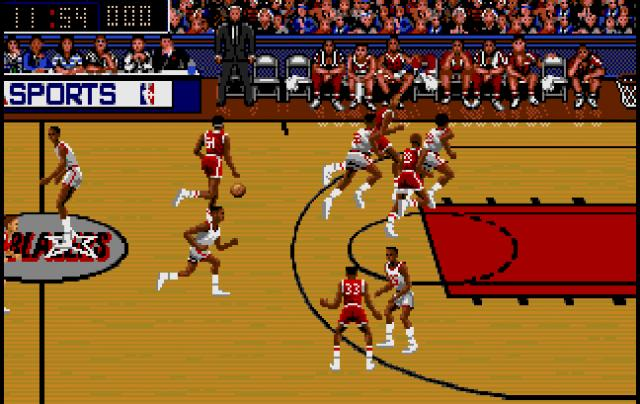
later-ea-game-target-look.png (provided by the project owner as "where we would like to get to"). What stands out, and what we did about it:

- Subtle floor. Low-contrast planks in a light tan, thin 1-pixel black lines, a painted logo in the centre circle, dashed free-throw circle inside the lane. NtBA now uses closer plank tones, one-pixel lines and an "NTBA" centre logo.
- Mild perspective. Sidelines horizontal, only a gentle slant at the lane. We reduced the far/near scale ratio from 1.8 to 1.4.
- Big, dynamic players. About 1/6 of the screen height, wide running strides with the body bobbing, different skin tones and hair, two clearly distinct kits (white/grey vs red). NtBA sprites are now 34 px tall (17% of the screen) with a four-frame run cycle and body bob.
- Tight framing. The bench, a standing coach in a suit and the far wall take only the top quarter of the screen so the court dominates. NtBA now gives the court 57% of the height.
- Courtside ad boards on the wall (fictional ones here) and a compact scoreboard in the top-left corner instead of a big centred panel.
- Not copied yet: the second kit (no opposition yet), distinct shadows under players, the lane painted in team colour with a dashed ring (we have the ring, in blue).
All the screenshots we studied are 320x200 (the TV Sports and DOS captures are exactly that size; the others are 2x/4x upscales of it). That was VGA's mode 13h with 256 colours on DOS, 32 colours (+ extra-half-brite) on the Amiga, and 16 on EGA; the Genesis showed 64 of 512 at 320x224. These games were shown on 4:3 monitors, so pixels were slightly taller than wide. NtBA's choice: 320x200, a 256-colour VGA-style palette (we use under 100), 6-bit channels, 4:3 display. We do not use 640x480: it was an option on PC (16 colours) but the genre did not use it and it would change the look.
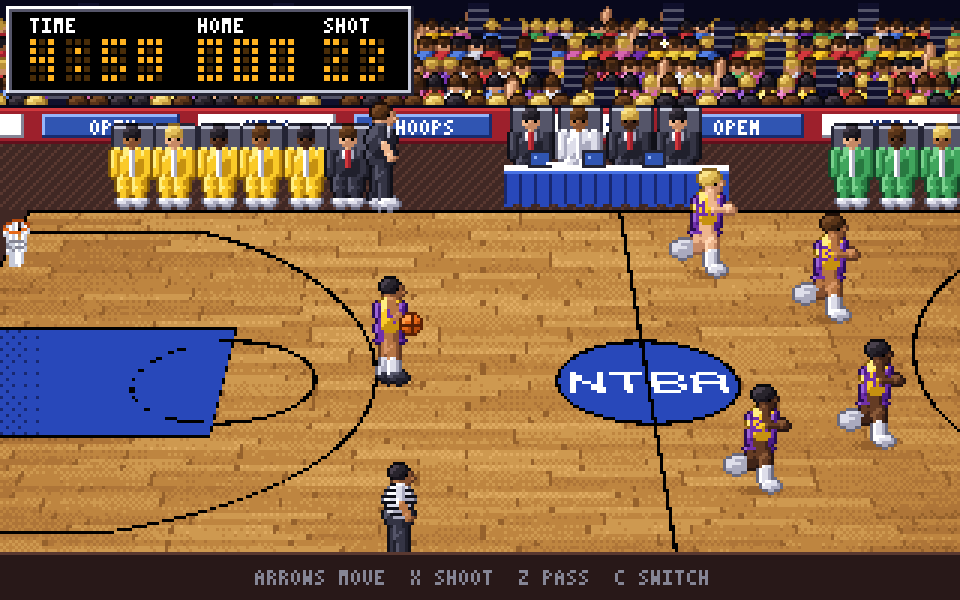
The proof of concept was reworked to chase this look (see the screenshots on How to Play). Status:
| Aspect | Original | NtBA now | Still to do |
|---|---|---|---|
| Camera | Scrolling half-court | Scrolls to follow the ball, eased | Lead the camera on fast breaks |
| Court perspective | Slanted baselines (1990) to mild (later) | Mild perspective projection | Tune the amount of skew |
| Hardwood | Multi-tone planks with breaks | Four close tones, random lengths, butt joints, centre logo | Grain, wear |
| Lane colour | Yellow / blue | Blue lane and centre circle | Centre-circle logo |
| Hoop | Backboard, arm, stanchion, net, shot clock | All of these; shot clock on the stanchion | Backboard shatter/vibration, net swish |
| Players | Numbered jerseys, varied looks, shaded and outlined | 34 px shaded outlined sprites, skeleton run cycle, IK dribble arm, numbers, 3 skin tones and hair colours, black shoes = controlled | Hand-authored sheets, more poses (dunk, defend) |
| Scoreboard | Amber dot-matrix, framed (compact in Bulls vs. Blazers) | Compact framed panel, dot-matrix digits | Team names, period |
| Bench & table | Bench with coaches, scorer's table, ad boards | Both benches, standing coach, scorer's table, officials, ad boards | Cheerleaders, photographers, animation |
| Crowd | Tiers, waving arms | Five parallax rows of shaded fans with aisles, waving arms and camera flashes | Signs and banners, reactions to scores |
| Shot mechanic | Hold and release at the apex, tap = fake | Instant shot | See Genesis Manual Notes |
Development Version badge. A small "DEVELOPMENT VERSION" plate sits flush with the top-right corner of the 320x200 framebuffer: amber lamp lettering in the game's own font on a black plate with a bevelled steel frame, like the other overlay plates. It is drawn last so nothing covers it, and it is outside the simulation, so it never affects game state or hashes.
None of this is required for the current milestone (single-player versus a bot); it is a backlog of presentation details that carry the "televised game" feel the project is after.
From the three title and menu images at the end of Reference Screenshots. We take ideas, not art.
- Title: a single strong logotype with a short supporting line, over a simple dark or blurred arena backdrop. Decoration is restrained: corner sparkles on one, a bevelled frame on the other. A small credit line sits at the bottom.
- Idle behaviour: the title is a screen, not a running game. The classic move is a short self-playing demo after a pause, then back to the title.
- Menu: a short vertical list of two to four chunky, high-contrast items on a plain textured background, with one cursor (a ball) beside the selected item. Nothing else competes for attention.