Repository navigation
For Developers
For contributors, translators, and anyone who wants to run or build the project from source.
| Tool | Version | Purpose |
|---|---|---|
| Python | 3.10 or 3.13 recommended | Runtime |
| pip | Latest | Package manager |
| Git | Any recent | Cloning the repo |
| PyInstaller | 6.x | Building the .exe
|
Python 3.13 is what the project is currently compiled against. Avoid very recent versions, not all libraries may support them yet.
The current source version is 1.0.8 (
src/app/__init__.py,pyproject.toml, andpackaging/version_info.txt).
git clone https://github.com/Hyacinthe-primus/File-Converter-Pro.git
cd File-Converter-Pro
pip install -r requirements.txt
pip install -r requirements-dev.txt             # Dev/Build dependencies
python src/main.pyEverything is installed by requirements.txt; see Credits for the full library list and what each package does. comtypes is Windows-only and no-ops on machines without Office.
FFmpeg is required for audio/video conversions; the other tools are optional. All are auto-detected at runtime; see Optional Tools for install links and what each tool unlocks. In a source run the directly resolvable executables are 7z/7zz, ffmpeg/ffprobe, gswin64c/gs, magick, soffice, wkhtmltopdf, pandoc, and tesseract. Pandoc may additionally use a LaTeX installation (pdflatex) when one is present.
Lookup order and config-file syntax are documented in External Tools (Advanced). In the source tree the override file is src/config/external_binaries.conf.
python src/main.py --helpThis prints all available flags (language, theme, context menu, achievement commands, etc.).
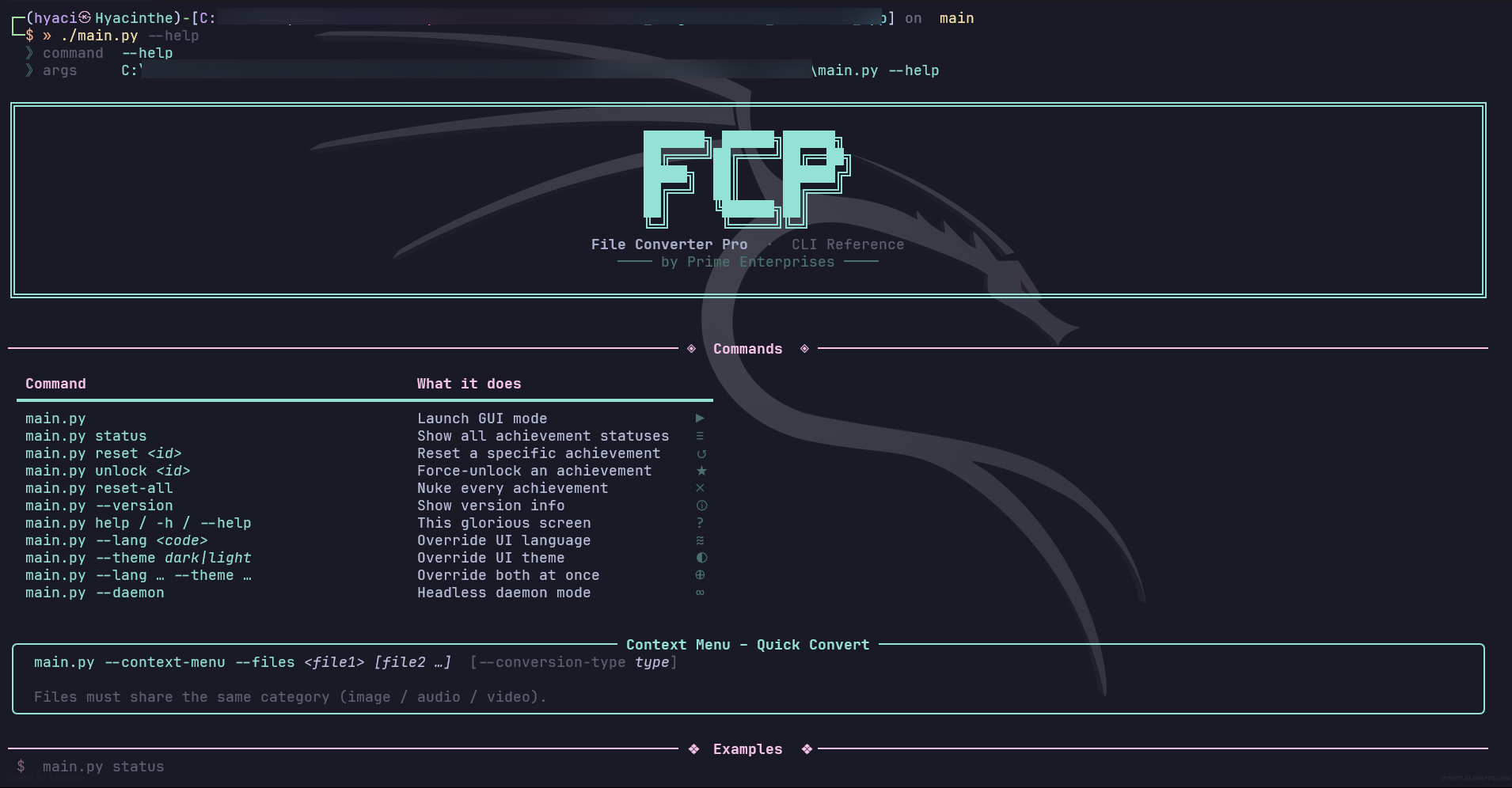
CLI output is only visible when running from source. The compiled
.exedoes not expose a console window.
# Run all tests
python -m pytest tests/ -v

# Run a specific test file
python -m pytest tests/test_mixins.py -v

# External binaries resolver tests
python -m pytest tests/test_external_binaries.py -v

# Run a specific test
python -m pytest tests/test_mixins.py::test_format_size_kb -v

# Run tests in fast mode (no verbose)
python -m pytest tests/ -q

# Run tests with error display
python -m pytest tests/ --tb=short
Current suite: 1,067 passed, 8 skipped (79 test modules plus conftest.py). The skips require Word/LibreOffice integration tools that are unavailable in the current environment.
Conversion reliability regressions to run when touching shared helpers:
python -m pytest tests/test_conversion_pipeline.py tests/test_conversion_helpers_characterization.py -q
python -m pytest tests/test_docx_to_pdf_consolidation.py tests/test_pdf_to_word_text_only.py -q
python -m pytest tests/test_ocr_consolidation.py tests/test_ocr_merge_workers.py -qtests/test_architecture.py guards cross-cutting invariants without launching the GUI:
-
Translation key consistency: every key in
src/languages/fr.jsonmust exist in every other language file, and anytranslate_text("...")literal that looks like a named key must exist infr.json. New UI strings must be added tofr.jsonand all language files or these tests fail. -
Mixin composition: every mixin in
src/app/mixins/(plusAppUIMixin/AppLogicMixin) must be in theFileConverterAppMRO, and key methods (e.g. project-tab handling) must resolve. -
QSS object names: every
setObjectName(...)must have a#selectorsomewhere (theme QSS, another.qssfile, or an inline/f-string stylesheet in code).
python -m pytest tests/test_architecture.py -q# Install ruff
pip install ruff
# Check all Python files
ruff check
# Check unused imports (F401)
ruff check --select F401
# Check unused variables (F841)
ruff check --select F841
# Check unused imports + variables
ruff check --select F401,F841
# Auto-fix unused imports
ruff check --select F401 --fix
# Auto-fix unused variables
ruff check --select F841 --fix --unsafe-fixes
# Auto-fix everything
ruff check --fix
# Code formatting (like black)
ruff format
# Check function complexity (C901)
ruff check --select C901
# Check duplicate imports (I001)
ruff check --select I001# Python syntax (check a file)
python -m py_compile file.py
# Run the application
python src/main.py
# Check file size
python -c "print(len(open('file.py').readlines()))"The project uses PyInstaller + UPX for compression. Build scripts are PowerShell-based.
pip install pyinstaller
winget install UPX.UPX
packaging/build.ps1 auto-detects upx.exe from PATH (then the optional $UPX_FALLBACK_PATH, including the standard WinGet install location). packaging/build_quick_check.ps1 still contains its own placeholder; set that to your local upx.exe path if you build Quick Check separately.
Run the build scripts from the packaging/ folder: build.ps1 looks for build.spec in the current directory.
Set-Location packaging
.\build.ps1
Runs PyInstaller with build.spec and produces packaging/dist/FCP/ (onedir output).
.\build_quick_check.ps1This requires an existing packaging/dist/FCP/ build and uses quick_check.spec. It is not run by build_all.ps1.
.\build_installer.ps1Calls Inno Setup with setup.iss and produces Output/FileConverterPro_Setup_<version>.exe. This script resolves the project root itself, but it expects the packaging/dist/FCP/ application build to exist.
Make sure Inno Setup is installed and on your PATH. Download: jrsoftware.org/isinfo.php
Note: The Quick Check utility is not included in this pipeline and must be built separately using
build_quick_check.ps1.
Set-Location packaging
.\build_all.ps1
build_all.ps1 runs the main application build, the installer build, and then creates Output/File_Converter_Pro_v<version>.zip from packaging/dist/FCP/ using 7-Zip. It also writes Output/checksums.txt with SHA-256 hashes for the installer and portable ZIP. Return to the repository root with Set-Location .. afterwards.
See the Directory Tree.
Main window inheritance chain:
Inheritance chain (MRO):
      AppLogicMixin(OptimizationMixin, ImageToPdfMixin, BatchMixin,
                    PdfOperationsMixin, PdfToWordMixin, WordToPdfMixin, CompressionMixin)
      └── AppUIMixin(FileManagementMixin, PanelsMixin, ProjectManagementMixin,
                     ThemeLanguageMixin, TranslationMixin, AppLogicMixin)
            └── FileConverterApp(AppUIMixin, QMainWindow)  ← QMainWindow mixed in here
                  └── FadingMainWindow
This chain is enforced by tests/test_architecture.py: every mixin class in app/mixins/ (plus AppUIMixin / AppLogicMixin) must be part of the FileConverterApp MRO, so a new mixin that is not composed into the app fails the test suite.
Batch conversion lives in app/mixins/batch.py. Each file is dispatched through _convert_batch_file() → _batch_to_pdf / _batch_to_docx / _batch_to_png based on the target format code ("pdf", "docx", "png").
-
Stable format codes: the batch dialog stores a code as combo-item data (
addItem(label, code)); the app reads it viaselected_format()instead of matching translated labels so it works identically in every language. -
Honest success reporting: a file only counts as converted when the output file actually exists (
_convert_batch_filereturnsFalseotherwise). Unsupported combos are reported instead of silently "succeeding". -
Engine reuse: document inputs reuse
AdvancedConverterEngine(txt_to_pdf,rtf_to_pdf,xlsx_to_pdf, …); PDF → DOCX uses_batch_pdf_to_docx()which tries Word COM → LibreOffice (_convert_pdf_to_docx_libreoffice) →_solid_fitz_fallback; PDF → PNG renders one page per file via PyMuPDF. -
Helpers (
_batch_copy,_batch_temp_file,_pdf_to_png) keep routing side-effect-free and testable, seetests/test_batch.py.