Repository navigation
Week 2
Week ending October 4, 2026 · Reflections recorded October 3

Illustrative Hub artwork: looking ahead while learning what today should look like.
I have put a great deal of work into building this Hub, but that does not mean I automatically trust every recommendation it gives me. This week, I deviated from the plan. I still find it difficult to fully respect a recovery period when the workload feels lighter than I believe I can handle.
I feel that I am in better shape than the current program suggests. That is an honest impression, and it is something I want to investigate rather than hide. The question is whether the program is underestimating my capacity, whether I am underestimating the work I am still recovering from, or whether both need adjustment.
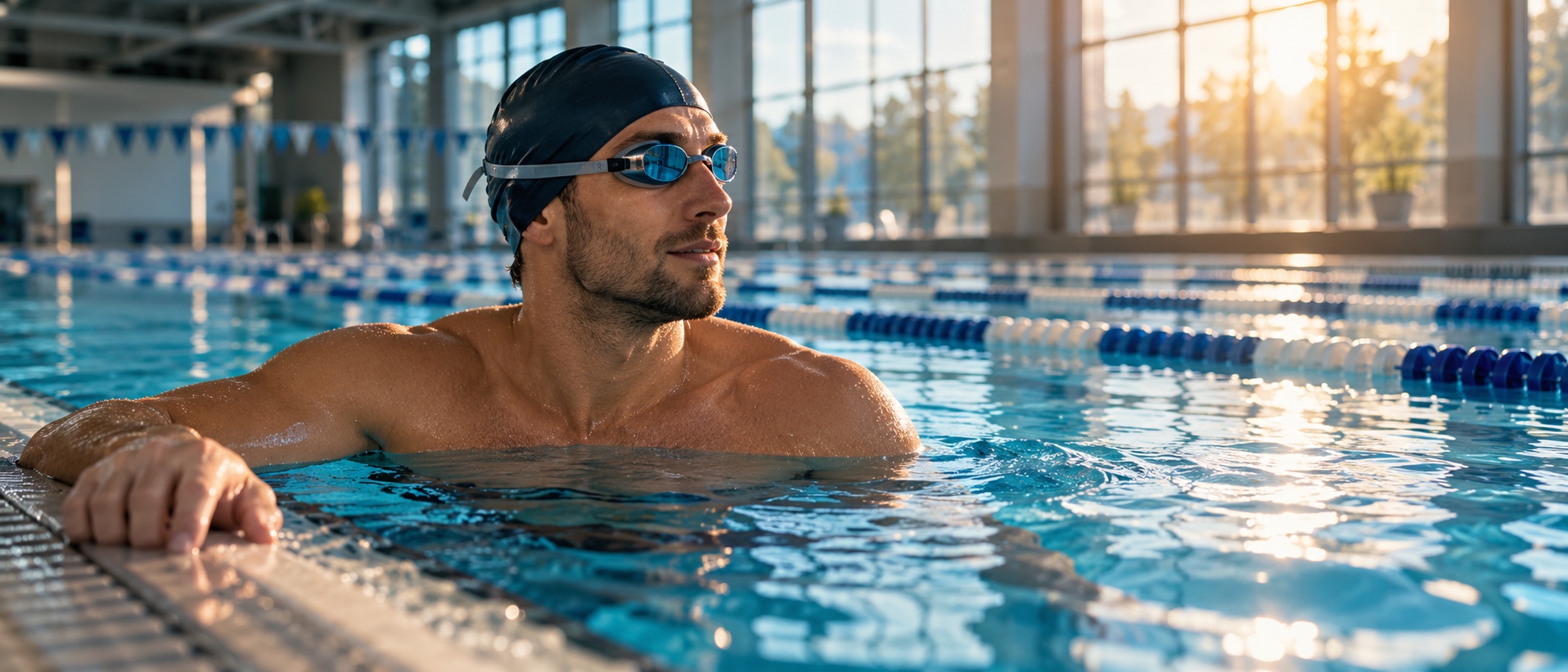
Swimming remained part of the week. This is app artwork, not a photograph of my recorded swim.
The saved records through Saturday include two swims totaling 105 minutes and about 4.21 km, a 36-minute bike session, and 86 minutes of logged strength and mobility across three sessions. One of those was a short medicine-ball circuit before swimming.
The strength work included rotational core training and an arms/upper-back session with slower repetitions and held positions. Those details matter: a small number of sets can still contain substantial time under load, which is why simply counting workouts or minutes cannot tell the whole story.

Strength and mobility belong in the record too. Illustrative artwork, not a photograph of the logged session.
These are different kinds of work, with different load calculations. I am not treating their scores as interchangeable or adding them together as one measure of fitness.

Recovery is an active part of the plan. The artwork sets the mood; the check-ins provide the evidence.
My check-ins have described plenty of energy, alongside continued calf tightness and pulling. The latest entry also recorded sore feet after spending a long time standing while working on the project.
That contrast is part of what makes this experiment interesting. I can feel ready to do more overall while a particular area still needs attention. The body map and recovery estimates give me a way to discuss that distinction, but agreement with how I feel is not enough to prove that a formula is correct.
I want the model to learn from the work I actually perform and from my response afterward. I also want to avoid changing its rules simply because a recommendation is inconvenient.
In the past, I have sometimes done a great deal of training without feeling that the benefits matched the effort. My goal with the Hub is to get more value from the work I do: progress that can accumulate, with enough room to recover and adapt.
The experience so far has been reassuring, interesting, convenient, and focused. Having a program and a place to record what happened makes me feel that I am accomplishing something. At the same time, some sessions have felt too easy, and I have not yet developed full confidence in the conservative workload.
Both observations belong in the record.
The next review should compare the planned work, the completed work, and the delayed response. If I repeatedly tolerate more work than forecast without a worsening response, that is evidence to examine for recalibration. If discomfort persists or increases, the plan needs to account for that too.
One good day, an easy-feeling session, or a strong performance will not settle the question. I want a pattern of evidence, with the original forecasts preserved so we can see where the model was right and where it was wrong.
The immediate goal remains the Rose Bowl 5K on January 17, with a comfortable finish as the priority. The longer ambition is to build toward a full Ironman over future training cycles. Those are reasons to improve the planning process, not reasons to rush the current recovery decision.
I am my own first client in this project. That means the journal should include the times I followed the plan and the times I did not.
This week’s lesson is that building a program and learning to trust it are different tasks. The Hub is still being calibrated, and so is my confidence in using it. Recording that openly gives us something useful to work with next week.
This is a personal account of using an experimental training model. The load readings are estimates; this journal does not establish improved fitness, recovery accuracy, or injury prevention.