Repository navigation
SparkEditor
SparkEditor is a required Windows build product and authoring surface in the blocked and uncertified stable-v1 profile. Its source inventory contains 64 *Panel.h classes; registration and default visibility are separate metrics. All three transform gizmos (translate, rotate, scale) now apply to World entities through one CommandHistory entry per drag, and World-document create/delete/duplicate/reparent/rename/transform/inspector edits are command-backed; EDT-210 remains open for the asset browse/drag/assign path, the author-to-installed-runtime round trip, and the still-unwired crash-recovery pipeline. Collaboration, visual scripting, plugin breadth, and non-Windows editor paths remain experimental or outside the profile.
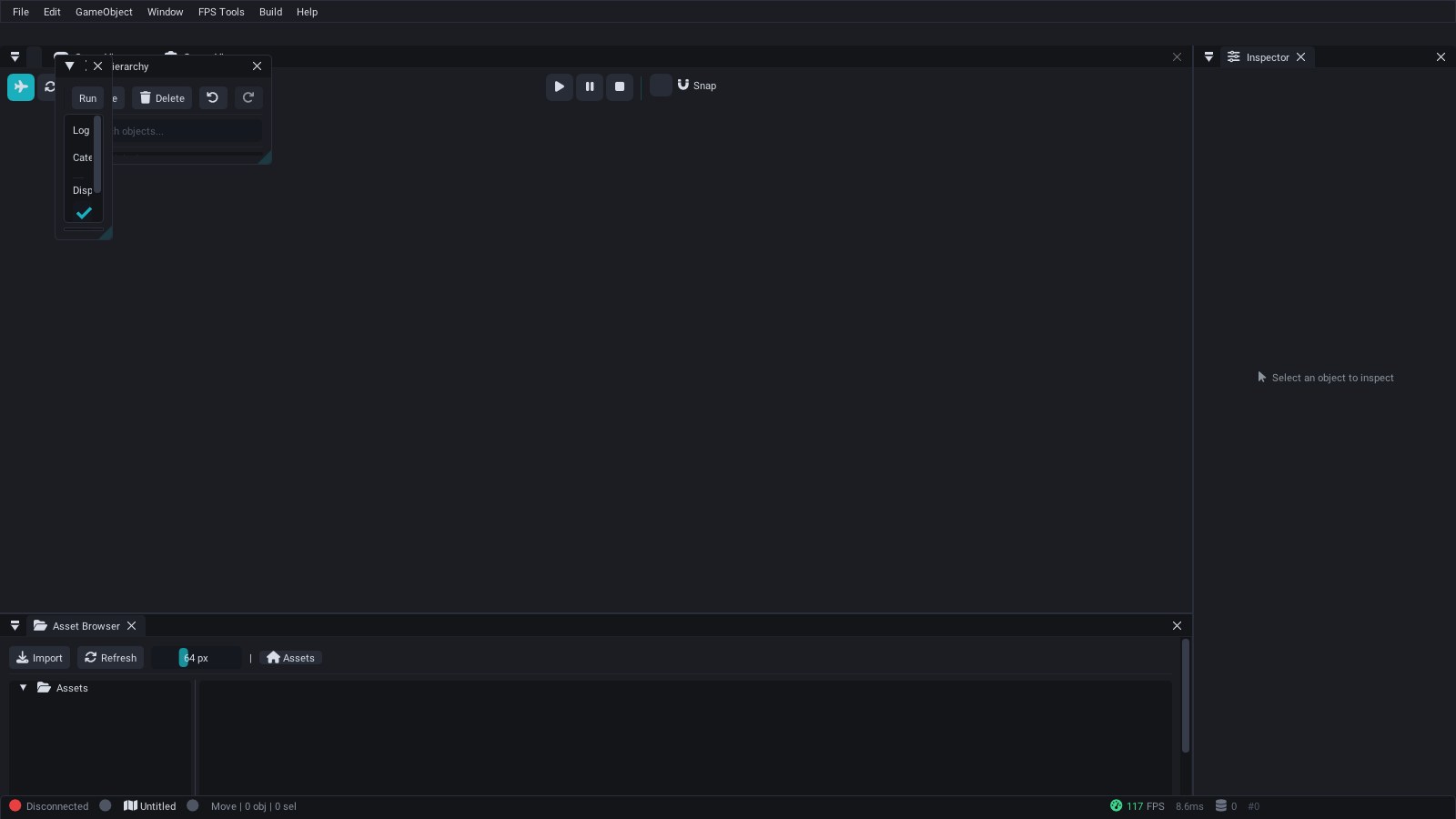
SparkEditor layout preview — Hierarchy, Scene View, Inspector, Asset Browser, and Console panels shown with the legacy Spark Professional palette.
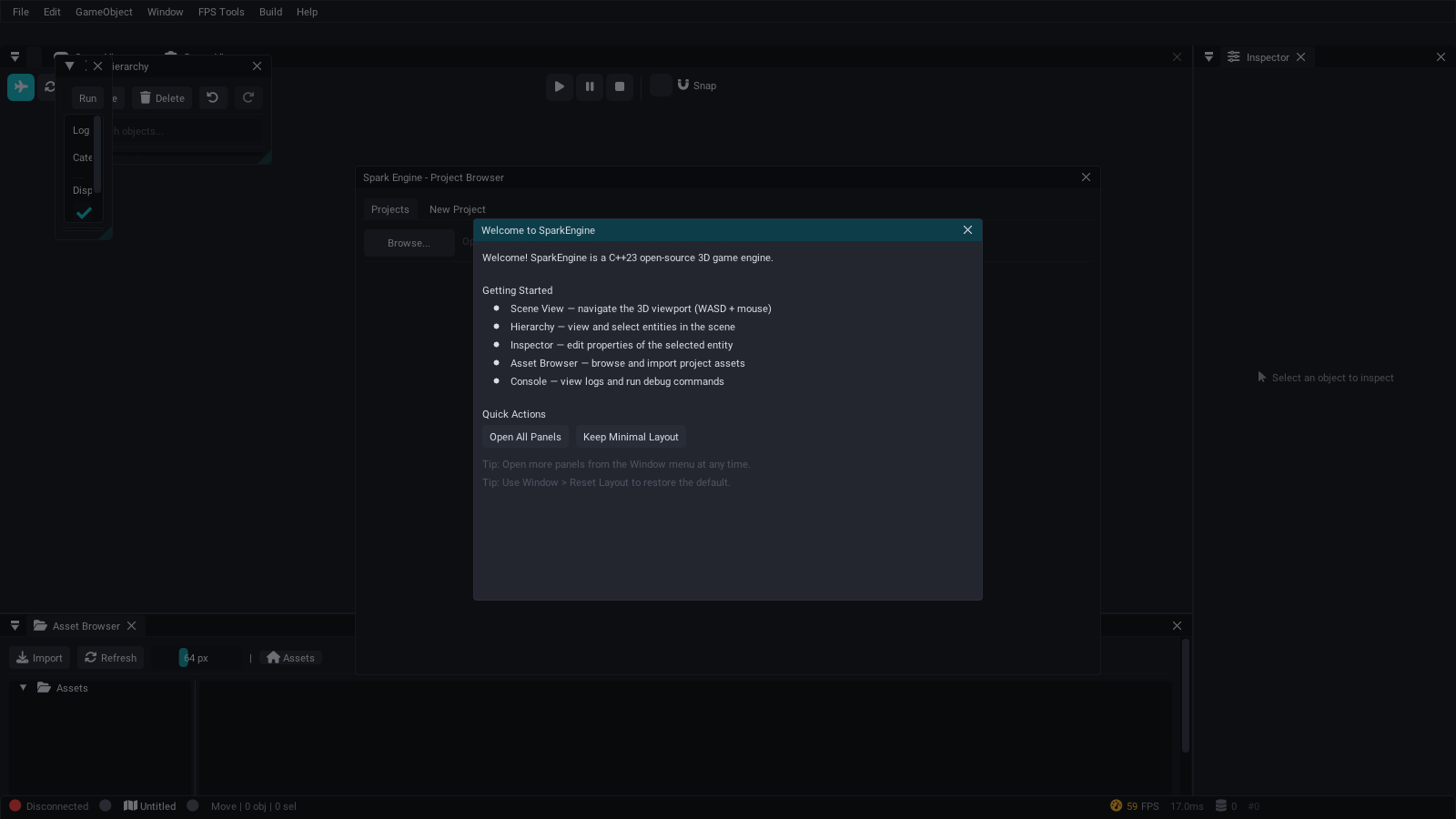
On first launch the editor opens a Start tab in the centre dock node (it is never shown in test mode). It replaces the old modal welcome screen and offers:
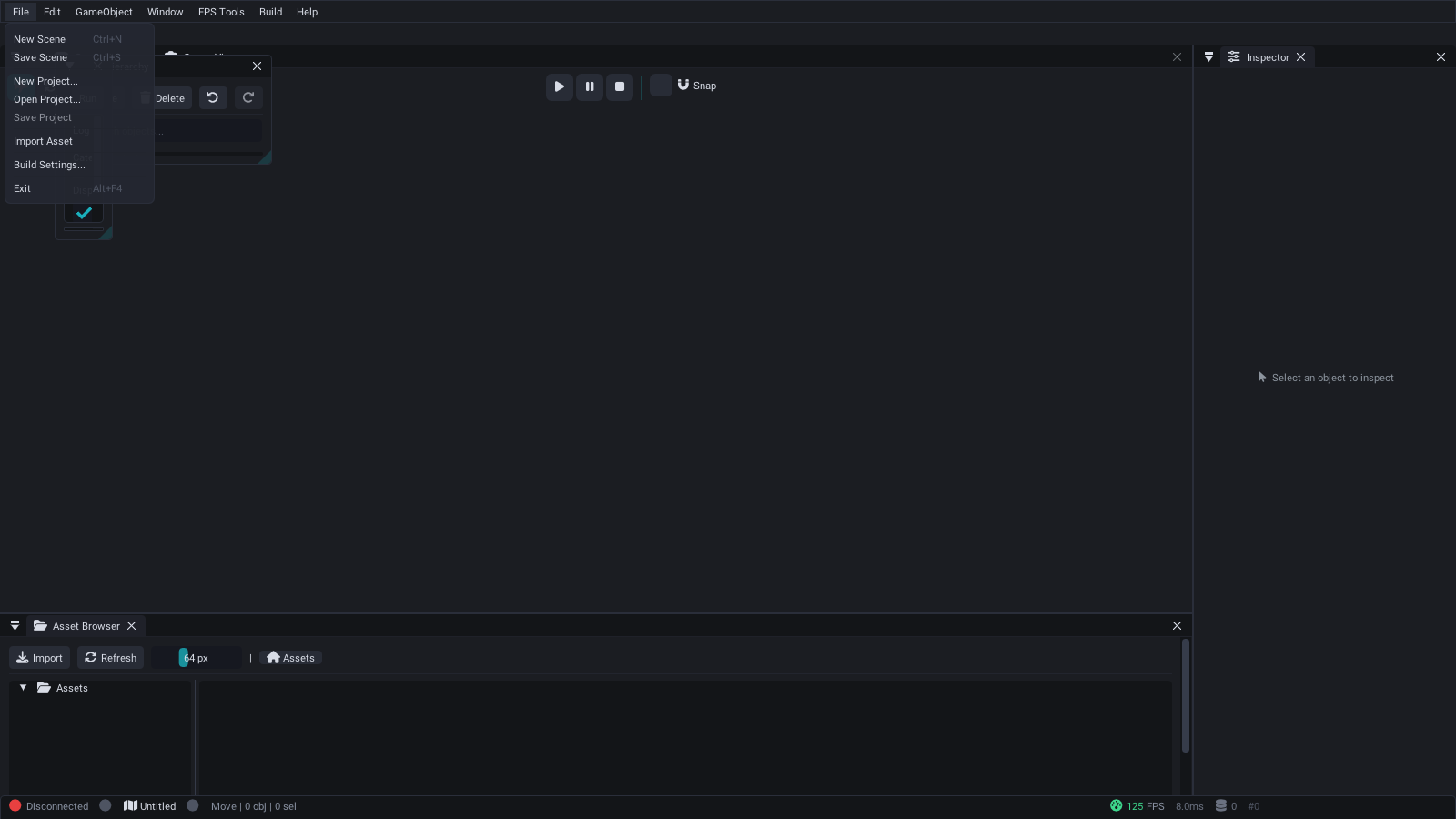
- Open Scene... (the default action), New Scene, Open Project Folder and Reset workspace layout (an explicit reset; the editor no longer resets the layout silently);
- Recent scenes, the last ten scenes you opened or saved, newest first;
- a keyboard-shortcut sheet;
- Show at startup, saved with your preferences.
Esc closes the tab; Help > Welcome... or View > Start Page reopens it.
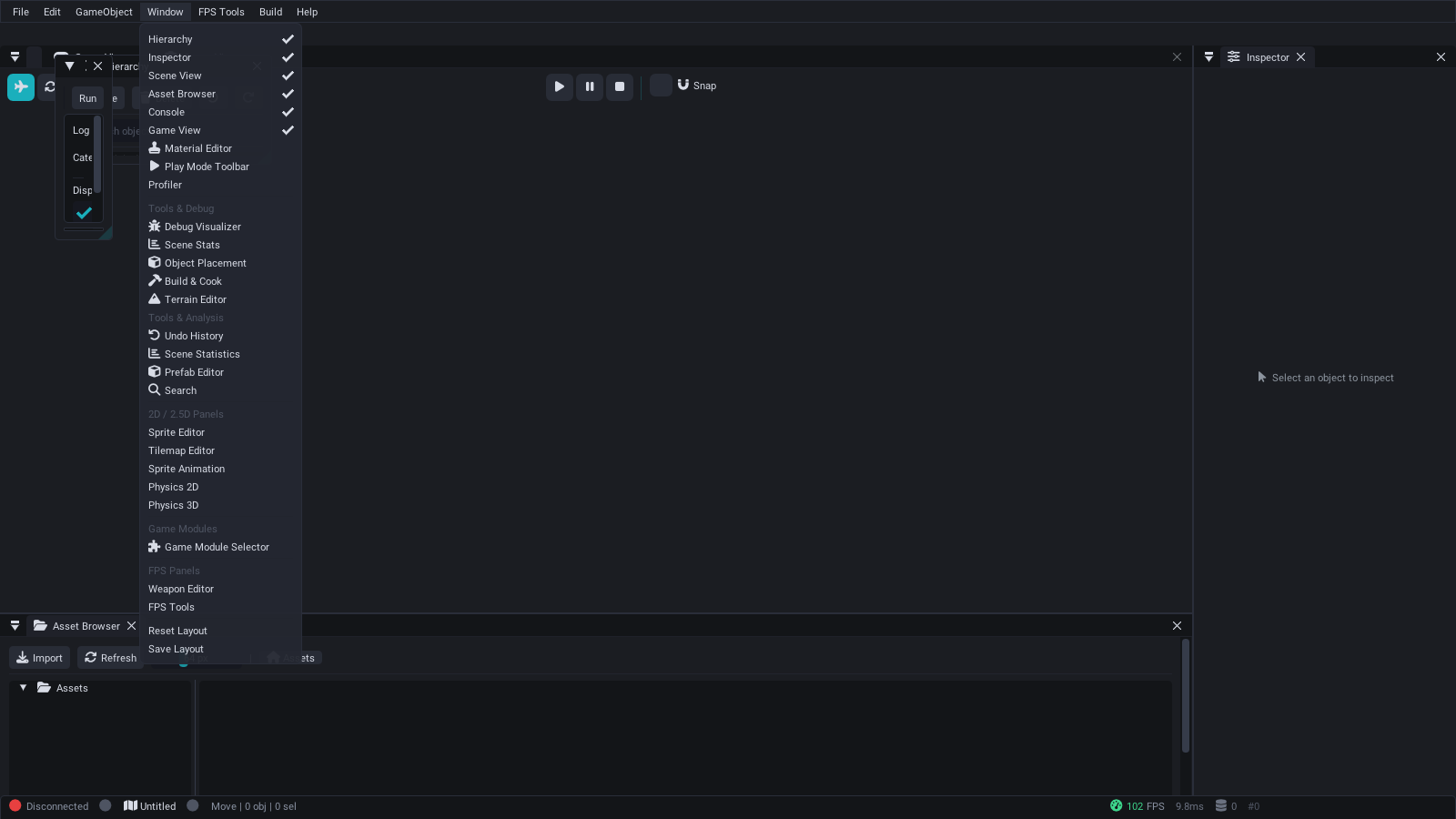
- Menu bar: File, Edit, View, GameObject, Window, FPS Tools, Build and Help (plus plugin menus).
- View menu: Appearance..., UI Scale (Increase, Decrease, Reset to 100%), Status Bar, Start Page and Command Palette (Ctrl+P).
- Toolbar: Move/Rotate/Scale and World/Local are segmented controls (W, E, R switch tools), the play controls sit in the centre, then snapping and the layout menu.
-
Status bar: a bar along the bottom of the window. It shows EDIT, or
PREVIEW with the whole bar in the ember accent while a play preview or a
launched game runs; connection, project and scene (the scene name gains a
*and a warning tint while it has unsaved changes); tool, object and selection counts; FPS and frame time (amber below 30 FPS, red below 15); the notification bell; and the UI scale (click it to reset). Hide it from View > Status Bar. - Notifications: toasts stack upward from the bottom-right corner, above the status bar. Each has a severity icon and word: Info and Success stay 4 seconds, Warning 8 seconds, and Error until you dismiss it. Hovering a toast or giving it keyboard focus pauses it; at most four are on screen, and the bell keeps the last 50 for review.
Additional panels can be enabled from the Window menu at any time:
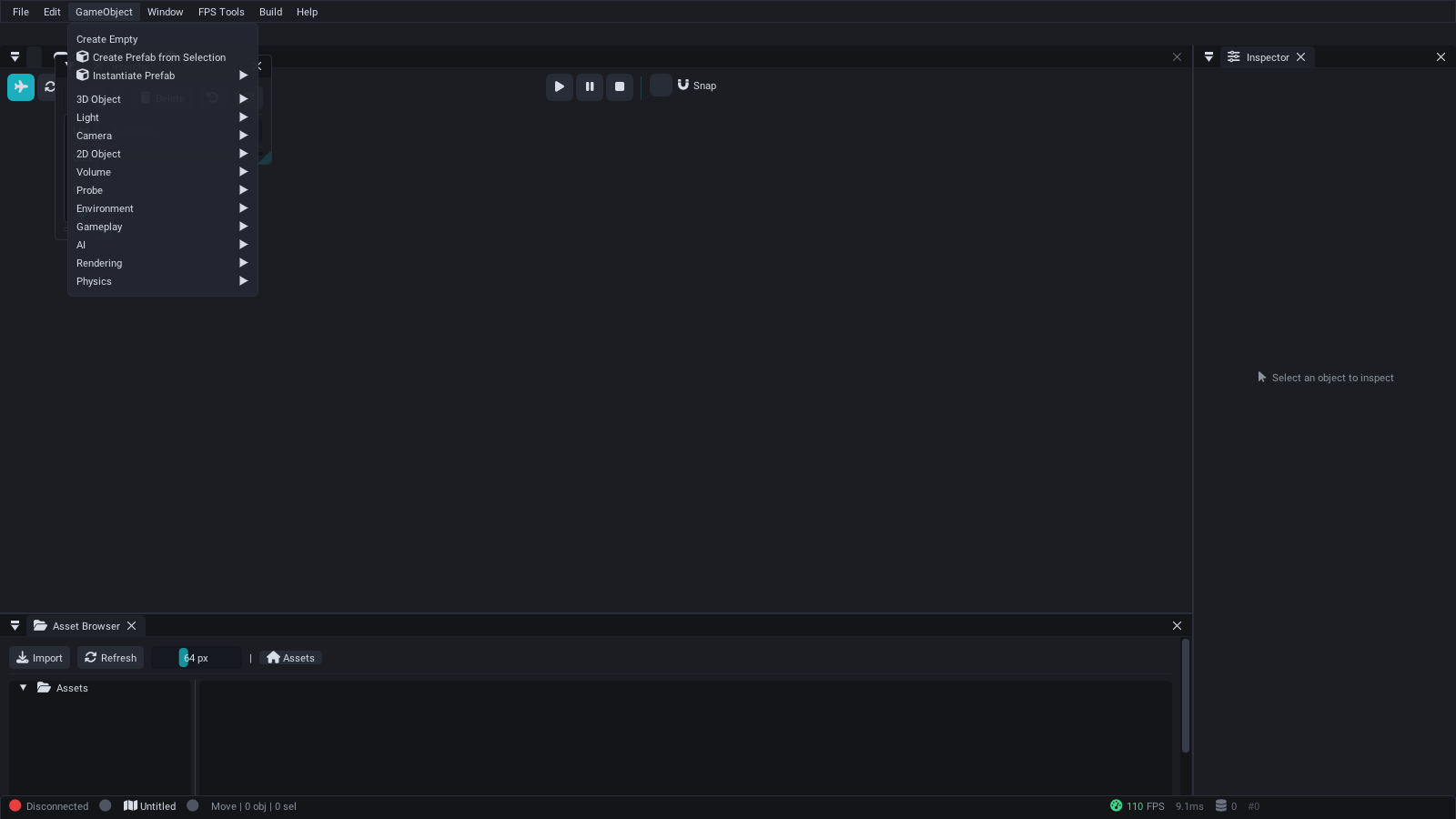
Create entities with pre-configured components:
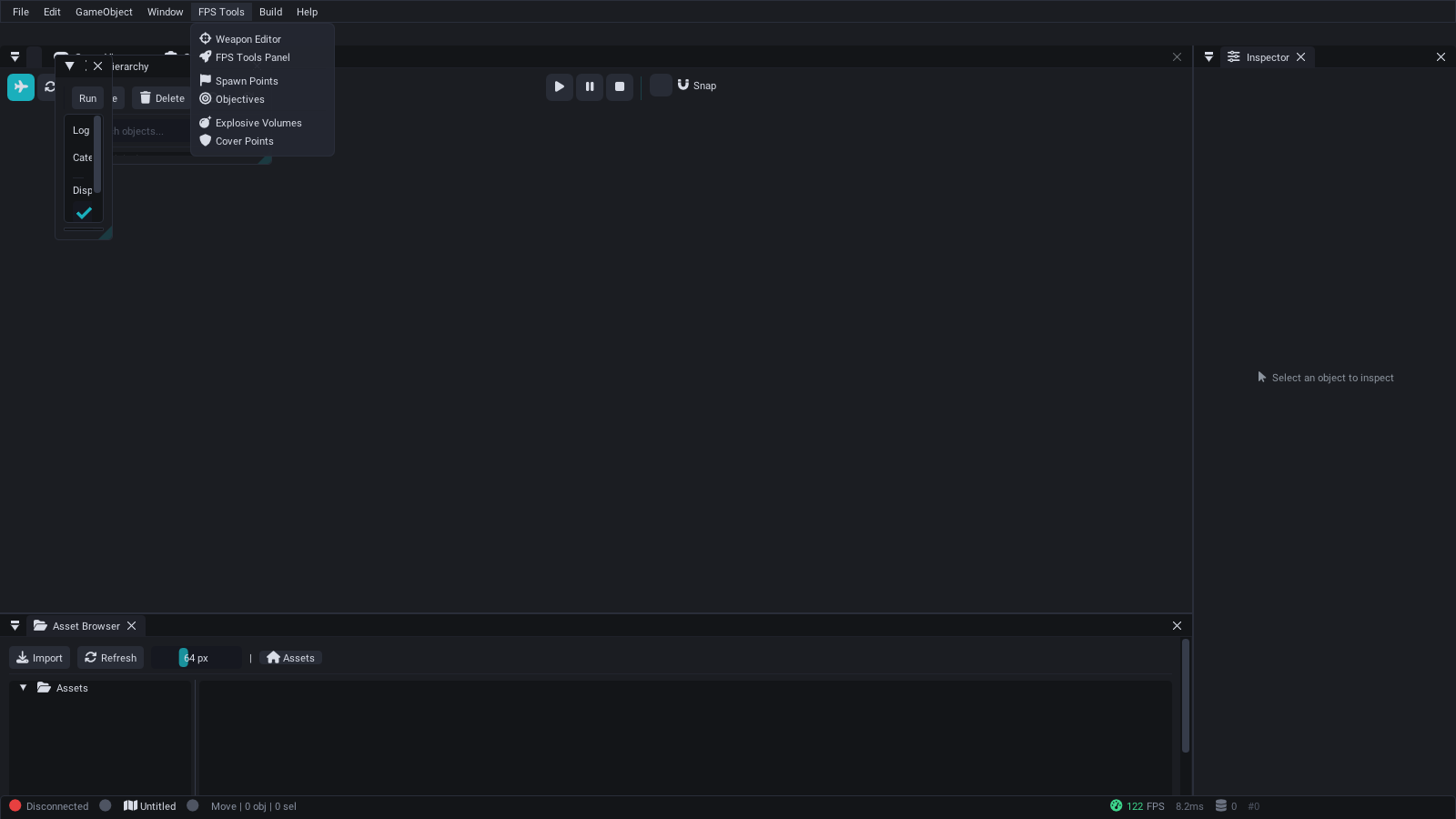
Weapon editor, spawn points, objectives, explosives, and cover points:
Source: SparkEditor/Source/
Platforms:
- Windows: Win32 + DirectX 11 ImGui backends (primary)
- Linux: Experimental SDL2 + OpenGL 3.3 ImGui path; Mesa llvmpipe is an explicitly configured development route, not certified support
ENABLE_EDITOR=ON
EditorApplication
  |
  +-- EditorUI
  |     |
  |     +-- EditorLayoutManager   (dock positions, panel visibility, layout save/load)
  |     +-- EditorTheme           (color palette, rounding, spacing, font config)
  |     +-- EditorPanel* panels[] (registered panel set)
  |     +-- SceneViewPanel gizmos  (translate/rotate/scale, one value via EditorUI::SetTransformTool)
  |     +-- UndoRedoManager       (command history stack)
  |     +-- CommandPalette        (Ctrl+P quick-command search)
  |
  +-- EditorPluginManager         (built-in + DLL plugin lifecycle)
  +-- SceneManager                (scene load/save/serialize)
  +-- PrefabManager               (prefab asset CRUD)
  +-- VersionControlSystem        (optional git integration; git runs from an argument vector, no shell)
  +-- BuildCookPanel               (cook, package, deploy)
  +-- PerformanceProfiler         (frame time, FPS, percentiles; CPU samples only from imported captures)
The entry point is EditorApplication (Core/EditorApplication.h). On Windows it
owns the Win32 window and DirectX 11 device/context/swap chain; the experimental
Linux implementation owns an SDL2 window and OpenGL 3.3 context. Each platform
path owns its ImGui context and backend bindings.
struct EditorConfig
{
    std::string projectPath = ".";
    std::string layoutDirectory = "Layouts";
    std::string logDirectory = "Logs";
    bool enableLogging = true;
    bool startMaximized = true;
    float autoSaveInterval = 30.0f;
    int windowWidth = 1600;
    int windowHeight = 900;
};

class EditorApplication
{
public:
    bool Initialize(const EditorConfig& config);
    int  Run();
    void Shutdown();
    bool IsRunning() const;
    void RequestExit();
    PerformanceMetrics GetPerformanceMetrics() const;
    void OnWindowResize(int width, int height);
    void SetWindowTitle(const std::string& title);
};Each frame executes the following steps:
-
ProcessMessages()-- Win32 message pump or the Linux SDL2 event loop -
Update(deltaTime)-- tick all panels, the Scene View gizmo interaction, profiler -
Render()-- begin the platform ImGui frame, render visible panels, and present through DX11 or swap the SDL/OpenGL window
Every panel inherits from EditorPanel (Core/EditorPanel.h), which provides a consistent interface:
class EditorPanel
{
public:
    EditorPanel(const std::string& name, const std::string& id);
    virtual ~EditorPanel() = default;

    virtual bool Initialize() = 0;
    virtual void Update(float deltaTime) = 0;
    virtual void Render() = 0;
    virtual void Shutdown() {}
    virtual bool HandleEvent(const std::string& eventType, void* eventData);

    // Visibility and state
    bool IsVisible() const;
    void SetVisible(bool visible);
    bool IsFocused() const;
    void SetFocused(bool focused);
    bool IsClosable() const;
    bool IsModified() const;

    // Persistence
    virtual std::string SaveState() const;
    virtual bool LoadState(const std::string& state);

    // Geometry
    void GetSize(float& width, float& height) const;
    void SetSize(float width, float height);
    void GetPosition(float& x, float& y) const;
    void SetPosition(float x, float y);

protected:
    bool BeginPanel();   // Sets up ImGui window
    void EndPanel();     // Finishes ImGui window
    void NotifyStateChange();
};The generated inventory below tracks source *Panel.h headers rather than a fixed count of registered, visible, or certified subsystem panels.
- Tree view of all scene nodes with parent-child relationships
- Drag-and-drop to reparent nodes
- Right-click context menu for add/delete/duplicate
- Search and filter nodes by name or type
- Property editor for the selected node/entity
- Transform editing (position, rotation, scale)
- Component editing with type-appropriate widgets
- Material assignment and configuration
- Component reflection via
ComponentReflection.h - Asset drops onto World entities: dragging a mesh or material from the Asset
Browser onto
MeshRenderer's Mesh Path or Material Path field validates theAssets/...reference against that slot's kind (wrong kind and path traversal are refused), flushes any field edit still being typed, and records one "Assign Mesh Asset" / "Assign Material Asset" undo step (Panels/InspectorWorldAssetDrop.h). The assignment is saved with the reflected scene. Regression coverage:Tests/TestEditorAssetDropWorldReal.cpp.
- Real-time 3D preview of the scene
- Play/pause/stop game simulation via
PlayModeToolbarPanel - Camera controls (orbit, pan, fly-through)
- Grid and axis overlays
The Scene View ships all three transform gizmos for selected World entities on
Windows: translate arrows, rotate rings, and scale box handles. Each drag commits
exactly one CommandHistory entry (SceneEditTools::CommitEntityRotation /
CommitEntityScale / translation), so a gizmo edit is a single undo step. Grid snap
applies 15 degrees to rotation and 0.1 to scale when snapping is enabled. The
toolbar buttons, the W/E/R hotkeys, the command palette, and the Scene View
toolbar all drive one value (EditorUI::SetTransformTool); previously they only
changed a status-bar label. The separate Gizmos/GizmoSystem class was deleted
as a duplicate of this path (see Stub and Abandoned Features).
Regression coverage: Tests/TestEditorGizmoTransformReal.cpp.
Asset Browser (see Asset Pipeline)
- File-system view of project assets
- Drag-and-drop assets into the scene
- Thumbnail previews for textures and models
- Dependency tracking via
AssetDependencyPanel
Material Editor (see Shader Pipeline)
- PBR material authoring
- Texture slot assignment
- Real-time preview sphere
- Blend mode and shader selection
Removed. The SparkEditor/Source/Animation/ timeline, clip manager, curve, and
playback classes had no production caller and were deleted rather than completed.
Sprite animation authoring lives in the Sprite Animation Editor Panel.
Terrain Editor (see Terrain and Procedural Generation)
- Heightmap painting (raise/lower/smooth/flatten)
- Texture splatting brush
- Object placement brush via
ObjectPlacementPanel - Terrain configuration (size, resolution, LOD)
- Save writes
.sparkterrainv2 to an editable project-relative path (defaultAssets/Terrains/<name>.sparkterrain, overwrite confirmation, directory created); texture layers have Diffuse/Normal fields and detail meshes a Mesh Path field
Weapon Editor (see Gameplay Systems)
A balance calculator: DPS chart and comparison table over weapon stats (damage, fire rate, spread, reload). Edits are session-only -- the panel cannot save, the no-op "Save All" button was removed, and no game module reads its values.
- Visual scripting nodes (see Scripting with AngelScript)
- Material graph editor
- Connection-based data flow
- Frame time, FPS, and frame-time percentiles (measured live)
- CPU sample hierarchy and draw-call/triangle counters are populated only from an imported capture file;
ProfileScope/PROFILE_SCOPEwere deleted and no panel is instrumented, so there is no live CPU sample producer - Memory usage tracking
- Frame time history
Debug console with real-time log streaming (the panel subscribes to Spark::Logger), severity filtering, and command execution.
- Real-time log output with color-coded severity (Info, Warning, Error, Fatal)
- Command input with Tab auto-completion and Up/Down history
- Case-insensitive text search across log output (substring match, not regex)
The Version Control panel launches git from an argument vector with no shell, so commit messages, branch names, and paths containing spaces, quotes, ampersands, or semicolons are accepted verbatim; the former "File path contains unsafe characters" guard is gone, commit messages are no longer mangled, and commit subjects no longer carry a trailing quote.
- Export logs to txt or csv
- Configurable scroll behavior (auto-scroll, pause on hover)
Source: SparkEditor/Source/Panels/ConsolePanel.cpp
3D viewport for editing the scene with editor camera controls.
- Orbit, pan, and fly-through camera modes
- Grid overlay with configurable spacing
- Multiple render modes (lit, wireframe, unlit, normals)
- Translate/rotate/scale gizmo rendering and interaction for selected entities (Windows path)
- Click-to-select entities via raycasting
Source: SparkEditor/Source/Panels/SceneViewPanel.cpp
Transport controls for the editor's explicitly labelled state preview. This is
not an in-editor game session: PlayModeManager::Update advances local
time and statistics counters, but the editor does not tick the game's ECS,
physics, AI, or scripting systems through this control. The subsystem toggles
affect those counters, not live gameplay. The authored scene remains a
preview. The prominent toolbar button and F5/F6 shortcuts open Play Control
instead of entering this preview, so the normal play affordance routes to the
verified out-of-process workflow.
To test actual gameplay, select a module and use the separate Play Control panel's Launch Game action, which starts SparkEngine in another process. That workflow requires its own installed-package validation.
- Explicit state-preview, Pause, Stop, and Step-Frame buttons
- Time-scale slider (0.1x to 10x)
- Per-subsystem toggle (physics, AI, audio, particles)
- Camera mode switching (editor camera vs. game camera)
- State-machine frame statistics overlay (not measured gameplay-system work)
Source: SparkEditor/Source/Panels/PlayModeToolbarPanel.cpp
Build configuration and packaging pipeline.
- Profile selection: Debug, Development, Release, Shipping
- Asset cooking with progress tracking
- Platform targeting (Windows, Linux, macOS stubs)
- Output directory configuration
- Build log with error/warning highlights
Source: SparkEditor/Source/Panels/BuildCookPanel.cpp
Runs the project's build workflows from inside the editor.
- Build workflows configure with the host preset (
windows-releaseon the stable-v1 platform) rather thanlinux-gcc-release - Clean & Rebuild requires an explicit confirmation, deletes only the open project's build directory, and fails with a clear message when no project is open
- Running a workflow still blocks the editor UI for the duration of the process
Source: SparkEditor/Source/Panels/WorkflowPanel.h
Launch and monitor a SparkServer process from the editor.
- Server cook settings and launch configuration for the single launch map (the Maps tab is a pick-list for that map)
- Local server launch for testing; the browser lists only the server launched from this editor (there is no discovery transport)
- Join is disabled until an editor client transport exists
- Monitoring shows uptime plus the player count parsed from SparkServer's health report
There is no LAN auto-discovery, no RCON console, and no kick/ban player list.
Source: SparkEditor/Source/Panels/DedicatedServerPanel.cpp
Preview - not connected. The grid, wireframe, collider, physics-contact,
navmesh, light-radius, and audio-range toggles are authored in the panel, but no
renderer consumes them yet and the panel reports no debug-draw counts. It is
listed in Stub and Abandoned Features
until SceneViewPanel reads it.
Source: SparkEditor/Source/Panels/DebugVisualizerPanel.cpp
Real-time EventBus inspector for debugging event-driven systems.
- Live event stream during play mode
- Filter by event type or source
- Event payload inspection
- Pause/resume event capture
Source: SparkEditor/Source/Panels/EventMonitorPanel.cpp
Visual dialogue tree authoring tool.
- Node types: Text, Choice, Branch, Event, End
- Speaker name and voice clip assignment per node
- Branching condition configuration
- Preview dialogue flow in-editor
Source: SparkEditor/Source/Panels/DialogueEditorPanel.cpp
Specialized tools for first-person shooter level design and balancing.
- Spawn point placement and team assignment
- Game mode configuration (Deathmatch, CTF, Domination)
- Player stats testing (health, armor, speed)
- Combat simulation for balance testing
- Level design helpers (cover analysis, sight lines)
Source: SparkEditor/Source/Panels/FPSToolsPanel.cpp
Live scene metrics dashboard, reading the open scene's World.
- Entity and component counts by type (from the open scene's World)
- Render statistics: draw calls and batches as reported by the scene viewport (only while it reports stats); triangle/vertex/shader/texture-VRAM figures are not measured
- Physics statistics: rigid bodies, contacts, constraints -- only while a game session runs
- Memory: the editor process working set (there is no per-asset mesh/texture/audio breakdown)
- Per-frame performance graphs with history
Source: SparkEditor/Source/Panels/SceneStatisticsPanel.cpp
Fuzzy search over the open scene and the project asset root.
- Search entities by name and by the reflected component types on those entities
- Search file names under the project asset root
- Selecting an entity result selects it in the editor; asset results report their path
- Search history with recent queries
Property-value search does not exist.
Source: SparkEditor/Source/Panels/SearchPanel.cpp
Creates real, undoable entities from the editor's entity templates.
-
Quick Place and Place Selected create entities through
CommandHistory - Entity template list (there is no drag-and-drop and no
PrefabManagerlookup) - Brush, line, grid, and scatter modes, align mode, and snap settings are authored in the panel but not yet read by the viewport -- they are not working placement modes
Source: SparkEditor/Source/Panels/ObjectPlacementPanel.cpp
Create, edit, and manage prefab assets.
- Prefab browser with search
- Component editing within prefab context
- Property serialization and override tracking
- Create prefab from selected entities
- Apply prefab changes to all instances
Source: SparkEditor/Source/Panels/PrefabEditorPanel.cpp
Project-level hub for opening, creating, and managing projects.
- Recent projects list with last-opened timestamps
- New project wizard with templates (FPS, RPG, Blank)
- Existing project browser with folder navigation
- Project settings quick-access
Source: SparkEditor/Source/Panels/ProjectBrowserPanel.cpp
Visual particle system authoring.
- Emission rate, lifetime, and burst configuration
- Emitter shapes: Point, Sphere, Cone, Box
- Color gradient editor over particle lifetime
- Physics integration (gravity, wind, collision)
- Live preview in viewport
Source: SparkEditor/Source/Panels/ParticleEditorPanel.cpp
The separate PostProcessingPanel was removed: it edited a SceneFile-backed
document model the editor no longer builds. Add a Post-Process Volume
component to an entity and edit bloom, tonemapping, fog, and related settings in
the Inspector.
String table editor for multi-language support.
- Supported languages: English, Spanish, French, German, Japanese, Chinese
- Key/value translation table with inline editing
- Missing translation highlighting
- Import/export CSV for translator workflows
Source: SparkEditor/Source/Panels/LocalizationPanel.cpp
Save/Load slot manager over the real save directory.
- Lists the
.spark_savefiles in the save directory with their metadata (timestamp, playtime, level) - Rename and delete slots
-
Load requires a running game session (a live
Worldin the engine context) and at least one enumerated slot; it is disabled otherwise - Export/Import were removed
Source: SparkEditor/Source/Panels/SaveSystemPanel.cpp
The Region Map Editor discovers every Terrafront continent lattice declared by
Assets/MMOFPS/Data/continents.json. Switching maps is disabled while the
current map has unsaved edits. Save validates the serialized document with the
strict JSON parser, refreshes that selected map's sibling .bak, and atomically
replaces only its declared region file, so an interrupted write cannot truncate
the live lattice.
Source: SparkEditor/Source/Panels/RegionMapEditorPanel.h
Spline path authoring for cameras, AI, and procedural content.
- Control point creation and editing
- Curve types: Catmull-Rom, Bezier
- Closed loop toggle
- Tension parameter adjustment
- Visual preview in scene view
Source: SparkEditor/Source/Panels/SplineEditorPanel.cpp
Applies the engine's own weather presets to the running WeatherSystem.
- Shows the engine's weather-type presets read-only
- Applies a selected type, intensity, and transition time to the running
WeatherSystem - With no game session the panel shows Preview - not connected
Custom presets, per-field authoring, and preset persistence do not exist.
Source: SparkEditor/Source/Panels/WeatherFogPanel.cpp
Visual timeline of the undo/redo command stack.
- Chronological command list with descriptions
- Click to jump to any point in history
- Current position indicator
- Saved state marker
Source: SparkEditor/Source/Panels/UndoHistoryPanel.cpp
Behavior tree visual editor.
- Node creation for Selector, Sequence, Decorator, Action types
- Template management for reusable tree patterns
- Agent inspection with live blackboard values
- Tree validation and error highlighting
Source: SparkEditor/Source/Panels/AIEditorPanel.cpp
Real-time AI agent runtime inspector for play-mode debugging.
- Agent list with color-coded state (Idle, Patrol, Alert, Combat, Flee, Dead)
- Per-agent blackboard variable viewer with type-aware display
- Behavior tree execution trace with active node highlighting
- Perception overlay toggles (detection ranges, attack ranges, nav paths, target lines)
- AI system statistics (agent counts by state, targets)
- State filtering and configurable refresh rate
Source: SparkEditor/Source/Panels/AIDebugPanel.cpp
2D physics configuration and debugging.
- Gravity vector configuration
- Collision layer matrix editor
- Debug visualization: AABBs, contacts, grid
- Interactive raycast testing tool
Source: SparkEditor/Source/Panels/Physics2DPanel.cpp
Sprite configuration for 2D rendering.
- Texture selection and source rectangle editing
- Pivot point setup with visual indicator
- Sorting layer and order assignment
- Color tint and flip controls
Source: SparkEditor/Source/Panels/SpriteEditorPanel.cpp
2D animation clip authoring.
- Frame-by-frame timeline with keyframe editing
- Per-frame duration control
- Preview with play/pause/step controls
- Onion skinning for animation reference
Source: SparkEditor/Source/Panels/SpriteAnimationEditorPanel.cpp
Tile-based map editing.
- Tools: Paint, Erase, Fill, Rectangle
- Collision layer painting
- Auto-tiling rules configuration
- Zoom and pan viewport
- Panel-local undo/redo commands; this does not establish complete editor-wide coverage
Source: SparkEditor/Source/Panels/TilemapEditorPanel.cpp
Game viewport with a simulated FPS HUD preview.
- The HUD overlay (crosshair, health/armor bars, ammo, minimap, kill feed, scoreboard) is generated by the editor and labelled on screen as
SIMULATED HUD - not game data; it is not connected toSparkGameFPSstate - The Game View fly camera no longer moves the scene's authored camera
- F5/F6 open Play Control. Select a module and use Launch Game for a real game process.
Source: SparkEditor/Source/Panels/GameViewPanel.cpp
SparkEditor contains an experimental multi-user collaboration implementation outside stable-v1. See Collaborative Editing for development documentation.
Key features:
- Peer presence — see other editors' selections and viewport cameras
- Node locking — pessimistic locks prevent conflicting edits
- Edit broadcasting — changes are visible across all editors in real-time
- Auto-expiry — locks expire after 5 minutes to prevent blocking
Source: SparkEditor/Source/Communication/CollaborativeEditSession.h
The UndoRedoManager (UndoRedo/UndoRedoManager.h) maintains command stacks. For the World document the following mutations are all command-backed and undoable (regression coverage in Tests/TestEditorUndoHierarchyReal.cpp and Tests/TestEditorGizmoTransformReal.cpp):
| Operation | Entry points |
|---|---|
| Create / delete / duplicate entity | Hierarchy context menu, Ctrl+D, Delete key |
| Rename entity |
F2, double-click, context menu, toolbar |
| Reparent | Hierarchy drag-and-drop |
| Translate / rotate / scale | Scene View gizmos (one command per drag) |
| Inspector property edits | Reflected component fields |
Editor-wide certification is still open under EDT-210 because the asset drag/assign path and the author-to-package round trip are not yet gated:
class UndoRedoManager
{
public:
    void ExecuteCommand(std::unique_ptr<EditorCommand> command);
    bool Undo();
    bool Redo();
    void UndoToIndex(size_t targetIndex);

    bool CanUndo() const;
    bool CanRedo() const;
    std::string GetUndoDescription() const;
    std::string GetRedoDescription() const;

    void Clear();
    void MarkSaved();
    bool HasUnsavedChanges() const;

    size_t GetMaxStackDepth() const;           // Default: 100
    void SetMaxStackDepth(size_t depth);
    void SetOnStackChanged(std::function<void()> callback);
};
Operations use ExecuteCommand() and implement EditorCommand::Execute() / Undo(). Executing a new command clears the redo stack, and UndoHistoryPanel exposes the recorded command history.
The editor's look comes from the shared SparkUI token library (the "Ember
Signal" design), which also styles SparkLauncher, the SparkInstaller GUI and the
in-game overlay. EditorTheme is the editor's adapter over those tokens.
Open View > Appearance... (or Help > Themes...). Changes apply immediately and are saved per user:
| Setting | Choices |
|---|---|
| Palette | Ember Studio (default), Cobalt Forge, Graphite Signal, plus registered or imported custom themes |
| Appearance | Dark, Light, High Contrast, or Match Windows (follows the Windows app theme and high-contrast setting) |
| Density | Standard (25 px controls at 100 %) or Compact (21 px) |
| UI scale | Auto (the monitor's display scale) or 75-200 % in 12.5 % steps |
| Accessibility and workspace | Always show keyboard focus, Reduce motion (turns off every fade and pulse), Show status bar, Show Start page at startup |
Custom and imported palettes are applied exactly as written and show a live contrast-audit badge; the built-in palettes pass that audit by construction. Reset to defaults restores every setting.
UI scale shortcuts: Ctrl+= (or keypad +) and Ctrl+- (or keypad -) step the scale by 12.5 %; Ctrl+0 returns to Auto. They do nothing while a text field has focus. The scale is also in View > UI Scale and on the status bar. On Windows the editor is Per-Monitor-V2 DPI aware, so it rescales when you move it to a monitor with another scale; neither scaling nor a palette change rebuilds the font atlas.
Preferences are stored in editor-preferences.ini in the per-user editor data
directory: palette, appearance, UI scale, density, the accessibility toggles,
the last layout and the recent scenes. The reader is bounded (64 KiB, a required
version header, known keys only, clamped numbers), so a damaged file is
ignored with a console warning and the defaults are used.
Use SparkEditor.exe --theme "Cobalt Forge" (or another exact name below) to
override the palette for one session; the saved preference is left alone.
The EditorTheme class (Core/EditorTheme.h) registers these built-in themes:
| Theme | Description |
|---|---|
| Ember Studio | Warm charcoal, ember accent, cyan data highlights (default) |
| Cobalt Forge | Cool slate, cyan accent, violet data highlights |
| Graphite Signal | Neutral graphite, silver accent, mint data highlights |
| Professional Light | Ember Studio on light surfaces (the Light appearance) |
| High Contrast | Ember Studio at 7:1 text contrast with a yellow focus ring (the High Contrast appearance) |
Choosing Professional Light or High Contrast as a palette is saved as Ember Studio with the Light or High Contrast appearance.
Retired built-in names remain accepted as compatibility aliases without extra picker entries: Spark Professional, Spark Ember, and Orange Accent resolve to Ember Studio; Spark Fusion, Unreal Pro, and Blue Accent resolve to Cobalt Forge; Unity Pro, VS Pro, and JetBrains resolve to Graphite Signal. Explicitly registered custom themes retain their names and take precedence over compatibility aliases. Unknown names fall back to Ember Studio.
The EditorThemeData struct contains 60+ color properties organized into groups:
-
Background:
background,backgroundDark,backgroundLight,backgroundAccent,backgroundHeader,backgroundActive,backgroundHover,backgroundSelected -
Text:
text,textDisabled,textSecondary,textAccent,textWarning,textError,textSuccess -
Buttons:
button,buttonHovered,buttonActive,buttonDisabled -
Frames:
frame,frameHovered,frameActive -
Borders:
border,borderLight,borderAccent,borderSeparator - Tabs/Scrollbars/Menus: full color sets for each
- Style values: rounding, border sizes, padding, spacing, shadows, font size
// Apply a built-in theme
EditorTheme::ApplyTheme("Ember Studio");

// Create a blended theme
EditorTheme::CreateBlendedTheme("Unity Pro", "Unreal Pro", 0.5f, "HybridTheme");

// Export/import custom themes
ThemeCustomizer::ExportTheme(theme, "MyTheme.json");
ThemeCustomizer::ImportTheme("MyTheme.json", theme);

// Open View > Appearance
ThemeCustomizer::ShowThemeEditor();
ExportTheme writes a versioned theme document that keeps every colour, metric
and flag, and ImportTheme reads it back through the bounded
EditorThemeDocument parser (fuzzed as SparkFuzzEditorThemeImport).
The EditorLayoutManager (Core/EditorLayoutManager.h) handles docking, saving, and loading panel layouts:
enum class DockPosition { Left, Right, Top, Bottom, Center, Float };

struct PanelConfig
{
    std::string name;
    std::string displayName;
    DockPosition dockPosition;
    ImVec2 size;
    ImVec2 position;
    bool isVisible;
    bool isFloating;
    bool canClose;
    bool canDock;
    float dockRatio;    // Ratio of parent space to occupy
    int tabOrder;
    std::string parentDock;
};
The editor uses ImGui's docking branch for a fully customizable workspace:
- Drag panels to dock at any edge
- Create floating windows
- Save and load layout configurations
- Reset to default layout
Layouts are managed from two places:
- Window menu: Reset Layout, Save Layout (saves "Custom Layout"), Save Layout As... (prompts for a name), Load Layout and Delete Layout (each lists the saved layouts).
- Toolbar layout menu (right end of the toolbar): Default, the saved layouts, Save Layout As..., Delete... (asks for confirmation) and Reset.
Layout names are validated before they become file names. The Start page's Reset workspace layout rebuilds the default dock tree.
One-time layout shift (Ember Signal): the status bar is now a viewport side bar, so the dock area ends above it instead of running underneath it. Layouts saved by an earlier editor load with the bottom dock node about 26 px shorter at 100 % UI scale; nothing is hidden behind the status bar any more. Save the layout again to keep the new geometry, or hide the status bar from View > Status Bar to get the space back.
The EditorPluginManager (Core/EditorPluginManager.h) supports both built-in and DLL-loaded editor plugins:
class EditorPluginManager
{
public:
    // Registration
    template<typename T> bool RegisterPlugin();
    bool LoadPlugin(const std::string& path);
    bool UnloadPlugin(const std::string& name);

    // Lookup
    IEditorPlugin* GetPlugin(const std::string& name) const;
    size_t GetPluginCount() const;
    std::vector<std::string> GetPluginNames() const;

    // Lifecycle
    bool InitializeAll(EditorApplication* app);
    void ShutdownAll();
    void UpdateAll(float deltaTime);
    void RenderAll();

    // Events
    void NotifySceneLoad(const std::string& scenePath);
    void NotifySceneSave(const std::string& scenePath);
    void NotifyEntitySelected(uint32_t entityID);
    void RenderMenuBarItems();

    // Panel registration from plugins
    void RegisterPanel(std::unique_ptr<EditorPanel> panel);
};
Plugins implement the IEditorPlugin interface and are loaded at startup or dynamically at runtime. Each plugin can register custom panels, menu items, and respond to editor events.
# Windows (preferred): CMake presets
cmake --preset windows-release
cmake --build --preset windows-release

# build.ps1 remains supported; ENABLE_EDITOR defaults ON, and -editor only forces it ON
.\build.ps1 -config Release -editor- All panel rendering uses immediate-mode ImGui; no retained scene graph overhead.
- The
PerformanceProfilerreports frame time, FPS, and percentiles; it has no per-panel or CPU-sample producer (PROFILE_SCOPEwas deleted), so bottleneck hunting needs an imported capture or an external profiler. - Gizmo rendering uses dedicated DX11 vertex/pixel shaders with minimal draw calls.
- The
EditorApplicationframe loop targets 60 FPS; the editor can optionally cap to lower rates when idle.
- All editor UI code runs on the main thread.
- The
EditorApplicationholds the DX11 device and context; rendering is single-threaded. - Background asset imports (if any) communicate results back to the main thread via queues.
- The
SimpleConsolePanelwraps the engine's thread-safeSimpleConsole.
- Verify
ENABLE_EDITOR=ONis set in CMake. - Confirm you are building on Windows with MSVC.
- Check that DirectX 11 runtime is available (Windows 10+ includes it).
- Check that the panel's
SetVisibleInMenu(true)is called during registration. - If the panel was loaded from a plugin, verify the plugin initialized successfully.
- Ensure the Scene View panel has focus so it receives mouse events before ImGui consumes them.
- Check the active transform tool (
W/E/Ror the toolbar) -- all surfaces driveEditorUI::SetTransformTool. - Verify at least one
Worldentity is selected in the hierarchy.
SparkEditor installs a Windows unhandled-exception filter at startup and
restores the previous filter on shutdown. Dumps and logs are written under the
per-user editor data directory (not a CWD-relative Crashes/). The recovery
dialog and RecordOperation journaling are still unwired (EDT-210), so a crash
leaves a dump but does not offer scene recovery.
- Open View > Appearance..., check the palette and appearance, or use Reset to defaults. A custom or imported palette that fails the contrast audit shows a warning badge there.
- For missing fonts or icons, check the startup log from
EditorFonts::LoadFonts()and the packagedEditorAssets/Fontsdirectory beside the executable. Fonts are loaded at startup; changing the palette or the UI scale does not reload the font atlas. - If text is too small or too large, press Ctrl+0 to return to Auto scale, or pick a fixed scale in View > Appearance....
- Report any panel that retains a fixed color across palettes; custom drawing should use the active theme's semantic colors or ImGui style colors.
- Time slider (0-24h) with formatted HH:MM display
- Time scale control (1x, 10x, 60x, 600x) with pause/resume
- Preset buttons: Dawn, Morning, Noon, Dusk, Midnight
- Sun direction, color, and intensity preview with color swatches
- Ambient lighting state display
- Day/night indicator and day period classification
- Day cycle progress bar
- Tabbed view: Abilities, Auras, Procs
- Ability authoring: targeting, range, cast time, cooldown, resource cost, channeling
- Aura authoring: type, school, duration, tick interval, modifiers, stacking
- Proc authoring: trigger mask checkboxes, chance, cooldown, charges
- Filterable lists with create/delete operations
- List of proximity trigger volumes with ID, shape, label, enabled state
- Create dialog for sphere/AABB triggers with center and size parameters
- Per-trigger detail editor (shape, center, radius/extents, enabled, occupant count)
- Viewport visualization toggle
- Visual condition set builder with AND/OR group logic
- 27 condition types matching ConditionSystem enum (IsAlive, HasItem, QuestComplete, etc.)
- Negation toggle per condition
- World variable editor (name/value pairs with add/edit/delete)
- World flag editor (boolean toggle list)
- Decal material list with create/delete
- Per-material texture paths (albedo, normal, roughness), opacity, fade time
- Surface-to-decal mapping table (Concrete, Metal, Wood, etc.)
- Active decal count display and "Clear All" button
- Max decal pool size configuration
- Scene Management -- Scene hierarchy and serialization
- Rendering and Graphics -- Material system and render pipelines
- Animation -- Animation state machines and timeline
- Cinematic Sequencer -- Timeline editor
- Entity Component System -- Component architecture
- Shader Pipeline -- Shader authoring and compilation
- Asset Pipeline -- Asset importing and management
- Physics -- Physics simulation
- Terrain and Procedural Generation -- Terrain editing and procedural tools
- Gameplay Systems -- Weapons, inventory, and game mechanics
- Scripting with AngelScript -- Visual scripting system
| Panel | Header |
|---|---|
AIDebugPanel |
SparkEditor/Source/Panels/AIDebugPanel.h |
AIEditorPanel |
SparkEditor/Source/Panels/AIEditorPanel.h |
AbilityEditorPanel |
SparkEditor/Source/Panels/AbilityEditorPanel.h |
AssetBrowserPanel |
SparkEditor/Source/Panels/AssetBrowserPanel.h |
AudioMixerPanel |
SparkEditor/Source/Panels/AudioMixerPanel.h |
BasicMaterialEditorPanel |
SparkEditor/Source/Panels/BasicMaterialEditorPanel.h |
BuildCookPanel |
SparkEditor/Source/Panels/BuildCookPanel.h |
CSGEditorPanel |
SparkEditor/Source/Panels/CSGEditorPanel.h |
CinematicSequencerPanel |
SparkEditor/Source/Panels/CinematicSequencerPanel.h |
CollaborationPanel |
SparkEditor/Source/Panels/CollaborationPanel.h |
ConditionEditorPanel |
SparkEditor/Source/Panels/ConditionEditorPanel.h |
ConsolePanel |
SparkEditor/Source/Panels/ConsolePanel.h |
CoroutineDebugPanel |
SparkEditor/Source/Panels/CoroutineDebugPanel.h |
DebugVisualizerPanel |
SparkEditor/Source/Panels/DebugVisualizerPanel.h |
DecalEditorPanel |
SparkEditor/Source/Panels/DecalEditorPanel.h |
DecorLayoutEditorPanel |
SparkEditor/Source/Panels/DecorLayoutEditorPanel.h |
DedicatedServerPanel |
SparkEditor/Source/Panels/DedicatedServerPanel.h |
DestructionEditorPanel |
SparkEditor/Source/Panels/DestructionEditorPanel.h |
DialogueEditorPanel |
SparkEditor/Source/Panels/DialogueEditorPanel.h |
EventMonitorPanel |
SparkEditor/Source/Panels/EventMonitorPanel.h |
EventResponsePanel |
SparkEditor/Source/Panels/EventResponsePanel.h |
FPSToolsPanel |
SparkEditor/Source/Panels/FPSToolsPanel.h |
GameModuleSelectorPanel |
SparkEditor/Source/Panels/GameModuleSelectorPanel.h |
GameModuleSelectorPanel |
SparkEditor/Source/Panels/PlayControlPanel.h |
GameViewPanel |
SparkEditor/Source/Panels/GameViewPanel.h |
HierarchyPanel |
SparkEditor/Source/Panels/HierarchyPanel.h |
InspectorPanel |
SparkEditor/Source/Panels/InspectorPanel.h |
LocalizationPanel |
SparkEditor/Source/Panels/LocalizationPanel.h |
MaterialEditorPanel |
SparkEditor/Source/Panels/MaterialEditorPanel.h |
ModdingPanel |
SparkEditor/Source/Panels/ModdingPanel.h |
NetworkDebugPanel |
SparkEditor/Source/Panels/NetworkDebugPanel.h |
ObjectPlacementPanel |
SparkEditor/Source/Panels/ObjectPlacementPanel.h |
ParticleEditorPanel |
SparkEditor/Source/Panels/ParticleEditorPanel.h |
Physics2DPanel |
SparkEditor/Source/Panels/Physics2DPanel.h |
Physics3DPanel |
SparkEditor/Source/Panels/Physics3DPanel.h |
PlayModeToolbarPanel |
SparkEditor/Source/Panels/PlayModeToolbarPanel.h |
PrefabEditorPanel |
SparkEditor/Source/Panels/PrefabEditorPanel.h |
ProjectBrowserPanel |
SparkEditor/Source/Panels/ProjectBrowserPanel.h |
ProjectSettingsPanel |
SparkEditor/Source/Panels/ProjectSettingsPanel.h |
PrototypingPanel |
SparkEditor/Source/Panels/PrototypingPanel.h |
RegionMapEditorPanel |
SparkEditor/Source/Panels/RegionMapEditorPanel.h |
ReplayPanel |
SparkEditor/Source/Panels/ReplayPanel.h |
SaveSystemPanel |
SparkEditor/Source/Panels/SaveSystemPanel.h |
SceneImportPanel |
SparkEditor/Source/Panels/SceneImportPanel.h |
SceneStatisticsPanel |
SparkEditor/Source/Panels/SceneStatisticsPanel.h |
SceneViewPanel |
SparkEditor/Source/Panels/SceneViewPanel.h |
ScriptDebugPanel |
SparkEditor/Source/Panels/ScriptDebugPanel.h |
ScriptEditorPanel |
SparkEditor/Source/Panels/ScriptEditorPanel.h |
SearchPanel |
SparkEditor/Source/Panels/SearchPanel.h |
ServiceTopologyPanel |
SparkEditor/Source/Panels/ServiceTopologyPanel.h |
SplineEditorPanel |
SparkEditor/Source/Panels/SplineEditorPanel.h |
SpriteAnimationEditorPanel |
SparkEditor/Source/Panels/SpriteAnimationEditorPanel.h |
SpriteEditorPanel |
SparkEditor/Source/Panels/SpriteEditorPanel.h |
StreamingPanel |
SparkEditor/Source/Panels/StreamingPanel.h |
TilemapEditorPanel |
SparkEditor/Source/Panels/TilemapEditorPanel.h |
TimeOfDayPanel |
SparkEditor/Source/Panels/TimeOfDayPanel.h |
TriggerEditorPanel |
SparkEditor/Source/Panels/TriggerEditorPanel.h |
UIDesignerPanel |
SparkEditor/Source/Panels/UIDesignerPanel.h |
UndoHistoryPanel |
SparkEditor/Source/Panels/UndoHistoryPanel.h |
VRConfigPanel |
SparkEditor/Source/Panels/VRConfigPanel.h |
VisualScriptPanel |
SparkEditor/Source/Panels/VisualScriptPanel.h |
WeaponEditorPanel |
SparkEditor/Source/Panels/WeaponEditorPanel.h |
WeatherFogPanel |
SparkEditor/Source/Panels/WeatherFogPanel.h |
WorkflowPanel |
SparkEditor/Source/Panels/WorkflowPanel.h |