Repository navigation
Looper Processors
🏠 Home · 🧭 Choose a method · 🚀 Quickstart · 🧰 Help
On this page
- 🧭 Follow one layer through the pipeline
- 🆕 Target-revision additions and dispatch
- Overview
- Workflow at a glance
- Concepts: solve, replay, pack, finalize
- Processor selection
LoopProcessorbase contract- Processor input/output reference
GPTQProcessorAWQProcessorQQQProcessorVPTQProcessorParoProcessorEXL3ProcessorEoraProcessorNativeProcessorDequantizeProcessorWeightOnlyProcessorModulePreProcessor- Continuation, finalizer errors, and extension boundaries
- Developer guidance and pitfalls
- Source files
- See also
Understand who captures statistics, solves weights, replays activations, and installs packed modules. This reference is for contributors debugging calibration or implementing a processor—not a prerequisite for quantizing your first model.
| Reading depth | Start here | What you get |
|---|---|---|
| Choose / understand | Solve, replay, pack, finalize | Distinct operations and owners |
| Practical debugging | Processor selection and input/output reference | The selected chain and the state it exchanges |
| Theory / advanced | Processor-specific sections below and continuation boundaries | Statistics, lifecycles, failure handling, and extension constraints |
Prerequisite: understand the public Quantization Lifecycle. Calibration-based processors and the weight-only lifecycle are different paths. A reconstructed weight used for replay is not the final packed inference representation; a solve loss is not held-out model quality.
For the integrated target, compare this detailed reference with BaseQModel and the looper source. Method-specific objectives remain in each method guide.
Next: trace the selected processor, then use Developer Guide for contribution rules or Troubleshooting for user-facing failures.
At the integrated target revision d4712ee13, quantization_run_plan.py selects processor steps and resolves their classes. BaseQModel._quantize_with_calibration() instantiates that ordered plan and passes it to ModuleLooper; selection is not a plugin registry inside the looper. The historical inventory below predates these additions:
| Path | Processor and lifecycle | Practical implication |
|---|---|---|
METHOD.MACAQ |
MacaqProcessor, direct LoopProcessor subclass; calibration capture and replay required |
Captures Hessians, solves MXFP4 plus transform state, reconstructs original-frame weights for replay, and packs with a resolved MACaQ Torch/Triton backend. See MACaQ for math and limits. |
| Ordinary NF12 conversion |
WeightOnlyProcessor direct packing; weight_only_nf12 log label |
No activation solve; preserve BF16 bits and method-specific escape state. See NF12. |
| CPTC conversion |
WeightOnlyProcessor direct packing; weight_only_cptc log label |
Searches a trellis for each weight block on the assigned device. See CPTC. |
tt-blockfloat checkpoint loading |
No quantization looper producer; TTBlockfloatConfig describes an inference checkpoint |
Do not call quantize() to make this format. The dedicated script and standalone helper are separate routes in Tenstorrent. |
FP8 is load-only and has no quantization processor.
Processors implement the algorithm-specific part of quantization: calibration hooks, statistics or activation capture, numerical conversion, reconstruction for sequential replay, packed-module installation, and adapter generation. The looper owns scheduling; the processor owns the work and state that scheduling invokes.
This reference covers every direct LoopProcessor subclass in gptqmodel/looper/ at source revision d4712ee13, including the planning-only ModulePreProcessor. For the full call graph, stages, device pools, offload policy, and resume transactions, read Quantization Lifecycle.
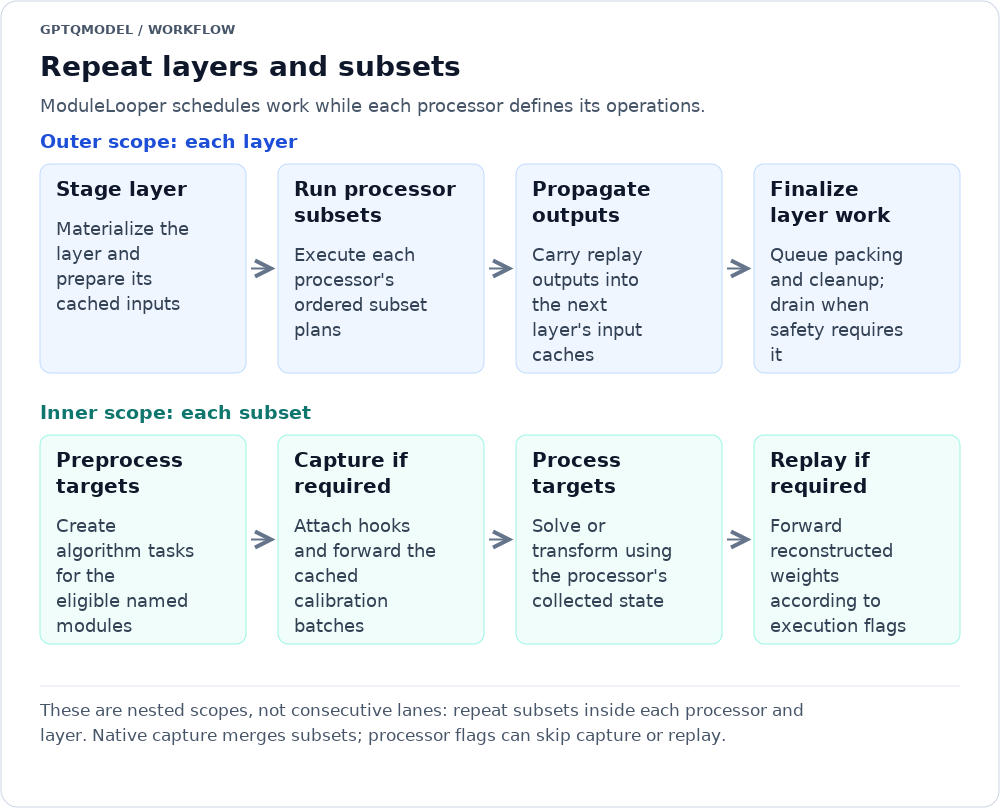
Reading the diagram: These are nested scopes, not consecutive lanes: repeat subsets inside each processor and layer. Native capture merges subsets; processor flags can skip capture or replay.
Text version of the workflow
- Outer scope: each layer: Stage layer → Run processor subsets → Propagate outputs → Finalize layer work.
- Inner scope: each subset: Preprocess targets → Capture if required → Process targets → Replay if required.
These operations are deliberately separate:
| Operation | Typical owner | Result |
|---|---|---|
| Plan/source annotation | ModulePreProcessor.preprocess() |
Ordered decoder/padding/smoothing state, not quantized weights |
| Capture |
pre_process_fwd_hook() and optional capture extensions |
Hessian, bounded/raw activations, native inputs, or EoRA statistics |
| Solve/optimize |
process() or weight-only quantize_module()
|
Reconstructed floating-point weights and method-specific packing payload |
| Replay | Looper / ForwardExecutor
|
Next-layer calibration inputs reflecting the reconstructed model |
| Pack/replace | submodule_finalize() |
Quantized runtime module installed at the original dotted name |
| Whole-run finalization | finalize() |
Model flags, adapter results, resource cleanup |
A reconstructed dense weight temporarily installed for calibration replay is not the final inference storage. Likewise, an algorithm loss printed during solving is not a model evaluation score. Packed outputs vary by kernel and format; do not treat every processor as a producer of the GPTQ qweight/qzeros/scales/g_idx layout.
Selection is implemented in BaseQModel._quantize_with_calibration(), not in a plugin registry inside ModuleLooper. The model wrapper constructs a list and passes it into ModuleLooper(model, processors=...).
| Config / condition | Primary processor | Additional processors |
|---|---|---|
Calibration METHOD.GPTQ / default calibration branch |
GPTQProcessor |
Optional native capture, source preprocessor, EoRA |
METHOD.AWQ |
AWQProcessor |
Optional source preprocessor and EoRA |
METHOD.QQQ |
QQQProcessor |
Optional source preprocessor and EoRA |
METHOD.VPTQ |
VPTQProcessor |
Optional source preprocessor and EoRA |
METHOD.PARO |
ParoProcessor |
Optional source preprocessor and EoRA |
METHOD.EXL3 |
EXL3Processor |
EXL3Config inherits PreProcessorConfig, including preprocessors, smoother, and smooth; eligible AUTO_NF12 sources are restored at quant_source. Adapter/EoRA, GPTAQ, and FOEM remain rejected |
qcfg.preprocessors nonempty |
No change to primary method |
ModulePreProcessor before the primary processor |
GPTAQ enabled globally or by a dynamic rule |
Numerical task chosen inside GPTQProcessor on the GPTQ branch |
NativeProcessor inserted at the beginning, including for GPTAQ with alpha=0
|
FOEM with alpha > 0 enabled globally or by a dynamic rule |
FOEM task chosen inside GPTQProcessor on the GPTQ branch |
NativeProcessor inserted at the beginning |
qcfg.adapter is a Lora
|
No change to primary method |
EoraProcessor appended; primary processor receives calculate_w_wq_diff=True
|
uses_weight_only_lifecycle() == True |
WeightOnlyProcessor |
Separate WeightOnlyLooper; optional local planning preprocessor, not the activation chain |
BaseQModel._eora_generate(...) |
DequantizeProcessor followed by EoraProcessor
|
Optional ModulePreProcessor before them |
Thus a representative extended GPTQ chain is NativeProcessor -> ModulePreProcessor -> GPTQProcessor -> EoraProcessor, when the corresponding supported settings apply. The native insertion is conditional: FOEM with nonpositive alpha does not trigger that capture insertion. An ordinary GPTQ run has just the primary processor unless additional features are configured.
AWQ and Paro construction passes the model wrapper and underlying model into their constructors; post-initialization receives the effective CalibrationConfig.batch_size explicitly. EoRA receives CalibrationConfig.adapter_dataset or, if absent, dataset, with the same preparation policy and sink exclusion disabled. The weight-only branch ignores calibration and rejects LoRA/EoRA, GPTAQ, and FOEM.
The base constructor in gptqmodel/looper/loop_processor.py is:
def __init__(
    self,
    tokenizer, qcfg: QuantizeConfig,
    calibration: Optional[CalibrationConfig] = None,
    forward: Optional[ForwardConfig] = None,
    lifecycle: Optional[ProcessorLifecycleConfig] = None,
):| Attribute / facility | Purpose |
|---|---|
qcfg |
Run-level config; per-module clones can apply dynamic overrides without globally rewriting it |
qcfg_dynamic |
Optional latest effective per-module config, used by GPTQ-family naming |
tasks |
Thread-safe mapping of per-module solver/capture tasks |
inputs_cache |
Thread-safe wrapper around InputCache
|
calibration_dataset |
Prepared calibration batches until initial cache capture/release |
num_batches, total_calibration_tokens
|
Prepared-batch count and token accounting, using masks when available |
lock and specialized locks |
Protect algorithm state, results, progress, input-cache replacement, timing, and diagnostics |
_results |
Processor-level mapping indexed by stable full module names |
log, durations, module_names, memory lists |
Completed-work diagnostics |
| Thread-local batch/mask state | Current capture batch and active padding mask without cross-thread contamination |
pb, layer_count
|
Progress handle and layer-count metadata supplied by orchestration |
When a CalibrationConfig with a dataset is supplied, the base requires nonempty input and a bound prepare_dataset callable. Finite unsized iterables are accepted and materialized for replay. It delegates concatenation, sorting, batching, minimum length, and separator handling according to that config. Fewer than 256 supplied samples and prepared average sequence length below 256 generate warnings. Without a supplied dataset it initializes zero batches and an empty calibration list; no-forward processors override verification as appropriate.
The public calibrated lifecycle rejects a missing CalibrationConfig.dataset; an empty or fully filtered dataset also raises. At the lower-level processor boundary, CalibrationConfig() still permits no-data processors. quantize() binds the model's preparer with CalibrationConfig.bind(); LoopProcessor forwards min_length to the helper as calibration_data_min_length. Multimodal overrides receive it via **kwargs and may apply different filtering. See CalibrationConfig fields and migration.
result_save(key, value), result_get(key, default=None), result_pop(key, default=None), and results() provide locked result access; results() returns a mapping copy. The base is an override contract with no-op methods, not an abc.ABC implementation that automatically rejects missing overrides.
Actual source defaults:
@dataclass(frozen=True)
class ForwardConfig:
    required: bool = True
    replay_after_process: bool = True
    all_modules_in_single_pass: bool = False
    subset_early_stop: bool = False
    activation_capture: bool = False
capture_layer_context: bool = False| Field | Effect |
|---|---|
required |
Needs activation forward/capture; false permits a quantization-only subset pass |
replay_after_process |
Authoritative next-layer outputs come from a replay after processing, not the pre-solve subset forward |
all_modules_in_single_pass |
Merges a layer's capture subsets; cached batches are still forwarded individually |
subset_early_stop |
Allows each replica to stop after all required subset hooks fire for its own batch; its pending members and stop flags reset before the next batch |
activation_capture |
Enables capture-only module/hook participation, including model-tree capture markers |
capture_layer_context |
Preserves pristine layer inputs/kwargs/outputs for a processor that needs them despite later replay |
The public frozen CalibrationConfig in gptqmodel/quantization/config.py groups data and preparation policy: dataset=None, concat_size=None, sort="desc", batch_size=1, min_length=10, concat_separator=None, exclude_attention_sinks=False, and adapter_dataset=None. prepare_dataset is set only by bind(), not the constructor. ProcessorLifecycleConfig groups a ForwardConfig with a CalibrationTypes policy and CheckpointSupport role. The looper and checkpoint preflight read the declared lifecycle rather than inferring capabilities from processor-class names. A supplied lifecycle and a conflicting forward raise ValueError.
MLA kv_b_proj can receive a single-head [B, 1, S, kv_lora_rank] latent. When its batch and sequence axes match the [B, S] keep mask, the capture hooks squeeze the unit head axis so padding and, where supported, exclude_attention_sinks affect the same rows as in other projections. NVFP4 activation range collection uses the padding mask only and retains real sink tokens. See MLA calibration row handling.
QQQ, MACaQ, and EXL3 capture apply the keep mask to flattened full grids [B*S, H], such as shared or all-expert bypass inputs. They omit padding even when sink exclusion is off, and omit marked BOS rows when it is on. Natively routed subsets that cannot be mapped back to token positions are not filtered by this mask. See calibration row ownership.
Effective constructor policies, assuming the default required=True where it is an argument:
| Processor | Forward | Replay after process | Single capture pass | Subset early stop | Activation capture | Original layer IO |
|---|---|---|---|---|---|---|
GPTQProcessor |
Yes | Yes | No | Yes | No | No |
AWQProcessor |
Yes | Yes | No | Yes | Yes | No |
QQQProcessor |
Yes | Yes | No | No | No | No |
VPTQProcessor |
Yes | Yes | No | No | No | No |
ParoProcessor |
Yes | Yes | No | Yes | Yes | When normalized opt_scope != "module"
|
EXL3Processor |
Yes | Yes | No | Yes | No | No |
EoraProcessor |
Yes | Yes | No | No | No | No |
NativeProcessor |
Yes | No | Yes | No | No | No |
DequantizeProcessor |
No | No | No | No | No | No |
WeightOnlyProcessor |
No | No | No | No | No | No |
ModulePreProcessor |
No | No | No | No | No | No |
The main work signature is shared by calibration processors:
def process(
        self,
        module: NamedModule,
        device: torch.device = None,
        subset: Optional[Dict[str, NamedModule]] = None,
        previous_subset: Optional[Dict[str, NamedModule]] = None,
        subset_index: Optional[int] = None,
        subset_total: Optional[int] = None,
):| Hook / method | Contract |
|---|---|
verify_calibration_dataset(processor_index) |
Validate own data and return whether initial capture should use it; a later processor returning false can reuse an earlier cache |
receive_input_cache(input_cache) |
Install shared/reused cache through the synchronized wrapper |
preprocess(module, **kwargs) |
Create task, clone effective config, or annotate state before skip evaluation/capture |
is_skipped(module) |
Decide whether this preprocessed candidate should enter processing |
pre_process_fwd_hook(name) |
Return a module forward hook consuming input/output tensors for statistics |
process(...) |
Solve, optimize, or transfer captured state; can run on a device worker thread |
receive_layer_inputs(layer_inputs) |
Install authoritative outputs as inputs for the next stage/layer |
receive_layer_forward_context(...) |
Optional pristine layer IO; Paro uses it for grouped optimization |
submodule_finalize(module, model, **kwargs) |
After consumers finish: install packed module, preserve adapter, or clean transient state |
finalize(model, **kwargs) |
After all layers and worker drains: final model flags/results and shared resource cleanup |
name() |
Label for logs and returned per-processor results; called during base initialization |
Submodule and whole-run finalization traverse processors in reverse order. EoRA must save its adapter before the base quantizer consumes/restores wq and packs the original quantized base. Native input buffers must remain alive until their downstream solver finishes. Do not pack a module immediately in a new process() implementation if later processors still require its dense state.
Optional capture extensions include begin_shared_input_capture(model, subset_names, is_lm_head_module=False), end_shared_input_capture(subset_names), and register_moe_root_capture_hook(moe_block, moe_block_name, handles). Default implementations do nothing. GPTQ/GPTAQ/FOEM, QQQ, VPTQ, MACaQ and eligible EXL3 captures elect leaders only from compatible explicit model-tree shared-input groups. Followers skip their own capture hook and adopt private statistic copies afterward; GPTAQ/FOEM copy dXXT with H. QQQ GSQ and already-shared EXL3 w3 aliases are excluded. HessianConfig.dedup_shared_inputs=False disables reuse where that config is exposed; MACaQ and EXL3 have no switch. AWQ can capture a model-specific pre-router MoE-root input. Coverage is queried with has_captured_input_ids(name) on participating processors; the name is historical and need not mean literal IDs are stored.
Subset cleanup releases capture hooks and inline hook markers on success, cancellation, and failure. This covers the forward_start callback, placement override, capture-context setup, and the forward itself. It also covers a stop at forward_end or an error while handing captured inputs or context to the processor. During failure teardown the calibration looper also clears any remaining inline hooks on the in-flight layer so a later ordinary forward can run past that layer. Cancelled-run cleanup
NamedModule provides the live module plus relative name, dotted full_name, layer_index, original module_dtype, shared state, and synchronized delegation. Algorithm task dictionaries often use relative names; packed replacement and persisted results use full names. Keep that distinction when adding a processor.
stream_state_payload_to_cpu(...) stages payload tensors through the transfer machinery. A finalizer using those tensors must call stream_sync() before reading/cloning them. Several packers clone the CPU state after synchronization so the packed consumer does not retain a borrowed staging buffer. Module-tree replacement uses parent-module locks; result/task locks alone do not protect graph mutation.
There is no base tmp_dir API allocating one scratch directory per processor. Distinguish these storage mechanisms:
| Storage | Ownership / behavior |
|---|---|
| Processor log file |
logs/<processor>_log_<random>_time_<timestamp>.log, relative to the process working directory; the constructor creates logs/
|
| Processor results | In-memory locked result map; EoRA later attaches it to model.lora_results
|
| Quantization offload directory |
qcfg.offload_to_disk_path; if omitted with offload enabled, config owns a shared temporary directory with gptqmodel_ prefix |
| Checkpoint attempt directory |
checkpoint_session() creates attempt-* under the checkpoint root and redirects offload there |
| Packed inference export | Written by the model save workflow, not by the base processor's temporary-log writer |
log_new_row(stat) prints the dynamic terminal table and submits _async_log_writer to the serial CPU worker. That writer appends an indented JSON object plus newline for each record; the whole file is not a single JSON array. Default columns include process/layer/module, feature dimensions, dtype/size, loss, samples, damping, time, forward time, memory, and dynamic configuration, with extra keys added as needed. Field availability and loss semantics vary by processor.
GPTQMODEL_LOG_QUANT_STATS enables an additional plain-text stats line when its value is not "", "0", "false", or "False". Memory collection combines available accelerator and CPU diagnostics; unavailable vendor telemetry is not itself a numerical quantization failure. At the documented revision, accelerator memory reporting uses the active device.
record_quant_log() copies the first nonempty owning processor log in run-plan order to model.quant_log; both calibrated and weight-only loopers call the same helper with processor objects. LoopProcessor.owns_quant_log=True is the default, so there is no method-name allow-list. EoraProcessor.owns_quant_log=False excludes adapter-timing rows: they must not create duplicate/blank quantization rows or replace the primary quantizer's statistics. If no eligible log exists, the helper preserves an existing model.quant_log, initializing it to [] only when absent/None. Thus standalone EoRA generation retains a restored quantization log. The writer emits quant_log.csv only for a nonempty model log; the per-processor return mapping and diagnostic files remain separate. Log assembly source · EoRA ownership.
Base finalize() closes diagnostic handles, releases shared Hessian workspace, and deletes the input cache/results references. quantize_config.keep_processor_logs=True is the default and preserves the per-processor log files. Set keep_processor_logs=False to delete them during base finalization after a successful loop; missing/non-file paths or cleanup errors do not fail quantization. An interrupted/failed run keeps its partial log because successful finalization was not reached. This is a config field, not a GPTQMODEL_KEEP_PROCESSOR_LOGS environment switch. NativeProcessor.finalize() clears native capture caches and then calls the base implementation, releasing the last layer's inputs without waiting for cyclic garbage collection. release_calibration_dataset() separately removes the retained prepared dataset after initial capture.
Device-SMI telemetry handles open on the first metric query rather than processor construction. A processor rejected before execution therefore starts no sampler threads. Entry-point failure cleanup also releases processors already built when calibration, checkpoint entry, or looper construction fails, covering calibrated/weight-only quantization and standalone EoRA; releases are best effort and do not mask the original exception. Token-length warnings/counting skip tensor-kwargs rows without input_ids. See failure cleanup.
Class / name()
|
Consumes | Intermediate state | Final output |
|---|---|---|---|
GPTQProcessor: gptq, gptaq, or foem
|
Dense source, Hessian/statistics; optional native inputs and activation calibration |
q_scales, q_zeros, q_g_idx; optional wq, w_wq_diff, activation scale |
Selected GPTQ-compatible packed linear; activation metadata where applicable |
AWQProcessor: awq
|
Captured activations, model scaling groups, dense source and replay kwargs | Host activations; q_scales, q_zeros, wq; optional weight error |
AWQ-format packed linear; scaled nonquantized neighboring weights remain in the model |
QQQProcessor: qqq
|
Activation batches/Hessian and dense source | Scales/zeros/group indices plus q_scales_extra; optional weight error |
QQQLinear or QQQTorchLinear with QQQ packed weights/scales |
VPTQProcessor: vptq
|
Calibration-built Hessian, dense source |
vptq_result; optional independent wq and error |
VPTQLinear codebooks, packed indices, optional residual/outlier data, scale/bias/permutation |
ParoProcessor: paro
|
Captured activations; grouped scopes also pristine layer IO/module |
pack_weight, scales/zeros, pairs, theta, channel_scales
|
ParoLinear with packed scalar weights plus learned rotation/scaling metadata |
EXL3Processor: exl3
|
GPTQ capture Hessian, source weight, effective EXL3 config | EXL3 tensor dictionary and optional bias |
ExllamaV3Linear with trellis/transform/codebook-related tensors |
EoraProcessor: eora
|
Activation statistics, preceding base wq and w_wq_diff, Lora config |
Temporary adapter; corrected dense replay weight | CPU Lora factors in results / model.lora_results; no new packed base linear |
NativeProcessor: native
|
Unquantized module inputs | native_inp |
No packed module; inputs consumed by later solver and then removed |
DequantizeProcessor: de-quantize
|
Mapping of existing TorchLinear modules plus original dense source |
wq, float32 w_wq_diff
|
No packed replacement; provides EoRA inputs |
WeightOnlyProcessor: weight_only_rtn, weight_only_gguf, weight_only_bitsandbytes
|
Dense source only | RTN scales/zeros/indices or direct-packing source | Selected method-specific packed module |
ModulePreProcessor: module-preprocessor
|
Config preprocessors and source dimensions | Decoder/padding/smoothing plan annotations | No packed replacement |
Source: gptqmodel/looper/gptq_processor.py. See GPTQ.
preprocess() calls clone_gptq_config_for_module(...); a full dynamic exclusion returns no config/task. The clone applies the supported per-module overrides, including quantization bits/symmetry/group size, MSE configuration, activation ordering, damping, static groups, and fallback. It constructs GPTAQ if the effective config has gptaq, otherwise FOEM if it has foem, otherwise GPTQ. The ordinary GPTQ task receives normalized fallback and expected total calibration tokens. Its quantizer is configured per-channel.
The forward hook feeds activations into the task. GPTQ preserves the batch keep-mask semantics so padded [B, S, H] batches are masked in the accumulator rather than incorrectly counted as real tokens. Explicit model-tree shared-input groups can share Hessian capture; the plan is enabled only for verified definitions and eligible groups, not just because two linears have equal dimensions. Followers adopt captured state after leader collection.
process() verifies placement consistency between module weight, assigned target device, task weight/Hessian, and current accelerator-thread context. It calls g.quantize(), which returns reconstructed weights, scales, zeros, group indices, duration, loss, effective damping, and sample count. Packing metadata is streamed to CPU; task buffers are freed and module.weight.data becomes the reconstructed weight for sequential replay.
With calculate_w_wq_diff=True, it computes the difference in float32 and preserves an independent CPU copy of the reconstructed weight under wq. That copy must not alias a parameter that subsequent lazy rematerialization might overwrite before EoRA runs.
For w4afp8, the processor enables FP8 input QDQ replay after solving the target. For w4a_nvfp4, it uses the observed/calibrated activation global scale and selected recipe, writes activation_global_scale, and enables NVFP4 replay. Existing stream-replay pre-hooks prevent a second QDQ of the same input. These replay helpers currently require torch.nn.Linear targets. Missing required headroom calibration or nonfinite observed activation maxima raise errors; they are not silently replaced by a valid-looking scale.
submodule_finalize() synchronizes staged transfers, restores the saved base reconstruction if EoRA temporarily changed the weight, consumes CPU q_scales/q_zeros/q_g_idx, creates the selected quantized module, and calls pack_module(...). Applicable activation-scale state is installed on the packed module. Original dense-weight registration and consumed temporary state are removed.
name() returns gptaq for an effective GPTAQ config, foem for FOEM, otherwise gptq. This is a reporting label; finalize() marks the model quantized and sets model.quantize_config.method = METHOD.GPTQ before shared cleanup. verify_calibration_dataset() rejects calibration_dataset is None; it does not test for zero prepared batches. has_captured_input_ids() reflects the task's forward counter, not just successful task construction.
Source: gptqmodel/looper/awq_processor.py. See AWQ.
AWQ uses captured activation features and model-defined scaling groups rather than converting each hooked module immediately. Construction requires both gptq_model and the underlying model; it resolves the quantized kernel from the wrapper or format mapping. Constructor defaults include apply_clip=True, duo_scaling=True, and max_chunk_memory = 1024 * 1024 * 1024 for chunked internal search computations. These are processor implementation attributes, not additional public quantize() parameters.
preprocess() registers each eligible module in _AWQLayerState, initializes its feature bucket, and records pending modules. Capture detaches input features to CPU, excludes matched padding rows, and retains batch metadata. The default token_rows policy samples during capture. It uses planned quotas when batch lengths match and a bounded rolling sample for dynamically routed rows. For batches with multiple eligible rows and one-row quotas, the plan samples the first eligible row once per eight quotas and the middle row for the others. Raw counts and row provenance remain available for coverage checks and replay. Siblings can share a host capture when they use the same source and keep mask. Model policy can additionally request MoE-root capture. Replay kwargs are aligned to the retained features, and scale-search reference outputs stay on the inspection device. See AWQ replay and memory.
For native MoE routing on padded batches, AWQ zeroes padding before routing and filters all-zero rows from routed subsets before updating coverage counts or the reservoir. A 2-D capture that matches the full token grid instead uses the keep mask; a count that merely matches the kept tokens does not skip the routed filter. A routed expert's existing reservoir cannot shrink because a concurrent capture with an older budget merges late. See AWQ replay and memory for the filter and budget rules.
process() merges the subset mapping, records completed subset indices and pending modules, and computes/caches previous-subset weight-scale context. It triggers _quantize_layer() only once the registered layer work is ready. A process() return for an early module therefore need not mean its module has already been solved independently.
The layer quantizer obtains model scaling groups, searches scales and optional clipping, applies scaling to participating modules, and calls apply_quant(). A source decoder can supply quant_source_module rather than the live wrapper. The pseudo-quantized dense weight becomes the replay weight; q_scales and q_zeros are staged to CPU, wq is recorded, and optional EoRA error is recorded. TP padding is trimmed back to the original column/group extent.
submodule_finalize() delegates to pack_module(): synchronize, restore base wq when needed, consume scales/zeros, create the AWQ kernel for the resolved format, and call the common packer with q_g_idx=None. Scaling can also mutate nonquantized neighbors such as norms; a packed weight alone is not the complete transformed model state.
AWQ logs feature-specific sample/token/batch/aggregation metadata, including separate activation and scaling-feature counts. If a module has no matching scaling-loss result, the displayed loss is "not applicable". Do not compare that column as though it had GPTQ's loss definition. Some AWQ/QQQ calibration errors retain the legacy GPTQProcessor wording; use the selected processor and call stack to identify the actual algorithm.
Source: gptqmodel/looper/qqq_processor.py. See QQQ.
preprocess() deep-copies the config, applies supported dynamic choices, constructs QQQ, supplies normalized fallback and expected samples, and configures its quantizer. Its hook calls add_batch(inp[0].data, out.data). Unlike GPTQ/AWQ/EXL3, it leaves subset early-stop at the base default False.
There is an important override boundary: the QQQ task receives the per-module clone, but tmp.quantizer.configure(...) reads bits, sym, mse.norm, and group_size from the processor-wide self.qcfg. Do not infer that every cloned override also changes this separate quantizer configuration at this revision.
process() calls the QQQ solver and frees its task in finally. Along with reconstructed weights it receives ordinary scale/zero/group-index metadata and q_scales_extra. Scales, zeros, and group indices are staged on CPU; optional EoRA state includes an independent CPU reconstructed-weight snapshot. The live module receives reconstructed weights for replay.
submodule_finalize() selects the concrete QQQ kernel: Darwin, CPU, and NPU use QQQTorchLinear / BACKEND.QQQ_TORCH; other supported accelerator paths use QQQLinear / BACKEND.QQQ. It creates that class and passes q_scales_extra into the common packer. QQQ saves packed B, s_channel, s_group, and bias when present. Per-channel layers save s_group as a zero-element tensor, and the loader accepts older per-channel checkpoints that omitted it.
Whole-run finalization sets METHOD.QQQ and model.quantized=True. Dataset replacement through set_calibration_dataset() is unsupported; initial calibration is required and task fwd_counter supplies the coverage probe.
Source: gptqmodel/looper/vptq_processor.py. See VPTQ.
This path constructs Hessians from calibration activations; it does not require a precomputed hessian_path. preprocess() skips full dynamic exclusions, clones the config, constructs VPTQ, and supplies fallback and expected sample count. The hook feeds input/output batches to the task's accumulator.
Unlike the GPTQ clone helper, this processor's preprocess() does not resolve individual dynamic field overrides into the clone: its explicit dynamic handling is the whole-module exclusion check. Do not assume the GPTQ override contract applies unchanged to VPTQ.
process() receives a VPTQQuantResult, duration, and loss, frees task buffers in finally, and restores the reconstructed weight into the live module's native layout for replay. It moves result tensors to CPU, including centroids, indices, res_centroids, res_indices, weight_scale, weight_bias, perm, and quantized_weight, and stores the object under vptq_result. Optional EoRA state uses float32 error and an independent CPU wq snapshot.
The finalizer creates VPTQLinear using BACKEND.VPTQ_TORCH, method-specific initializer arguments, and original module dtype; then calls:
qmodule.pack(linear=layers[module.full_name], vptq_result=result)The runtime loader fills codebook embeddings, packed code indices, optional residual/outlier data, scale/bias, and permutation data from the result. The source linear contributes its bias. VPTQLinear.pack() rejects a missing result; codebook and index validation occurs while loading it. A reconstructed dense tensor is a replay artifact, not a substitute for those codebooks/indices.
Finalization sets METHOD.VPTQ, FORMAT.VPTQ, and the model's quantized flag. Dataset replacement is unsupported. VPTQ is not in the quantization checkpoint adapter's supported-chain allowlist at this revision.
Source: gptqmodel/looper/paro_processor.py. See Paro.
Paro is a standalone capture/optimize/export/pack workflow, not an AWQ subclass. It accepts the wrapper and underlying model, maintains _ParoLayerState, and defers solving until all registered layer subsets finish capture. Its execution config enables activation capture/early-stop and requests pristine layer IO when the normalized optimization scope is not "module".
Inputs depend on scope:
| Scope | Required optimization context |
|---|---|
module |
Each module's captured activation features |
compute_block |
Group/module context plus preserved layer inputs, kwargs, and target outputs |
layer |
Layer-level optimization context, preserved IO, and pristine source/replay state |
The processor receives layer context and pristine source modules through explicit hooks. Grouped replay loaders can stream CPU-owned batches to device shards and rebuild autograd-safe tensors from inference-mode capture. It does not rely on ordinary inference-mode tensors becoming trainable merely because an optimizer is invoked.
process() records pending/completed subset state and triggers _quantize_layer() once ready. The implementation resolves optimization groups, optimizes modules/groups, installs reconstructed replay weights, logs results, and releases layer feature/replay caches after completion. Missing features with fallback disabled raise an error; grouped optimization without preserved layer inputs/outputs raises an error.
The pack payload contains pack_weight, q_scales, q_zeros, pairs, theta, and channel_scales; optional EoRA state is separate. pack_weight is the weight in the packing coordinate system, not necessarily the dense replay reconstruction. The finalizer synchronizes and clones that payload, restores pack_weight on CPU, creates the resolved Paro kernel, calls the common packer with no group-index tensor, verifies the replacement is a ParoLinear, copies rotation/scaling buffers, and invokes post_init().
The looper prewarms the rotation runtime and restricts Paro quantization to a single device at this revision. It also drains Paro finalizers synchronously to avoid retaining optimization state across layers. finalize() sets METHOD.PARO; the label is paro. Continuation extends the base state with clean_group_layer_inputs, allowing the supported checkpoint chain to preserve its persistent cross-layer context without pickling live optimizers/locks.
Source: gptqmodel/looper/exllamav3_processor.py. See EXL3.
preprocess() clones effective EXL3 settings and constructs a GPTQ capture task, not a GPTQ weight solver. The capture config uses group_size=-1, desc_act=False, sym=True, and act_group_aware=False, with the effective device/pack dtype. The hook feeds activation batches and the current batch index into that accumulator.
process() finalizes the captured Hessian on the target device and converts the source weight to the quantizer's layout. For a zero-token projection or one below the configured fallback threshold, it constructs an identity proxy Hessian and sets the quantizer's sample count to zero to select EXL3's uncalibrated trellis path. The CUDA/HIP branch builds H_data with single_use=True and calls quantize_exl3(..., return_weight_q=True). This reconstructs the weight for replay while releasing the single-use Hessian factor.
There is also an internal MLX helper branch for CPU/MPS targets when exl3_mlx_quantization_available() succeeds. This does not broaden the public API: the current BaseQModel.quantize() EXL3 entry rejects non-CUDA/HIP quantization before reaching this processor. Do not advertise direct CPU/MPS EXL3 quantize() from the existence of an internal branch. See MLX Apple Silicon for the separate platform surface.
The quantizer returns a reconstructed weight, proxy error, and packed tensor dictionary. Tensors and optional bias are streamed to CPU; reconstructed weights are assigned to the live source-layout module for replay. submodule_finalize() synchronizes, clones recognized payload fields (trellis, suh, svh, su, sv, bias, mcg, mul1) when present, and calls create_exllamav3_module(...) under the parent lock. Dense weight and optional bias registrations on the old module are removed.
finalize() sets the model quantized, METHOD.EXL3, FORMAT.EXL3, and qlinear_kernel = ExllamaV3Linear. The public chain rejects LoRA/EoRA, GPTAQ, and FOEM. The layer stage's generic finalized-module disk-offload guard includes GPTQ/QQQ/AWQ/Paro, not EXL3; checkpoint capture can serialize supported EXL3 packed artifacts independently.
docs/exl3-mi350x-quant-lifecycle.md records a historical MI350X/gfx950 quantizer study and explicitly is not the current implementation contract. Its kernel timings, worker counts, and occupancy observations are not required settings for this class.
Source: gptqmodel/looper/eora_processor.py. See EoRA.
EoRA consumes base quantization error and activation statistics to produce low-rank correction factors. It does not quantize the base weights independently. A preceding quantizer or DequantizeProcessor must provide both w_wq_diff and the base reconstructed wq.
preprocess() clones the Lora config, applies per-module adapter.rank dynamic overrides, records the target device, and initializes per-device segment accumulators. Full dynamic exclusions set module.adapter_cfg=None. Hooks compute activation contributions with batch indices; segment accumulation merges contributions into the eigen-scaling matrix without requiring every contribution to make an immediate CPU round trip.
process() asserts the adapter config is Lora, finalizes the eigen-scaling matrix, moves the weight difference to float32 on the target device, and computes A and B at the requested rank. It installs a temporary corrected dense replay weight based on wq + (B @ A), while preserving the uncorrected base wq on CPU for the base packer. TP padding is trimmed appropriately. The corrected reconstruction is checked as FP16/BF16; the factors are moved to CPU in a new Lora object under module state adapter.
The submodule finalizer moves that object into the results map under the full module name. Whole-run finalization clears accumulators, attaches results to model.lora_results for saving, and runs shared cleanup. The base quantizer's later reverse finalizer packs only the base quantized weights, not the temporary dense weight with the correction fused into it.
If EoRA is the first processor, missing calibration is rejected; as a later processor it can report that a previous cache should be reused. set_calibration_dataset() can replace its dataset and update batch count. Its continuation override explicitly serializes each completed Lora as rank/path/factor fields and reconstructs Lora objects on restore rather than pickling them.
Source: gptqmodel/looper/native_processor.py.
Native capture preserves pristine per-module inputs for GPTAQ or positive-alpha FOEM. It combines a layer's subsets into one capture plan (ForwardConfig.all_modules_in_single_pass=True) and forwards each cached calibration batch through it, with no replay-after-process. The flag does not collapse the dataset or all model layers into a single forward. Each preprocess() allocates a list, and the hook detaches inp[0] and stages it according to the GPTAQ/FOEM device:
| Device setting | Capture destination |
|---|---|
"auto" |
DEVICE_1 |
"cpu" |
CPU |
| Other string | torch.device(value) |
torch.device |
That device |
| Unrecognized value |
DEVICE_1 fallback |
Do not interpret DEVICE_1 as a promise that a second physical GPU exists; it is the utility's resolved device constant. process() transfers the captured list to module.state["native_inp"] and removes its processor-cache entry. submodule_finalize() removes that shared-state key after consumers finish; finalize() empties the native cache mapping and runs base cleanup, including when native capture never ran. There is no packed-module output.
For GPTAQ/FOEM capture with a matching [B, S] keep mask and [B, S, H], flattened [B*S, H], or single-head MLA [B, 1, S, H] inputs, _split_batch_samples() stores one masked [N_kept, H] entry per nonempty sample, tagged with its calibration batch_index. Sibling projections such as Q/K/V or gate/up reuse the same read-only tensor entries when they receive the same source storage/view and mask in that batch. Each capture thread has its own slot in a lock-protected sharing map. The sharing key includes storage pointer, offset, shape, stride, dtype, and device; equal values in unrelated tensors do not qualify. A batch-index or mask-identity change replaces that thread's slot; process() and finalize() clear all slots, releasing retained sources and masks even when those methods run on another thread. The cache retains its source and mask while active. Consumers must not mutate entries or the source between sibling hooks. Missing/incompatible masks retain the one-entry-per-batch path; this sharing changes neither per-module entry lists nor sample pairing. See the native capture implementation and batch-split contract.
is_skipped() currently returns false for eligible candidates. Calibration is required, and set_calibration_dataset() raises NotImplementedError because construction fixes capture setup.
Source: gptqmodel/looper/dequantize_processor.py.
The constructor has a deliberately different input contract:
def __init__(self, quantized_modules: Dict[str, TorchLinear]):It initializes the base with no tokenizer/config/calibration, batch size 1, and no-forward/no-replay execution policy. verify_calibration_dataset() returns false; its dataset setter discards supplied data and resets batch count to zero.
process() pops the existing packed module by module.full_name, calls its optimize(), computes m.dequantize_weight().T on the dense source's device, and adds any required TP pad columns. It computes the difference between the dense source and the reconstruction in float32 and stores w_wq_diff and wq. The quantized-module input mapping is consumed as work progresses.
This is a preparatory stage for _eora_generate()'s DequantizeProcessor -> EoraProcessor chain, not a public model-wide dequantization/export command. Missing mapping entries naturally fail instead of fabricating a reconstruction. Its finalizer removes temporary w and wq; downstream EoRA consumes the difference. Its label is exactly de-quantize.
Source: gptqmodel/looper/weight_only_processor.py. This class is a LoopProcessor subclass but uses the dedicated WeightOnlyLooper protocol: the orchestrator calls quantize_module() rather than the base no-op process().
def __init__(
    self,
    tokenizer,
    qcfg: WeightOnlyProcessorConfig,
    forward: Optional[ForwardConfig] = None,
    *,
    measure_weight_error: bool = False,
):

def quantize_module(
    self,
    module: NamedModule,
    *,
    device: Optional[torch.device] = None,
) -> Optional[WeightOnlyProcessorConfig]:
clone_weight_only_config_for_module(...) applies per-module config/skip policy. The orchestrator excludes skipped modules before device work; quantize_module() can also return None for exclusions. An explicit scheduled device is installed on the clone, which is handed into finalization.
| Method | Conversion stage | Pack stage | Log label |
|---|---|---|---|
| RTN |
RTN.quantize() returns reconstructed weight and scales/zeros/group indices; metadata streams to CPU |
Create selected module, synchronize and consume metadata, call common pack_module(...)
|
weight_only_rtn |
| GGUF | No activation solve; preserve original dense source | qmodule.pack_original(linear=original_layer, scales=None, zeros=None, g_idx=None, smooth=active_qcfg.smooth) |
weight_only_gguf |
| BitsAndBytes | Same direct-pack lifecycle | Method-specific pack_original(...)
|
weight_only_bitsandbytes |
| NF12 | Same direct-pack lifecycle | Method-specific pack_original(...)
|
weight_only_nf12 |
| CPTC | Direct packing, with optional YAQA sketches collected before the loop |
pack_original(..., device=active_qcfg.device) encodes on the assigned device |
weight_only_cptc |
The finalizer creates the module with method-specific format/init kwargs and register_buffers=False, then invokes the appropriate packing path. Direct-pack rows record measured pack time in seconds and report zero processor samples, including when CPTC collected YAQA sketches separately before the loop. The loss column defaults to n/a. Setting measure_weight_error=True reconstructs each dense weight after packing to log mean absolute error, without changing the packed payload. GGUF dequantized matrices are transposed for this comparison; BitsAndBytes and NF12 already expose [out, in] weights.
Consumed scale metadata, TP padding/source references, and the old dense weight registration are released. finalize() marks the model quantized and runs base cleanup; it does not rewrite all methods to GPTQ. Input/output embedding fast conversion currently supports RTN only, and embedding-only operation has separate save/offload restrictions handled by WeightOnlyLooper.
See BitsAndBytes, and GGUF for format/runtime requirements. A no-calibration lifecycle does not imply every kernel can run or pack on every device.
Source: gptqmodel/looper/module_preprocessor.py.
This additional subclass is part of the execution chain when preprocessors are configured. It initializes with an empty CalibrationConfig and a no-forward/no-replay lifecycle policy. Its label is module-preprocessor; calibration verification returns false and process() does nothing.
preprocess() walks configured preprocessors in order:
| Config | State emitted |
|---|---|
AutoModuleDecoderConfig |
Decoder code/source/target dtype, passthrough forward/save policies, quant_source_decode_policy="defer_until_quantization", optional native floatx runtime plan |
TensorParallelPadderConfig |
Column padding plan computed from LCM of (2, 4, 8) and positive group size |
SmootherConfig |
to_dict() entry in preprocessor_pipeline
|
It stores the ordered preprocessor_pipeline, optional auto_module_decoder, and nonzero tp_pad_info; absent plans remove stale decoder/padding-related keys. For a transformers.Conv1D, the row/column interpretation follows its transposed weight layout. The class annotates a plan rather than independently performing every decode/pad/smooth transformation in its no-op process().
On the calibration path it is a processor before the primary quantizer. On the weight-only path the orchestrator constructs a local planner and calls it before handing decoded source modules into weight-only conversion. These are distinct integration points.
continuation_state_dict() captures completed boundary state: the input cache, log, prepared counts, results, and available statistics. It deliberately excludes live tasks, locks, partial Hessians, and unfinished optimization accumulators. load_continuation_state_dict() restores completed state; normal replay creates future tasks. AWQ additionally saves avg_losses, nsamples, nsamples_total, and quant_batch_size; EoRA and Paro extend the schema for their persistent data as well.
Having this method does not automatically make a new processor resumable. QuantizationCheckpointAdapter.bind() allows exact chains for GPTQ/AWQ/QQQ/Paro (with optional EoRA), weight-only, and EXL3 alone. VPTQ and chains containing ModulePreProcessor, Native, or Dequantize are not on the allowlist. Model/source/config/device restrictions apply in addition; see Quantization Lifecycle.
Extensions observe orchestration, not arbitrary partially completed processor calls. LoopExtensions.start() permits one compatible resume cursor; LoopBoundary.quiesce() waits for all preceding finalizers before returning results or raising. A boundary is borrowed only during its callback and belongs to the orchestration thread. Serializing state from a worker or retaining a boundary for later use is invalid.
wait_for_submodule_finalizers=False permits overlap only where the looper deems it safe. W4A modes, multiple quantization accelerators, and Paro force synchronous per-layer draining. Overall completion still waits for device tasks, stream transfers, and watcher threads. A failure after process() but before packing/offload is a failed quantization, not a completed module just because its loss row was printed.
| Issue | Correct integration rule |
|---|---|
| Wrong module identity | Use relative names for the current task namespace and stable full names for replacement, dynamic matching, persisted results, and cross-layer identity |
| Unobserved MoE expert | Implement truthful coverage detection and explicit fallback behavior; a task's existence does not prove it captured activations |
Rematerialization changes wq
|
Preserve independent reconstruction storage when another processor needs it later |
| EoRA accidentally packed into base weights | Preserve uncorrected wq; let reverse finalization save the adapter and pack the base separately |
| Corrupt staged scale metadata | Synchronize stream transfers before reading; clone borrowed host payloads where the consumer needs independent ownership |
| Missing subset context | Accept the full process(...) contract; layer-deferred solvers must track pending modules/subsets and run once |
| Premature packing | Keep dense source/reconstruction until downstream capture/process/replay consumers finish |
| Thread-unsafe replacement | Follow parent-module lock conventions in addition to task/result locking |
| Assuming no-forward means no orchestration | Planning/dequantization stages still participate in layer identity, state, skip logic, finalization, and cache hand-off |
Assuming all subclasses override process()
|
Weight-only intentionally exposes quantize_module() to its dedicated looper |
| Treating logs as checkpoints | Log objects are diagnostics; safe resume requires quiescent boundary state and published checkpoint artifacts |
| Treating logs as identical quality metrics | GPTQ loss, AWQ search loss, EXL3 proxy error, Paro validation loss, and direct-pack MAE have different meanings |
| Unsupported hardware inferred from class name | Validate method/format/backend/device before construction; portable packing and accelerated inference are separate capabilities |
| Blanket resume claims | Add an explicit supported state adapter and packed schema; the base continuation method is necessary but insufficient |
When adding a processor, declare its ProcessorLifecycleConfig (forward policy, calibration policy, checkpoint role), define captured data and coverage semantics, isolate per-module overrides, make replay reconstruction and packing payload ownership explicit, and release temporary tensors as soon as their last consumer completes. If checkpointing is intended, specify persistent boundary state without arbitrary objects and extend the explicit packed-module schemas. Changes to quantization math, packers, or kernels require the project's numerical/storage validation; processor logs alone do not validate correctness.
| Path | Responsibility |
|---|---|
gptqmodel/models/base.py |
Constructs processor chains, selects weight-only path, composes _eora_generate()
|
gptqmodel/looper/loop_processor.py |
ForwardConfig, ProcessorLifecycleConfig, shared state/results, logging, continuation, lifecycle hooks |
gptqmodel/quantization/config.py |
Public frozen CalibrationConfig, validation, and model-preparer binding |
gptqmodel/looper/named_module.py, input_cache.py
|
Stable per-module state and batch-aligned inputs |
gptqmodel/looper/module_looper.py, stage_layer.py, stage_subset.py, forward_executor.py
|
Processor scheduling, capture, replay, finalization, coverage |
gptqmodel/looper/gptq_processor.py |
GPTQ/GPTAQ/FOEM task dispatch, Hessian capture, replay and packing payloads |
gptqmodel/looper/awq_processor.py |
AWQ activation capture, layer-scale search, clipping, packing |
gptqmodel/looper/qqq_processor.py |
QQQ capture, solver and scale-aware packing |
gptqmodel/looper/vptq_processor.py |
VPTQ Hessian capture, result transfer, codebook packing |
gptqmodel/looper/paro_processor.py |
Deferred layer/group optimization, replay context, rotation payload |
gptqmodel/looper/eora_processor.py |
Activation contributions and low-rank adapters |
gptqmodel/looper/exllamav3_processor.py |
EXL3 capture, solve, trellis payload and replacement |
gptqmodel/looper/native_processor.py, dequantize_processor.py
|
Pristine-input and existing-base reconstruction stages |
gptqmodel/looper/weight_only_processor.py, weight_only_looper.py
|
RTN solve/direct pack and weight-only orchestration |
gptqmodel/looper/module_preprocessor.py |
Ordered decoder/TP/smoother plan annotations |
gptqmodel/looper/gptq_checkpoint.py, checkpoint_modules.py, continuation.py, extension.py
|
Supported chains, packed continuation schemas, safe boundary persistence |
gptqmodel/quantization/gptq.py, gptaq.py, foem.py, qqq.py, vptq.py, rtn.py
|
Numerical task implementations called by processors |
gptqmodel/quantization/config.py |
Method/lifecycle/config policies |
gptqmodel/utils/model.py |
create_quant_module and pack_module
|
gptqmodel/nn_modules/qlinear/qqq.py, vptq_torch.py, paro.py
|
Method-specific packed-module consumers |
gptqmodel/nn_modules/exllamav3.py |
EXL3 packed module creation/storage |
docs/looper-checkpoint-redesign.md, docs/multi_gpu_quantization.md, docs/exl3-mi350x-quant-lifecycle.md
|
Checkpoint design, device-pool usage, historical EXL3 lifecycle measurements |