Repository navigation
Home
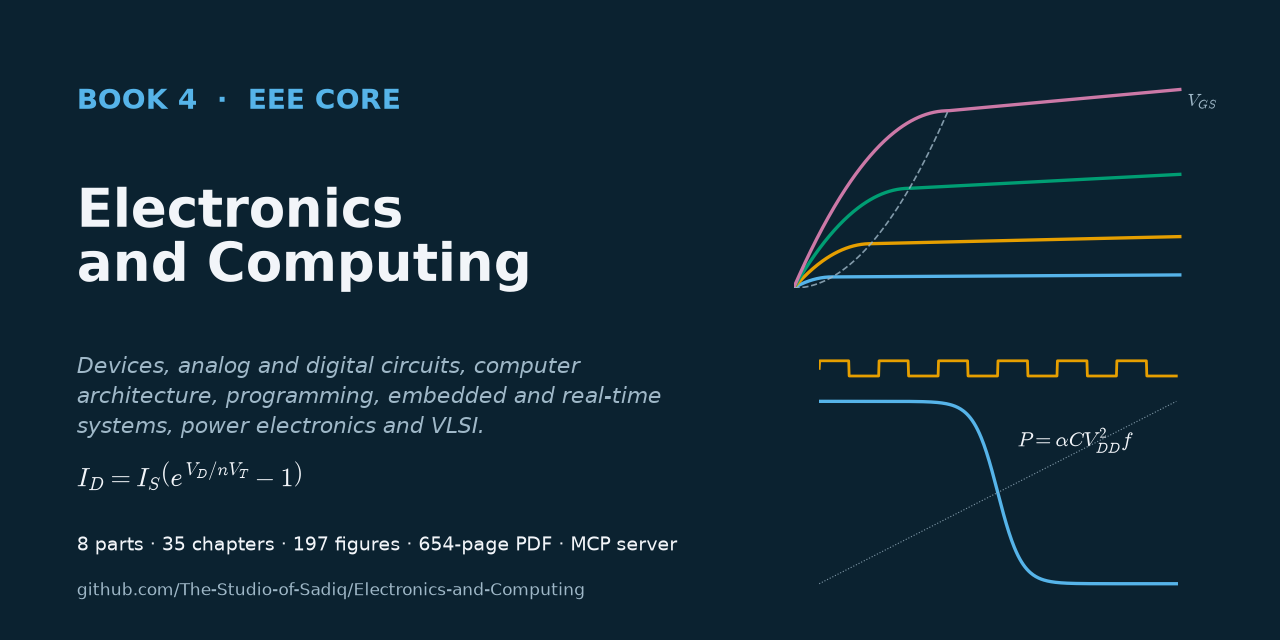
Book 4 — The Electronics & Computing Core. Electronic devices, analog and digital hardware, computer architecture, programming, embedded computation and hardware–software interaction: diodes and transistors, amplifiers and op-amps, logic and sequential design, processors, memory and FPGAs, HDLs, C/C++ and Python for engineers, embedded and real-time systems, power electronics, CMOS and VLSI, and co-design. It extends Engineering Physics and Circuits, Signals and Communications into devices, circuits and computing hardware.
| Parts | 8: Electronic Devices → Analog Electronics → Digital Electronics → Computer Architecture and Digital Hardware → Programming and Computational Systems → Embedded and Real-Time Systems → Power Electronics → Integrated Circuits and VLSI |
| Chapters | 35, about 293k words, each starting from an engineering problem |
| Figures | 197, each computed from the chapter's own numbers by a reproducible Python script |
| Formats | Markdown with LaTeX math (reads on GitHub and in Obsidian) and a typeset PDF (654 pages) |
| Tooling | One-command PDF build, book checks in CI, and an MCP server for reading and searching the book with an AI client |
| License | MIT |
- New reader: read on, then open the Chapter Guide and begin at Chapter 1.
- Looking for a topic: the Chapter Guide lists every chapter's opening questions and sections.
- Want the PDF: download it here or from the latest release, or build your own (Tooling).
- Using Claude or another AI client: the book ships an MCP server (Tooling).
- Found an error or want to help: see Contributing and House Style.
devices → analog circuits → digital logic → computer hardware → software → embedded and real-time systems → power electronics → integrated circuits and co-design.
One idea runs through all of it: a nonlinear device, biased and switched, is turned into a reliable abstraction (an amplifier, a logic gate, an instruction, a task, a converter), and every abstraction holds only inside the limits of voltage, current, time, power and temperature that the device beneath it sets. The diode law of Part I becomes the bias network of Part II, the noise margin of Part III, the memory cell of Part IV, the number format of Part V, the interrupt latency of Part VI, the switching loss of Part VII and the timing slack of Part VIII.
Each chapter starts from an engineering problem (a MOSFET that browns a board on a warm afternoon, an amplifier that oscillates when a cable is plugged in, a state machine that locks up after reset, an I²C bus that hangs after a brown-out, a buck converter that runs hot at light load, a chip that misses timing at the slow corner), builds a model with stated assumptions, solves it, and takes it to a measurable consequence. Real numbers come in tables with units and in worked examples recomputed in full; each chapter closes with a What remains open table. There are no exercises.
After every important law, theorem or rule a box states what kind of truth it is:
| Label | Meaning | Examples |
|---|---|---|
| Fundamental | Follows from physical law or the system's definition | Charge conservation behind KCL, the Boltzmann factor in the diode law, Boolean algebra as two-valued logic |
| Derived | A mathematical consequence of more basic results | The hybrid-π model, the closed-loop gain formula, two's-complement arithmetic, Amdahl's law, buck volt-second balance, CMOS dynamic power |
| Approximate | Valid under stated assumptions | The ideal op-amp, the constant-drop diode, square-law MOSFET, the Miller approximation, linear-ripple converter formulas |
| Empirical | Fitted to observation | Moore's law, the 10 °C capacitor-life rule, Arrhenius reliability, Rent's rule, cache miss-rate curves |
| Topic | Where it lives |
What do I need to know first? Calculus, complex numbers, linear algebra and differential equations; semiconductor physics as in Engineering Physics; circuit analysis, frequency response and Laplace methods as in Circuits, Signals and Communications. Results from those books are cited with links where they are used.
Can I read it in Obsidian? Yes: open the repository folder as a vault; math and links work.
Can I reuse it? Yes, under the MIT License. Please credit the book; CITATION.cff gives a citation.