
-
A registered class with no steps is no longer filed as unregistered. A plugin type
somebody registered and has not written a step for yet is not listed — there is nothing
to document — so its.csfile fell through to In folder, not registered, whose
tooltip said in as many words that nothing registers it. That is the opposite of what
happened to that class, and it sent you off to register something that was already
registered. Those files now have a group of their own, and the middle column's status
line counts them apart from the classes nothing registers at all.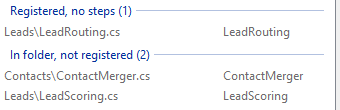
-
The assembly list drops its Isolation column and spends the width on saying what is wrong
with each assembly's source. That column read
Sandboxdown every row you were shown — Dataverse online forces it on everything that is
not Microsoft's, and the Microsoft's switch hides the rows where it does not — so a
quarter of the pane was spent saying the same word. It is gone, an assembly registered in
full trust says so in its tooltip, and the Source column got the width. What it spends it
on is the thing the roll-up would not say:3/4 ✗told you how bad it was without telling
you which, and no file and declared in two files are two different afternoons.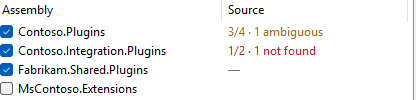
Its three empty states — not ticked yet, no source folder chosen, nothing registered in the
assembly — also answer when hovered, and the last of them reads—as soon as the row is
ticked rather than staying blank until a folder is chosen. -
Stale files have a group of their own, so "what have I got to rewrite" is one look rather
than a scan. They sat inside Matched, marked with a word
on the row, which is no way to answer "what have I got to rewrite" — the one question in
that pane you can act on with a single press.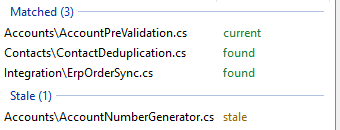
-
The tool behaves itself on a slow link: eight ways a fetch still in flight could mislead
you or lose your work are fixed. XrmToolBox draws a small panel in the middle of
a tool while it waits on the environment — not a sheet over the whole tab — so every button
stayed live for however long the fetch took. On a fast connection that window is
milliseconds wide. On a slow one it is where most of a session is spent, and eight things
went wrong in it:-
Closing the tab mid-fetch could take the tab down with it. The answer still arrived,
and was handed to a control that no longer existed. Every fetch now checks before it
draws, the way the folder scan always has. -
A late answer could overwrite a newer one — for good. Press Refresh while a fetch
is still out and two answers to two different questions are in the air; whichever landed
last was believed, and because the assembly was then in the cache it was never asked
about again. Fetches now carry the question they belong to and are dropped if it has
moved on. -
Ticking assemblies one at a time re-asked for the ones already on their way. Five
ticks put the first assembly on the wire five times. There is now one question out at a
time, and whatever is ticked meanwhile goes out together when it lands — one round trip
for the batch instead of one per tick. -
Load Assemblies and Write to Files are dead while their own work runs. Pressing Load
again cost a second full query whose answer cleared everything ticked since the first;
pressing Write twice put two writers over the same files, where the backup name is only
accurate to the second, so the two.bakcopies collided and the pristine original was
the copy that got lost. -
Write waits for the environment. It was offered while an assembly was still loading,
and would write a half-loaded list with a report that read like a complete one. -
The status lines stop claiming what has not arrived.
2 assemblies · 4 of 4 classes
is a complete-sounding sentence about a list with an assembly missing from it, and every
class of that assembly was filed, in words, under In folder, not registered — then
quietly un-filed when the network caught up. The count now says what it is waiting on,
the assembly's own row shows…, and nothing is called unregistered until every
registration is in.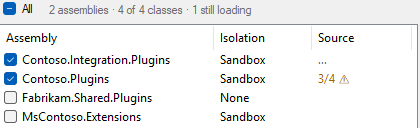

-
A fetch can be abandoned. The progress panel now offers Cancel. A query already on
the wire cannot be recalled, but the three round trips behind it can be called off, which
is most of the wait on the link where it matters. Nothing is recorded, so unticking and
ticking again asks afresh. -
A fetch that fails says so where you can still read it. The dialog is dismissed and
then there is only the list, and an environment that could not be reached looked exactly
like an environment with nothing in it. The status line keeps the reason.
tests\slow.ps1is what found all of it: ten scenarios driving the real control against
a Dataverse that takes seconds to answer, with a screenshot per gesture. -
-
The source folder can be slow too, and no longer freezes the window when it is. A plugin
repository is as likely to be on a UNC share, a mapped drive or a sync client that has
stopped syncing as it is to be on a disk, and against one of those simply asking whether a
folder exists blocks until the network gives up. That question was being asked from the
button-state pass, which runs on every keystroke in the folder box — so typing the path
to a share that was down froze the tool once per character. It is now asked once, on a
worker, after the same half-second pause the scan already waits out, and everything else
reads the answer it left. The box saysLooking for that folder...while the question is
out, rather than calling the path wrong before anybody has looked.Create Attribute Definitions File was the last thing still writing on the UI thread —
both looking for the file and writing it. It runs on a worker like every other write. -
The source folder is read once, not once per class, so a 250-file project scans in 17 ms
rather than four seconds. A project of 250 files with 33
registered classes took four seconds to scan and six to write. Reading all 250 files takes
twelve milliseconds, so none of that was ever the disk: every registered class was
re-scanning every file's text with a regex of its own, working out which local classes are
plugins built a freshRegexfor every name-against-class pair and did it again on every
pass, and one press of Write to Files walked and re-read the whole folder once per
class. The folder is now read and parsed once and answered out of a dictionary.On 250 files, 33 classes Was Now Scan 4051 ms 17 ms Write 6306 ms 48 ms A 4000 file repository — larger than most plugin repositories get — now scans in about
600 ms, of which 430 ms is reading the files. -
Write no longer freezes the window: it runs under the same progress overlay that loading
the assemblies does. It ran on the UI thread, so a slow write was a
tool that had stopped repainting. It runs under the same progress overlay as loading the
assemblies does, and says how many classes it is writing. -
Marks from another folder are cleared when you change folders, rather than sitting
there looking authoritative until the new scan lands. A rescan of the same folder — the
one that follows a write — keeps its marks up, because blanking the column on the way back
from a successful write reads as a fault. -
tests\perf.ps1times the scan and the write over generated repositories of 250 to 4000
files, against what reading the folder once costs on the same machine. It is what found
all of the above. -
The summary comment is grouped by table, so a plugin registered against a dozen tables
reads as a dozen short lists. A generic plugin — one class registered
against a dozen tables to stamp the same column on all of them — used to read as one
interleaved list, every table's steps scattered through it by stage. The comment now
takes a table at a time, tables alphabetically, keeping the order each table's own steps
run in; a step on a global message goes last./// Sync Post-Create of account (order 1): (all columns) /// Sync Post-Update of account (order 1): (all columns) /// Sync Pre-Update of annotation (order 1): (all columns) /// Sync Post-Create of annotation (order 1): (all columns)
The attributes are unchanged and stay in execution order: that is the order Xrm Tools
reads them back in. The one thing that did change there is a tiebreak — steps tying on
stage, rank and message name are now ordered by table rather than by whatever the query
returned, so the same registration writes the same file twice running. -
The docs, the store listing and the generated definitions file now name
Xrm Tools as whose attribute model this is. It is
the Visual Studio extension that reads
these same attributes back to deploy and register an assembly — and that is worth
installing whether or not you use this. Compatibility with it is this tool's premise; it
had earned more than a passing link. -
XrmToolsMetaAttributes.csgainsStages.DepecratedPostOperation = 50— upstream's
spelling, upstream's[Obsolete]— which it had been missing. Nothing the tool writes
changes: a step at the retired stage 50 is still emitted as(Stages)50, because naming
that member is a compile error against the real package too. -
The emitted attributes are now checked against the real
XrmTools.Meta.Attributes
package rather than only against our copy of it.tests\compat.ps1compiles a corpus
covering every emitter decision against both, at four package versions, and compares the
constructed attributes property by property. -
Nothing that goes wrong should reach XrmToolBox's crash dialog. Everything the tool
does on a worker already reported itself — a failed query, a locked file, a folder that
cannot be read — but the same work on the UI thread had no net under it at all, so one
unlucky registration could take the tab down while drawing a list. Composing the output
for a class is now guarded everywhere it happens: in the preview the class says so in its
own place and the rest of the list still renders, in the source column it reads as stale,
and on Write to Files it lands in the report's Failed section by name, beside the
files that could not be written. A settings file XrmToolBox cannot read or write no
longer costs the tab either — that read happens before any of the UI exists, so a throw
there was a tool that would not open and gave no reason. And a folder nested past what
Windows will open — which a package cache manages without trying — is stepped over the
way an unreadable one already was, rather than failing the whole scan.
Install from the XrmToolBox Tool Library, or Comentality.PluginStepCodegen on NuGet. Requires XrmToolBox 1.2025.7 or later.