Repository navigation
Dependency Sources
The most precise source wins:
| Priority | Source | Versions | Transitive dependencies |
|---|---|---|---|
| 1 | --python PATH |
exact, as installed | yes |
| 2 |
uv.lock, poetry.lock, pdm.lock, Pipfile.lock
|
exact | yes |
| 3 |
requirements*.txt, requirements/*.txt, pyproject.toml
|
exact when pinned with ==
|
no |
Requirement files follow -r includes and -c constraint files; constraints only pin packages that are listed elsewhere. pyproject.toml is read as PEP 621, dependency groups and Poetry. When a lockfile holds several versions of one package for different Pythons, as uv's forked resolutions do, the one for your project's Python is used.
Unpinned requirements are judged by the newest release they allow and marked as such. When Django itself is only a range with an upper bound, such as Django>=4.2,<5.0, the newest release it allows is assumed and a warning says so. --from sets the version you run; at a terminal the tool asks for it.
django-upgrade-report services/api services/worker, or -r services to find them: one report per project, after an overview with each project's step and counts, the packages that block more than one project, and the upgrades several projects share. --recursive looks for lockfiles, requirements*.txt, requirements/*.txt and pyproject.toml files with dependencies; it skips virtual environments, node_modules, build output and hidden directories, and counts a directory inside a project as part of it unless it has its own lockfile. A project without dependencies is listed as not checked, the others are still reported, and the run exits with 2.
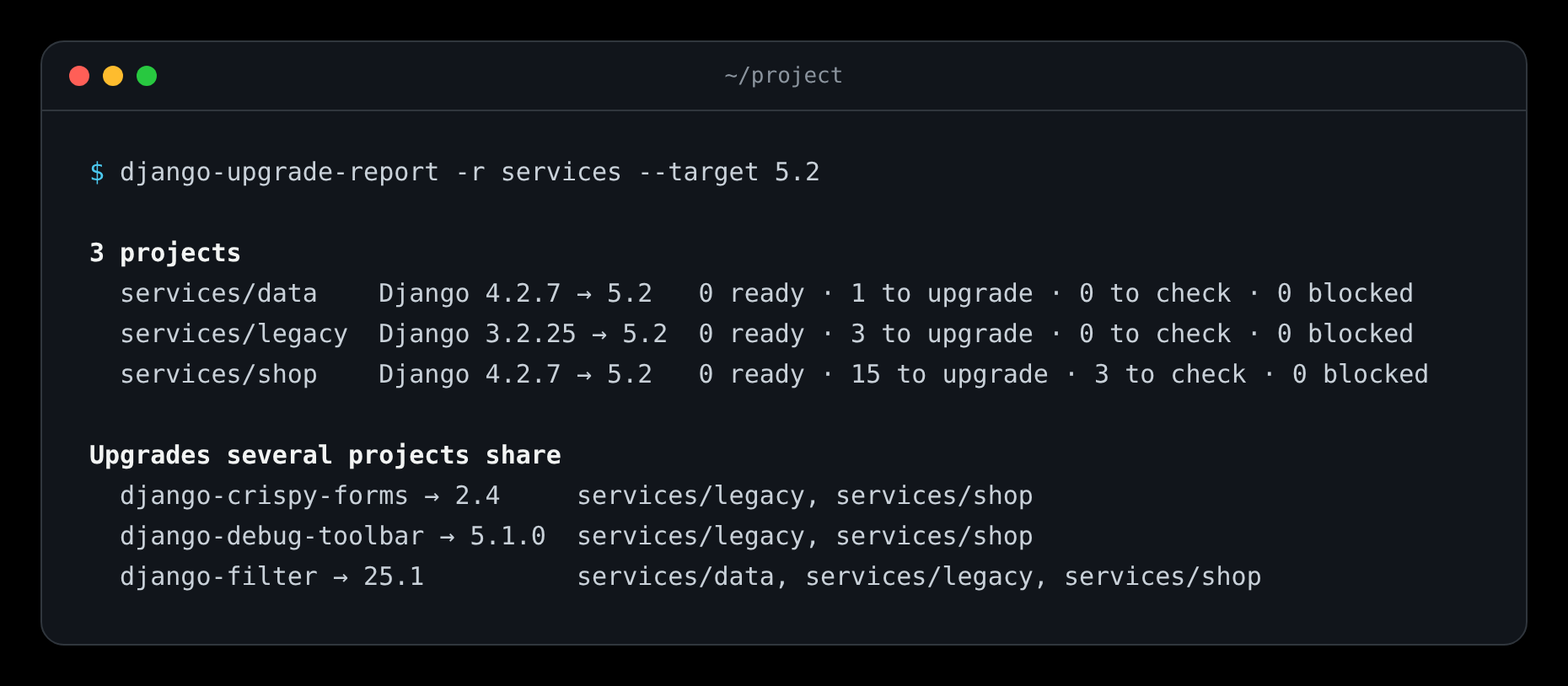
The HTML report links each project from the overview, and the JSON report is a document of its own, "kind": "multi". In the GitHub Action, path takes one project per line, or recursive: true finds them; the outputs count over all projects.
Environment markers such as python_version < "3.12" decide which requirements apply, so the tool needs your project's Python. It takes the first of:
- the interpreter passed with
--python, -
.python-version, -
requires-pythoninuv.lock, -
requires-pythoninpyproject.toml, - the
pythondependency in Poetry'spyproject.toml, -
python_versioninPipfile.lock, - your answer, when it asks at a terminal.
A range counts as its lower bound. Markers are evaluated for CPython on Linux, where Django apps are deployed, never for the machine running the tool. Against the target, a package is judged on the newer of your project's Python and the oldest Python the target Django supports.
A lockfile also holds what your dependencies need. The report says which packages your project names itself, "direct" in the JSON report and the "only direct dependencies" switch of the HTML report, because only those are yours to bump in a requirement; the others move when the package that needs them does.
| Source | Direct dependencies |
|---|---|
uv.lock |
What the project lists, with its extras and dev groups; in a workspace, what every member lists. |
poetry.lock, pdm.lock
|
What pyproject.toml beside it lists: [project], Poetry's dependencies and groups, [dependency-groups], PDM's dev dependencies. |
Pipfile.lock |
[packages] and [dev-packages] of the Pipfile beside it. |
requirements*.txt, pyproject.toml
|
Everything they list. A -c constraint only pins a version, it adds nothing. |
--python |
What the project's uv.lock, else its pyproject.toml lists, matched by name. |
Without the file beside the lockfile, or with --python and neither file, the report does not say ("direct": null), and the switch is not there.
Packages from git, a local path, a URL or a private index are never looked up on PyPI and their names are never sent there. This covers git+https://..., -e and path lines in requirement files, name @ url requirements, git, path and URL sources in lockfiles, --index-url and --no-index in requirement files, a private default index or no-index in uv, Poetry, PDM or Pipenv, and the PIP_INDEX_URL, UV_INDEX_URL, UV_DEFAULT_INDEX, PIP_NO_INDEX and UV_NO_INDEX environment variables. Credentials in those URLs are removed before anything is shown.
A fork or local package is still judged by what it declares itself, read locally: the installed metadata with --python, the pyproject.toml of a local directory, or the constraints poetry.lock and pdm.lock record. A fork pinned years ago with Django<4.1 shows up as blocked, with a note saying where it comes from. Its own requirements count too: a fork that pins django-filter<23 holds back that upgrade.
| Your index | Pass |
|---|---|
| Implements PyPI's JSON API | --index-url https://pkgs.example.com/pypi |
| Mirrors PyPI (Artifactory, Nexus, devpi) |
--check-private-on-pypi, which sends those names to PyPI |
| Neither | Nothing: those packages are listed as not checked |
Credentials in --index-url (https://user:token@host/...) are sent as basic authentication and never shown in output or error messages.
Answers are cached in ~/.cache/django-upgrade-report (or $XDG_CACHE_HOME/django-upgrade-report): a project's release list for 24 hours, the metadata of a single release for good. --no-cache turns it off, --offline answers from it alone, --prefer-cache asks the index only for what is missing. A new version of the tool may keep more of each answer and fetch everything once more; delete the directory now and then to free the space.