Repository navigation
Upgrading Python
Django 6.0 needs Python 3.12. When the target Django needs a newer Python than your project uses, the report starts with what all your dependencies need on it, not only the Django-related ones. A C extension without a wheel for the new Python is the most common surprise of a Django upgrade.
Python 3.12 first (2)
  These dependencies need something before they run on Python 3.12.
  ↑ numpy            1.22.4 → 1.26.0  1.22.4 no wheel for Python 3.12, pip builds it from source
  ↑ psycopg2-binary  2.9.3 → 2.9.9    2.9.3 no wheel for Python 3.12, pip builds it from source
  3 more dependencies run on Python 3.12, all pure Python.
  1 says nothing about Python versions: pycrypto.
  Django 4.2.7 does not declare Python 3.12, 4.2.8 does: update Django 4.2 first.
--python-target |
Checks |
|---|---|
auto (default) |
The Python the target Django needs, when your project uses an older one. Your project's Python must be known, see Dependency sources. |
3.13, … |
That Python, whatever Django needs. Useful for a Python upgrade on its own. |
none |
Nothing. |
In this order:
- A
Requires-Pythonthat excludes it means no. - A
Programming Language :: Python :: 3.12classifier means yes. - A wheel built for it (
cp312) means yes. - An
abi3wheel for an older Python, or a pure-Python wheel (py3-none-any), runs on it too. - Wheels only for other Pythons mean pip builds it from source: that needs a compiler and headers and often fails. Without a source distribution it cannot be installed at all, which means no.
- Otherwise the release says nothing about Python versions.
Wheels count when they install on CPython under Linux on x86_64, where Django apps run. PyPy and free-threading (cp313t) wheels do not count.
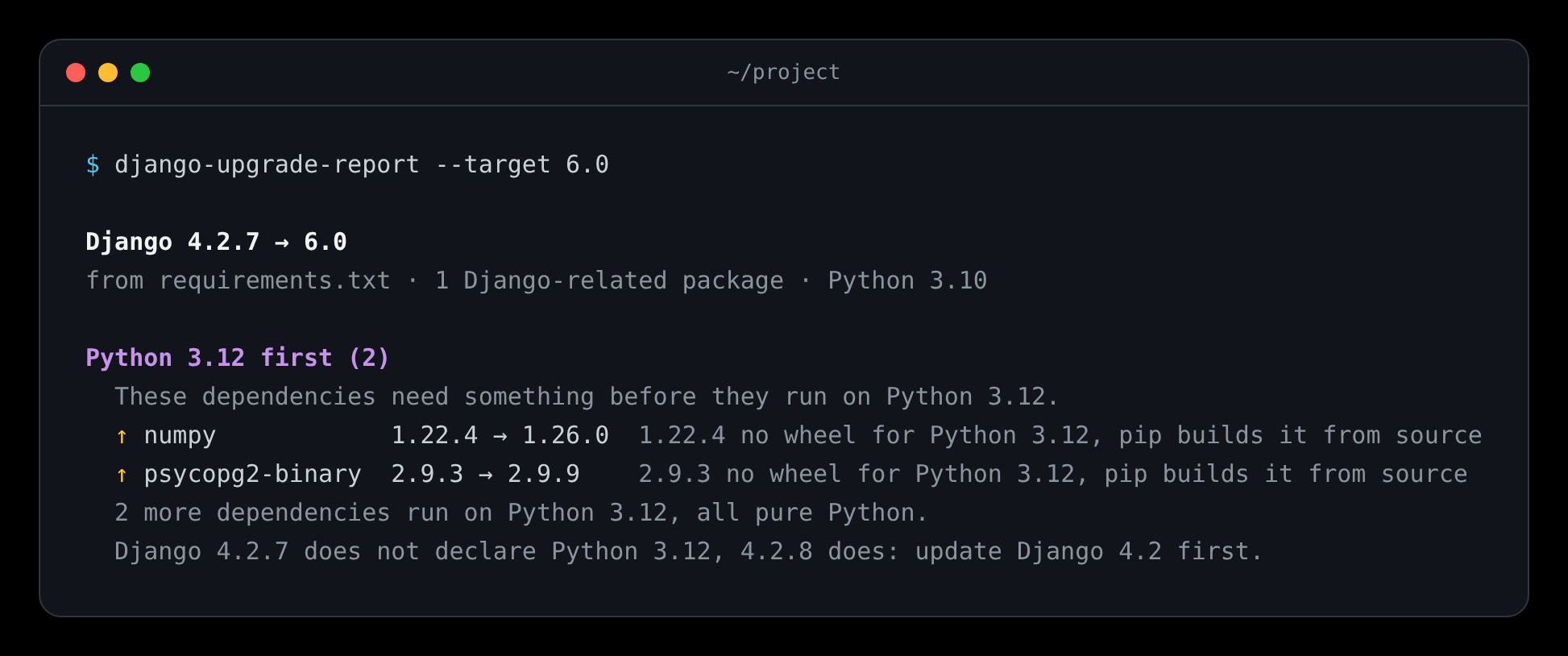
- Rows for dependencies whose installed release excludes the Python or would be built from source, with the oldest newer release that runs on it, and those no release fixes (blocked).
- A note goes together with the switch to Python 3.12 when that release no longer runs on the Python you use today.
- One line counts the dependencies that run on it already; another names those whose release says nothing about Python at all (old sdist-only packages).
- One line says whether your Django patch release declares the Python, or which patch of your series first does.
- In the Django plan, an upgrade whose release excludes the new Python says so on its row.
The installed releases come from the cache the Django check already filled. A release history is only fetched for a dependency that needs an upgrade.
django-upgrade-report --fail-on-python blockedfails when a dependency has no release that runs on the new Python. The GitHub Action has the inputs python-target and fail-on-python, and the output python-blocked. The JSON report has the section under python.