Repository navigation
Choosing A CPU
--cpu-type picks the CPU, --cpu-variant its configuration; the BIOS, the firmware and the
tools follow, because the wrapper of each CPU carries its memory map, compiler flags and
software support. Which one? It depends on what you want to run on it; here is how we choose,
among the thirty-two soft CPUs and seven hard ones of the catalog.

litex_sim --cpu-type=serv --cpu-variant=standard # try another one in a minuteMost SoCs embed one to control the system and to split the work between software and
hardware. Some do not need any: a bridge-driven design controlled from the host
(SoCMini, --cpu-type=None), or a PCIe card whose CPU is the host's. And when the FPGA
carries a hard CPU (Zynq, Cyclone V, Agilex), the SoC runs on it: Hard core CPUs.
-
A controller for your cores, the BIOS, bare-metal firmware or an RTOS:
vexriscv(standard, orliteandminimalon small FPGAs),neorv32for its MCU peripherals and Zephyr support,serv,fazyrvorfemtorv quarkwhen every LUT counts. -
Linux:
vexriscv_smp(the reference, 32-bit, up to 8 cores),vexiiriscvornaxriscv(64-bit, more performance),rocketandcva6(64-bit, upstream kernels),mor1kxandmarocchino(OpenRISC),microwatt(POWER), or a hard CPU. -
Floating point:
vexriscv_smp --with-fpu,naxriscv --with-fpu,vexiiriscv,rocket full,cva6,cva5 standard+atomic+float+double,cv32e40p standard+fpu,femtorv petitbateau. -
GDB over JTAG:
vexriscv +debug,vexriscv_smp,naxriscv,vexiiriscv,neorv32 +debug,cva6,veer_eh1,openc906(Debug with GDB). -
A custom instruction:
vexriscv full+cfuwith--cpu-cfu=<verilog>(CFU Playground).
Start with vexriscv: it is the default, it is what we try everything on first, and it stays
small. Go to vexriscv_smp, vexiiriscv or naxriscv for Linux (generated at build time with
your options), to rocket if you want upstream Linux and have a big FPGA, to neorv32 if you
like an MCU with its own peripherals, to serv or femtorv when you count LUTs.
--cpu-variant selects a configuration among the ones the wrapper lists (its variants
list, printed when a name is wrong). The names are CPU specific, with common ones:
| Variant | Meaning |
|---|---|
minimal |
The smallest working configuration, often without exceptions. |
lite |
Bare metal and RTOS on small FPGAs (iCE40, small ECP5 and Artix-7). |
standard |
The default: bare metal and RTOS on modern FPGAs. |
full |
Every feature of the core. |
linux |
MMU, supervisor mode, what Linux needs. |
Extensions are suffixed with +: +debug (the debug port), +fpu, +smp, +cfu, +irq,
+ghdl... Each combination is a key of the CPU's list, there is no generic combinator:
vexriscv has standard+debug, serv has no +debug. Who has what:
| Variant | CPUs |
|---|---|
minimal |
cva5, lm32, neorv32, picorv32, vexriscv |
lite |
lm32, neorv32, vexriscv |
full |
coreblocks, cva6, neorv32, rocket, vexriscv |
linux |
coreblocks (small_linux), gowin_ae350, marocchino, mor1kx, rocket, vexiiriscv, vexriscv_smp |
+debug |
neorv32, vexriscv (+hwbp adds hardware breakpoints) |
+fpu, float |
cv32e40p, mor1kx, cva5 (+float+double); --with-fpu on vexriscv_smp and naxriscv |
+smp, several cores |
mor1kx, marocchino; --cpu-count on vexriscv_smp, naxriscv, cva5, neorv32; rocket --cpu-num-cores
|
The generated CPUs (vexriscv_smp, naxriscv, vexiiriscv) take their configuration from
command-line options rather than variants (naxriscv is always Linux capable, --xlen 64
for 64 bits); the pre-generated ones (vexriscv, rocket) ship one netlist per variant in
their pythondata-cpu-* package.
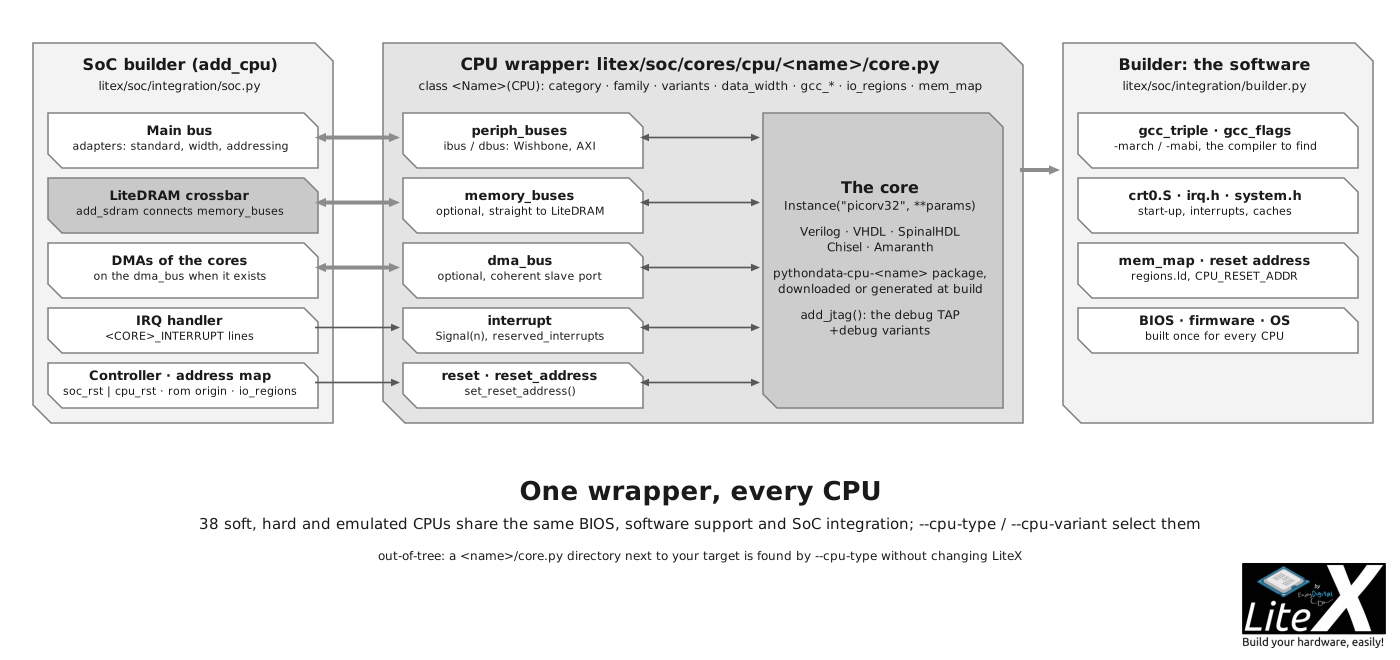
soc.add_cpu(name, variant, reset_address), called by SoCCore, does the same with every
wrapper:
- Its peripheral buses (instruction and data Wishbone, or AXI and AXI-Lite) become masters of the main bus, adapted to the standard and width of the SoC.
- Its memory buses (VexRiscv-SMP, NaxRiscv, VexiiRiscv, Rocket, AE350) go straight to the
LiteDRAM crossbar through
add_sdram, bypassing the main bus. - Its DMA bus (coherent, on VexRiscv-SMP, NaxRiscv and VexiiRiscv) is a slave port for the DMAs of the cores, so that Linux sees coherent memory.
- Its IO regions (
0x80000000to0xffffffffon most 32-bit cores) say where uncached peripherals can live; itsmem_mapoverrides the default origins. - Its reset address is the ROM origin, the BIOS;
--cpu-reset-addressmoves it to the flash or the main RAM, and some CPUs impose theirs (Rocket and CVA60x10000000, BlackParrot0x70000000, MIPS0x1fc00000). - Its interrupts are wired to the IRQ handler and exported to
soc.h. - Its compiler flags (
gcc_triple,gcc_flags,linker_output_format) drive the BIOS and firmware build;add_software_packagesandprepare_softwareadd CPU-specific software (the Zynq BSP, the Rocket and NaxRiscv linker scripts). - The
CPU_TYPE_<name>,CPU_VARIANT_<variant>,CPU_FAMILY,CPU_NAME,CPU_NOPandCPU_RESET_ADDRconstants are generated for the software.
Add a new CPU writes a wrapper of your own.
- CPUs: the catalog, with the variants, the sources and the language of each one.
- Hard core CPUs: Zynq, Cyclone V, Agilex, EOS S3, Gowin.
- Run Linux on your SoC: the Linux line in practice.
- Debug the CPU with GDB: OpenOCD and GDB on the debug ports above.