Repository navigation
LiteX Approach
This page is the why behind LiteX: the choices we made since 2012, building systems for clients and open-source projects, and still stand by. The code, the cores and the rest of this wiki follow from them.
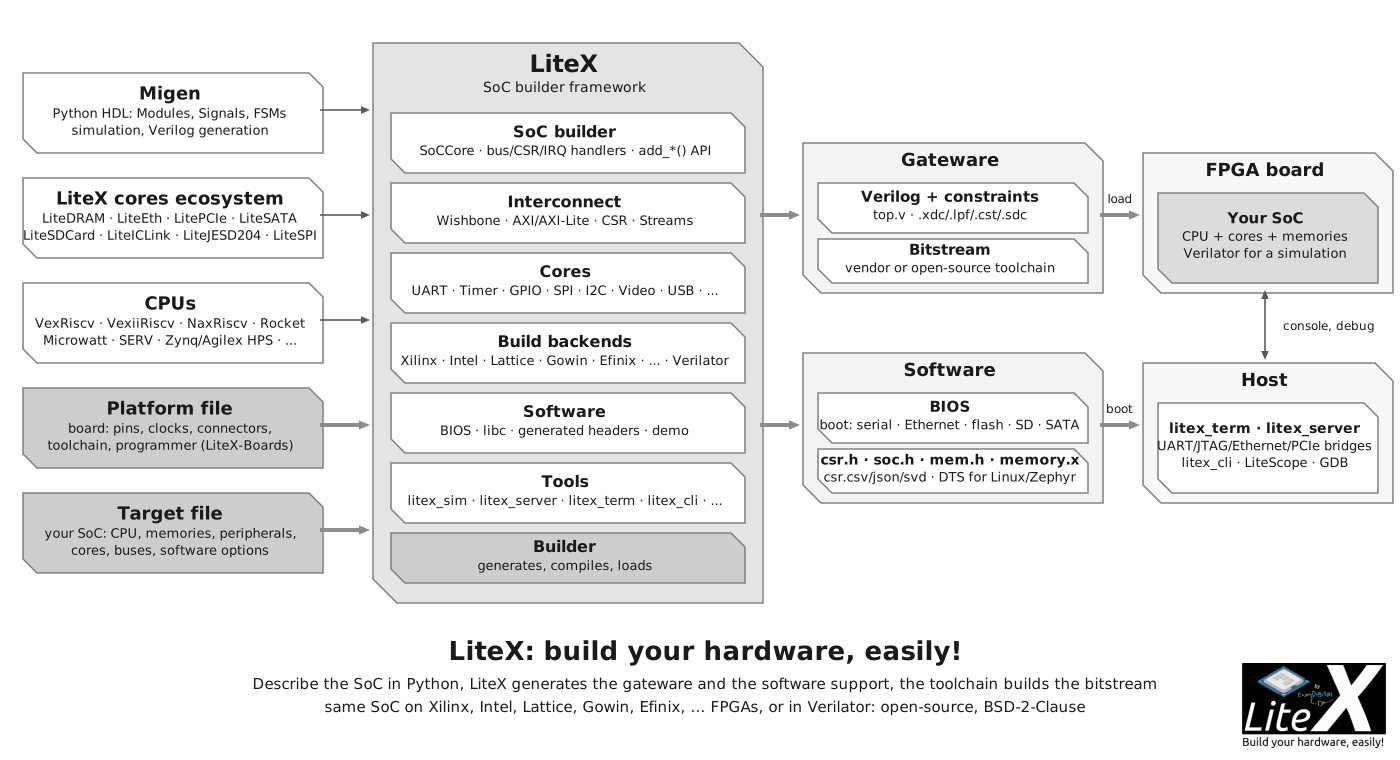
A LiteX design is a Python program. Migen describes the logic (Modules, Signals, finite state machines, clock domains) and generates the Verilog; Python does everything around it: parameters, address maps, generated software headers, toolchain scripts, simulation, host scripts talking to the running SoC. A SoC is short because the work is in the cores and in the builder, not in each design.
Migen is a small DSL (sync vs comb, Signal, If/Else, FSM, Record) shared by the
whole ecosystem of cores, and LiteX stays on it: it is stable, well understood, and no longer a
barrier for an engineer coming from Verilog/VHDL, all the more since today's AI coding assistants
are fluent in it. The LiteX for Hardware Engineers page
is written for that reader, and existing Verilog/VHDL/Amaranth/SpinalHDL/Chisel cores are
reused as they are, converted
to Verilog at build time when needed.
Cores talk to each other and to the CPU through a small number of interfaces, and the whole framework is built on them:
-
Streams (
valid/ready/first/last/payload/param) for data paths: converters, FIFOs, packetizers and clock domain crossings are generic and reused by every core. - Wishbone and AXI/AXI-Lite for memory-mapped traffic, with an interconnect (shared bus or crossbar), width/burst converters and bridges between them.
-
CSRs (control/status registers, generated by
AutoCSR) for control: the same Python declaration gives the hardware register, its address, the C/Rust header, thecsr.csv/json/svddescription and the documentation. -
EventManagerfor interrupts.
Because the contracts are stable, a core written for one project (a video pipeline, a PCIe DMA,
a SerDes link) drops into another, and the SoC builder can wire the common
parts (add_sdram, add_ethernet, add_pcie, add_sdcard, ...) in one call each.
A protocol does not depend on the FPGA it runs on. The architectural style document is the reference; in short, each decision lives in its owning layer:
| Layer | Owns |
|---|---|
| Protocol core (LiteEth MAC, LitePCIe endpoint, LiteDRAM controller...) | framing, state machines, stream behavior |
Device adapter (litex/build/<vendor>, the PHYs) |
primitives, PLLs, SerDes, I/O, clock domains, reset sequences |
| Integration wrapper | the stable stream/control/CSR interface between the two |
| Platform and target | pins, clocks, constraints, which cores are instantiated |
So the same SoC builds for Xilinx, Intel, Lattice, Gowin, Efinix, CologneChip, Anlogic or Microsemi parts, with vendor toolchains or the open-source ones (Yosys/nextpnr, Project Trellis/IceStorm/Oxide/Apicula/Peppercorn, F4PGA), and in Verilator. Adding a device means writing an adapter, not a copy of the protocol.
- Cores are developed with Migen's Python simulator and
pytest(test/in each repository: unit tests with Python models, CI on every push). - A full SoC runs in Verilator with its real BIOS and firmware (
litex_sim), with models for the serial port, Ethernet (TAP), SDRAM, SPI flash, SD card...; QEMU co-simulation runs the CPU in QEMU against the simulated gateware. - On hardware, the SoC is never a black box: a host bridge (UART, JTAG,
Ethernet, PCIe) exposes the whole address space to the host (
litex_server,litex_cli, Python scripts), LiteScope captures internal signals through the same bridge, and the CPU is debugged with GDB over JTAG. A board bring-up starts with the bridge and the BIOS, before any application.
That is the order most LiteX features went through, and the last step matters as much as the first: what stays is the solid part the next project builds on. Features land when they have been used on real hardware; the Projects page shows where they come from, and the recent ones (USB3-PIPE, TriXium, LiteX-M2SDR) are documented with the same approach: simulation, measurements on the board, then upstream contributions to LiteX and the cores.
- No vendor IP in the protocol cores. Vendor primitives stay in the device adapters, so that a design can move between vendors and to the open-source toolchains.
- Keep the public names. Class names, constructor arguments, CSR layouts, command-line options and clock domain names are used by many targets; a refactor provides compatibility aliases or a migration path.
-
Generated outputs are the interface with software.
csr.h,soc.h,mem.h,memory.x,csr.csv/json/svdand the device trees are generated from the SoC, never written by hand. -
Standalone cores for other flows. The cores ship a generator (
litedram_gen,liteeth_gen,litepcie_gen,litex_soc_gen, ...) producing a Verilog core with a plain interface for designs that are not LiteX SoCs (Export). - Validate with elaboration, simulation and one real build. A Python import proves nothing: elaborate every supported variant, run the tests, build a representative target when the toolchain is available, and say in the pull request what was not tested on hardware.
-
Code and commits in the house style: the
coding style and
module: Description of the change.(Feedback, contribution, support).
LiteX and the cores are released together three times a year, tagged YYYY.04, YYYY.08
and YYYY.12 (the tag is the version on PyPI, litex_setup.py --tag=2026.08 checks out a
release of every repository); master is where the development happens and is used by most
projects. CHANGES.md lists
what changed in each release, the
release process
how a release is made. CI builds and runs the test suite of each repository on every push
(simulations of every CPU, buses, cores); an
hardware CI runs the designs on real boards.
LiteX was started by Enjoy-Digital to build custom FPGA systems for clients, and is still used for that: most of the cores and features come from these projects, were made open source with the clients' agreement and have been improved by the community since. Enjoy-Digital leads the development; the collaborative projects live in LiteX-Hub. The framework is permissively licensed (BSD-2-Clause), and we ask in return for feedback, contributions and the respect of the work involved (Feedback, contribution, support).
- SoC builder: the integration logic this page describes, class by class.
- Streams, Wishbone bus, CSR bus: the contracts the cores share.
- Cores: what is in the repository, and the ecosystem around it.
- Projects: the systems the features come from.