User Guide Assets
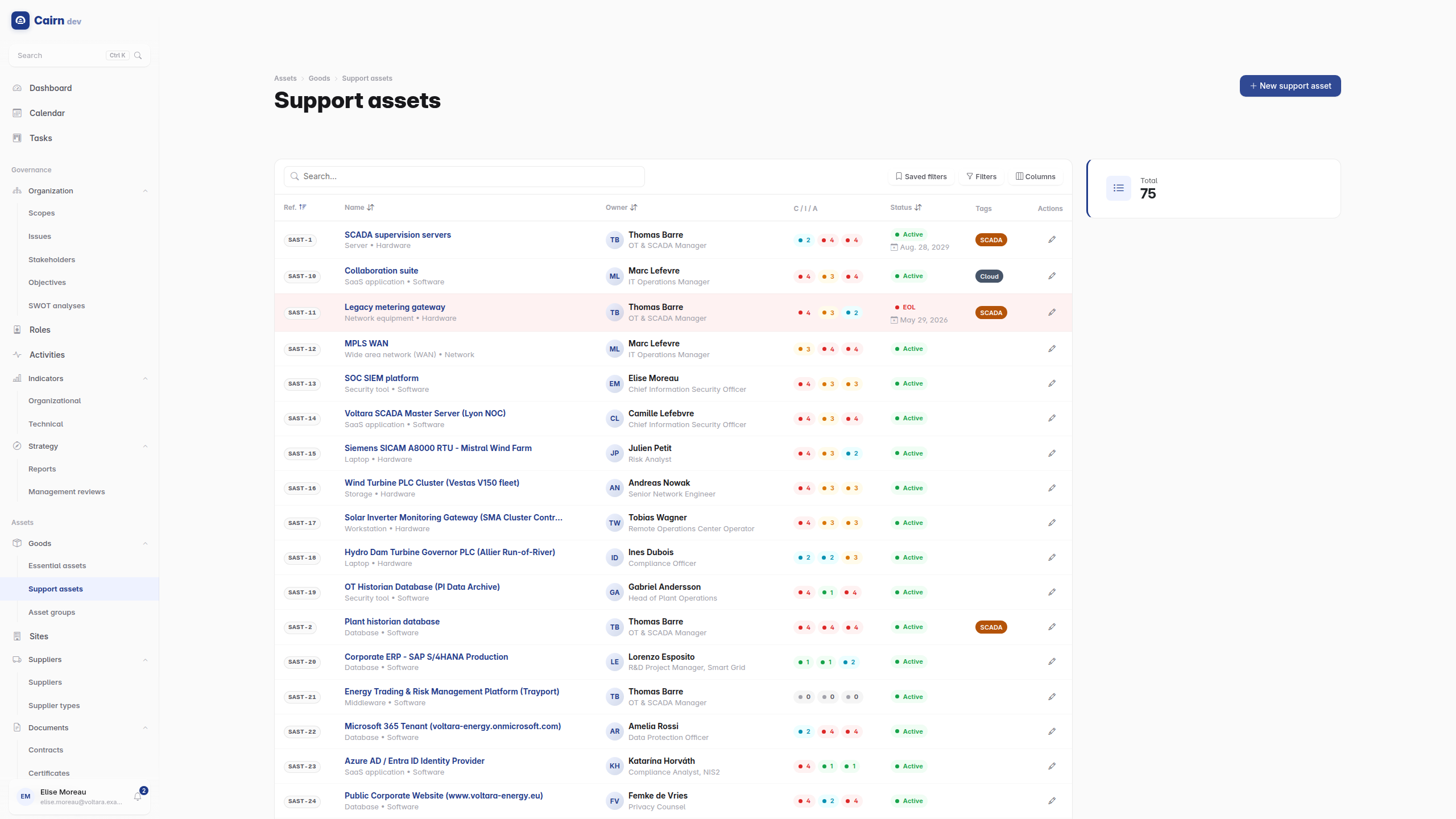
Cairn separates what the business depends on from what carries it, and the separation is the point rather than a taxonomy exercise.
Essential assets are business processes and information : the payroll process, the customer database, the SCADA telemetry. They are what a risk is ultimately about. Each is valued on three criteria, confidentiality, integrity and availability, on a five-level scale. That valuation is a business judgement and it is where the whole model gets its weighting.
Support assets are the IT infrastructure that carries them : servers, applications, network equipment, services, sites, people. They have a lifecycle of their own : end of life, end of support, warranty expiry.
A dependency links an essential asset to the support assets it relies on, with a criticality and a redundancy indication. There are four kinds : asset to asset, asset to supplier, site to asset, site to supplier.
Two things fall out of the graph, and they are the reason to build it.
CIA inheritance. A support asset automatically inherits the highest CIA levels of the essential assets that depend on it. You value the business process once, and the criticality of the server underneath it is derived rather than argued about.
SPOF detection. Cairn continuously identifies single points of failure : where one support asset or one supplier carries something critical with no redundancy. The count is on the dashboard, and the detail names the dependency. A SPOF you have accepted is a decision; a SPOF you did not know about is an outage waiting for a Tuesday.
The dependency graph renders all of it visually, which is usually how somebody first notices that three critical processes rest on one virtualisation host.
Logical groupings of support assets, for when the same treatment applies to a set rather than to individuals.
Physical and logical locations : offices, datacenters, cloud regions, and they are hierarchical. A site runs an operational lifecycle rather than the default one:
Draft ──▶ Commissioning ──▶ Operational ──▶ Review
                                              │
                            Decommissioned ◀──┘
Sites participate in dependencies, so "which processes stop if this datacenter does" is a question the graph answers.
The third-party register, and the part of the module most often driven by a regulator rather than by choice.
A supplier carries its contacts, its mapped addresses, its subsidiaries, and its sub-processors : the parties your supplier in turn relies on. That last one is what supply-chain mapping under NIS2 and DORA actually requires, and it is why the field exists rather than a free-text note.
Supplier types carry requirements, and a supplier is evaluated per requirement with an evidence review rather than given a single overall score. "Compliant" as a single verdict is not defensible; "compliant on twelve of fourteen requirements, with these two under remediation" is.
Suppliers can be bulk imported from CSV, which matters when the register starts as a spreadsheet somebody has been maintaining for three years.
Contracts are multi-party : suppliers on one side, customer stakeholders on the other. They carry amendments, supersession (which contract replaced which), an attached PDF stored securely rather than on a share, and a lifecycle of Draft, Active, then Expired or Terminated.
Certificates are your own : the ISO 27001, HDS or SOC 2 certificates your organisation holds. Each is attached to the framework it attests, with the certification body, validity dates, the sites it covers, its renewal history and the PDF.
Certificates are what the Trust Center publishes, so keeping them current here is what keeps the public page honest.
- Activities first, in organisational context.
- Essential assets, attached to those activities, valued on CIA.
- Support assets, the infrastructure.
- Dependencies between them. This is the step people skip, and it is the one that makes CIA inheritance and SPOF detection work.
- Suppliers, with their types and requirements.
- Contracts and certificates, attached to the suppliers and frameworks that already exist.