User Guide Incidents
ISO/IEC 27001:2022 A.5.24 to A.5.28 and A.6.8, with the statutory reporting duties attached to the incident that raises them.
The module is built on one idea : an incident record is evidence. Its chronology, its artefacts and its notification decisions may end up in front of a regulator, so the design refuses shortcuts that would make any of them deniable.
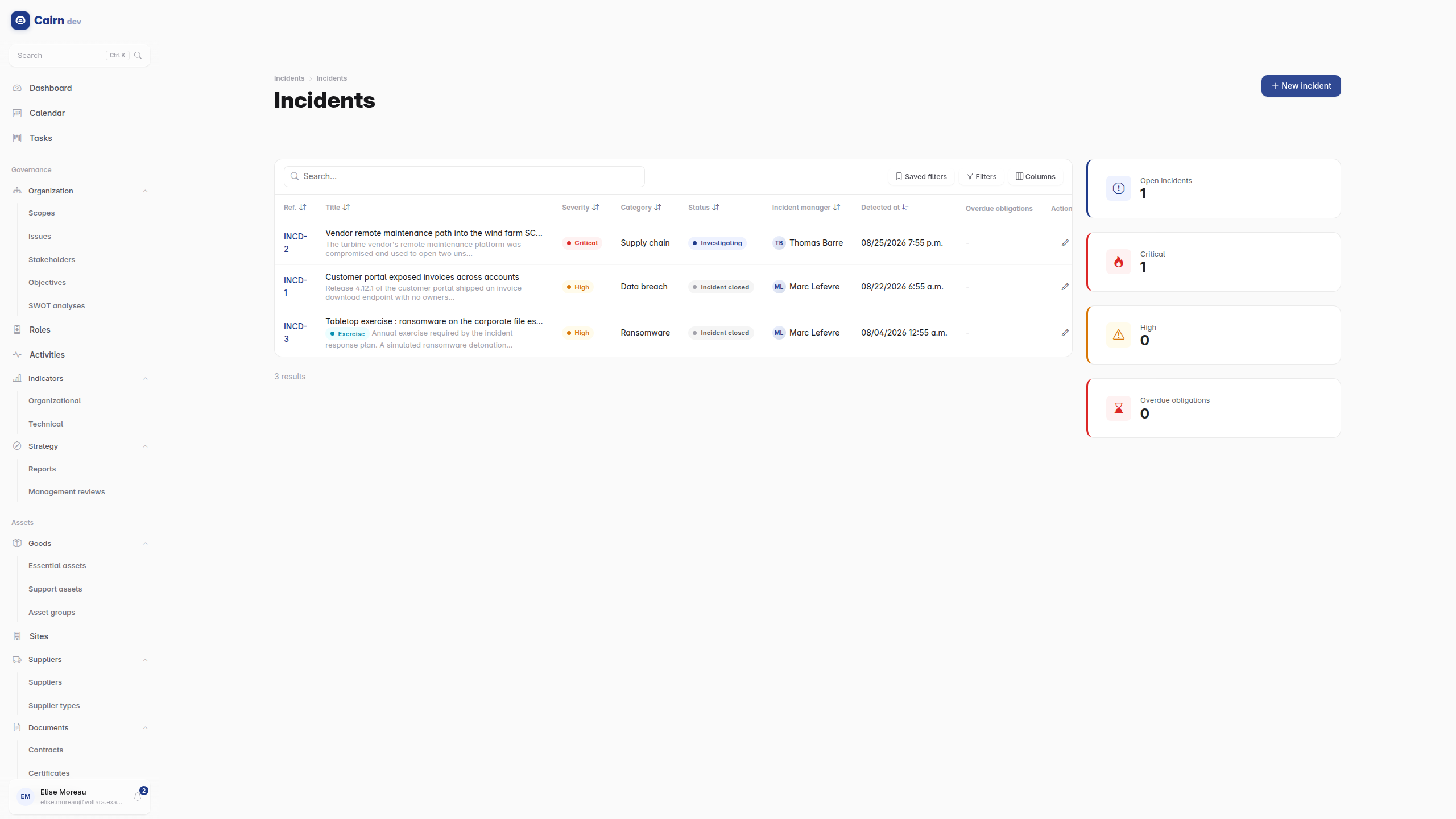
Not everything reported is an incident, and treating it as one inflates your numbers and your workload.
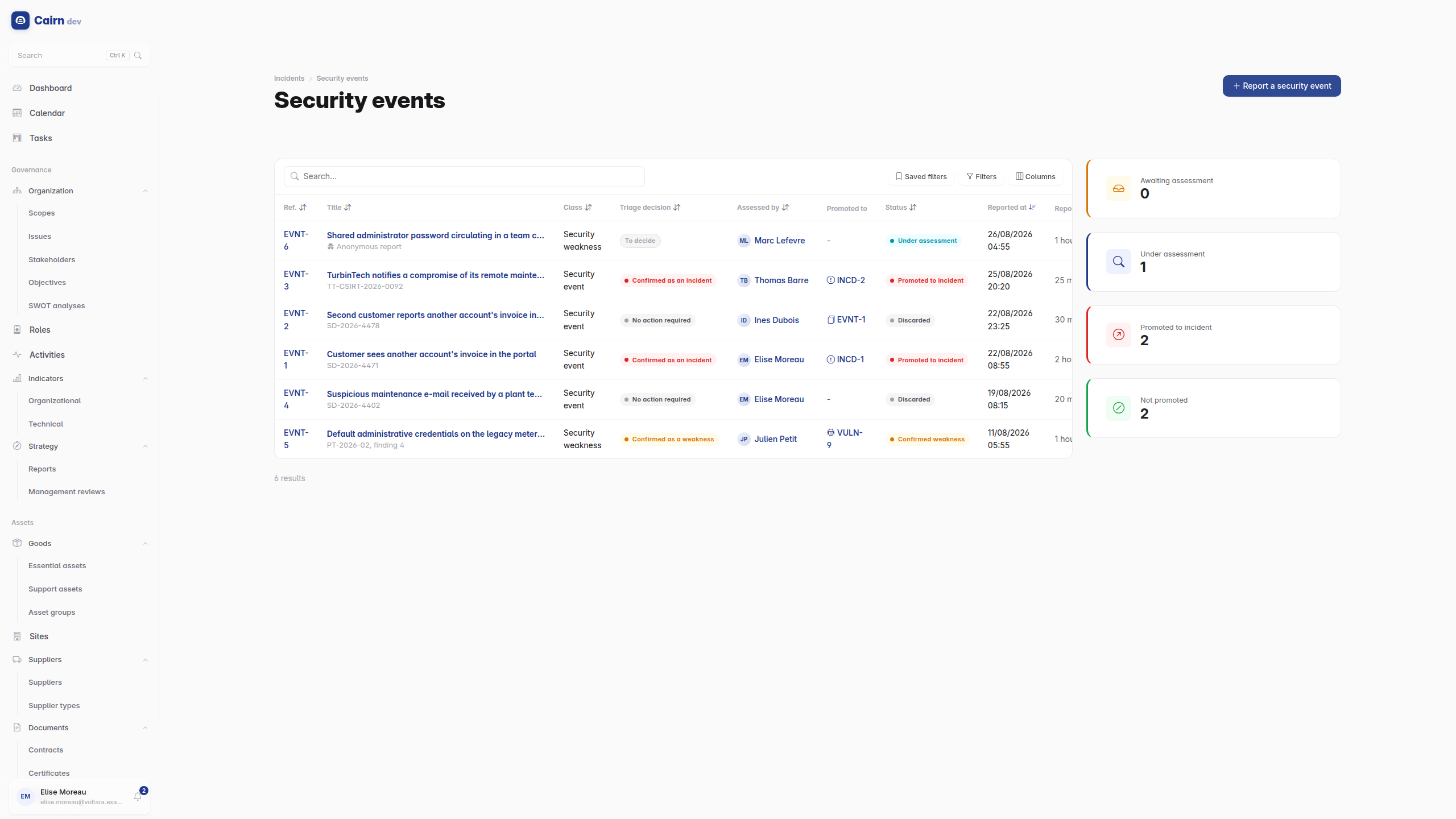
A security event (A.6.8) is the intake. Anyone can raise one. It is assessed before anything escalates : a false positive stays an event and is closed as one. A confirmed event is promoted, in a single recorded act, into either an incident or a vulnerability.
Promotion is a transition, not a copy-paste. It creates the target, declares it, moves the event on, and checks both the event's transition permission and the create permission of the register receiving it. The link between the event and what it became is preserved.
Detected ──▶ Triaged ──▶ Investigating ──▶ Contained ──▶ Eradicated
                                                              │
        Closed ◀── Post-incident review ◀── Recovered ◀───────┘
Each transition writes its own entry in the incident's chronology. The timeline is a by-product of handling the incident, not a form somebody has to remember to fill in afterwards, which is precisely when memory is worst.
The chronology is append-only. There is no edit and no delete. A mistake is
corrected by appending an entry of type correction that names the entry it
supersedes. That is how a timeline stays credible : the correction is visible,
not invisible.
Response plans are the playbooks, prepared in advance. Response actions are what was actually done during this incident, with an owner and a status.
The evidence register (A.5.28) is the part with the strictest rules, because this is what has to survive a challenge.
An artefact is hashed on acquisition. Evidence is sealed as a lifecycle
state, not as a checkbox somebody can untick. Its integrity can be
re-measured on demand, returning one of three verdicts : match,
mismatch, or not_verifiable. The third exists because "we cannot check" is
an honest answer and pretending otherwise is not.
Handling is recorded in an append-only chain of custody. Release and destruction are permissioned transitions, never a delete. Nothing removes a row from the custody ledger.
Artefacts never appear in an API payload and are never at a guessable URL. They stream through a permission-checked download, so evidence carrying a TLP caveat is not one URL guess away from anyone.
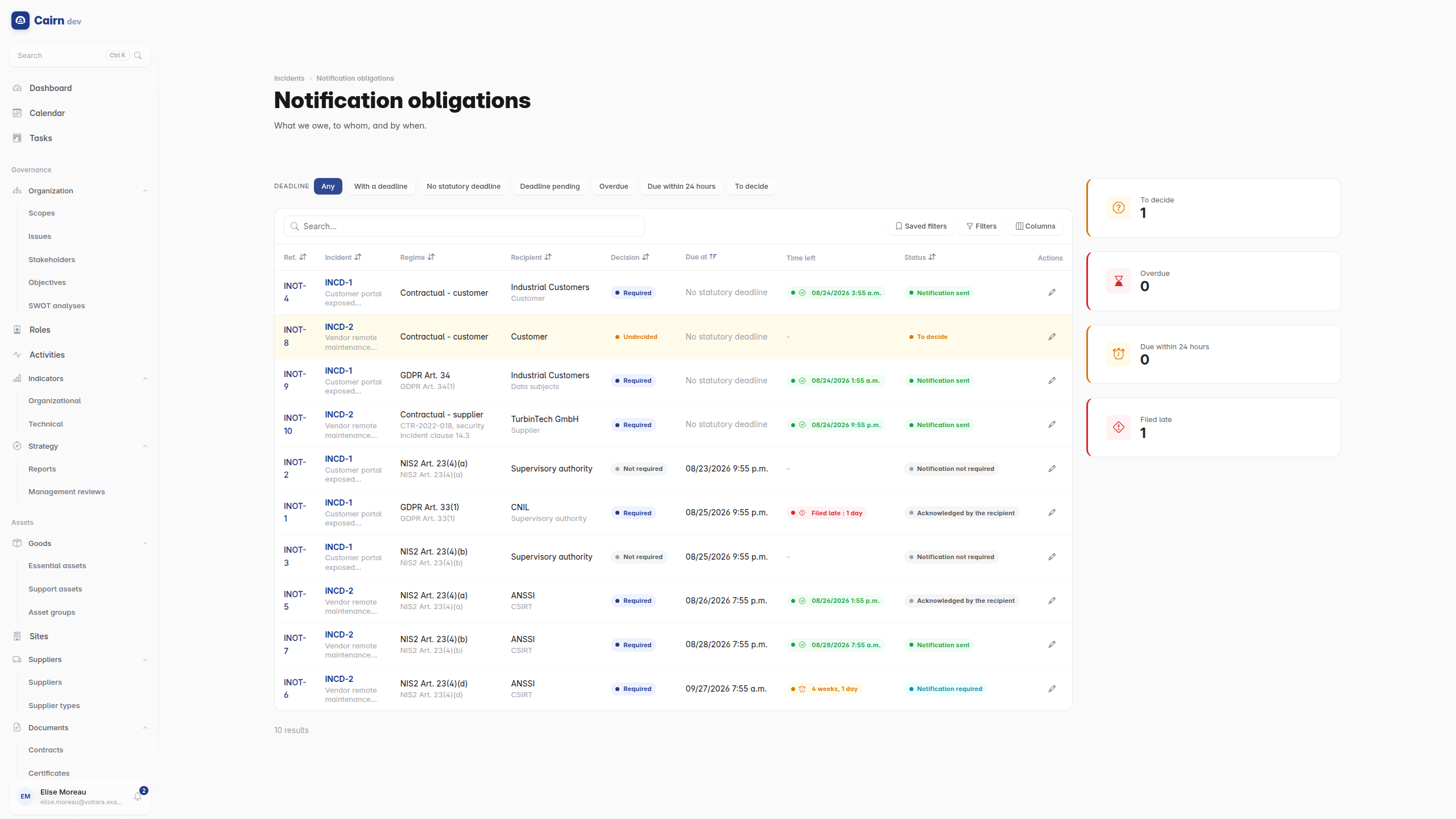
This is the module's most demanding surface, and the one that pays for itself the first time a clock is running.
At triage, Cairn generates the notification obligations that apply, from a catalogue of reporting authorities and obligation templates : GDPR Article 33 and 34, NIS2, DORA, ePrivacy, CRA, sector-specific and contractual.
Each obligation runs its own legal clock from the incident's awareness anchor. GDPR's 72 hours and NIS2's 24-hour early warning are different clocks on the same incident, and Cairn tracks them as such rather than picking one. Due dates and overdue status are computed, never typed, so they cannot be quietly adjusted.
An obligation is discharged through an append-only filing log that keeps the proof of what was actually transmitted, with the recipient's acknowledgement and external reference recorded when they come back. Filing again supersedes an earlier filing rather than overwriting it.
Deciding not to notify is itself a decision. It is named, timestamped, approved, and carries a written rationale. It is never a blank row. When a regulator later asks why they were not told, the answer exists, with a date and an author, instead of being reconstructed.
The Notification deadlines dashboard widget shows the clocks that are late or still running, together with the incidents still open behind them.
Where personal data is involved, a GDPR qualification record is opened : the Article 33(5) record, with its own confirm or rule-out verdict. Ruling out a breach is a recorded decision with a reason, on the same principle as deciding not to notify.
The A.5.27 review, and the place where an incident stops being an incident and becomes an improvement.
A review feeds three registers : the nonconformity register, the risk register, and the ISMS change log. Its corrective actions get an effectiveness verification, so "we fixed it" is a claim someone checked rather than a claim someone made.
Under Incidents -> Configuration:
Reporting authorities are the bodies you may have to notify : your data protection authority, your NIS2 competent authority, your financial regulator, with their contact routes.
Obligation templates encode the rule : which regime, which trigger, which deadline, measured from what. Getting these right once is what makes triage generate the correct obligations every time afterwards.
Both are shared catalogues, deliberately not filtered by scope : a reporting authority is reference data, not a record about your organisation.