User Guide Compliance
A framework is a standard or regulation you measure yourself against : ISO 27001, GDPR, NIS2, DORA, or your own internal policy set. It contains sections, which contain requirements.
Frameworks can be imported from Excel, which is how most organisations get started : the control set already exists in a spreadsheet, and retyping it is both slow and error-prone.
Each requirement carries a compliance status from an eleven-value scale, richer than compliant / non-compliant because an audit finding is not binary : not assessed, evaluated, non-compliant, partially compliant, major nonconformity, minor nonconformity, observation, improvement opportunity, compliant, strength, not applicable.
The audit statuses map onto the conformance averages, so a major nonconformity weighs differently from an observation in the percentage you see on the dashboard.
A requirement is either applicable to your scope or not, and the justification for "not applicable" is what an auditor reads first.
A framework can also be switched to risk-driven applicability, where each requirement's applicability is derived automatically from the risks linked to it. In that mode the field becomes read-only and follows the risk register : a control is applicable because a risk requires it, rather than because someone ticked a box. It is the more defensible model, and it only works if the risk register is actually maintained.
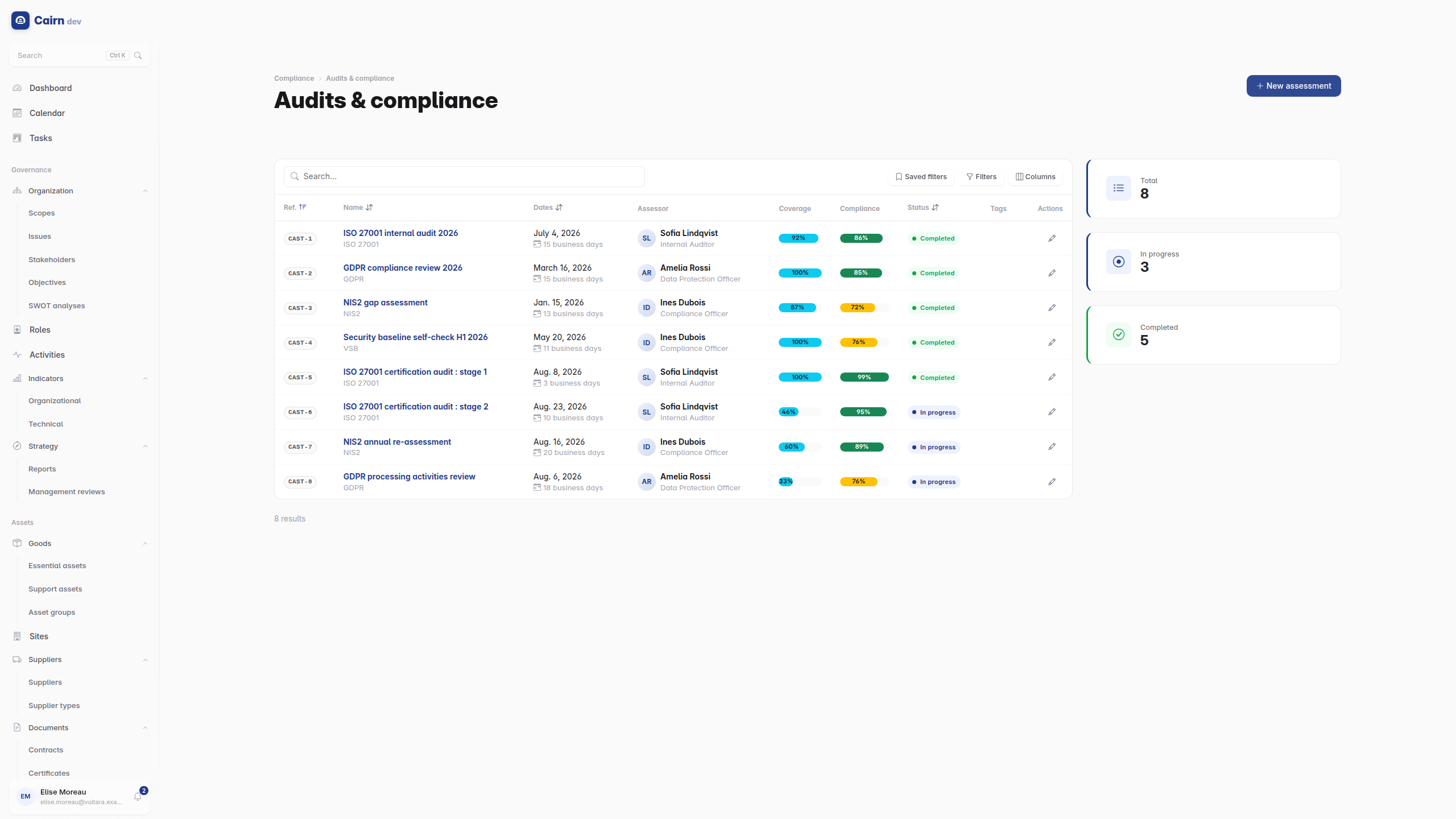
An assessment is an audit : an assessor, a period, one or more frameworks in scope, and a status of its own. It is where requirements get evaluated and findings get raised.
The assessment detail page is one of the few in Cairn that uses tabs, because Planning, Findings and History are genuinely distinct modes of working rather than sections of one page.
While an assessment is running, the Ongoing audits widget appears on the dashboard. It disappears when none is.
The organisation-wide nonconformity register, ISO 27001 clause 10.1 and 10.2. One register, fed from five sources : audits, incidents, management reviews, monitoring and complaints.
That single register is the design decision worth noticing. Nonconformities raised during an audit and nonconformities raised by a post-incident review are the same kind of object with the same lifecycle, and keeping them in one place is what lets you answer "what is open against us" in one screen rather than three.
Each nonconformity carries its corrective action and, crucially, an effectiveness verdict : did the correction actually work. A corrective action with no verification is a closed ticket, not a closed nonconformity.
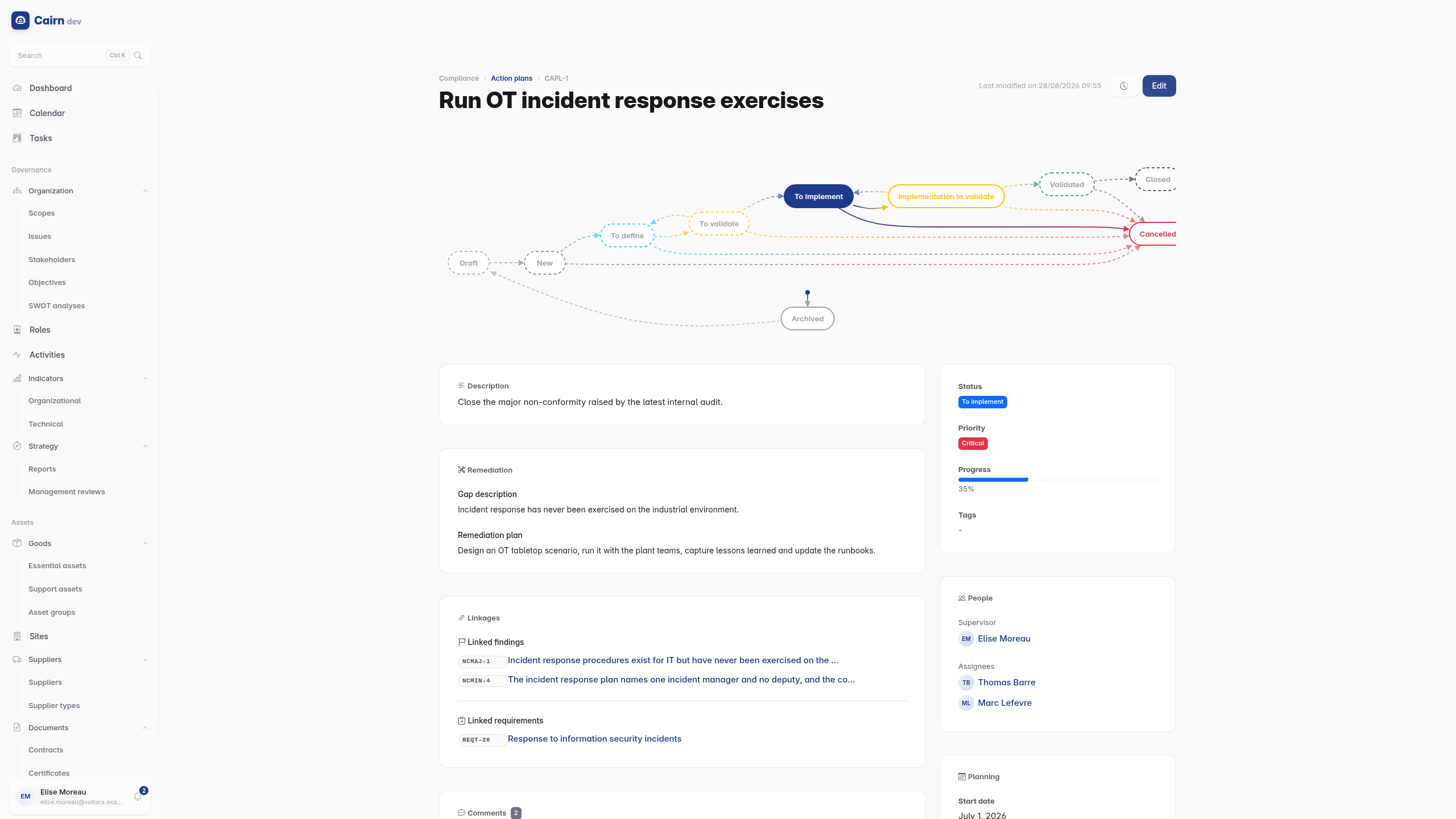
The remediation work, linked to the requirements it addresses. An action plan has an owner, a priority, a target date, a gap description and a remediation plan.
It runs a longer lifecycle than most records, because remediation has real stages : new, to define, to validate, to implement, implementation to validate, validated. Two of those steps are validations by design, one on the plan and one on the delivery, so "we agreed the plan" and "we agree it was done" are separate recorded decisions.
Any of those steps can also be cancelled, and every transition backwards is a refusal with a recorded reason.
Action plans appear on the tasks board alongside risk treatment actions, so the remediation backlog is visible in one place regardless of which module raised it.
Inter-framework mappings : this ISO 27001 control satisfies that NIS2 article.
The payoff is compounding. Once ISO 27001 is assessed and mapped to NIS2, the NIS2 picture is largely derived rather than re-audited. For an organisation subject to three overlapping regimes, this is the difference between three audits and one plus two reconciliations.
- Import or create the framework.
- Review applicability, and justify every exclusion.
- Run an assessment, evaluating requirements and raising findings.
- Raise action plans for the gaps, with owners and target dates.
- Map to your other frameworks, once the first is meaningfully complete.
- Generate the Statement of Applicability from reports.