User Guide Risks
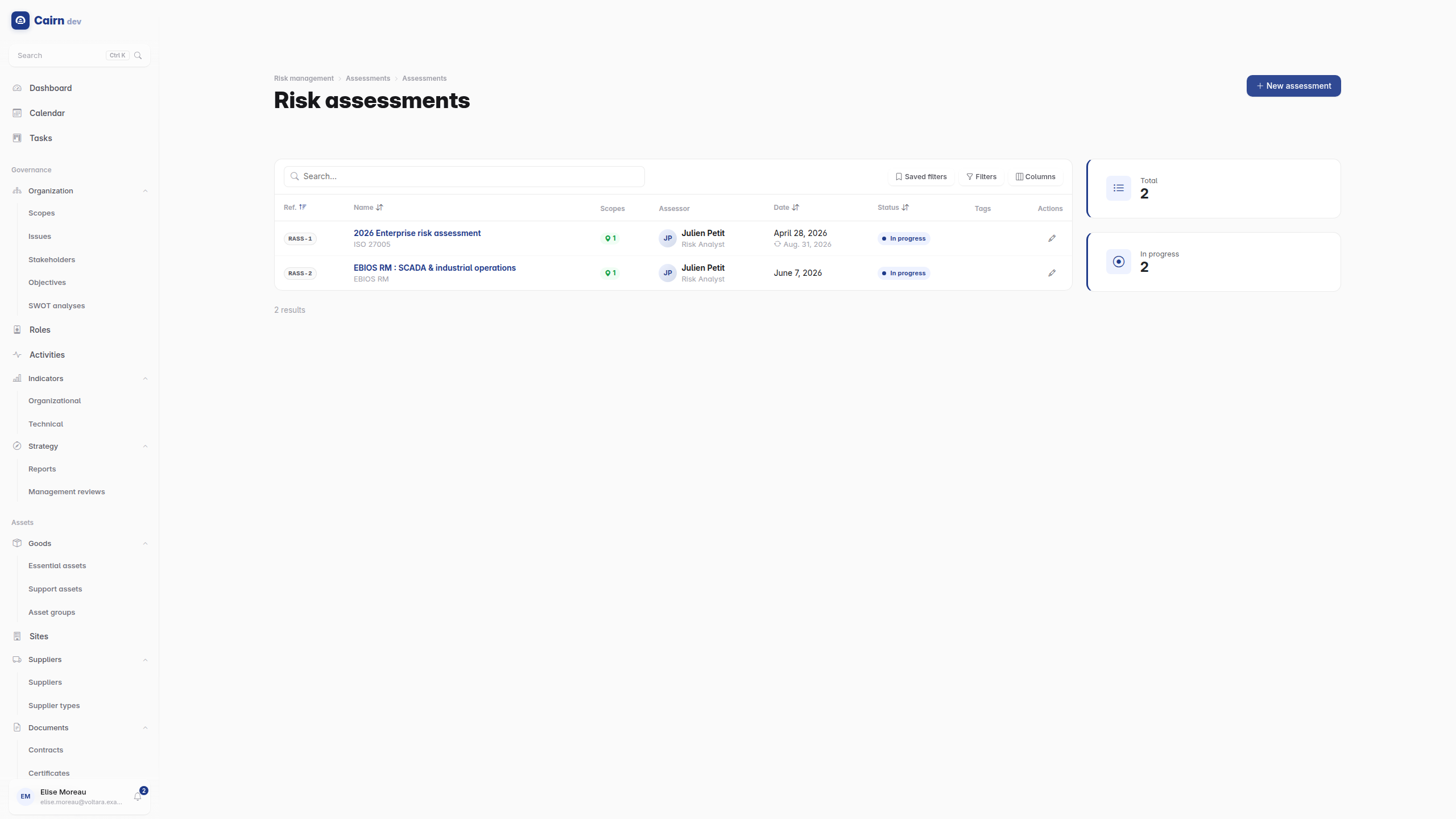
Cairn supports two methodologies. ISO 27005 is the classic threat x vulnerability approach. EBIOS RM is the ANSSI method (version 1.5), run as five workshops. Both feed the same unified risk register, so an organisation can use one, the other, or both without ending up with two disconnected registers.
Risk criteria define the scales : the likelihood levels, the impact levels, and the matrix that turns a pair of them into a risk level. Create them before your first assessment, because they are what scores mean.
Editing criteria later does not rewrite scores already given. Each risk keeps a frozen snapshot of the criteria it was scored under, so historical scores stay meaningful and a matrix change does not silently rewrite last year's audit. This is the right behaviour and it does mean two risks scored under different criteria are not directly comparable.
A risk is tracked at three levels :
| Level | Meaning |
|---|---|
| Initial | Before any control |
| Current | With the controls actually in place today |
| Residual | After the planned treatment |
Each has its own likelihood and impact. The gap between current and residual is the value your treatment plan claims to deliver, and the risk treatment flow widget on the dashboard visualises exactly that movement.
A treatment decision is one of four : accept, mitigate, transfer, avoid.
Threats are reusable, classified by type (deliberate, accidental, environmental) and origin. Vulnerabilities are reusable too, with severity, CVE references and remediation guidance.
Both run an approval lifecycle, so a catalog does not fill up with duplicates somebody added in a hurry. A draft threat cannot be linked into an analysis until it is validated.
An ISO 27005 analysis is an atomic scenario : one threat exploiting one vulnerability against one asset. Likelihood and impact combine into a level through the assessment's matrix.
Keeping scenarios atomic is what makes them re-usable and comparable. "Ransomware affects the company" is not a scenario; "phishing (threat) exploits the absence of MFA (vulnerability) against the payroll process (essential asset)" is.
The five workshops, in order, each building on the last.
Workshop 0 and 1, framing and the security baseline. The study framework, then the security baseline with feared events : one per CIA criterion per essential asset, so the possibilities are enumerated rather than brainstormed. Baseline gaps link to compliance requirements, which is where the risk and compliance modules meet.
Workshop 2, risk origins. ANSSI risk sources with their motivation, resources and activity, from which a threat level V1 to V4 is computed via Grid A. Targeted objectives (lucrative, strategic, terrorist, ideological, revenge, ludic). The two combine into SR/OV pairs, scored for relevance and priority, with a retention gate deciding which pairs go through to workshop 3.
Workshop 3, strategic scenarios. The ecosystem cartography, where each
stakeholder is positioned by (dependency x penetration) / (maturity x trust)
and lands in a control, monitoring or danger zone. Then strategic scenarios
linking retained SR/OV pairs to feared events, with ordered attack path steps.
Workshop 4, operational scenarios. The technical detail : likelihood on the ANSSI V1 to V4 scale, gravity inherited from the parent strategic scenario, and attack techniques mapped to a shared MITRE ATT&CK catalogue. A heatmap shows technique coverage. Operational scenarios are then consolidated into the unified risk register, idempotently, so re-running the consolidation does not duplicate.
Workshop 5, treatment. A summary per assessment with the residual risk strategy, the monitoring plan, the PACS narrative and before/after cartography snapshots. PACS measures (governance, protection, defense, resilience, awareness) link to treatment plans, baseline gaps and compliance requirements.
The six workshop progress trackers are created automatically on every EBIOS RM assessment, so the workshop status is visible without anyone maintaining it.
Structured remediation : ordered actions, progress tracking, cost estimates, and links to compliance action plans so the same work is not tracked twice in two modules.
A plan whose target date passes is marked overdue automatically by a nightly job. This only happens if your administrator has scheduled it; see operations.
Treatment actions appear on the tasks board.
Some risks are accepted, and accepting one properly is a formal act rather than an omission.
An acceptance record carries who accepted, the conditions, an expiry date and a
review schedule, and it goes through a two-step approval. When valid_until
passes, the acceptance is marked expired automatically, and upcoming
expiries are reported ahead of time so somebody can act.
That expiry is the point. An accepted risk that nobody revisits is an accepted risk that has quietly become an unmanaged one, and this is the mechanism that surfaces it.
Two heatmaps, current and residual, each its own dashboard widget so you can show one, the other or both. They are also generated into the risk register report.