
Every Grok session — one living command center.
An unofficial, local-first dashboard for Grok Build: watch active agents, control sessions over ACP, inspect Git changes, and move through your complete local history without leaving the browser.






Watch the 24-second product tour · See what’s new in v0.10.0 · Quickstart · What it does · Architecture · Security
Note
Grok UI is an independent community project. It is not affiliated with or endorsed by xAI.
|
◉ A runtime that tells the truth Active agents come from Grok’s real process registry. Turns, phases, reasoning, responses, tools, context, and cost updates flow into the dashboard over one live event stream. |
⌘ Native session control Create, resume, prompt, approve, and cancel Grok sessions through the Agent Client Protocol. Permission choices are rendered exactly as Grok provides them—never guessed or auto-approved. |
|
◇ One Session Console per agent Open any recorded CLI session or managed lane in a clearly labeled Session Console to chat with the agent, review its activity, inspect changes, manage permissions, send follow-ups, and launch a session-scoped web preview. Managed sessions survive dashboard restarts. |
↗ Git changes as they happen The selected repository is watched live. Staged, unstaged, and untracked files update automatically, with bounded diffs and no manual refresh required. |
|
⌁ Cross-session workflow command field Grok Build v0.2.112+ workflow updates become one live run field: phase progression, per-agent token usage, models, duration, budget use, failures, results, and safe Pause, Resume, or Stop controls. Searchable, paginated rosters stay usable as a workflow scales. Failed runs expose recovery only when Grok reports that the current process can resume them. |
|
|
◎ Secure remote sessions Register trusted Grok UI host agents over managed SSH forwarding or a private Tailscale network. The Fleet view shows identity, versions, capabilities, health, latency, last seen, freshness, and bounded telemetry. With a separate per-host control grant, start a managed Grok session and continue the same live conversation from another device, including follow-ups, Grok permission choices, and interruption. |
|
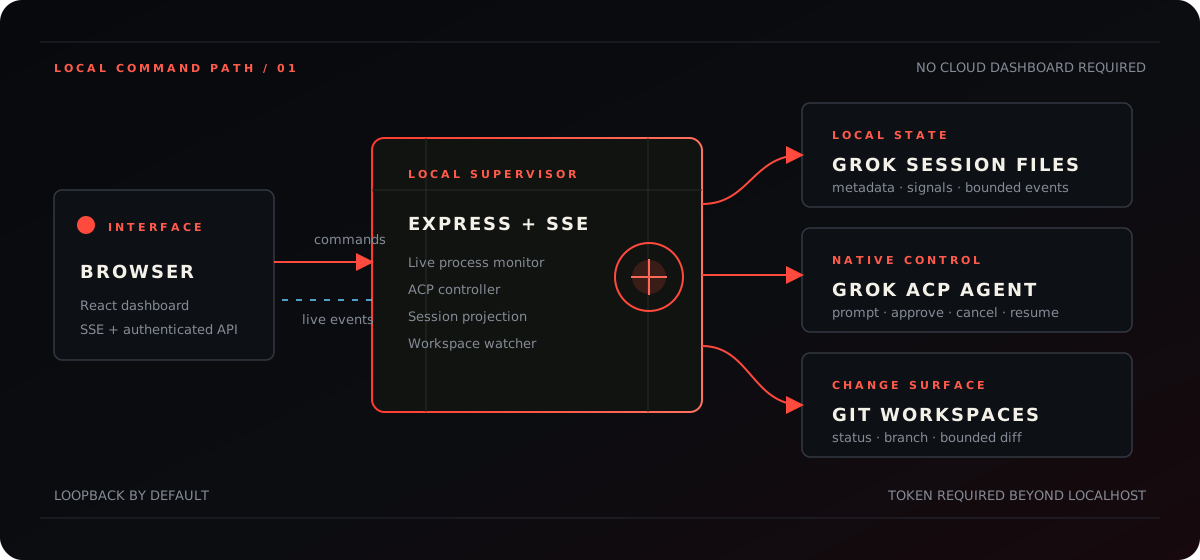
Grok UI runs as one local Express supervisor. The browser receives runtime, control, dashboard, workspace, and fleet events over SSE; commands return through authenticated API routes. Optional host agents keep monitoring on an authenticated read-only protocol and expose remote sessions only through a second, explicitly enabled control credential. Grok credentials and host-agent tokens never enter the browser.
- Node.js 22 or newer
- A working
grokinstallation - Grok Build account access
The packaged release checks its environment, starts the local server, and opens the dashboard:
npx --yes grok-uiRun diagnostics without starting the dashboard:
npx --yes grok-ui doctorStart the read-only agent on a machine you want to monitor:
GROK_UI_AGENT_TOKEN='<separate-long-random-token>' \
npx --yes grok-ui agent
The agent always requires its own token, including on loopback, and defaults to
127.0.0.1:4311. Use --host, --port, --grok-home, or --state-dir after
agent when that machine needs an override. The central Fleet view stores the
matching token server-side when you register the host.
To opt that host into secure remote sessions, provide a second, different token:
GROK_UI_AGENT_TOKEN='<monitoring-token>' \
GROK_UI_AGENT_CONTROL_TOKEN='<different-control-token>' \
npx --yes grok-ui agent
In the central Fleet editor, enter the same control token and enable Remote Sessions for that host. A healthy, fresh host can then start Grok in a workspace it has already observed. The Remote Session Console streams the conversation, accepts natural-language follow-ups, presents Grok's exact permission choices, and can interrupt the current turn. It is not a remote terminal and exposes no arbitrary shell.
git clone https://github.com/joeynyc/Grok-UI.git
cd Grok-UI
npm ci
npm run doctor
npm start
npm start creates the production build automatically when it is missing.
For file-watching development, use npm run dev.
The versioned delivery plan is maintained in
docs/roadmap.md.
The first launch opens a live setup diagnostic that distinguishes a missing CLI, an unauthenticated account, and a profile that simply has not created its first session yet. Machine-specific paths are never included in those checks.
| Option | Purpose |
|---|---|
doctor |
Check Node, Grok CLI, authentication, and local state |
agent |
Start the authenticated host agent; remote sessions are opt-in |
--port <number> |
Override dashboard port 4310 or agent port 4311 |
--host <address> |
Override the loopback bind address |
--grok-home <path> |
Use a specific Grok state directory |
--state-dir <path> |
Use a specific private Grok UI state directory |
--no-open |
Start without opening a browser |
--version |
Print the installed Grok UI version |
Start grok in any workspace and the session appears as soon as its live
process registers. The runtime view projects:
- agent state: working, waiting, idle, or needs input
- current phase and active tool
- structured user, assistant, reasoning, plan, and tool events
- turns, tool calls, context usage, and reported cost
- process identity and workspace
Process liveness is rechecked continuously, so “live now” means an open Grok process—not a recently modified history file.
Grok UI supervises grok agent --no-leader stdio and communicates through
the official Agent Client Protocol.
It supports new sessions, session/load, prompts, permission requests,
confirmed cancellation, and independently running managed lanes. Stop also
cancels pending permissions, preserves final tool updates, surfaces a retry when
Grok does not confirm, and leaves the lane ready to resume. Rename and archive
actions are local Grok UI overlays; Grok’s own session files are never rewritten.
The local Session Console detects dev or start scripts in the workspace
already associated with that session and shows the exact command before
anything runs. Starting a preview launches a separate process without a shell,
binds supported frameworks to a random loopback port, and streams a bounded
output tail into the console.
The preview surface includes desktop, tablet, and mobile widths, reload and external-open controls, and an explicit Stop action. Preview processes are ephemeral and terminate when Grok UI shuts down. Privacy Mode hides the embedded application and redacts the displayed command and logs.
The Runs view listens for Grok’s structured workflow_updated notifications on
UI-managed ACP sessions and aggregates them across the command field. Each run
can show:
- current status, objective, phase progression, and latest event
- per-agent state, phase, model, duration, and token usage
- active, used, reserved, and total agent allocation
- derived run-wide token totals with explicit incomplete-usage states
- pause context and final result summary
- Pause, Resume, and Stop controls when the run state supports them
Controls use Grok’s documented /workflow pause|resume|stop <display-name>
commands and accept only validated display handles. Persisted snapshots remain
visible after a dashboard restart, but their controls are disabled because Grok
only resumes failed or paused workflows inside the process that owns them.
Grok UI intentionally does not scrape the terminal dashboard or imply visibility into historical CLI-only workflow runs. A run appears after a UI-managed session emits its first workflow update.
The v0.9 Usage view extends the existing token and cost telemetry with a durable local ledger. It reports by project, model, session, agent, and time period, while keeping session totals separate from workflow-agent detail.
Every value says whether it is Grok-reported, derived, incomplete, or unavailable. Grok UI does not substitute context-window occupancy for cumulative CLI token usage, and explicitly mixed observation scopes are never presented as precise spend.
Optional token or reported-cost budgets can be scoped globally or to a project, model, session, or workflow agent. They are evaluated only against a non-overlapping ledger scope, and local alerts are deduplicated at 80% and 100%. JSON and CSV exports are capped, authenticated, and redacted on the server before download whenever Privacy Mode is active.
The Live view projects bounded process trees from active Grok and UI-managed process IDs. It discovers listening TCP ports only for that selected process set, classifies common databases and development services without connecting to them, and shows structured test status and external-call categories from the existing safe tool lifecycle.
Inspection uses fixed timeouts, output, process-count, and tree-depth caps. Raw command arguments, tool input, credentials, headers, terminal history, and unrelated host processes are never included in the browser contract.
The v0.10 Fleet view monitors up to 32 explicitly registered hosts. Each host reports a stable identity, Grok UI, agent, and Grok versions, negotiated read capabilities, health, round-trip latency, last-seen time, and freshness. Bounded tabs show remote sessions, workflow runs, runtime state, and provenance-aware usage.
Hosts can be reached in three constrained ways:
- SSH — Grok UI manages a fixed loopback forwarding process with
argument-separated
sshoptions, batch mode, no shell, and no remote command. - Tailscale — the registry accepts only
.ts.netnames or addresses from Tailscale's IPv4 or IPv6 ranges. - Direct — an advanced/test transport restricted to HTTP or HTTPS loopback origins.
The monitor polls every 5 seconds with a 3.5-second request timeout and at most four concurrent remote reads globally, including explicit refresh and detail requests. Per-agent responses are capped at 2 MiB and the central fleet projection at 4 MiB. A sample becomes stale after 15 seconds and offline after 45 seconds. Connecting, healthy, degraded, stale, offline, incompatible, unauthorized, and unavailable states remain distinct in the UI.
v0.10 is strictly read-only on remote machines. It cannot remotely start work, send prompts, approve permissions, pause, resume, interrupt, stop, execute a shell, write files, or probe arbitrary endpoints. Registering, editing, refreshing, or removing a host changes only the central monitor configuration or triggers a read.
v0.11 keeps all v0.10 monitoring routes read-only and adds a separate, host-authorized control channel. It lets a user start or continue a real ACP-managed Grok conversation from another device, send follow-ups, answer Grok's permission requests, and interrupt a running turn.
Every mutation carries a durable command ID and bounded delivery expiry. Retrying the same delivery cannot silently create duplicate work, and a host restart turns an ambiguous command into an explicit reconciliation state instead of replaying it. Existing CLI-observed sessions remain read-only; follow-up control is limited to host-managed sessions. Controls remain unavailable while the host is stale, unhealthy, incompatible, disabled, or missing the exact capability.
The initial scope does not add arbitrary shell access, remote workflow
Pause/Resume/Stop, team roles, or shared approvals. See
docs/v0.11-secure-remote-sessions.md
for the product contract and staged decisions.
Three complete visual systems ship with the dashboard:
- Operator — carbon black, signal lime, and a precision HUD grid
- Event Horizon — deep-space red, cold starlight, and glass command surfaces
- Minimal Calm — quiet stone surfaces, sage signals, and restrained motion
Theme selection stays in local browser storage and never changes session data.
- The server binds to the loopback interface by default.
- Non-loopback binding requires
GROK_UI_TOKEN. - Grok credentials never pass through the browser.
- Local preview processes bind to loopback, receive no Grok credentials, and start only after an explicit user action.
- Persistent Privacy Mode replaces visible session names, paths, identifiers, event content, file names, remote host names, and endpoints with stable presentation-safe aliases.
- Privacy Mode protects recordings and screen shares; it is not an access-control boundary. Authorized browser clients can still receive the underlying local data.
- Authentication cookies are
HttpOnlyandSameSite=Strict. - API responses are non-cacheable and include restrictive security headers.
- Raw system prompts and durable-memory bodies are not indexed.
- File, diff, and event reads are bounded.
- Host-agent reads require a dedicated bearer token, reject redirects, time out after 3.5 seconds, and cap responses at 2 MiB.
- Fleet URLs are restricted by transport, and the connector accepts only fixed
/agent/v1/protocol paths. - Diff access is restricted to workspaces associated with known sessions.
- Grok UI contains no analytics or product telemetry.
- Repository screenshots and diagrams use sanitized demo data only.
For remote use, set a long random token, place TLS or a private tunnel in front of the server, and bind only to the interface you intend to expose:
HOST='<bind-address>' \
GROK_UI_TOKEN='<long-random-token>' \
npm start
See SECURITY.md for the full deployment and reporting guidance.
| Variable | Default | Purpose |
|---|---|---|
HOST |
loopback | API bind interface |
PORT |
4310 |
API port |
GROK_HOME |
~/.grok |
Grok state directory |
GROK_BIN |
grok |
Grok executable used by the ACP controller |
GROK_UI_TOKEN |
empty | Required for non-loopback binding |
GROK_UI_STATE_DIR |
~/.grok-ui |
Private annotations and managed-session state |
GROK_UI_AGENT_TOKEN |
empty | Required dedicated bearer token for host-agent mode |
GROK_UI_AGENT_CONTROL_TOKEN |
empty | Optional, distinct token that enables secure remote sessions on the host |
GROK_UI_AGENT_HOST |
127.0.0.1 |
Host-agent bind interface |
GROK_UI_AGENT_PORT |
4311 |
Host-agent port |
GROK_UI_AGENT_LABEL |
system hostname | Optional host label advertised by the agent |
npm run dev       # Run API and Vite with file watching
npm run doctor    # Check Node, Grok CLI, authentication, and local state
npm run setup     # Run preflight checks and create a production build
npm run check     # Type-check client and server
npm test          # Run unit and integration tests
npm run test:e2e  # Run production browser onboarding and control tests
npm run build     # Produce client and server builds
npm run verify    # Check, test, and build
npm run release:check # Audit the exact package contents
npm run test:package  # Install and launch the packed artifact in isolation
npm start         # Build when needed, then serve the production app
npm run agent     # Serve the built host agent; control remains opt-in
npm run serve # Serve an existing production build without rebuildingserver/
grok-controller.ts ACP lifecycle, prompts, approvals, cancellation
workflow-state.ts workflow notification projection and safe controls
live-monitor.ts active process and runtime event projection
usage-ledger.ts provenance-aware durable usage reporting
session-projection.ts shared local session-to-row projection
host-agent.ts read-only monitoring and opt-in session control
remote-command-store.ts durable command reconciliation and audit evidence
fleet-protocol.ts versioned parsing, caps, and host namespacing
fleet-registry.ts atomic private connection registry
fleet-connectors.ts bounded direct, Tailscale, and SSH transports
fleet-monitor.ts polling, compatibility, health, and freshness
grok-store.ts historical metadata aggregation
session-reader.ts bounded conversation and tool timeline
session-state.ts durable managed lanes and local annotations
preview-supervisor.ts loopback web preview lifecycle and bounded logs
workspace-inspector.ts live Git status and bounded diff inspection
security.ts local and remote access gate
src/
views/ControlView.tsx command deck and approval queue
views/WorkflowsView.tsx cross-session workflow command field
views/UsageView.tsx time- and dimension-based usage ledger
views/FleetView.tsx fleet page coordination and registry actions
views/fleet/ status, editor, selectors, and telemetry panels
views/ChangesView.tsx live repository change workbench
views/SessionWorkbench.tsx
local session timeline, preview, and operations
views/RemoteSessionWorkbench.tsx
live remote conversation and safe controls
App.tsx dashboard shell and event-stream client
styles/fleet.css Fleet-only presentation
styles/minimal-calm.css isolated quiet-theme presentation layer
The longer design and trust-boundary notes live in docs/architecture.md. Concrete edit routing and safety invariants live in docs/AGENT_GUIDE.md.
Grok UI is a community project. Its local monitor, control, workbench, runtime, usage, and Git inspection paths are functional and covered by automated tests. v0.10 multi-machine monitoring is released. Packed releases are installed and launched in isolation on macOS and Linux CI. Grok Build, ACP, and the fleet protocol can evolve, so compatibility fixes may be needed for future releases.
MIT — see LICENSE.