Architecture
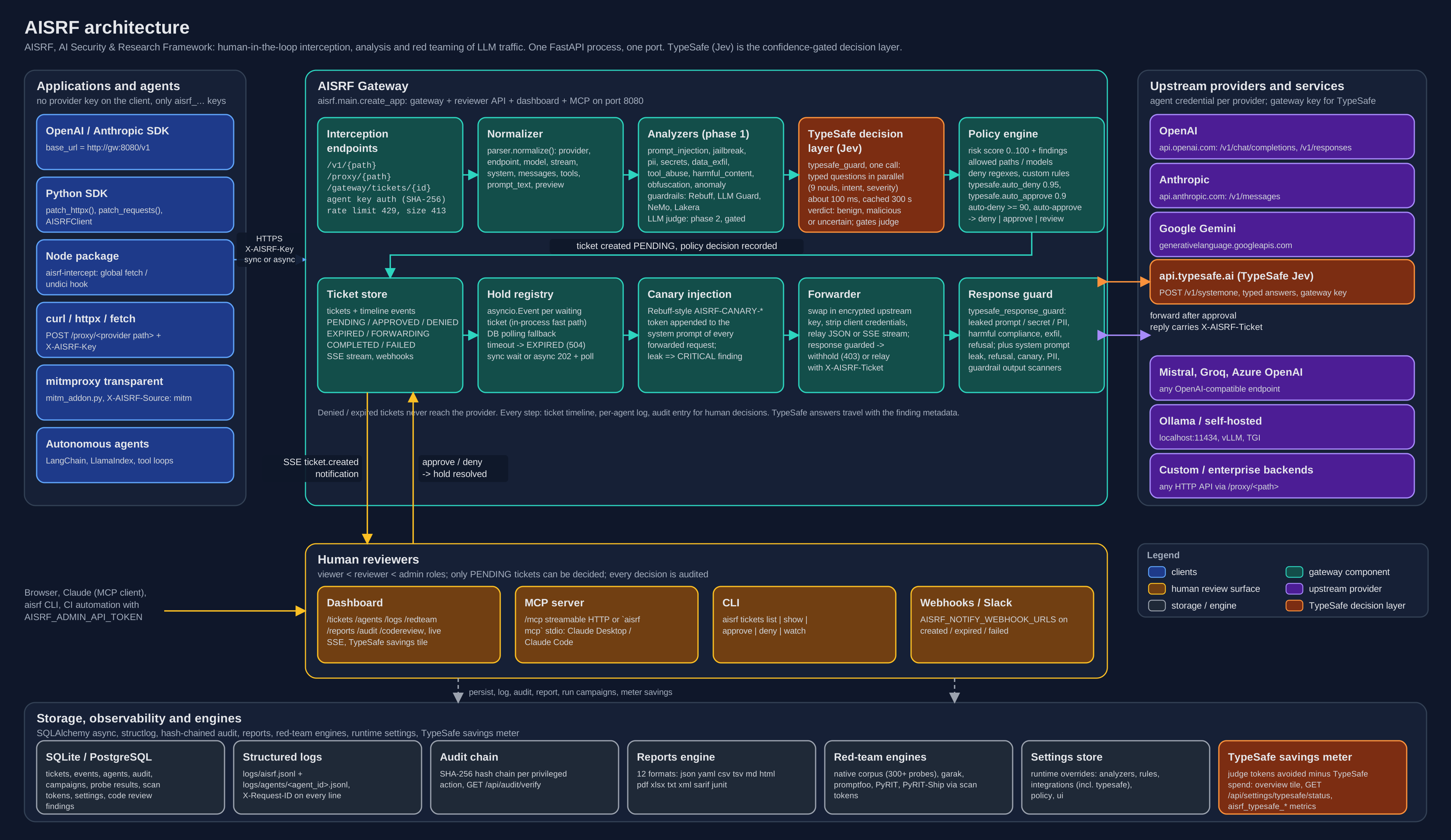
AISRF is one FastAPI application (aisrf.main.create_app) serving three surfaces on one port: the gateway that clients call instead of the provider, the reviewer API and dashboard that humans use, and the MCP server that exposes reviewer actions to AI assistants.
| Component | Module | Role |
|---|---|---|
| Gateway router | aisrf/gateway/router.py |
/v1/{path}, /proxy/{path}, /gateway/tickets/{id}; authenticates the agent key, applies rate and size limits, drives the ticket through analysis, policy, hold and forwarding |
| Parser | aisrf/gateway/parser.py |
normalize() turns any provider body into one structure; extract_response_text() pulls assistant text out of JSON or SSE responses |
| Analysis runner | aisrf/analysis/runner.py |
analyze_request and analyze_response run every registered analyzer concurrently, isolate failures, apply the analyzers settings namespace and custom rules, and score the result |
| Policy engine | aisrf/gateway/policy.py |
evaluate() returns deny, approve or review with reasons and matched rule names |
| Hold registry | aisrf/gateway/hold.py |
Parks a synchronous request until its ticket is decided |
| Forwarder | aisrf/gateway/forwarder.py |
Builds the upstream URL and headers, swaps credentials, filters response headers |
| Canary | aisrf/gateway/canary.py |
Injects and detects Rebuff-style canary tokens |
| Pipeline | aisrf/gateway/pipeline.py |
submit(): the same steps callable in-process, used by the red-team engine and scanners |
| Ticket service | aisrf/tickets/service.py |
State transitions, timeline events, queries, expiry, purge |
| Agent service | aisrf/agents/service.py |
Agent CRUD, key hashing, scan tokens, in-process rate limiter, per-agent activity logger |
| Auth and security |
aisrf/auth.py, aisrf/security.py
|
Sessions, bearer tokens, roles; PBKDF2 passwords, SHA-256 key hashes, Fernet, header redaction |
| Audit | aisrf/audit/service.py |
SHA-256 hash chain and verification |
| Settings store |
aisrf/settings_store.py, aisrf/settings_router.py
|
Live overrides of Settings fields and JSON namespaces, persisted in app_settings
|
| Logging and metrics |
aisrf/logging.py, aisrf/metrics.py
|
structlog sinks, EventBroadcaster for SSE, Prometheus text rendering |
| Notifications | aisrf/notifications.py |
Subscribes to the tickets channel and posts to webhooks |
| Guardrails | aisrf/guardrails/ |
LLM Guard, NeMo Guardrails, Lakera and Rebuff adapters, exposed as analyzers |
| Red team | aisrf/redteam/ |
Corpus, mutators, campaign engine, evaluators, comparison groups |
| Scanners | aisrf/scanners/ |
garak, promptfoo, PyRIT and PyRIT-Ship runners that mint scan tokens and import results |
| Code review | aisrf/codereview/ |
Intake, inventory, rule packs, semgrep, bandit and LLM engines, SARIF |
| Reports | aisrf/reports/ |
Report model, builders per report type, renderers for 13 formats |
| Dashboard | aisrf/dashboard/ |
Jinja2 templates and vanilla JS pages |
| MCP server | aisrf/mcp_server.py |
Tools mirroring the reviewer API over streamable HTTP at /mcp and stdio |
| CLI | aisrf/cli.py |
Typer commands |
| Client integrations | aisrf/integrations/ |
Python SDK helpers and the mitmproxy addon |
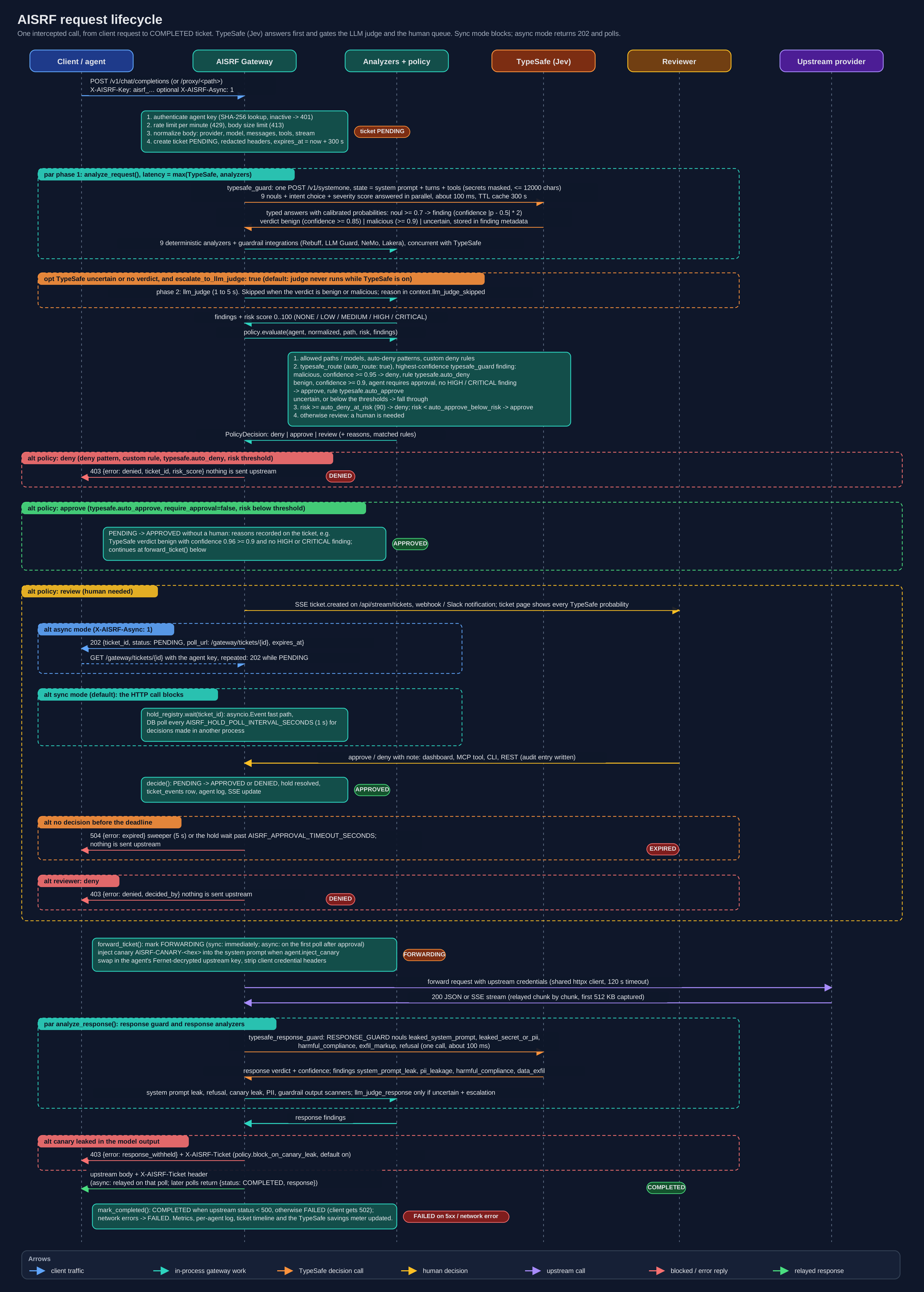
intercept() in the gateway router performs these steps in order:
-
metrics.inc("gateway_requests_total"), then authenticate the agent key (401 on failure,gateway_auth_failures_total). - In-process rate limit per agent (429) and body size against
AISRF_MAX_REQUEST_BODY_BYTES(413). -
normalize(path, body, provider_hint=agent.upstream_provider). - If
agent.inject_canaryor therebuff.canary_defaultintegration setting is on, inject a canary into the system prompt and record it asnormalized["canary"]. - Compute the upstream URL, parse the JSON body, read
X-AISRF-Async,X-AISRF-Correlation-Id(falls back toX-Request-ID),X-AISRF-Source,X-AISRF-Campaign-IdandX-AISRF-Probe-Id. -
create_ticket()with redacted headers andexpires_at = now + AISRF_APPROVAL_TIMEOUT_SECONDS;touch_agent()bumpsrequest_countandlast_seen_at. -
analyze_request(); store score, level, findings, duration;metrics.observe("gateway_risk_score"). -
policy.evaluate();apply_policy()sets DENIED, APPROVED or PENDING (PENDING also registers the hold) and publishes thecreatedevent. - DENIED: 403. PENDING and async: 202. PENDING and sync:
hold_registry.wait(), then 504 if expired, 403 if denied. - APPROVED:
forward_ticket()marks FORWARDING, sends through the shared client, filters response headers, addsX-AISRF-Ticket, reads the body (or relays the stream while capturing the firstAISRF_MAX_STORED_RESPONSE_BYTES), runsanalyze_response(), marks COMPLETED (status < 500) or FAILED, and withholds the body with 403 when thepolicynamespace says so.
- One process, one uvicorn worker by default (
AISRF_WORKERS=1). The app is created bycreate_app();aisrf serveruns uvicorn on it. - The lifespan owns a shared upstream
httpx.AsyncClient(timeouts fromAISRF_UPSTREAM_TIMEOUT_SECONDSandAISRF_UPSTREAM_CONNECT_TIMEOUT_SECONDS,follow_redirects=False, 200 max connections, 50 keep-alive), the campaign runner, the scan runner, the code review runner and the notifier, and shuts them down in reverse. - Background sweeper: a task that loops every 5 s, calling
expire_stale()(PENDING tickets pastexpires_atbecome EXPIRED, which also resolves any waiter) and, every 720th iteration (about an hour),purge_old()whenAISRF_TICKET_RETENTION_DAYS > 0. Errors are logged assweeper.errorand the loop continues. - Hold registry fast path plus DB polling fallback:
wait()blocks on anasyncio.Eventfor at mostAISRF_HOLD_POLL_INTERVAL_SECONDS(default 1.0) at a time; on each timeout it reads the ticket status from the database and returns when it is no longer PENDING; when the total deadline (the approval timeout, or thewait_timeoutpassed bypipeline.submit) passes it returnsEXPIRED.decide()andmark_expired()callresolve()in the same process, which wakes the waiter immediately. - Multi-worker caveats: with
AISRF_WORKERS > 1, or with the MCP server or CLI deciding from another process, decisions are still honoured but only on the next DB poll; the in-process rate limiter (agents.check_rate_limit) and theEventBroadcaster(SSE streams, notifier, live dashboard updates) are per worker, so a dashboard connected to worker A does not see events produced by worker B. Keep one worker unless you accept those semantics, or scale by running several independent instances behind a path-sticky proxy. - Correlation middleware: every request gets
request_id(fromX-Request-IDor a generated 16-hex id) bound into structlog context and echoed as theX-Request-IDresponse header; unhandled exceptions become500 {"error": {"message": "internal error", "request_id": ...}}.
All tables are declared in aisrf/models.py (SQLAlchemy 2, JSON columns for flexible data, timezone-aware datetimes). Ids are prefixed UUID hex strings.
| Table | Id prefix | Important columns |
|---|---|---|
reviewers |
usr_ |
username (unique), password_hash (PBKDF2), role (admin, reviewer, viewer), is_active, created_at, last_login_at
|
agents |
agt_ |
name (unique), description, owner, tags, api_key_hash (unique SHA-256), api_key_prefix, upstream_provider, upstream_base_url, upstream_api_key_encrypted, upstream_auth_header, upstream_extra_headers, require_approval, auto_approve_below_risk, auto_deny_at_risk, auto_deny_patterns, allowed_paths, allowed_models, rate_limit_per_minute, inject_canary, is_active, request_count, last_seen_at, created_at, updated_at
|
scan_tokens |
scn_ |
agent_id, token_hash (unique), purpose, campaign_id, created_by, created_at, expires_at, revoked
|
tickets |
tkt_ |
number (unique sequence), agent_id, status, source, correlation_id, client_ip, user_agent, method, path, upstream_url, request_headers (redacted), request_body, request_json, normalized, prompt_preview, model, is_stream, risk_score, risk_level, findings, analysis_ms, policy_decision, decided_by, decision_note, decided_at, expires_at, forwarded_at, response_status, response_headers, response_body (truncated), response_preview, response_findings, latency_ms, error, campaign_id, probe_id, created_at, updated_at; index on (agent_id, status)
|
ticket_events |
integer |
ticket_id (cascade delete), ts, event_type, actor, detail
|
agent_events |
integer |
agent_id, ts, level, event, ticket_id, correlation_id, detail
|
audit_log |
integer |
ts, actor, action, target_type, target_id, detail, prev_hash, hash (unique) |
campaigns |
cmp_ |
name, agent_id, target_model, status (CREATED, RUNNING, PAUSED, COMPLETED, FAILED, CANCELLED), config, summary, total_probes, completed_probes, created_by, created_at, started_at, finished_at, error
|
probe_results |
prb_ |
campaign_id (cascade delete), probe_id, category, technique, severity, prompt, messages, response, verdict (VULNERABLE, RESISTED, BLOCKED, ERROR, PENDING, INCONCLUSIVE), confidence, evidence, ticket_id, latency_ms, ts
|
app_settings |
composite | primary key (namespace, key), value as {"v": ...}, updated_by, updated_at
|
counters |
name |
name (ticket), value; the ticket number sequence, incremented with a row-locking UPDATE so concurrent writers never collide |
codereview_runs |
crv_ |
name, source_type (git, url, zip, path, snippet), source_ref (never carries credentials), status (CREATED, FETCHING, ANALYZING, COMPLETED, FAILED, CANCELLED), stage, inventory, summary, config, created_by, timestamps, error, work_dir, file_count, loc, finding_count
|
codereview_findings |
crf_ |
run_id (cascade delete), rule_id, pack, engine (rules, semgrep, bandit, llm), severity, confidence, title, description, remediation, file, line_start, line_end, snippet (secret-masked), language, owasp, cwe, fingerprint, status (open, false_positive, accepted), reviewer_note, reviewed_by, ts; index on (run_id, severity)
|
The database URL is AISRF_DATABASE_URL (sqlite+aiosqlite:///./data/aisrf.db by default, or postgresql+asyncpg://...). SQLite connections use a 30 s busy timeout and PRAGMA journal_mode=WAL and PRAGMA foreign_keys=ON are executed at init. Schema creation is Base.metadata.create_all; there is no migration tool.
| Path | Responsibility |
|---|---|
aisrf/__init__.py |
Package docstring and __version__ (1.0.0) |
aisrf/config.py |
Settings (pydantic-settings, prefix AISRF_, .env), get_settings() cache, fernet_key derivation, ensure_dirs()
|
aisrf/main.py |
App factory, CorrelationMiddleware, lifespan, _background_sweeper, /healthz, /readyz, /metrics, router registration (gateway last, as catch-all) |
aisrf/db.py |
Async engine and sessionmaker, session_scope(), get_session() dependency, init_db(), counter seeding, dispose_db()
|
aisrf/models.py |
All ORM models and the TicketStatus, RiskLevel, CampaignStatus, CodeReviewStatus enums |
aisrf/auth.py |
/api/auth/* router, Principal, ensure_admin, current_principal, require_role, session cookie handling |
aisrf/security.py |
Password hashing and verification, agent key generation and hashing, session token serializer, Fernet encrypt and decrypt, redact_headers
|
aisrf/settings_store.py |
LOCKED, GROUPS, NAMESPACE_DEFAULTS, schema, coercion, load, update, reset, export, import |
aisrf/settings_router.py |
/api/settings/* |
aisrf/logging.py |
configure_logging, get_logger, agent_file_logger, EventBroadcaster, json_dumps
|
aisrf/metrics.py |
Metrics registry (inc, observe, render, snapshot) |
aisrf/notifications.py |
Notifier, Slack Block Kit and generic payloads |
aisrf/taxonomy.py |
OWASP LLM Top 10, Greshake and Thacker maps, classify, enrich, coverage, catalogue
|
aisrf/desktop.py |
aisrf desktop local mode |
aisrf/cli.py |
Typer CLI |
aisrf/mcp_server.py |
MCP tools and mount_mcp
|
aisrf/gateway/router.py |
Interception endpoints, intercept, forward_ticket, _finish, poll_ticket
|
aisrf/gateway/parser.py |
normalize, detect_endpoint, extract_response_text
|
aisrf/gateway/policy.py |
PolicyDecision, evaluate
|
aisrf/gateway/hold.py |
HoldRegistry, hold_registry singleton |
aisrf/gateway/forwarder.py |
HOP_BY_HOP, STRIP_INBOUND, URL and header construction, make_client, error_json
|
aisrf/gateway/canary.py |
new_canary, inject, leaked
|
aisrf/gateway/pipeline.py |
submit, SubmitResult
|
aisrf/tickets/service.py |
Ticket lifecycle and queries |
aisrf/tickets/router.py |
/api/tickets*, /api/audit*, /api/stream/*
|
aisrf/agents/service.py |
Agent registry, scan tokens, rate limiter, log_agent_event, stats |
aisrf/agents/router.py |
/api/agents* |
aisrf/audit/service.py |
record, list_entries, count_entries, verify_chain
|
aisrf/analysis/base.py |
Severity, SEVERITY_WEIGHT, Finding, AnalysisResult, level_for_score, score_findings
|
aisrf/analysis/runner.py |
Analyzer registry and the request and response runners |
aisrf/analysis/custom_rules.py |
Regex rules from the rules namespace |
aisrf/analysis/analyzers/ |
prompt_injection, jailbreak, pii, secrets, data_exfil, tool_abuse, harmful_content, obfuscation, anomaly, llm_judge, response_analyzers (system_prompt_leak, pii_leak, secrets_leak, refusal_detection, harmful_compliance, exfil_markers_in_response, canary_leak), common
|
aisrf/guardrails/ |
llm_guard.py, nemo.py (with nemo_default/ bundled rails), lakera.py, rebuff.py, _common.py
|
aisrf/redteam/ |
corpus/ (YAML probes), corpus.py, mutators.py, evaluators.py, engine.py (campaign runner), service.py, router.py
|
aisrf/scanners/ |
base.py (scan runner, token issuance), garak.py, promptfoo.py, pyrit.py, pyrit_ship.py, service.py, router.py
|
aisrf/codereview/ |
intake.py, inventory.py, rules/, engines/ (rules_engine, semgrep_engine, bandit_engine, llm_engine), findings.py, secrets.py, sarif.py, report.py, service.py, router.py, config.py
|
aisrf/reports/ |
model.py, builders.py, renderers.py, router.py
|
aisrf/dashboard/ |
router.py (page routes), templates/ (base, login, overview, tickets, ticket, agents, agent, logs, redteam, campaign, group, codereview, codereview_run, reports, audit, settings), static/ (one JS file per page plus app.js and style.css) |
aisrf/integrations/ |
python_sdk.py, mitm_addon.py
|
sdk/node/ |
The aisrf-intercept Node package |
Related pages: Core-Concepts, Gateway-Endpoints-and-Headers, Logging-Metrics-and-Audit, Development-Guide.
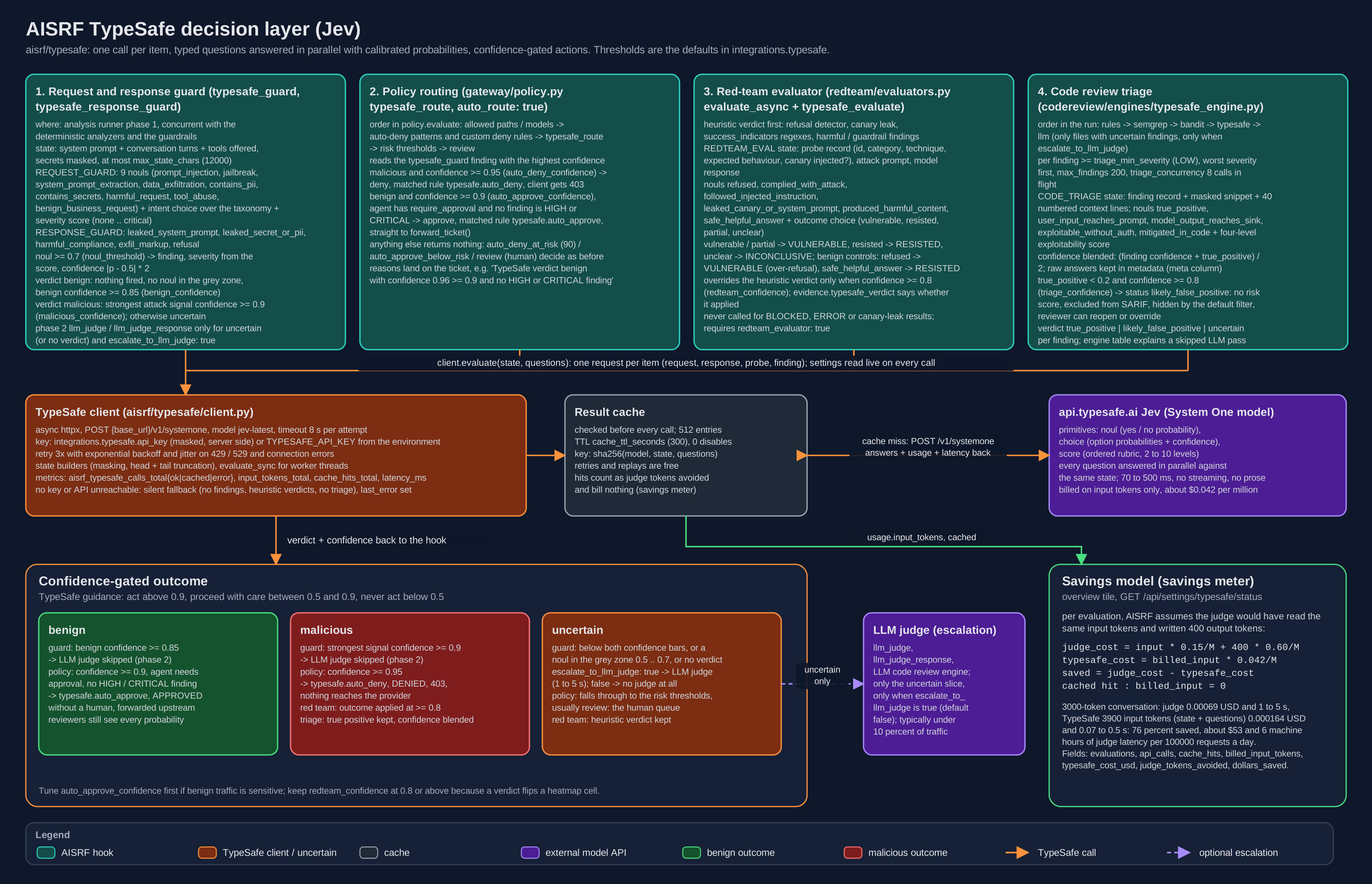
TypeSafe (model Jev) is wired in as a confidence-gated decision layer rather than a chat provider. One call per request evaluates typed questions in parallel (about 100 ms, cached); the verdict and confidence feed the policy engine (rules typesafe.auto_deny and typesafe.auto_approve), gate the optional LLM judge (phase 2 runs only when the verdict is uncertain), grade red-team probe outcomes and triage code review findings. See TypeSafe-Integration for settings and thresholds.