Settings Center
The dashboard page at /settings (templates/settings.html, static/settings.js). It exposes every runtime setting, the five JSON namespaces, reviewer management, export and import, and reference material. Viewers and reviewers see everything read-only; only admins can change values. Every section has a sub-navigation entry and a URL hash (/settings#policy); the last visited section is remembered in the browser.
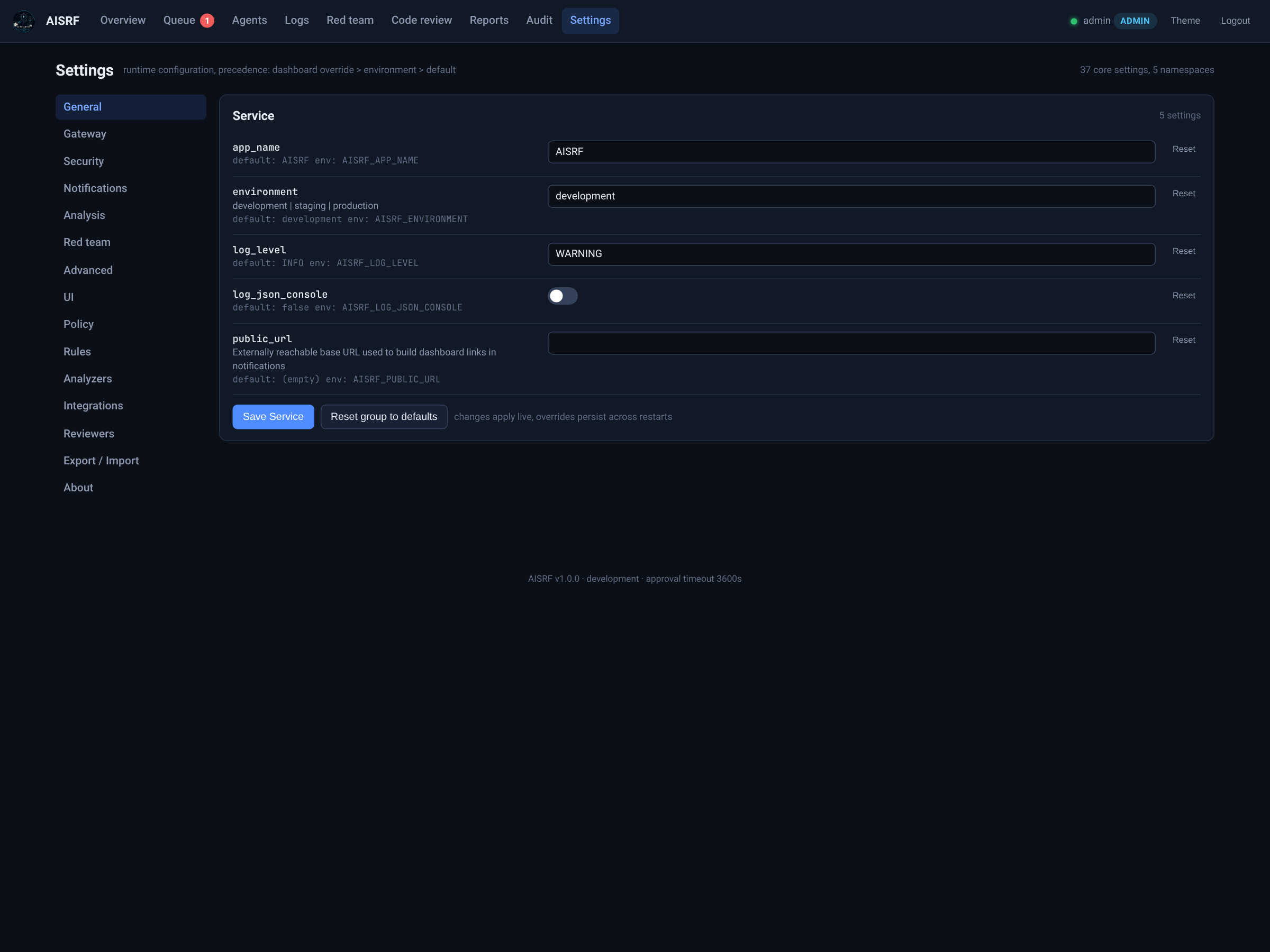
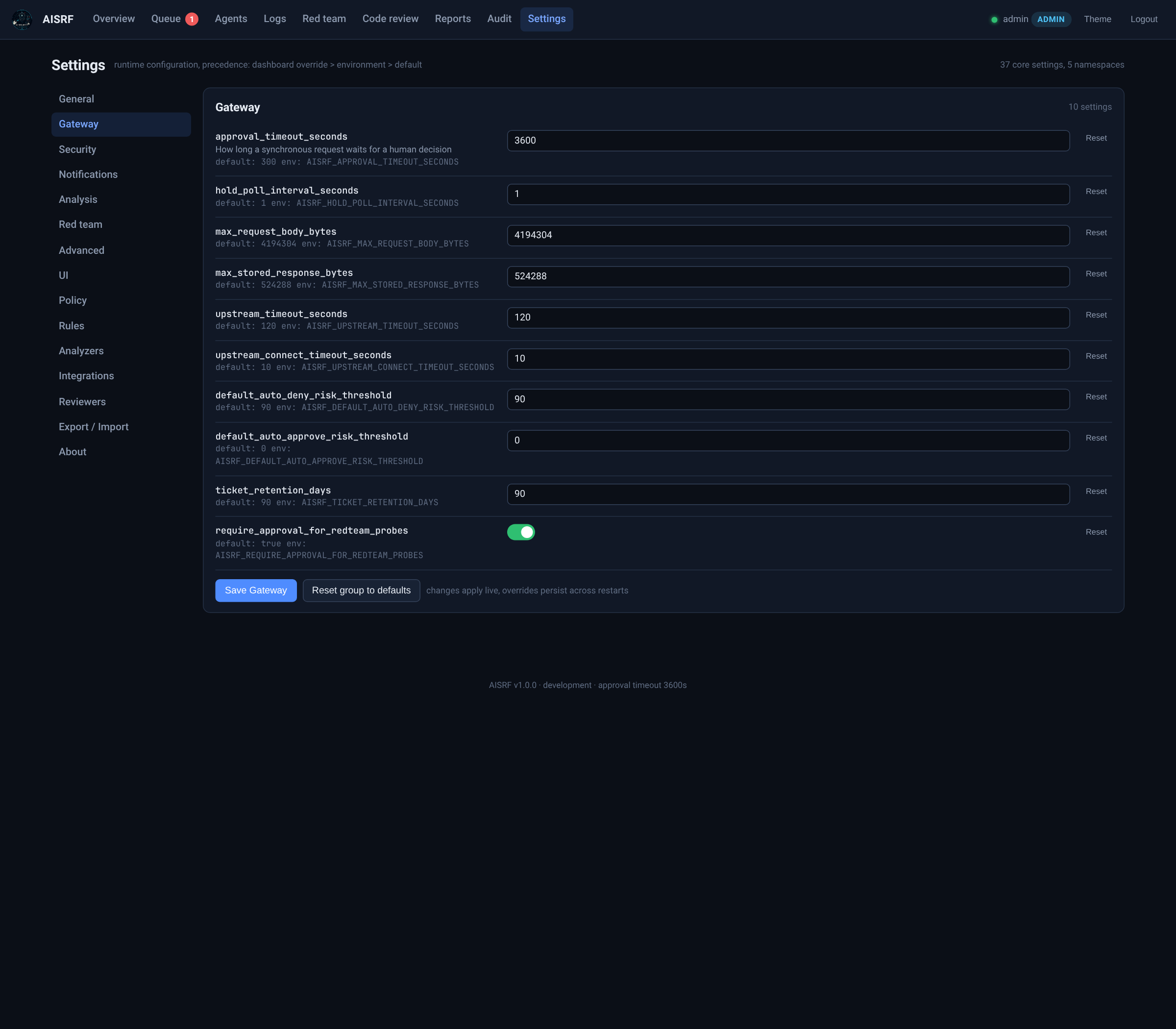
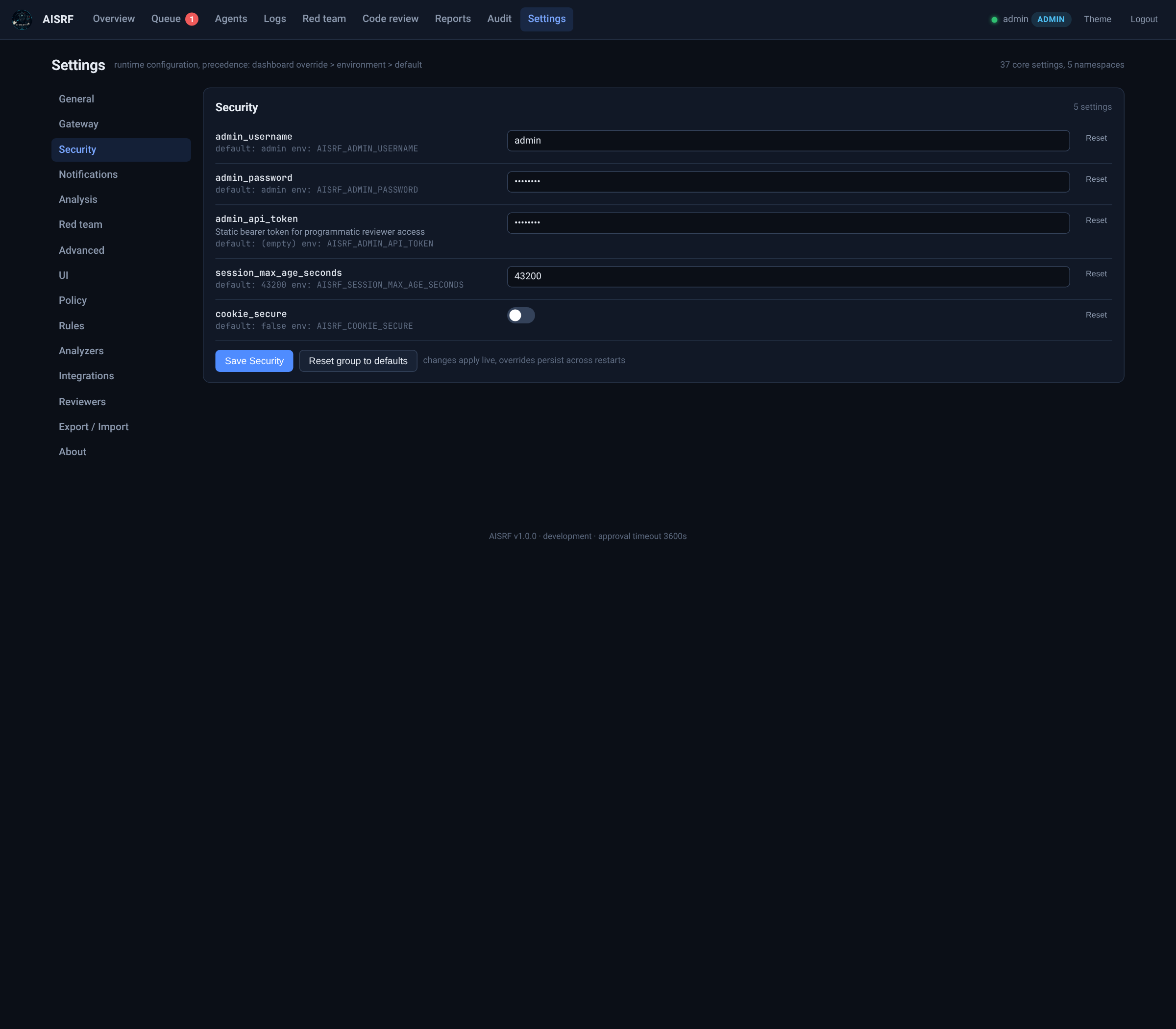
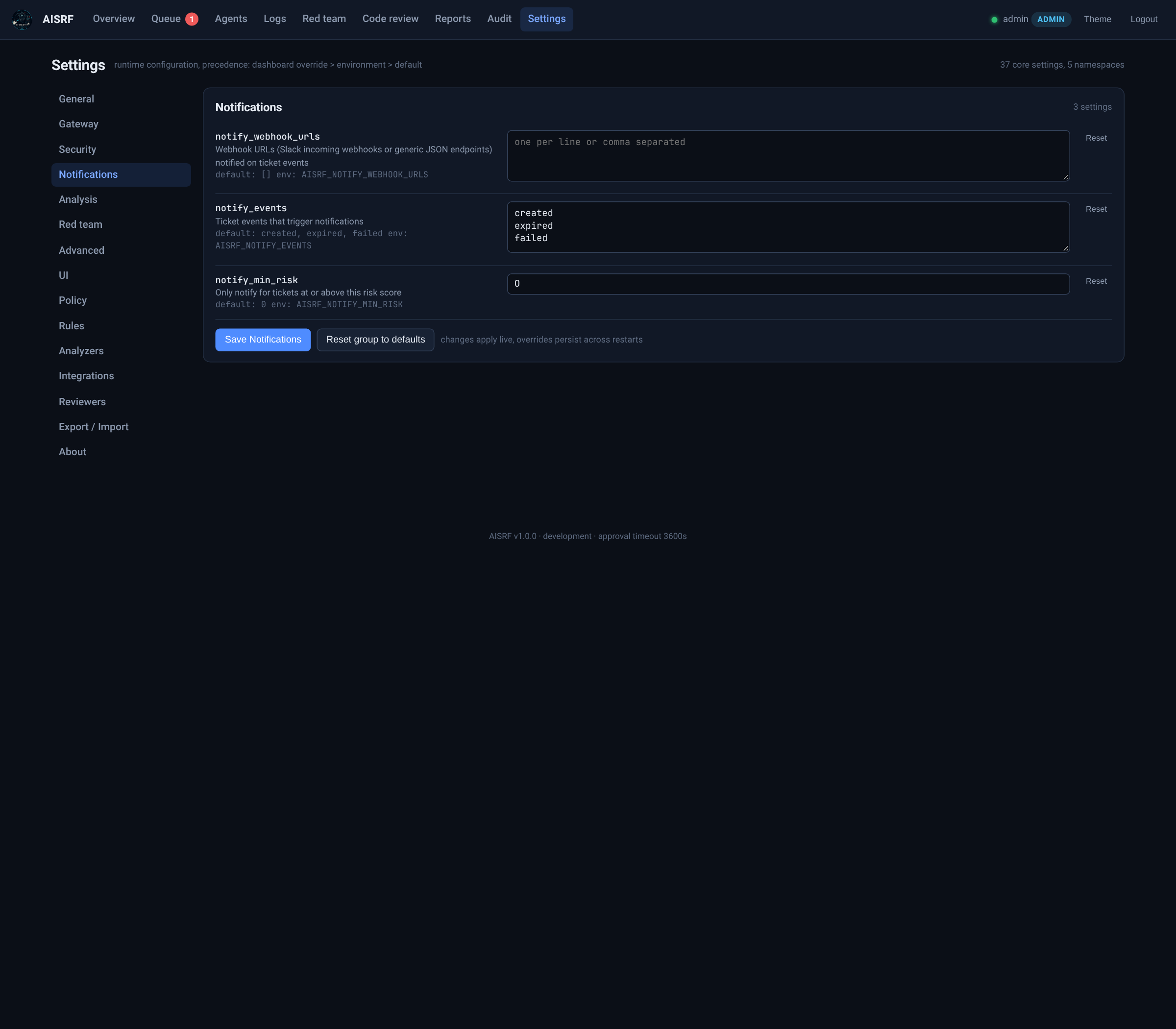
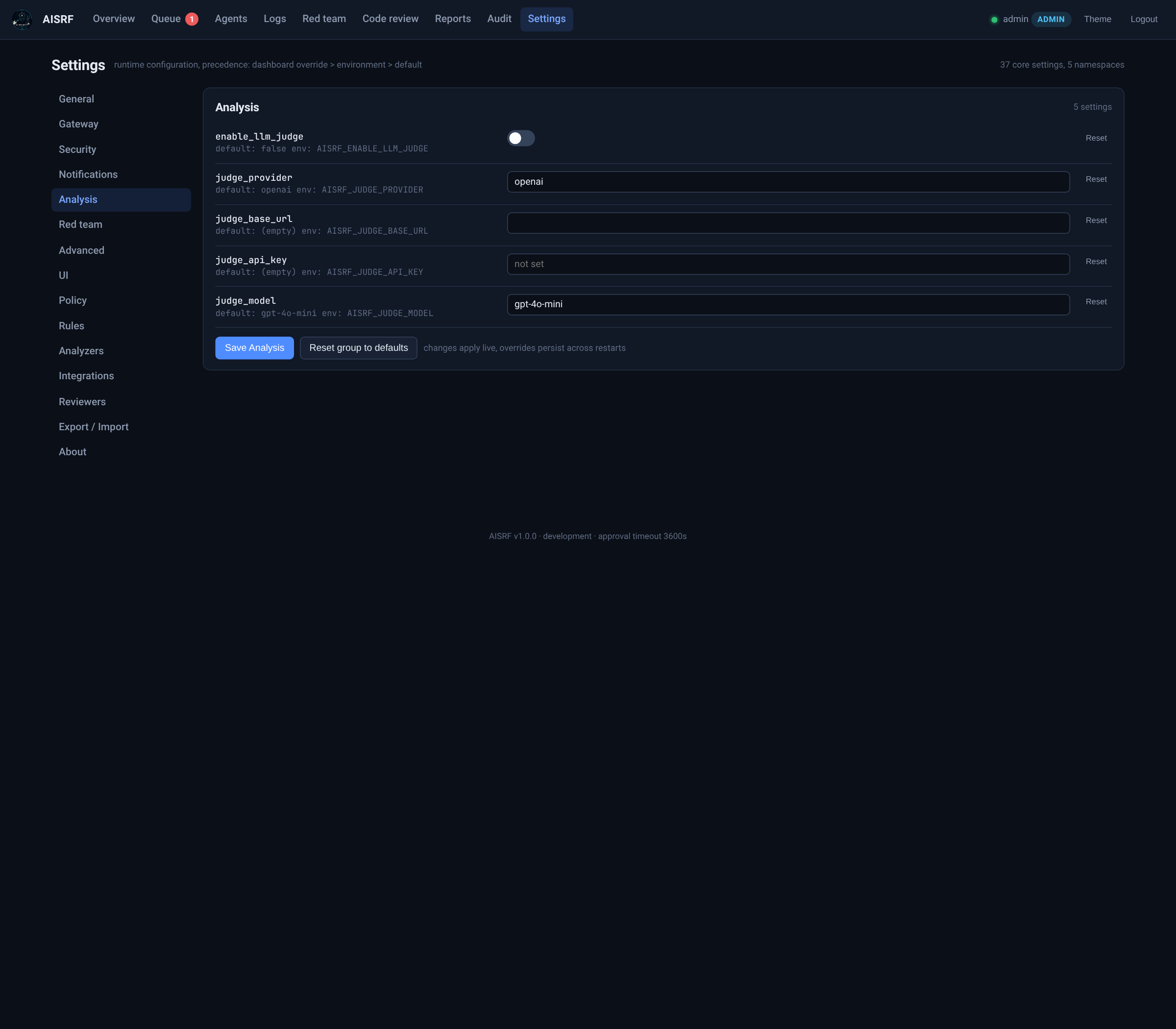
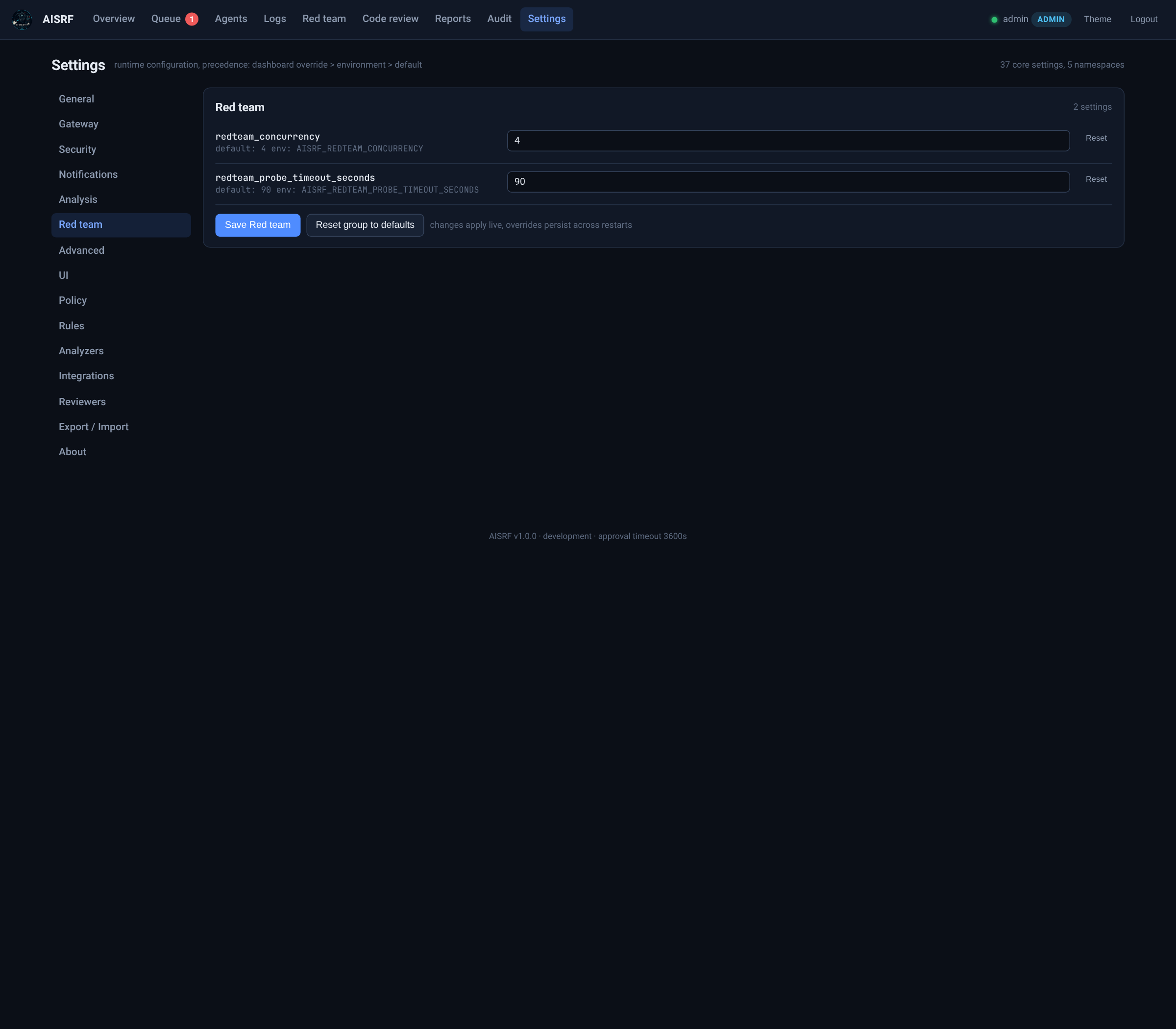
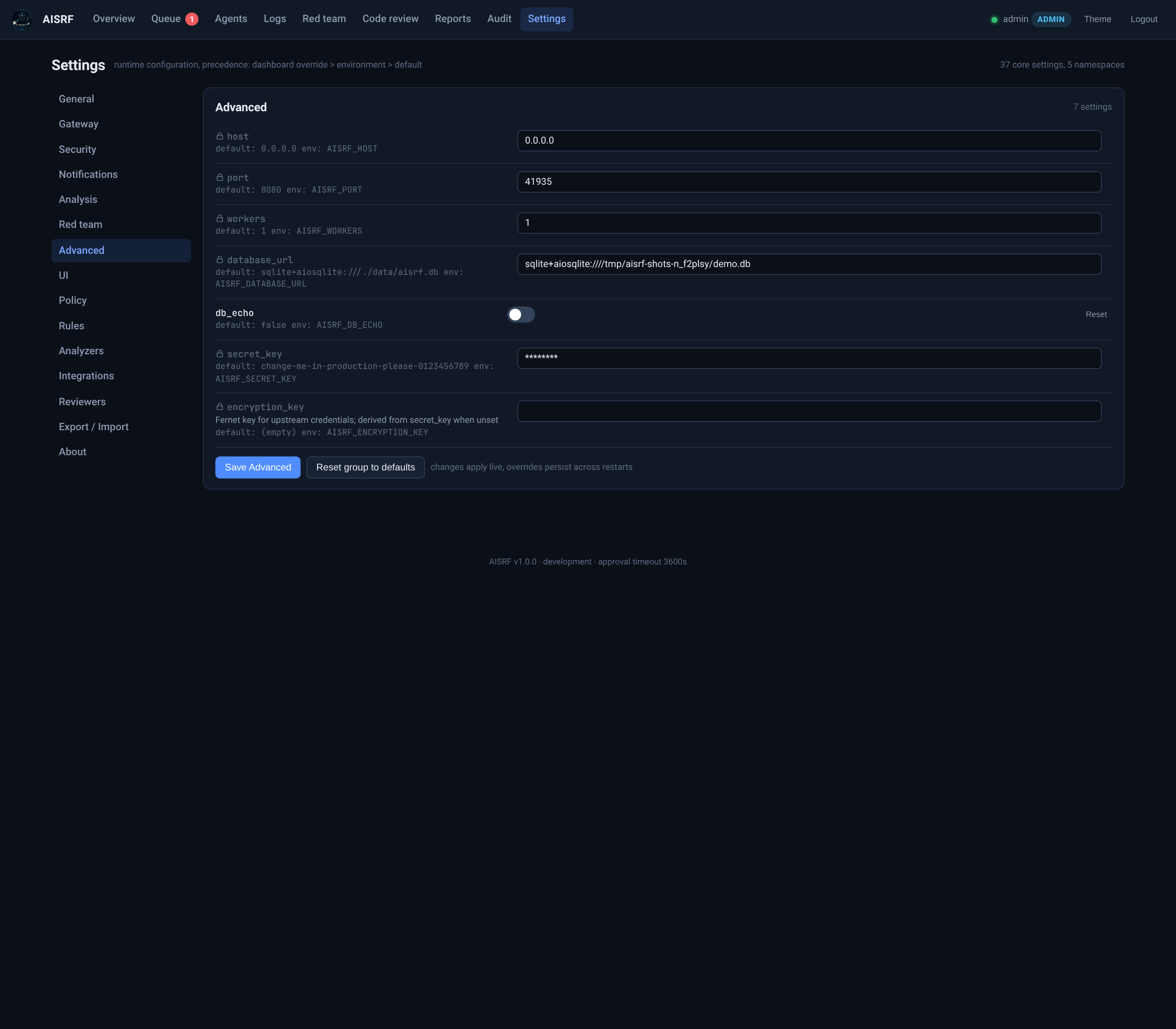
The first seven sections (General, Gateway, Security, Notifications, Analysis, Red team, Advanced) are generated from GET /api/settings/schema, which returns one entry per Settings field with key, group, type, description, default, value, secret, locked and env. Each row shows the key, its description, the default and the environment variable name, and a control chosen by type:
| Field type | Control |
|---|---|
| locked | Read-only text with a lock icon; tooltip Set AISRF_... in the environment and restart
|
| bool | Toggle switch |
| int, float | Number input |
| list | Textarea, one value per line or comma-separated |
| secret | Password input showing ******** when a value is stored; leaving it unchanged keeps the stored value |
| other | Text input |
Per row, Reset calls POST /api/settings/core/reset with {"keys": ["<key>"]} and drops that override so the environment or default applies again. Per section, Save <group> collects the modified rows and calls PUT /api/settings/core with {"changes": {...}}; Reset group to defaults confirms and resets every unlocked key of the group. Changes apply live and persist across restarts.
| Section | Group | Fields |
|---|---|---|
| General | Service |
app_name, environment, log_level, log_json_console, public_url
|
| Gateway | Gateway |
approval_timeout_seconds, hold_poll_interval_seconds, max_request_body_bytes, max_stored_response_bytes, upstream_timeout_seconds, upstream_connect_timeout_seconds, default_auto_deny_risk_threshold, default_auto_approve_risk_threshold, ticket_retention_days, require_approval_for_redteam_probes
|
| Security | Security |
admin_username, admin_password, admin_api_token, session_max_age_seconds, cookie_secure
|
| Notifications | Notifications |
notify_webhook_urls, notify_events, notify_min_risk
|
| Analysis | Analysis |
enable_llm_judge, judge_provider, judge_base_url, judge_api_key, judge_model
|
| Red team | Red team |
redteam_concurrency, redteam_probe_timeout_seconds
|
| Advanced | Advanced |
host, port, workers, database_url, db_echo, secret_key, encryption_key (all locked except db_echo) |
Defaults, types and semantics of every field: Configuration-Reference.
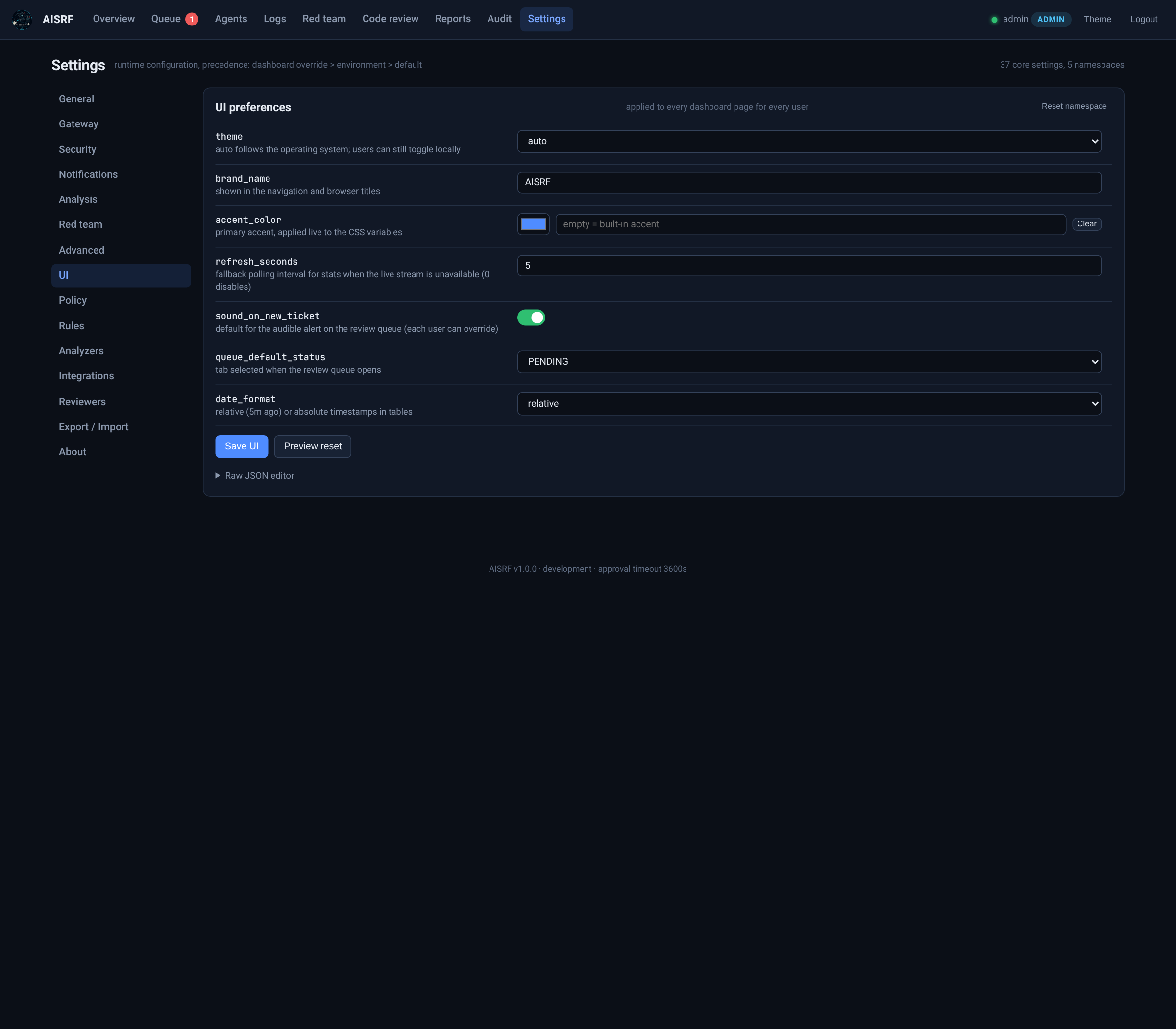
Namespace ui, loaded with GET /api/settings/ns/ui, saved with PUT /api/settings/ns/ui, reset with POST /api/settings/ns/ui/reset.
| Control | Effect |
|---|---|
theme select (auto, dark, light) |
Applied live as a preview; auto follows the operating system; users can still toggle locally |
brand_name text |
Shown in the navigation and browser titles |
accent_color colour picker plus hex text and Clear |
Primary accent applied live to the CSS variables; empty keeps the built-in accent |
refresh_seconds number |
Fallback polling interval for stats when the live stream is unavailable; 0 disables |
sound_on_new_ticket toggle |
Default for the audible alert on the review queue |
queue_default_status select (PENDING, All, DENIED, COMPLETED, EXPIRED, FAILED) |
Tab selected when the queue opens |
date_format select (relative, absolute) |
Timestamp style in tables |
| Save UI | Persists the document and applies it for every user |
| Preview reset | Reverts the live preview to the saved values |
| Raw JSON editor | Edit the whole namespace document; validated as a JSON object before Save raw document |
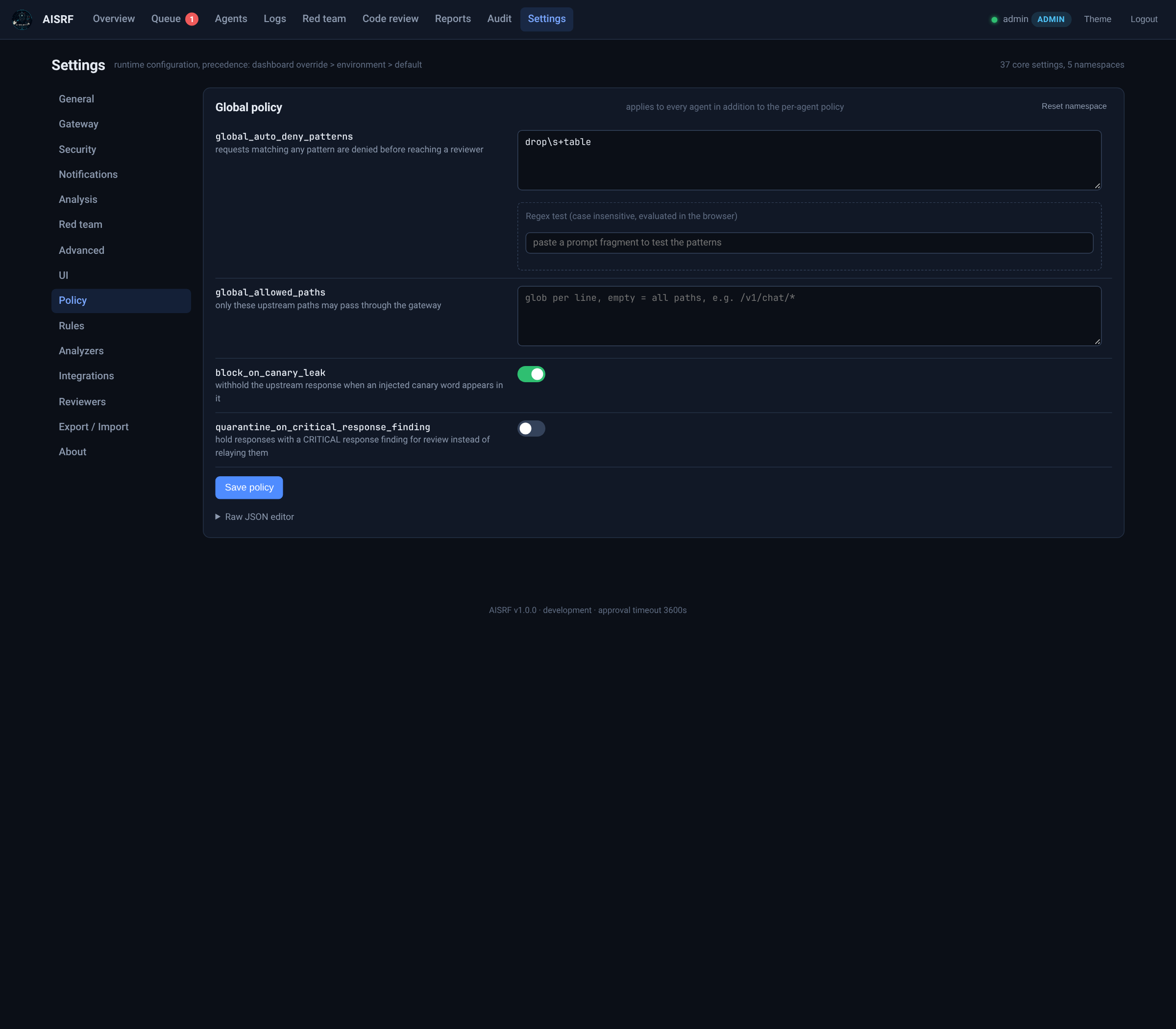
Namespace policy.
| Control | Effect |
|---|---|
global_auto_deny_patterns textarea |
One regex per line, denied for every agent before a reviewer sees the ticket; the Regex test box below evaluates every pattern (case-insensitive, in the browser) against a pasted prompt fragment |
global_allowed_paths textarea |
One glob per line; empty allows all paths |
block_on_canary_leak toggle |
Withhold the upstream response when an injected canary appears in it |
quarantine_on_critical_response_finding toggle |
Withhold responses that carry a CRITICAL response finding |
| Save policy | Validates every regex, then PUT /api/settings/ns/policy
|
| Reset namespace, Raw JSON editor | As above |
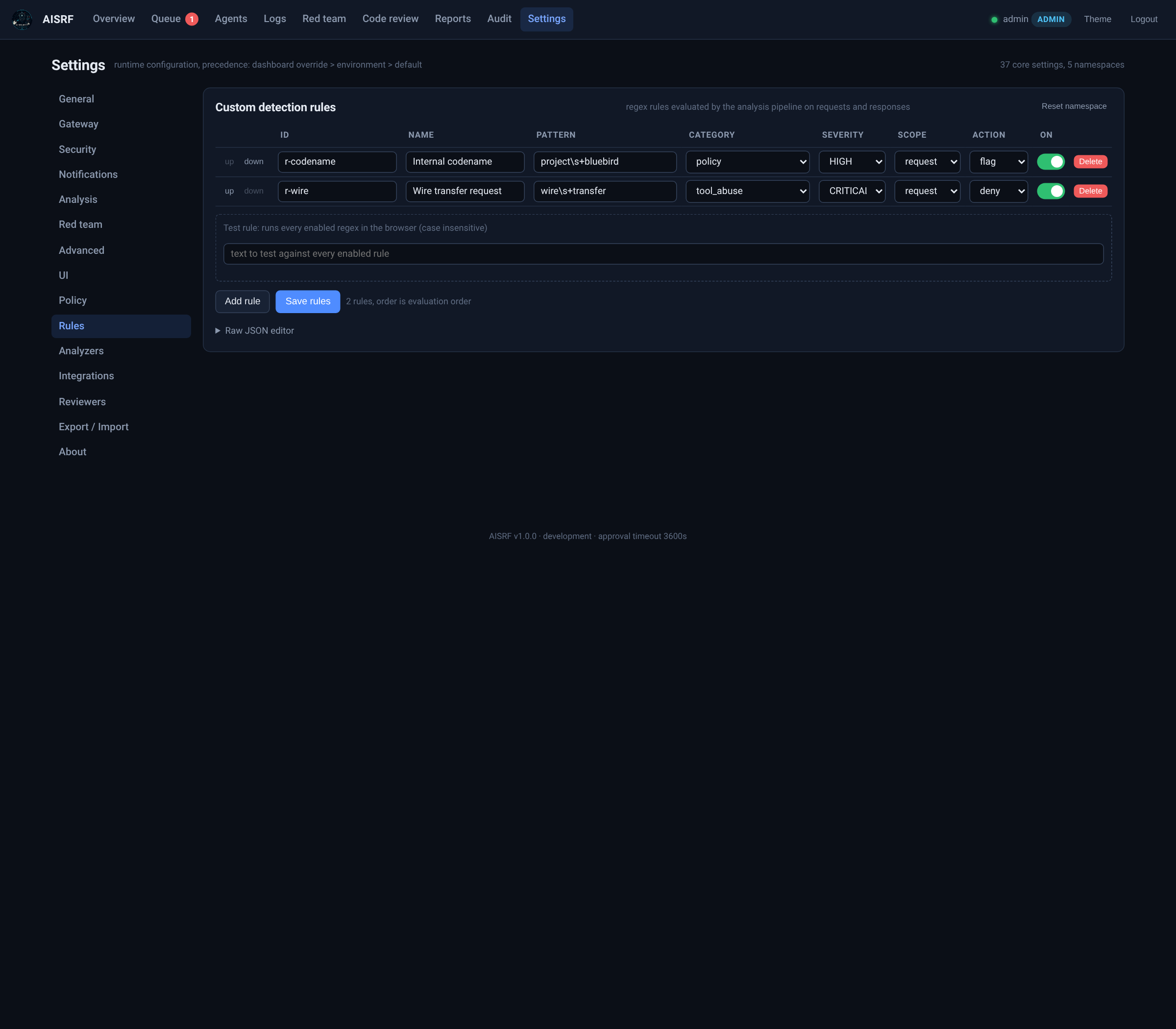
Namespace rules, key custom. A table with one row per rule and these columns: reorder buttons (up, down; order is evaluation order), Id (must be unique and non-empty), Name, Pattern (regex, border turns red when invalid), Category (from the taxonomy category map, loaded from GET /api/settings/taxonomy), Severity (INFO, LOW, MEDIUM, HIGH, CRITICAL), Scope (request, response, both), Action (flag, deny), On toggle, Delete. Add rule appends a row with id rule-<n>, severity MEDIUM, scope request, action flag. The Test rule box runs every enabled regex against typed text in the browser and shows the action and the match. Save rules validates patterns and ids and calls PUT /api/settings/ns/rules with {"custom": [...]}. See Custom-Rules.
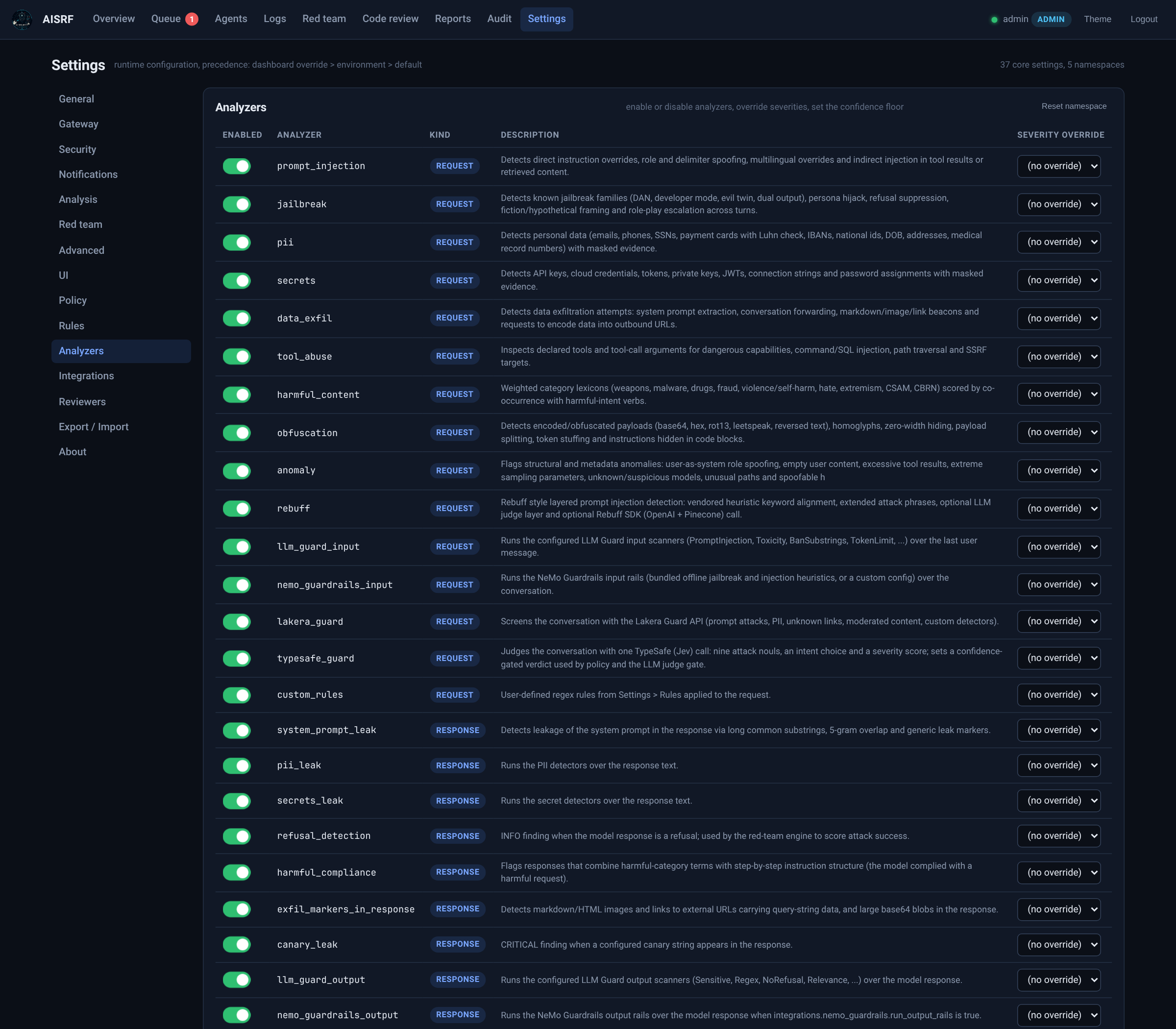
Namespace analyzers, loaded with GET /api/settings/analyzers, which returns the registered analyzers (name, kind, description) plus the current config.
| Control | Effect |
|---|---|
| Enabled toggle per analyzer | Adds or removes the name from disabled
|
| Severity override select per analyzer | severity_overrides[<analyzer>] |
| Severity override per category table plus Add category override |
severity_overrides[<category>] for taxonomy categories |
confidence_floor slider (0 to 1, step 0.05) |
Findings below this confidence are dropped before scoring |
| Save analyzers |
PUT /api/settings/ns/analyzers with disabled, severity_overrides, confidence_floor, category_weights
|
See Analyzers.
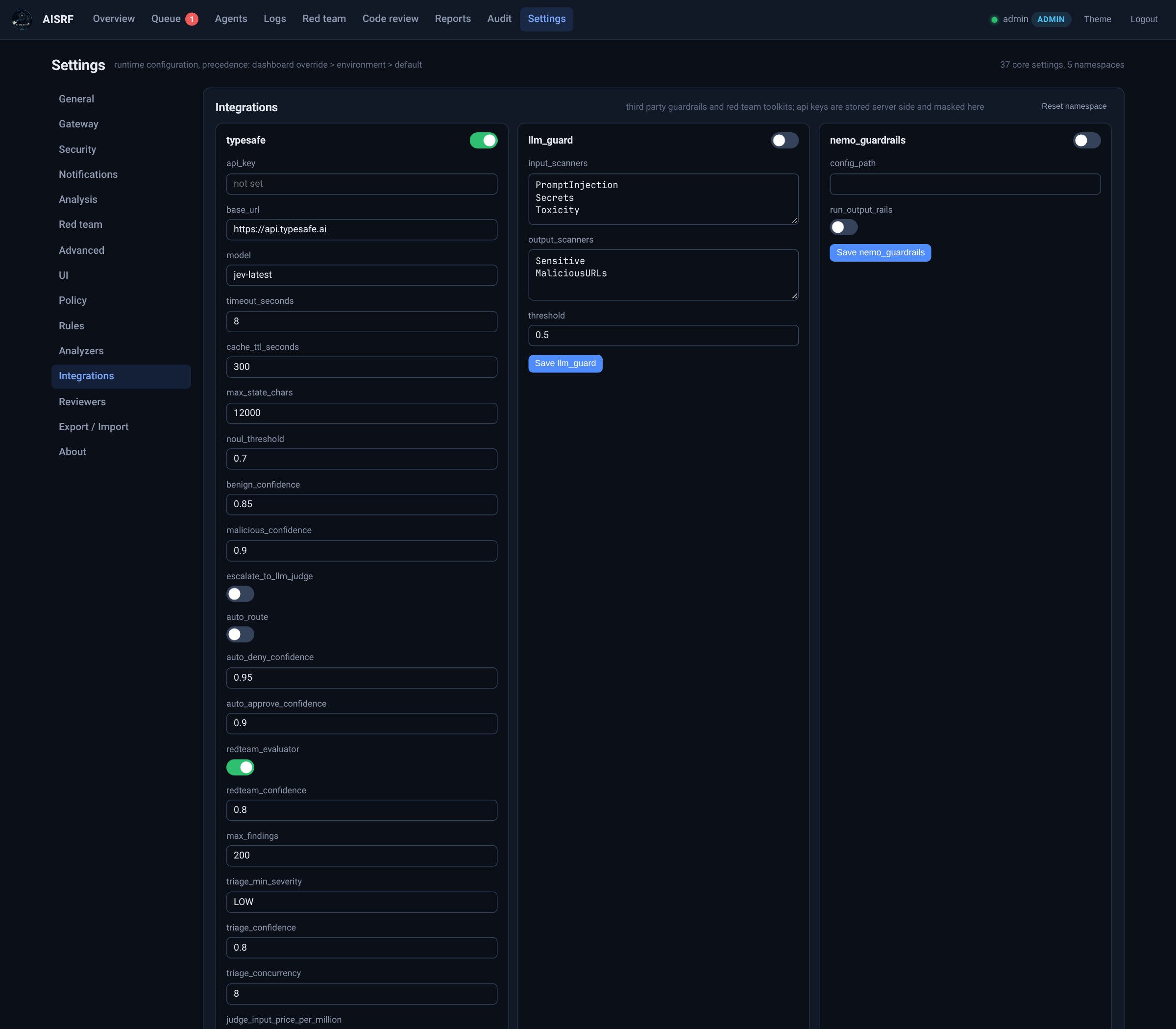
Namespace integrations. One card per integration: llm_guard, nemo_guardrails, lakera, rebuff, garak, promptfoo, pyrit, pyrit_ship, plus any extra key present in the stored document. Each card has an Enabled toggle in its header and one control per key, chosen by the type of the default value: toggle for booleans, number input for numbers, textarea (one per line) for lists, password input for keys matching api_key, secret, token or password (masked as ********, unchanged when left masked), JSON textarea for objects, text input otherwise. When a value differs from the default the label shows (default: ...). Save <name> sends only that integration's document to PUT /api/settings/ns/integrations. Guardrail status and health checks use GET /api/settings/guardrails and POST /api/settings/guardrails/health (admin) from the guardrails pages. See Guardrails and Scanner-Engines.
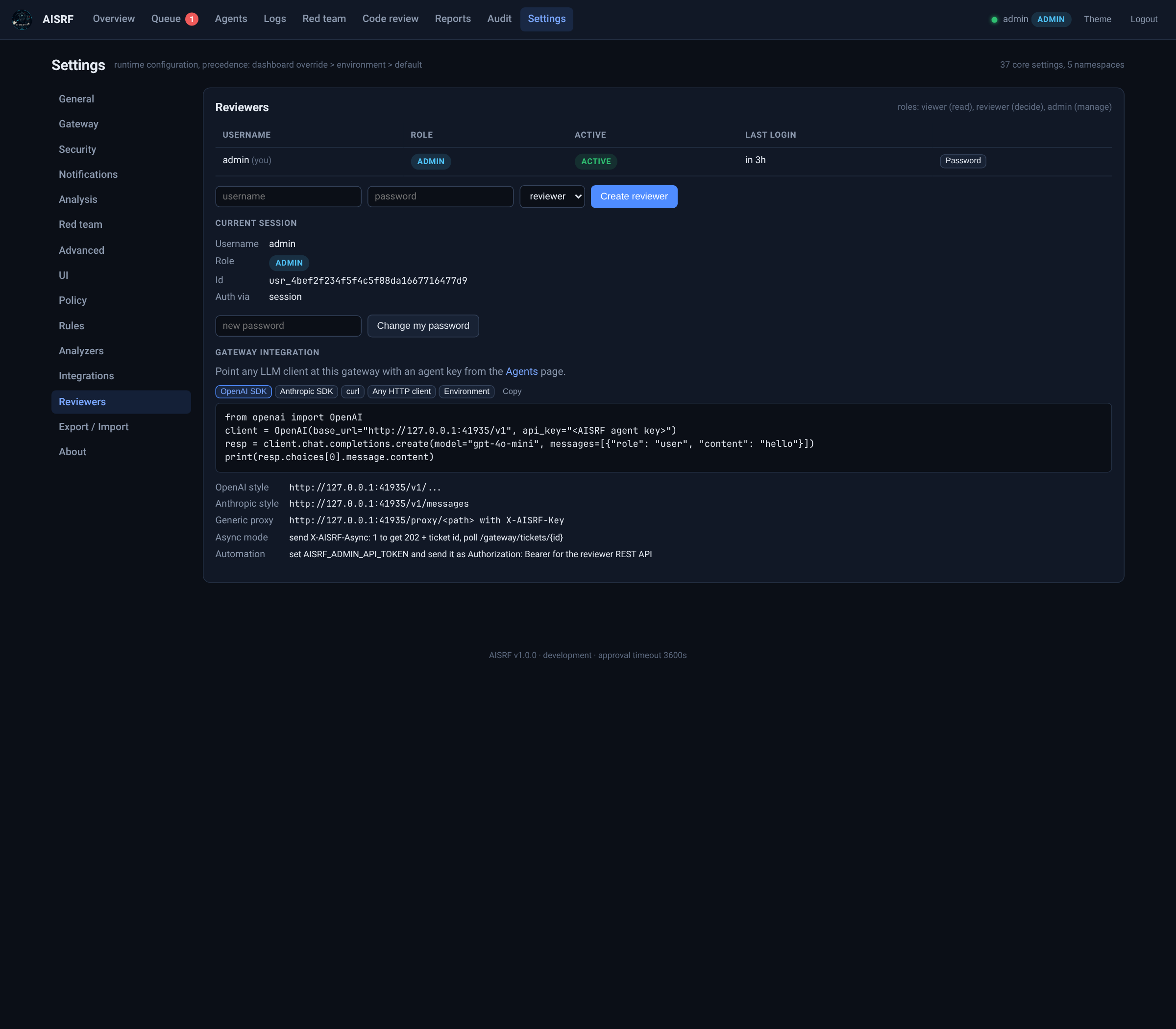
Not a namespace; backed by /api/auth.
| Control | API |
|---|---|
| Reviewer table (username, role badge, active or inactive, last login) |
GET /api/auth/reviewers (admin) |
| Password button per reviewer | POST /api/auth/reviewers/{id}/password |
| Deactivate button (not for yourself) | DELETE /api/auth/reviewers/{id} |
| New reviewer form (username, password, role) | POST /api/auth/reviewers |
| Change your own password form |
POST /api/auth/reviewers/{your id}/password (any role) |
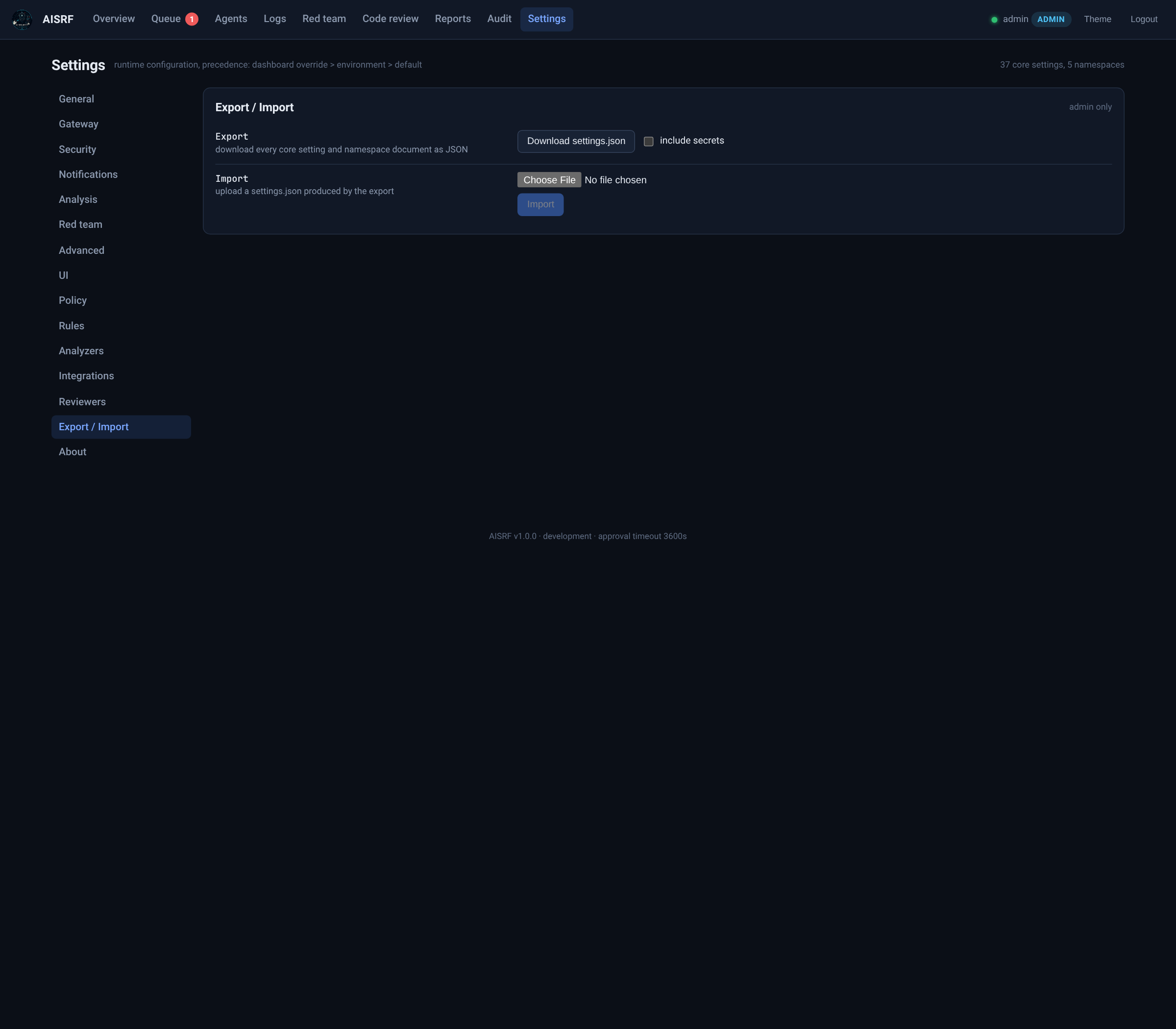
| Control | API |
|---|---|
| Download settings.json, with an include secrets checkbox |
GET /api/settings/export?include_secrets=<bool>; the file is named aisrf-settings-<date>.json
|
| Import file picker, preview of core key count and namespaces, Import button with confirmation | POST /api/settings/import |
Import replaces existing overrides for the keys present in the file and is audited as settings.import.
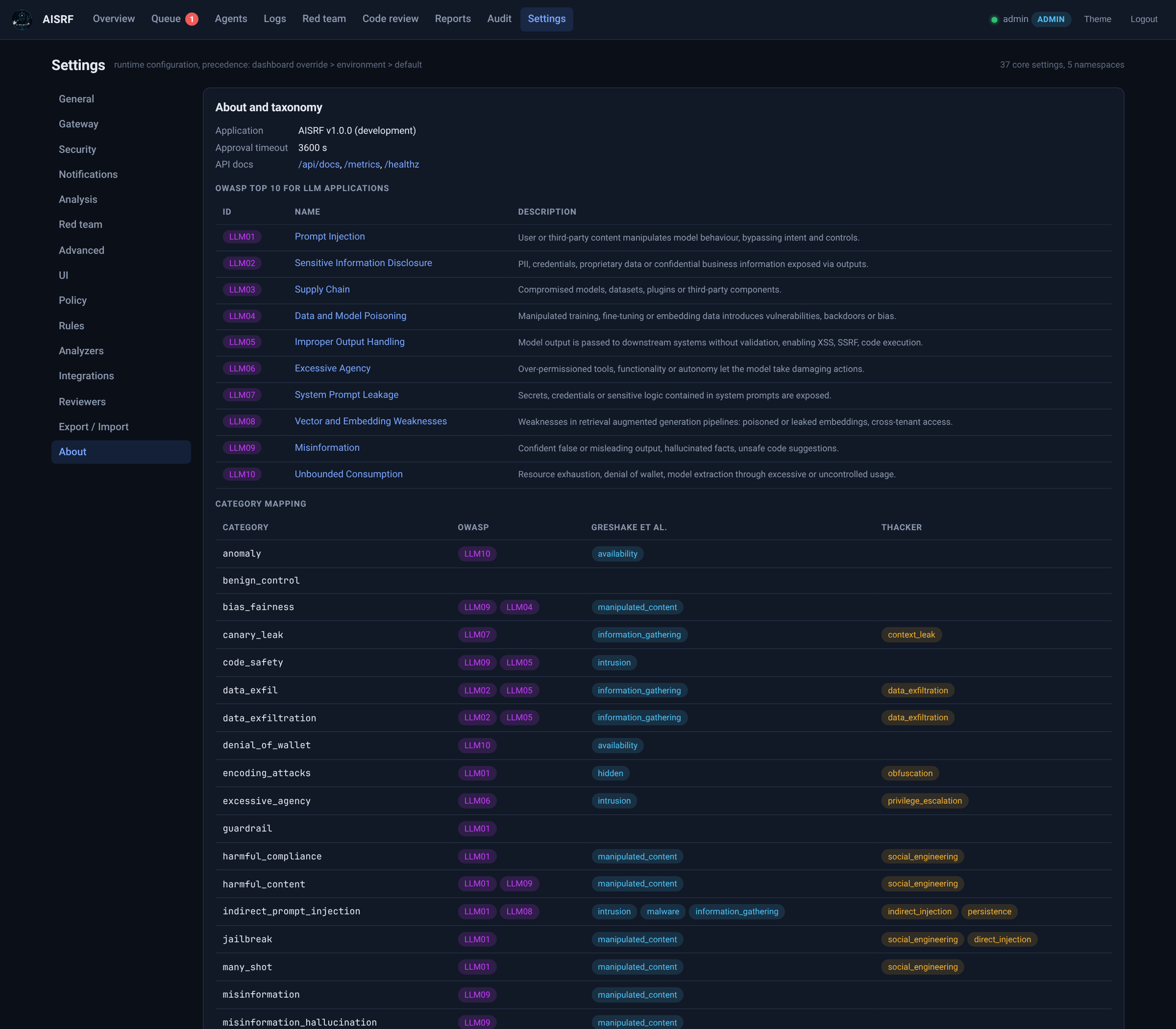
Reference material rendered from GET /api/settings/taxonomy: the OWASP Top 10 for LLM Applications table with links, the category mapping table (category to OWASP, Greshake and Thacker chips with tooltips), the Greshake threat and delivery definitions, the Thacker technique definitions and the references list (OWASP, Greshake et al. 2023, Thacker primer, garak, promptfoo, PyRIT, Rebuff, LLM Guard, NeMo Guardrails, Lakera Guard). The Integration panel on the same page shows ready-to-copy snippets for the current origin: OpenAI style base URL (<origin>/v1/...), Anthropic style (<origin>/v1/messages), generic proxy (<origin>/proxy/<path> with X-AISRF-Key), the async header, and the automation token hint.
Every save and reset writes an audit entry (settings.update or settings.reset with the namespace and keys, settings.import for imports) and publishes settings.updated on the settings broadcaster channel. The status line at the top of the page reports the number of core settings and namespaces loaded from the schema endpoint.
Related: Configuration-Reference, Dashboard-Guide, Security-Model.
One capture per section, taken from the demo instance.