
Stop guessing why Turborepo missed the cache.
Compare two runs, isolate the changed evidence, and find the first task that invalidated the graph.


npm · crates.io · release binaries · issues
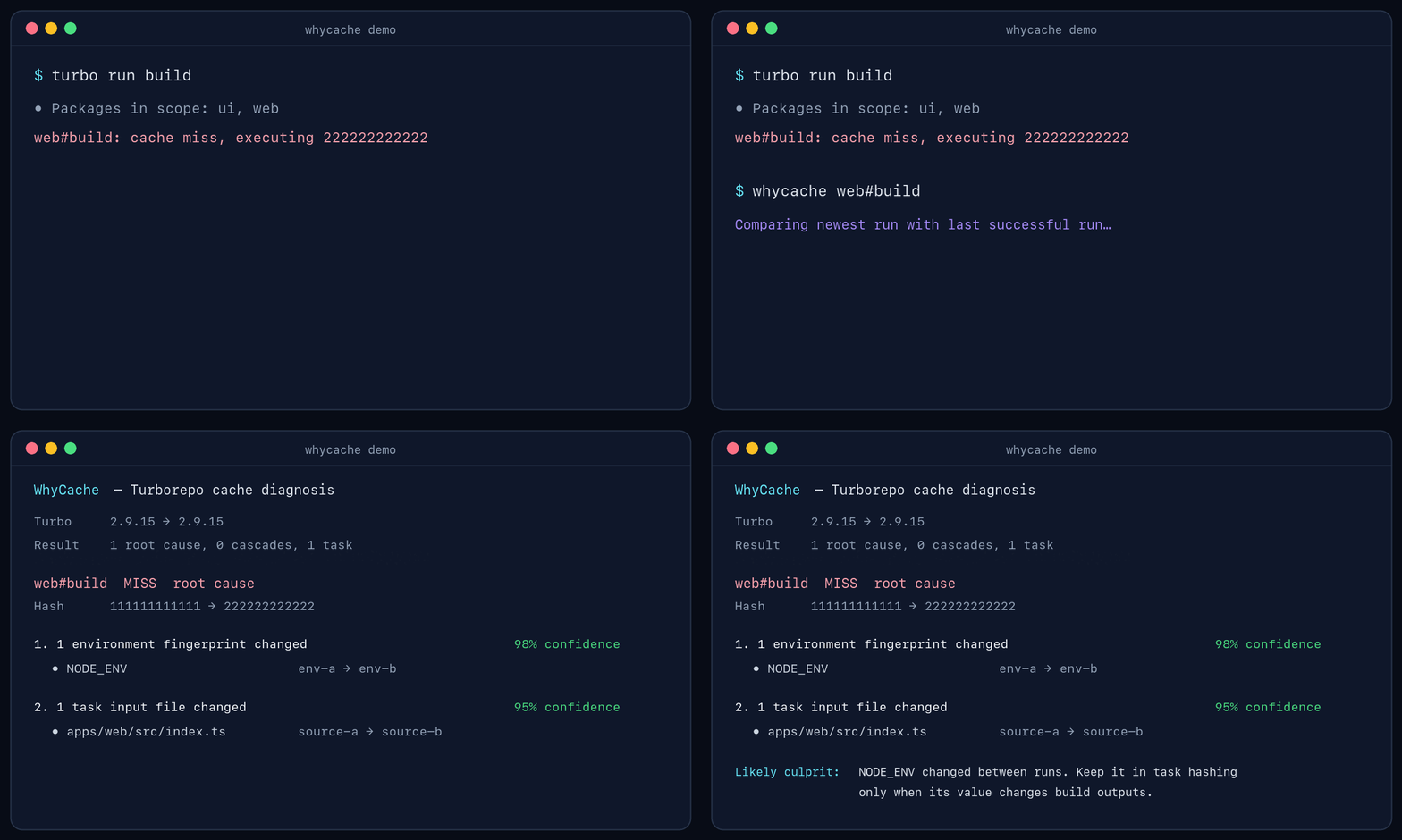
WhyCache is a small, fully local Rust CLI for answering one expensive question:
Why did this task miss when I expected a cache hit?
It reads the run summaries Turborepo already produces, compares a known-good baseline with the current run, removes unchanged noise, ranks the remaining causes, and attaches every conclusion to before/after fingerprints. It understands direct invalidation, downstream cascades, and the important case where the hash did not change but the cached artifact was unavailable.
No source upload. No account. No API key. No telemetry. No AI. 🛡️
A Turborepo task hash can change because of source files, environment fingerprints, lockfiles, global inputs, task configuration, dependency hashes, an upstream task, or even a Turborepo version change. Raw run summaries contain the evidence, but they are large and graph-shaped.
WhyCache turns that evidence into an investigation order:
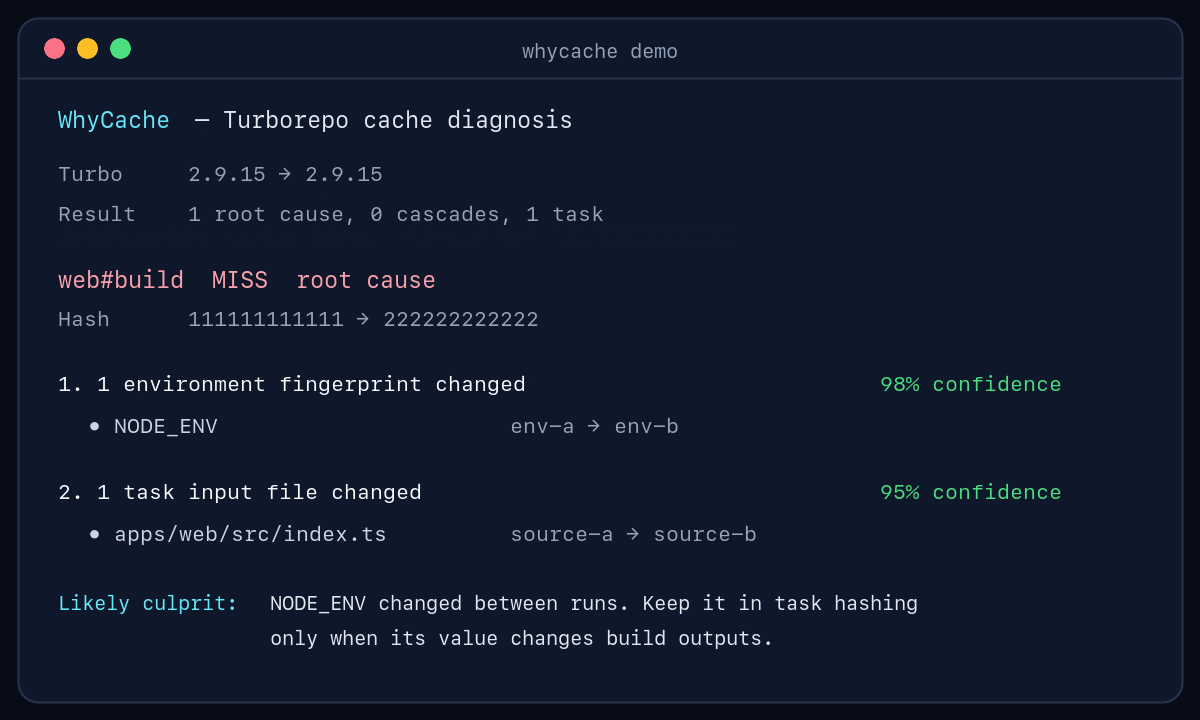
web#build  MISS  root cause
  Hash      111111111111 → 222222222222

  1. 1 environment fingerprint(s) changed  98% confidence
     • NODE_ENV  env-a → env-b

  2. 1 task input file(s) changed  95% confidence
     • apps/web/src/index.ts  source-a → source-b

  3. 1 upstream task hash(es) changed  90% confidence
     • ui#build  upstream-a → upstream-b

  💡 Likely culprit: NODE_ENV changed between runs.
The example above is generated from the checked-in compatibility fixture and protected by exact golden-output tests.
npm install --global whycacheThe npm launcher selects the native package for your operating system and architecture. The JavaScript launcher has no third-party runtime libraries.
cargo install whycache --lockedDownload the archive for your platform from GitHub Releases, verify it against SHA256SUMS, and place whycache on your PATH.
git clone https://github.com/Lebyy/whycache.git
cd whycache
cargo install --path . --locked
WhyCache requires Rust 1.85 or newer when building from source.
| Operating system | Architecture | npm package | Release asset |
|---|---|---|---|
| Linux | x86-64 | whycache-linux-x64 |
linux-x64 |
| Linux | ARM64 | whycache-linux-arm64 |
linux-arm64 |
| macOS | Apple Silicon | whycache-darwin-arm64 |
darwin-arm64 |
| macOS | Intel | whycache-darwin-x64 |
darwin-x64 |
| Windows | x86-64 | whycache-windows-x64 |
win32-x64 |
Ask Turborepo to retain a summary when you run the task:
turbo run build --summarizeAfter a later run misses, diagnose every missed task:
whycacheOr focus on one task name or fully qualified task id:
whycache build
whycache web#build
By default, WhyCache chooses the newest summary as the current run and the nearest earlier successful summary as the baseline.
You can run WhyCache before enabling --summarize:
whycache buildWhyCache captures turbo run build --dry=json at .whycache/last-summary.json. A dry summary calculates inputs without executing the task. The first invocation honestly reports baseline_captured; the next invocation compares current inputs against that baseline.
Running whycache without a task reads all task names from turbo.json and captures them together.
whycache build --against .turbo/runs/previous.jsonExternal systems can stream a baseline over standard input:
cat previous.json | whycache build --against -| Evidence | What a change means | Reported safely? |
|---|---|---|
| Task input fingerprints | Source, config, generated input, or declared dependency changed | ✅ Path + hash |
| Environment fingerprints | A configured variable affected the task hash | ✅ Name + fingerprint only |
| Lockfiles | The external dependency graph changed | ✅ Path + hash |
turbo.json |
Repository-wide pipeline configuration changed | ✅ Fingerprint |
| Resolved task definition | Command, inputs, outputs, cache policy, or dependencies changed | ✅ Structured diff |
| Global inputs | A root-level file or global environment entry invalidated tasks | ✅ Path/name + hash |
| Upstream task hashes | A dependency changed first and propagated through the graph | ✅ Task id + hash |
| Package dependency hash | External packages or workspace dependency state changed | ✅ Hash only |
| Engine constraints | Node/package-manager constraints changed | ✅ Constraint text |
| Turborepo version | Hashing behavior may differ between the two runs | ✅ Version only |
| Same hash with a miss | The cache key is stable but the artifact was unavailable | ✅ Cache metadata |
Unchanged evidence is summarized instead of repeated, so a large monorepo report stays focused.
WhyCache classifies each task before ranking its evidence:
| Classification | Meaning | First action |
|---|---|---|
root cause |
The task's own inputs or configuration changed | Inspect the highest-confidence evidence |
cascade |
Only an upstream task changed | Follow the named upstream task |
cache unavailable |
Hash stayed identical but the run missed | Check local/remote cache access and retention |
new task |
The task did not exist in the baseline | Confirm the pipeline/package change |
unchanged |
No relevant change was found | No cache-key investigation required |
unexplained |
The summary lacks enough supported evidence | Review the warning and raw summary version |
Confidence is a deterministic priority—not a probability generated by a model. Exact, task-local evidence ranks above broad or downstream evidence. Multiple plausible causes remain visible.
whycache buildColor is enabled only for an interactive terminal, so redirected output stays clean.
whycache build --json > whycache-report.jsonJSON output is deterministic for the same inputs and currently uses schema version 1. Consumers should branch on schemaVersion and ignore unknown fields. See the complete JSON contract.
{
  "schemaVersion": "1",
  "tasks": [
    {
      "taskId": "web#build",
      "cacheStatus": "miss",
      "classification": "root_cause",
      "causes": [
        {
          "kind": "environment",
          "confidence": 98
        }
      ]
    }
  ],
  "warnings": []
}whycache build --md >> "$GITHUB_STEP_SUMMARY"Markdown uses the same diagnosis model as human and JSON output, including evidence tables, confidence, likely culprit, unchanged signals, and next checks.
whycache build --gitWhen both summaries contain commit SHAs, --git adds line counts for already identified evidence paths. WhyCache invokes the local Git executable with argument arrays; it does not execute a shell command assembled from summary data.
Generate and retain summaries in your build job, then write the diagnosis directly to the step summary:
- name: Install WhyCache
  run: npm install --global whycache

- name: Explain cache misses
  if: always()
  run: whycache build --md --git >> "$GITHUB_STEP_SUMMARY"
For a pull-request bot, store whycache build --json as an artifact and post the Markdown output using your existing trusted workflow permissions.
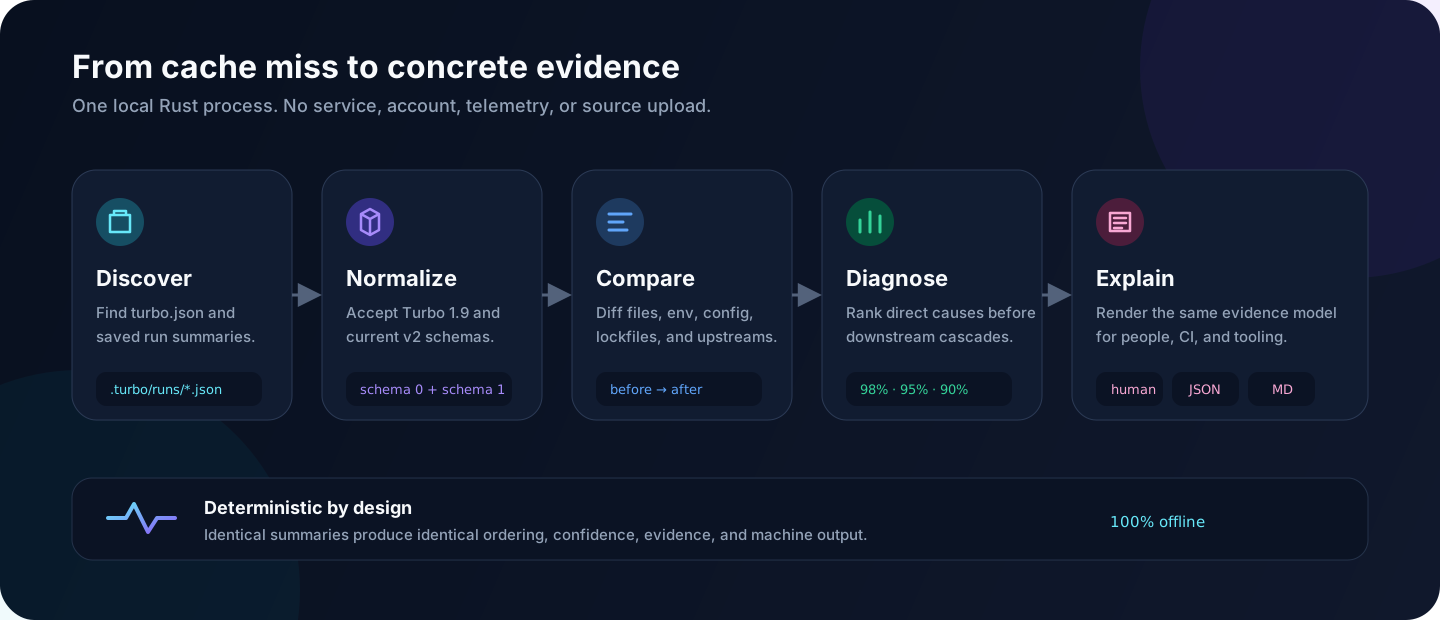
- Discover — walk upward to the Turborepo root and deterministically order
.turbo/runs/*.json. - Normalize — deserialize known Turbo 1.9 and v2 fields, treat historical
nullcollections as empty, and ignore unknown additions. - Compare — diff task-local and global evidence, then build upstream dependency edges.
- Diagnose — separate direct root causes from inherited cascades and rank causes by specificity.
- Explain — render one versioned report model as terminal text, JSON, or Markdown.
Renderers never perform diagnosis, which keeps every output format semantically identical. Read the deeper architecture notes.
Usage: whycache [OPTIONS] [TASK]
| Argument | Purpose |
|---|---|
[TASK] |
Match a task name such as build or an exact id such as web#build |
--against <SUMMARY> |
Use a specific baseline; pass - to read JSON from stdin |
--json |
Emit stable machine-readable JSON |
--md |
Emit GitHub-flavored Markdown |
--git |
Add Git numstat evidence when both commits are available |
-h, --help |
Show CLI help and examples |
-V, --version |
Show the installed WhyCache version |
--json and --md are mutually exclusive. Invalid usage and missing tasks exit with status 2; operational and parse failures exit with status 1.
- Runs entirely on the local machine or CI runner.
- Never uploads summaries, source paths, hashes, or Git metadata.
- Never reads task environment values to reconstruct secrets.
- Shows environment variable names and Turborepo-provided fingerprints only.
- Uses no network client, telemetry SDK, analytics, AI, or hosted service.
- Pins third-party GitHub Actions to immutable commit SHAs.
- Runs RustSec and CodeQL workflows in addition to the warning-free test matrix.
Please report vulnerabilities privately using the process in SECURITY.md.
| Surface | Coverage |
|---|---|
| Turborepo 1.9 | Real schema-0 fixture and scheduled 1.9.9 canary |
| Turborepo 2.0 | Scheduled 2.0.0 canary |
| Current Turborepo v2 | Real fixture and scheduled latest canary |
| Linux | Native x86-64 and ARM64 release jobs |
| macOS | Native Intel and Apple Silicon release jobs |
| Windows | Native x86-64 release job |
| Rust | MSRV job on Rust 1.85 plus stable CI |
Unknown run-summary fields are ignored. Declared schema versions other than 0 and 1 are parsed in compatibility mode with a visible warning; WhyCache does not silently claim full support for an untested schema.
- WhyCache explains differences present in run summaries; it is not a general-purpose build profiler.
- A historical miss cannot be reconstructed if no baseline or previous summary exists. Automatic mode starts collecting evidence for the next comparison.
- An unchanged hash proves the key stayed stable, but a local summary alone cannot distinguish eviction from remote-cache authentication, team selection, or retention policy.
- Environment values are intentionally unavailable. This protects secrets but means the report names the changed variable rather than printing its plaintext value.
- If Turborepo introduces a new schema, WhyCache warns until that version has a real fixture and compatibility test.
cargo fmt --all -- --check
cargo clippy --all-targets --all-features -- -D warnings
cargo test --all-targets --all-features
cargo +1.85.0 test --all-targets --all-features
cargo audit
The repository is intentionally small:
src/                    CLI, discovery, parsing, diagnosis, Git, renderers
tests/fixtures/         Sanitized real Turbo schemas and deterministic scenarios
tests/golden/           Exact human, JSON, and Markdown output contracts
npm/                    Cross-platform native npm packages and launcher
.github/workflows/      CI, CodeQL, RustSec, canary, and release automation
assets/                 Logo, real terminal capture, and architecture artwork
docs/                   Architecture, JSON contract, and release procedure
Changes must remain warning-free and evidence-backed. Parser changes need a sanitized fixture; diagnosis changes need ranking and classification tests; renderer changes need updated golden files. See CONTRIBUTING.md.
A v* tag builds five native archives, tests each runner, generates checksums, creates the GitHub release, and publishes the matching platform packages, npm installer, and Rust crate. Package versions are synchronized by scripts/sync-version.sh before tagging.
The complete checklist is in docs/releasing.md.
Does WhyCache replace turbo run --summarize?
No. Turborepo produces the evidence; WhyCache compares and explains it. When history is empty, WhyCache can invoke Turborepo's dry JSON mode to establish a truthful baseline without executing tasks.
Does it send my repository data to an AI model?
No. There is no AI integration, network client, API key, account, or telemetry path. Diagnosis is a deterministic Rust comparison engine.
Why are confidence scores so exact?
They are stable priorities. A changed environment fingerprint is direct task evidence, an exact file change is slightly lower, and an upstream hash is ranked below local evidence because it describes propagation. They are not statistical probabilities.
Can it run in a large monorepo?
Yes. WhyCache compares summary maps in memory, sorts output deterministically, and collapses unchanged signals. Use a task filter when you want the smallest possible report.
Issues and focused pull requests are welcome. Please read the contribution guide and code of conduct first.
WhyCache is not affiliated with or endorsed by Vercel. Turborepo is a trademark of its respective owner.
Licensed under either the MIT License or Apache License 2.0, at your option.