Detect symmetry axes in images and score mirror symmetry along them. imgsym implements multiple algorithms from symmetry research — 4 detectors and 13 scorers — behind one small API, and benchmarks them head-to-head.
pip install imgsymThis covers the classical scoring methods and the nxc / xfeatures / r_lip
detectors. Some methods pull optional extras:
pip install "imgsym[deep]"      # alexnet, deep_features
pip install "imgsym[wavelets]"  # wavelets detector
pip install "imgsym[all]" # everything (+ numba speedups)import cv2
import imgsym
# find symmetry axes: (angles, midpoints, lengths, strengths), strongest first
img = cv2.imread("assets/butterfly.jpg")
bf_axes = imgsym.detect_axes(img, detector="nxc")
vis1 = imgsym.visualize(img, bf_axes)
# score mirror symmetry along an axis; higher = more symmetric
axis = imgsym.get_axis(bf_axes, 0) # strongest detected axis
imgsym.score_along_axis(img, axis, method="hog") # 0.89
# binary shape masks have their own detector
mask = cv2.imread("assets/synthetic_star.png", cv2.IMREAD_GRAYSCALE)
star_axes = imgsym.detect_axes_from_mask(mask, detector="r_lip", mode="multi", threshold=0.9)
vis2 = imgsym.visualize(cv2.cvtColor(mask, cv2.COLOR_GRAY2BGR), star_axes)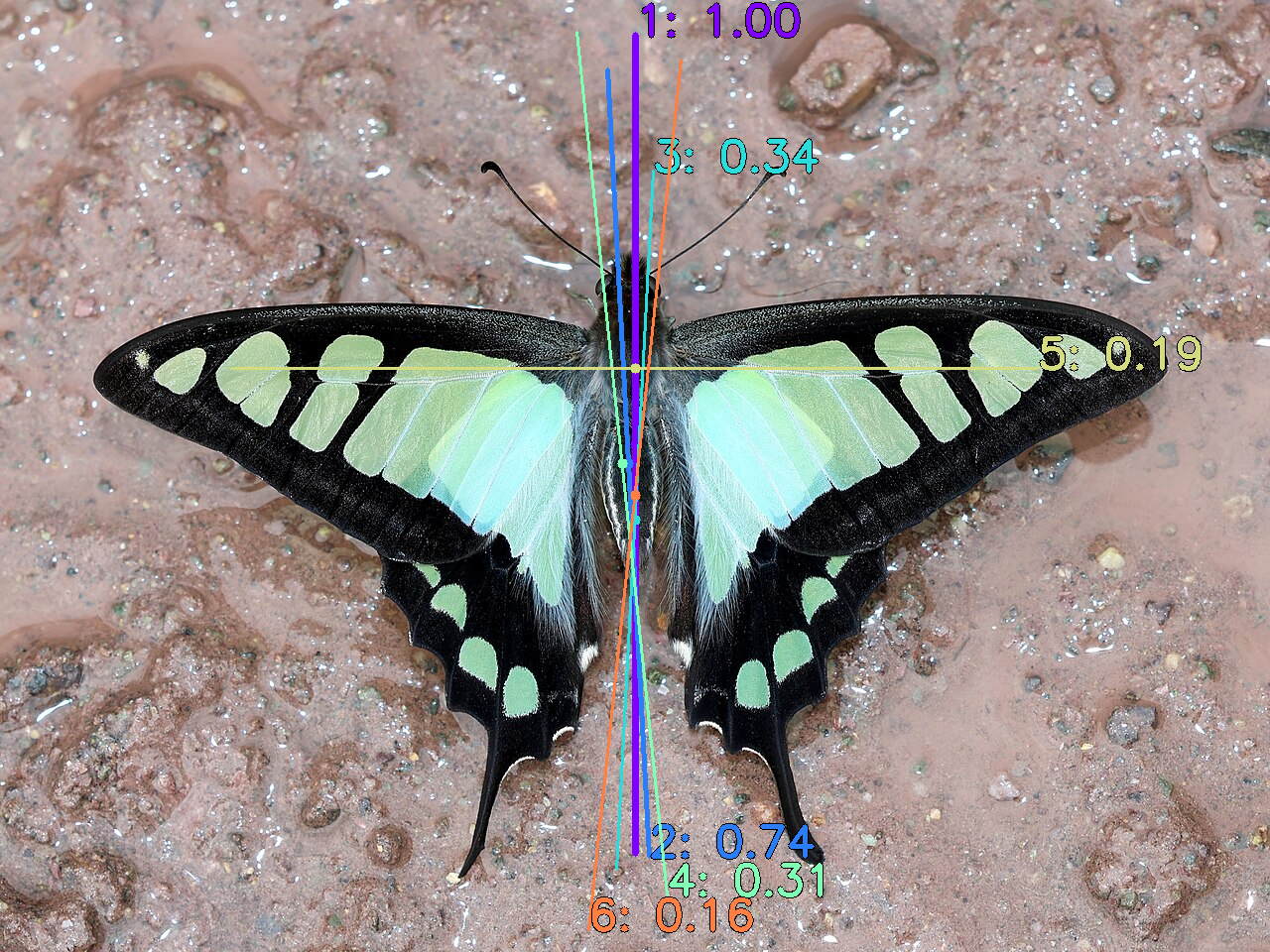 |
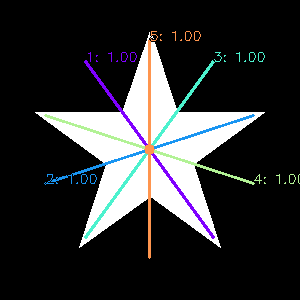 |
natural image — nxc |
binary shape mask — r_lip |
demo.ipynb reproduces every figure on this page and has more to
play with.
Natural images — imgsym.detect_axes(image, detector=...)
Detection accuracy is competition-protocol max-F (a detected axis counts if
its angle is within 10° of ground truth and its center lies on the true
segment), measured on three annotated benchmarks with
scripts/eval_detection_competition.py:
| detector | symComp17 | NYU | symComp13 | speed (s/img) | source |
|---|---|---|---|---|---|
nxc |
0.67 | 0.81 | 0.80 | ~7 | Cicconet et al. (2017) |
xfeatures |
0.59 | 0.74 | 0.57 | 0.05–0.2 | Loy & Eklundh (2006) |
wavelets |
0.46 | 0.53 | 0.49 | ~0.15 | Elawady et al. (2017) |
nxc leads on every benchmark — use it when accuracy matters; xfeatures is
~25× faster and the solid middle ground; wavelets trails clearly.
Binary shapes — imgsym.detect_axes_from_mask(mask, detector=...)
A different input domain, so not comparable above:
| detector | speed (s/img) | source |
|---|---|---|
r_lip |
<0.1 | Nguyen et al. (2022) |
Numbers, not guesswork: skill is single-axis discrimination skill (2·AUC−1; 1 = perfect, 0 = chance) averaged over the four datasets of our benchmark (see Benchmark); speed is the median scoring time per crop on CPU. Scores are comparable within a method, not across methods.
Three methods share the top and are statistically close — deep_features
(0.83), alexnet (0.81), hog (0.80). hog runs at 0.45 ms, ~20× faster
than alexnet and ~370× faster than deep_features, which makes it the
default choice; reach for deep_features when accuracy matters more than
speed. Below the top tier there is a clear gap to gabor and the remaining
classical measures.
| scoring method | skill | speed (ms) | source |
|---|---|---|---|
deep_features |
0.83 | 169 | Brachmann & Redies (2016), generalized to modern backbones |
alexnet |
0.81 | 9.9 | Brachmann & Redies (2016) |
hog |
0.80 | 0.45 | Renero-C. et al. (2017) |
gabor |
0.71 | 14.9 | Shaker & Monadjemi (2015) |
gradient |
0.67 | 0.72 | Gnutti, Guerrini & Leonardi (2021) |
multi_scale_gradient |
0.65 | 0.36 | multi-scale extension of the gradient measure |
local_global |
0.65 | 7.8 | Hogeweg et al. (2017), "PatchNN" |
sliding_window |
0.65 | 0.07 | windowed variant of pixel correlation |
pixel_correlation |
0.64 | 0.06 | Mayer & Landwehr (2018) |
phog |
0.63 | 0.85 | Renero-C. et al. (2017) |
dct |
0.61 | 0.15 | Gunlu & Bilge (2009) |
weighted_binary |
0.58 | 0.05 | Bauerly & Liu (2006) |
eros |
0.27 | 1.1 | Smith & Jenkinson (1999) |
Full citations live in each method's docstring (imgsym/scoring/calculators.py).
The local_global scoring method matches every patch to its best mirror-twin
on the other side of the axis. calculate_heatmap returns the per-patch match
quality as a map about the vertical center column (aligned below is the
image rotated so the detected axis is that center column — see the notebook).
calc = imgsym.SymmetryCalculatorFactory.create("local_global")
score, heatmap = calc.calculate_heatmap(aligned)   # (H, W) map of mirror-match quality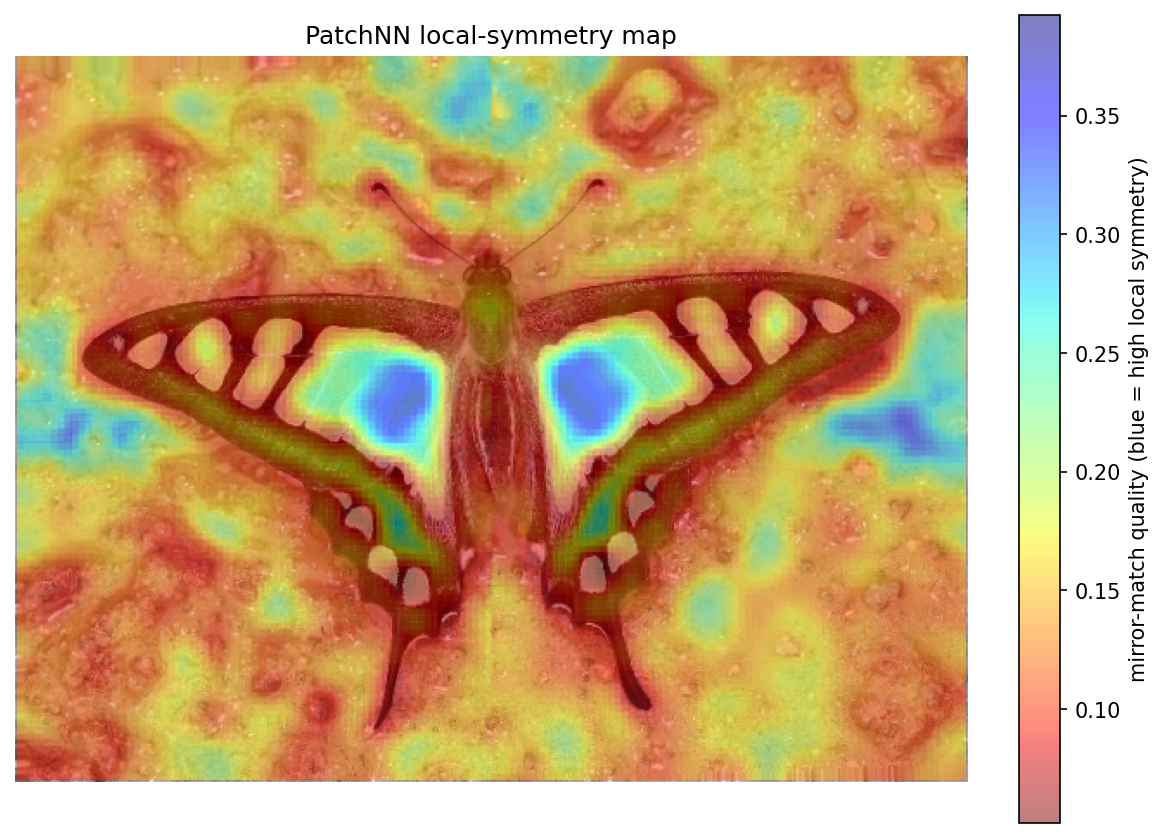
Blue = high local symmetry, red = low: the mirrored wing bands read blue, while the gravel background is genuinely asymmetric and reads warm. (Butterfly photo from Wikimedia Commons.)
The skill numbers above come from the symmetry-scoring benchmark that ships in
scripts/: every method ranks true symmetry axes against perturbed negatives
on four annotated datasets (~3900 axis units), with derived results
(leaderboards, ablations, timings) tracked under results/. The raw per-image
score JSONs are not tracked — they regenerate deterministically (fixed seeds)
from the datasets, whose sources and expected directory layout are documented
in data/README.md:
python scripts/run_discrimination.py                    # single-axis protocol
python scripts/run_discrimination.py --protocol multi   # multi-axis protocol
The full protocol and analysis are described in the accompanying paper.
MIT — see LICENSE.
