Repository navigation
Releases: perkel666/MegaCapybara
Release list
MegaCapybara 1.37

Fixed
- A conversation could stop working for good when the model wrote
run_in_backgroundas text, such as"True", instead oftrue. The server answered every later request in that conversation with an empty error 500. Text values are now accepted. (#3) - A conversation could also stop working when an earlier tool call's arguments were not valid JSON. The server answered every later request with error 400. Such a call is now shown to the model without its arguments.
- A request field of the wrong type, such as
"stream": "true", now gets error 400 with a message that says what is wrong. It used to get an empty error 500. - The launcher's window title showed version 1.35 in release 1.36.
The "Source code" files GitHub attaches to this release hold only the README and the docs. The engine's source code will be released soon.
MegaCapybara 1.36
What's new
A new model: Qwen3.8 Flash-Next
MegaCapybara now runs Qwen3.8 Flash-Next, a 177-billion-parameter mixture-of-experts model, on one RTX 5090. It is built on turboderp's EXL3 quantization and runs on MegaCapybara's own kernels.
The model's experts don't all fit in the card's 32 GB of memory. The most used ones stay on the GPU and the rest are read from RAM. While you work, the engine moves the experts your work needs most into VRAM.
-
Two sizes. Tiny stores the experts at 2 bits and is faster, with more room for context. Small stores them at 3 bits and gives answers closer to the original model.
-
Uncensored versions of both sizes. The launcher downloads all four from perkel/Qwen3.8-Flash-Next-MC and perkel/Qwen3.8-Flash-Next-Uncensored-MC.
-
Two ways to write faster: DFlash2 (the default) and MTP. DFlash2 uses a separate drafter that the launcher downloads with the model. MTP uses a layer built into the model. Both give exactly the model's own answers. Speed with Tiny, in tokens per second:
No speculation MTP DFlash2 (default) Coding, one agent 299 440 498 Prose, one agent 289 300 318 Coding, four agents at once 678 789 Coding, eight agents at once 779 993 -
Images. Flash-Next can read images. Its vision encoder stays in RAM, so it takes no GPU memory away from the experts.
-
Long context. Conversations can be up to a million tokens long. You can store the context at 8, 6 or 4 bits per value to fit more of it.
Suggested: 64 GB of RAM.
All models
- Agents that don't use a drafter now share their work. Before, each one ran in turn. Now they are processed together, so eight agents on the 27B Medium model reach 622 tokens per second instead of 92.
- Images are processed faster. A one-megapixel image now takes 50 milliseconds instead of 221.
Fixed
- A short opening that many requests share is now kept in memory. Before, it could be pushed out by longer ones and read again every time.
- Conversations that have just answered are no longer the first to be removed when the RAM cache is full.
- Emoji and other characters that span two tokens came out as
�in tool-call arguments, which could break an agent's file edits. - When the loop guard stops an answer, the OpenAI API now reports
finish_reason"length". It used to report "repetition", which some clients such as OpenCode rejected. - The server could fail with "save KV: out of memory" and stop answering when many experts or conversations were held in RAM. It now stays within the memory that Windows lets the GPU use.
- Requests that ask for no thinking are now honoured in every common form.
- Requests are no longer limited in how many images they can contain.
Launcher
- The download panel groups models by family, Qwen3.8 27B and Qwen3.8 Flash-Next. One Download button gets a model with everything it needs.
- The monitor shows a queued request and the conversation it continues as a single entry.
The "Source code" files GitHub attaches to this release hold only the README and the docs. The engine's source code will be released soon.
MegaCapybara 1.35
What's new
-
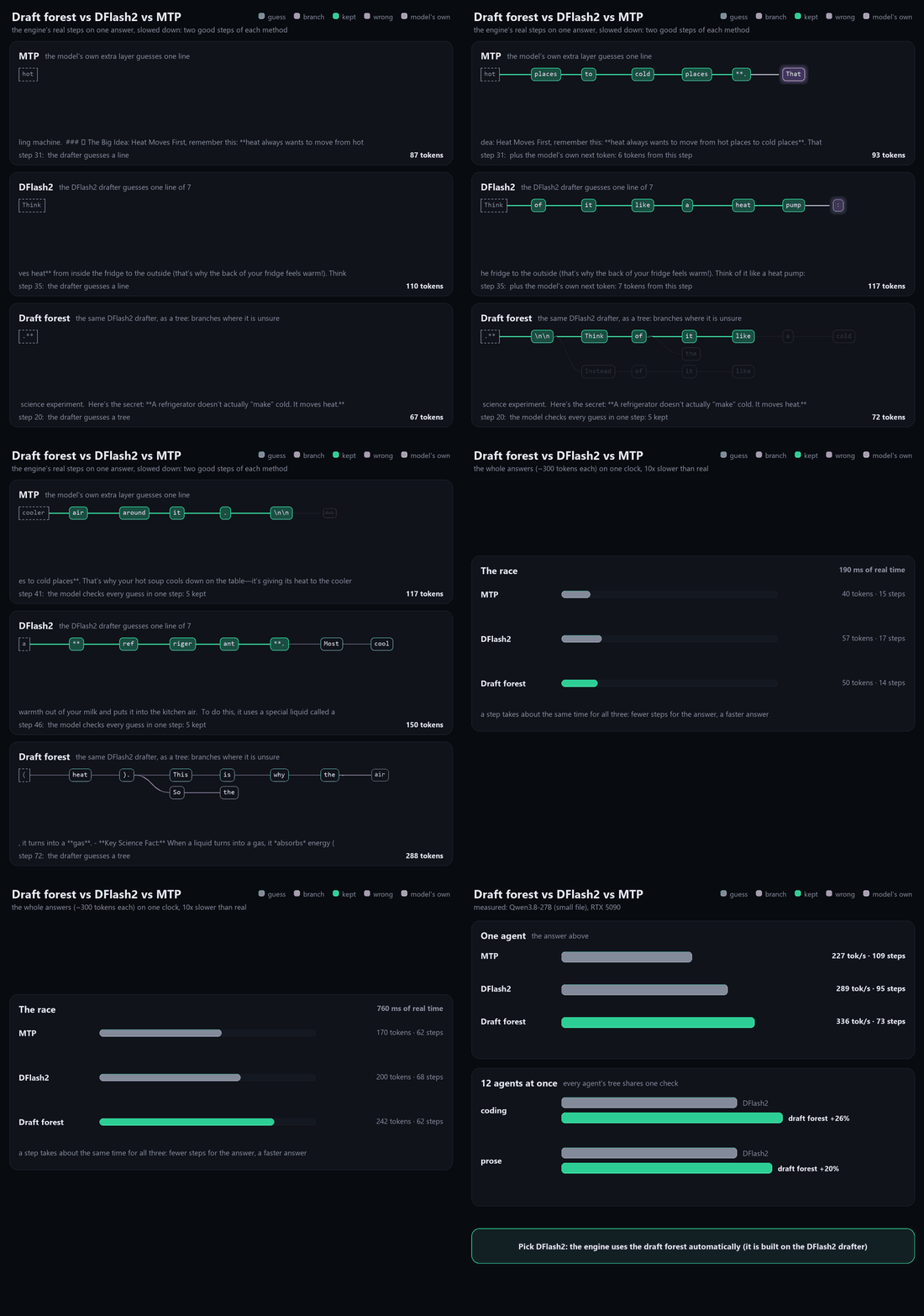
Draft forest: faster with many agents. DFlash2 and MTP guess the next tokens as one line, and the first wrong guess ends the round. The draft forest takes the same DFlash2 drafter's guesses as a tree instead: where the drafter is unsure it also tries its second and third choices, so a miss on one branch is often caught by another and more tokens are kept per step. With several agents, all their trees share one check, and the rows go where guesses are likeliest to be kept. Many agents at once gain the most (the table below). Answers are the model's own, as before.
You don't need to turn it on: when you pick DFlash2 (the launcher's default), the engine uses the draft forest automatically instead of the slower one-line DFlash2, because the draft forest is built on the DFlash2 drafter.
-
More tokens per second in total when many agents work at once. Each shared step that checks several agents' guesses got cheaper (a new kernel for the model's linear-attention layers, faster weight reads), and a ~25 ms stall that every new request caused is gone. Coding speed per model file, measured with 1.17's engine (2026-10-01) and with this one:
Size 1 agent, 1.17 1 agent, 1.35 8 agents, 1.17 8 agents, 1.35 12 agents, 1.35 Tiny 540 537 1,890 2,333 (+23%) 2,782 Small 495 499 1,755 2,379 (+36%) 2,584 Medium 440 436 1,638 2,203 (+35%) 2,529 Large 377 372 1,427 1,953 (+37%) 2,269 XXL 313 307 1,255 1,645 (+31%) 1,921 Tokens per second, coding answers up to 2,000 tokens, Qwen3.8-27B on one RTX 5090. One agent alone writes as fast as before; the gain is with many at once.
-
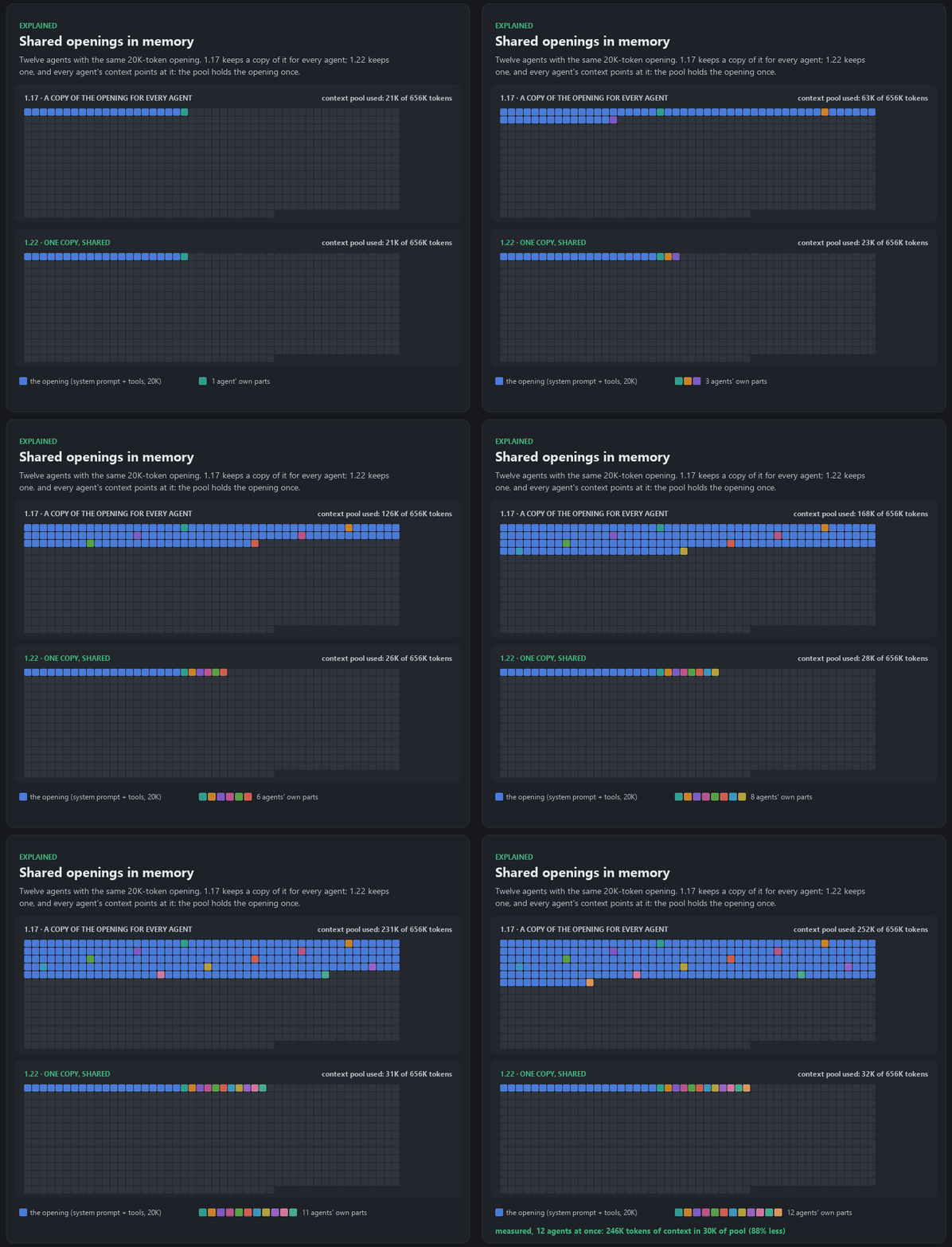
Shared openings use their memory once. Agents that start with the same system prompt and tools now share one copy of it in the context pool instead of holding a copy each: 12 agents with the same 20K-token opening held 246K tokens of context in 30K tokens of the pool (88% less). Shared openings also move to the RAM cache as one copy, and come back shared.
-
Honest projections in the launcher. Every model file was re-measured with this version (DFlash2 meaning the draft forest, many agents measured on a server already running) and its scores updated on Hugging Face under the same names, and the launcher's MTP and many-agents figures were re-measured too. Files you downloaded earlier keep their old scores: download them again to see the new figures. (This replaces v1.34, released earlier today, whose many-agent figures were measured on a freshly started server and read 10-20% low.)
-
Crash and hang reports. If the server crashes, its log shows where (functions and lines) and a crash dump is saved in
logs\; if it stops making progress for 30 seconds, the log gets every thread's stack.megacapybara.pdbships beside the server for this.
Fixed
- A crash when a shared opening was kept while the RAM cache was nearly full. With many agents and a large opening (64K tokens), the server could crash with nothing in its log.
- The monitor froze and the server looked hung under heavy load. With 12 agents running and many more requests queued, every connection thread was taken and the launcher's statistics got no answer. The server now always has a thread for them.
- Agents re-reading their whole conversation after part of its cache went to RAM: their next turn read 50K–120K tokens again instead of continuing (introduced in the withdrawn 1.22).
- A conversation whose cache was in RAM was sometimes read again from scratch when VRAM was briefly short; it now waits a moment for room instead.
- All running conversations could end at once when the RAM cache was full and a request continued a conversation that had been moved to RAM.
- The monitor listed idle conversations as held in VRAM when most of their cache was in RAM.
The "Source code" files GitHub attaches to this release hold only the README and the docs; the engine's source code will be released soon.
MegaCapybara 1.17
What's new
-
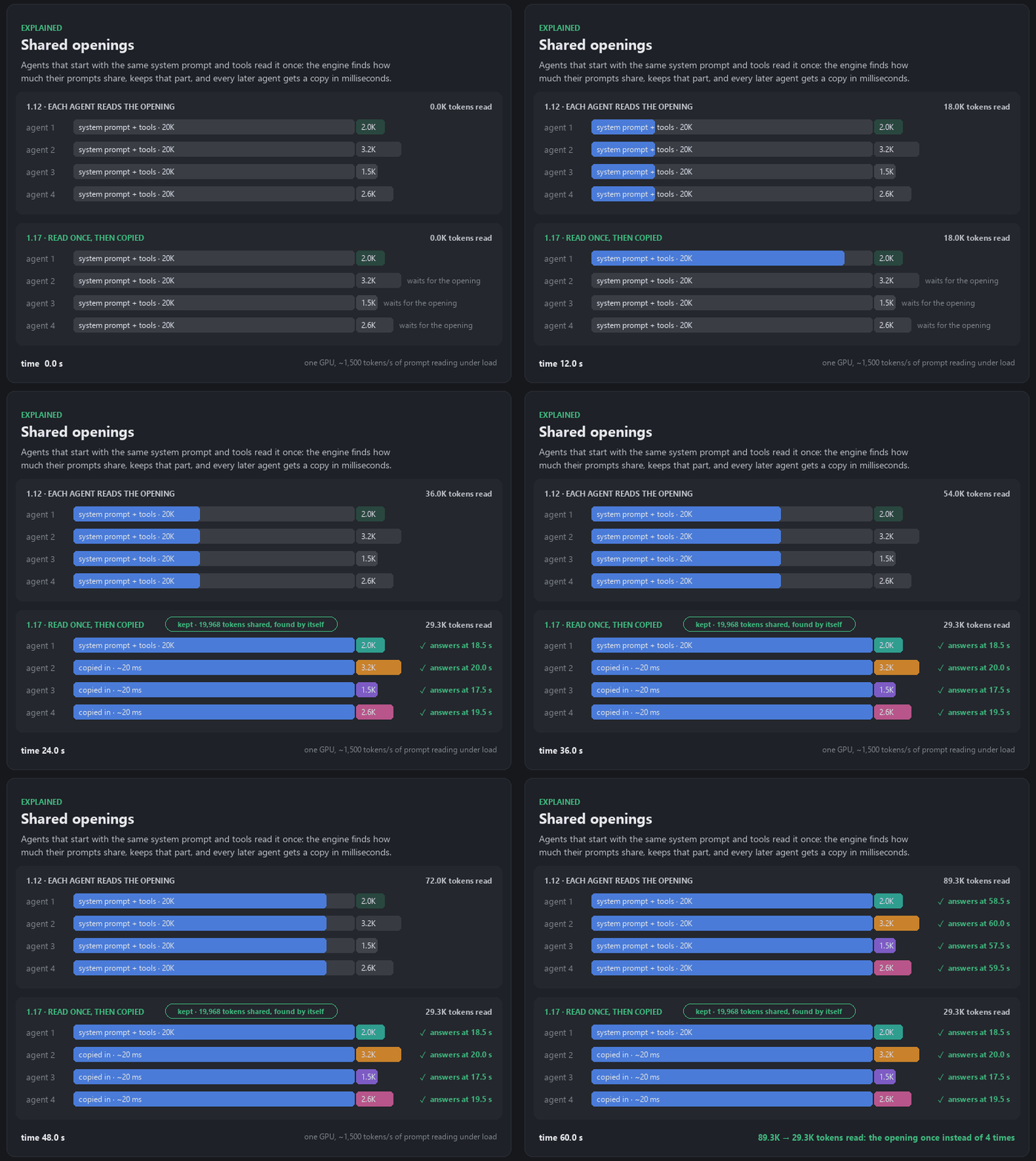
Shared openings are read once. Agents that start with the same system prompt and tools read that part once; later ones get a copy in a few milliseconds and read only their own part. Prompts sent together (a dispatch of agents, or every conversation coming back after a restart) wait for the first one instead of each reading it. The engine finds the shared length by itself (an agent's system prompt and tools are often ~20K tokens), and keeps a few openings by how much reading they save, inside the RAM cache's budget. Answers are the same as reading the prompt whole.
-
The log says when a conversation cannot be resumed and why, and when a shared opening is kept or reused.
Fixed
- Agents re-reading their whole conversation every turn (1.12). Under heavy agent load, 1.12's RAM cache could fill Windows' memory limit for the GPU; conversations then lost their resume point and each turn read its whole context again (on a busy session: 110 turns in 27 minutes re-read 4.8M tokens, and requests answered fell from ~500 to 24 per 10 minutes). 1.17 counts the memory the cache really holds and keeps room for every running conversation's resume point.
The "Source code" files GitHub attaches to this release hold only the README and the docs; the engine's source code will be released soon.
MegaCapybara 1.12
What's new
- Faster prompt reading. About 8-9% faster: 8 prompts of ~11K tokens at once 7.4K -> 8.1K tokens/s, a
145K-token prompt 5.2K -> 5.6K tokens/s (small model, RTX 5090). - Faster generation in long conversations. Each speculative round is 4-9% faster from 8K to 240K tokens of
context (up to 20% with long drafts); short conversations are unchanged. - Agents keep their cache while they wait. A conversation counts as finished only after 20 minutes without a turn,
and one whose last tool call runs in the background (as Claude Code's Bash withrun_in_background) stays open, so
an agent waiting for its tests comes back without reading its whole context again. - The shared context is about 3% smaller than in 1.08 (larger buffers for reading prompts).
The "Source code" files GitHub attaches to this release hold only the README and the docs; the engine's source code will be released soon.
MegaCapybara 1.08
What's new
- See where each conversation's context is. The monitor's Conversations tab shows VRAM, RAM and disk side by
side, each conversation as a dot with its size; a prompt being read shows in its slot. - Statistics tab (instead of the launcher's Server log): how the slots spent the last 10 minutes and since the
start: whether the clients send enough work, or requests wait for context. - Smarter cache, the disk as the last resort. Finished jobs' caches go first and are never written to disk;
nothing idle for an hour stays on disk; an active conversation's state stays in RAM. On a busy hosted hour this
removes thousands of disk round trips and the ~3 s wait they added to agent turns.
The "Source code" files GitHub attaches to this release hold only the README and the docs; the engine's source code will be released soon.
MegaCapybara 1.04
What's new
- Download counts on Hugging Face. After the launcher downloads a model, it requests that model repository's
config.jsononce, so Hugging Face counts the download. Nothing about you or your PC is sent.
The "Source code" files GitHub attaches to this release hold only the README and the docs; the engine's source code will be released soon.
MegaCapybara 1.03
What's new
Conversations keep their cache when many agents share the server. Under memory pressure, 1.02 could drop a whole idle
conversation (often 100K–300K tokens) and read it again from scratch on its next turn.
- A conversation coming back from RAM no longer causes another one to be dropped: it swaps places with an idle one.
- Running out of pinned RAM moves another conversation to disk instead of dropping the one being moved.
- The conversations needed last make room first; one is never pushed out for one that is needed later.
The "Source code" files GitHub attaches to this release hold only the README and the docs; the engine's source code will be released soon.
MegaCapybara 1.02
What's new
- First public release: the server and the launcher for Windows 11 and Linux, the presets, and model downloads from
Hugging Face in the launcher.
The "Source code" files GitHub attaches to this release hold only the README and the docs; the engine's source code will be released soon.