Layers 13 14 Greek
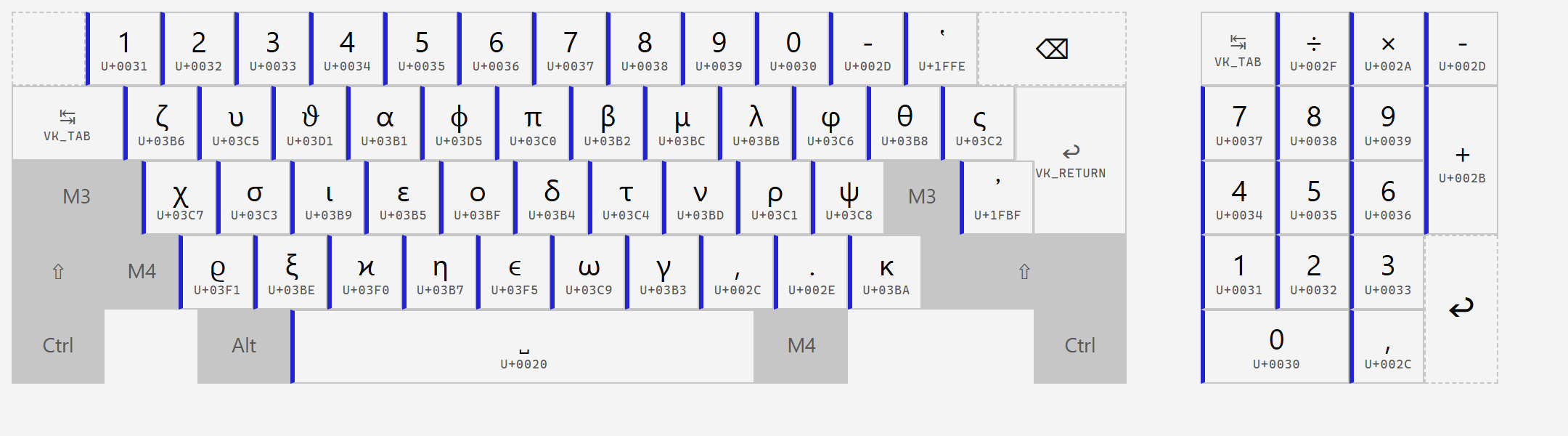
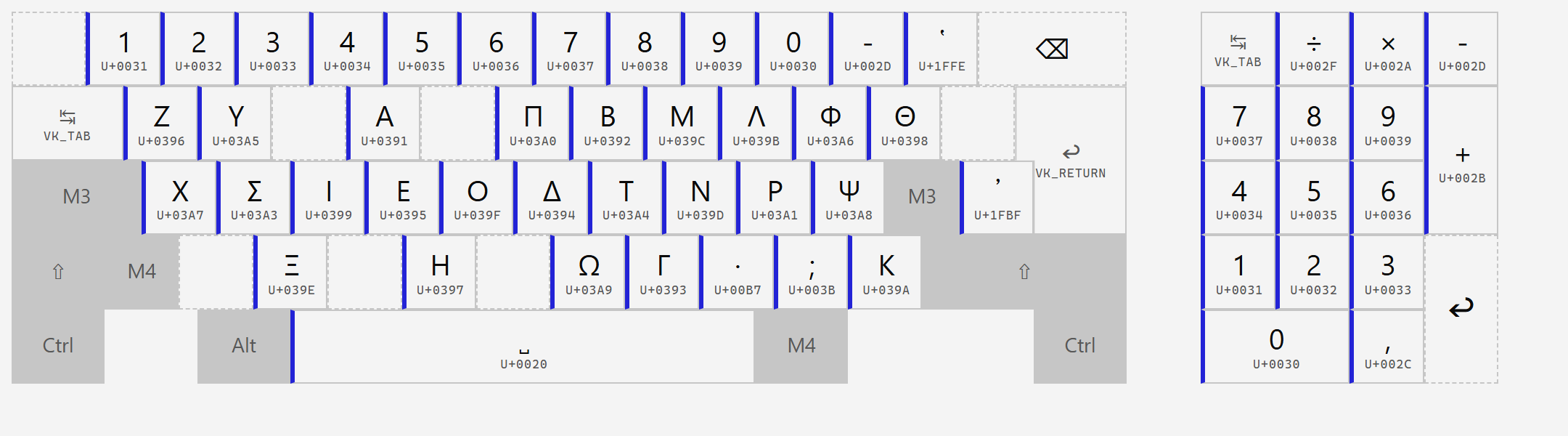
Lock with M3+F4. Release with the same chord or with M3+Esc. Hold Shift for the capitals.
| Layer | Held | Contents |
|---|---|---|
| 13 | – | lower case |
| 14 | Shift | upper case, on the same positions |
Phonetically: each Greek letter sits on the Latin key it sounds like. α on a, β on b, μ on m, π on p, λ on l, θ on j, φ on f, ζ on z. The capitals are on the same keys one Shift away, so the block is learned once and used in both cases.
The alternative would have been the Greek national keyboard order, which is QWERTY-derived and would have meant learning a second finger arrangement on top of Noted's. Phonetic placement keeps the letters where your fingers already expect the corresponding sound.
Where a letter has two forms, both are present: ß carries final sigma ς next to σ on s, and the variant forms ϑ and ϕ have their own keys alongside θ and φ.
The two dead-key positions to the right of the letters carry the breathing marks – psili (smooth, U+1FBF) and dasia (rough, U+1FFE). Combined with the compose tree, that is what makes polytonic Greek typable: the breathings, the accents and the iota subscript combine onto vowels through compose sequences rather than each combination needing its own key. There are more than a thousand precomposed polytonic characters in Unicode; no layer could hold them, and none needs to.
Digits, comma and full stop keep their ordinary behaviour on both layers, as do the keypad, the space bar and the function keys. You can lock Greek and write a sentence with numbers and punctuation in it without releasing the lock. That property was set here first and became the rule for Cyrillic as well.
Greek has no +Mod3 or +Mod4 layer. Holding either inside the locked block falls back to layer 1.