Getting Started
Run Valendo-1.0.0-setup.exe. It installs per user, so it does not ask for an administrator password, and it puts a shortcut on the desktop and in the Start menu.
SmartScreen will warn about an unrecognised publisher, because the installer is not signed by a certificate authority. More info → Run anyway.
Open the .dmg for your chip — arm64 for Apple Silicon, x64 for Intel — and drag Valendo to Applications.
The app is not notarised, so macOS blocks the first launch. The unblock is three clicks and happens once:
- Open Valendo. macOS refuses and offers to move it to the Bin. Say no.
- System Settings → Privacy & Security. Scroll to the bottom: there is a line saying Valendo was blocked, with an Open Anyway button.
- Click it, confirm, and the app opens. It never asks again.
If that line does not appear — it sometimes does not, depending on the macOS version — one command does the same thing:
xattr -dr com.apple.quarantine /Applications/Valendo.appThat command removes the "downloaded from the internet" flag that Gatekeeper checks. It is not a workaround for a broken app; it is the standard way to run software whose author has not paid Apple's yearly developer fee.
Why the block exists. Apple Silicon refuses to run any binary with no signature at all, so Valendo is signed ad-hoc — a signature that proves the file has not been tampered with since it was built, but says nothing about who built it. What is missing is notarisation: Apple scanning the app and stamping it. Only a paid developer account can request that stamp. Building from source produces the same app with no block at all, because nothing was downloaded.
See Building from Source.
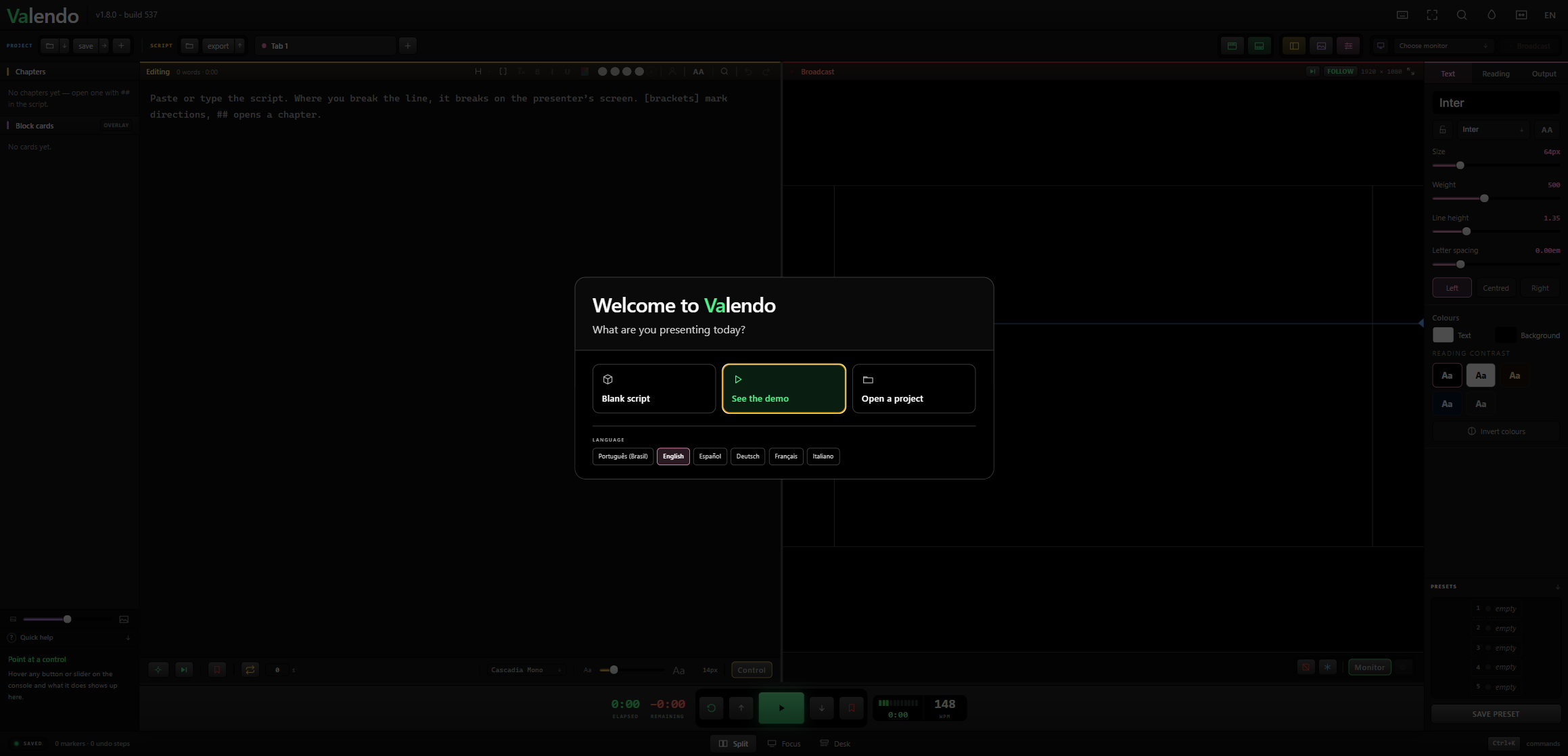
Valendo greets you in the language of your operating system, and lets you change it right there — the sample script, the tab name and the colour presets follow the choice immediately.
Four ways in:
| Choice | What happens |
|---|---|
| Pick up where I left off | Brings back the last session, exactly as you left it. Only appears when there is something to bring back. |
| Blank script | An empty editor. |
| See the demo | A short script that shows the app at work. You can delete it afterwards. |
| Open a project | Loads a .valendo file you saved before. |
This screen appears on every launch, not only the first one. Valendo does not restore your last script by itself — opening it in someone else's studio, or with the screen already mirrored to a wall, would otherwise reveal the previous show without anyone asking. Recent projects appear as chips above the buttons, and clear empties that list for good.
Escape and clicking outside pick the least destructive way in: continue when there is something to continue, the demo when there is not.
Paste it, type it, or import a txt, md, docx or pdf.
Two marks matter:
## Cold open

Good evening. Tonight we look at a change that is already happening.

[look at camera two - pause]

The important part is this: nobody has to stop the recording.
-
##at the start of a line opens a chapter. Chapters appear in the left column with their duration, and as amber ticks on the progress line. Any Markdown heading level works,#through######, so a script pasted from elsewhere often arrives already marked. -
[square brackets]around a whole paragraph make it a stage direction: painted in blue, italic on the presenter's screen, and never counted as words to be spoken.
A blank line separates paragraphs. Nothing else is markup.
- Pick a monitor in Choose monitor, at the top right. Identify flashes a number on each screen so you know which is which.
- Press Broadcast. The presenter's screen goes full screen on that monitor.
- Press Space, or the big green button.
The number beside the ruler is the pace in words per minute. The mouse wheel changes it anywhere in the app; the arrow keys nudge it.
Everything is live. Fix a typo, raise the type size, change the margin, put a card on screen — the word under the reading line stays put. That is the whole point of the app, and it is explained in The Reading Anchor.
Ctrl+S saves the whole programme — every tab, appearance, markers, cards — into a .valendo file. That file is what you carry to another machine.
Separately, Valendo autosaves your session so a power cut does not cost you the script. That autosave is what Pick up where I left off offers on the next launch.