Guardrails Deep Dive
Four independent layers stand between the model and your clusters. A change must pass all four, in order. The point of four layers is that each fails differently, so a gap in one is caught by the next.
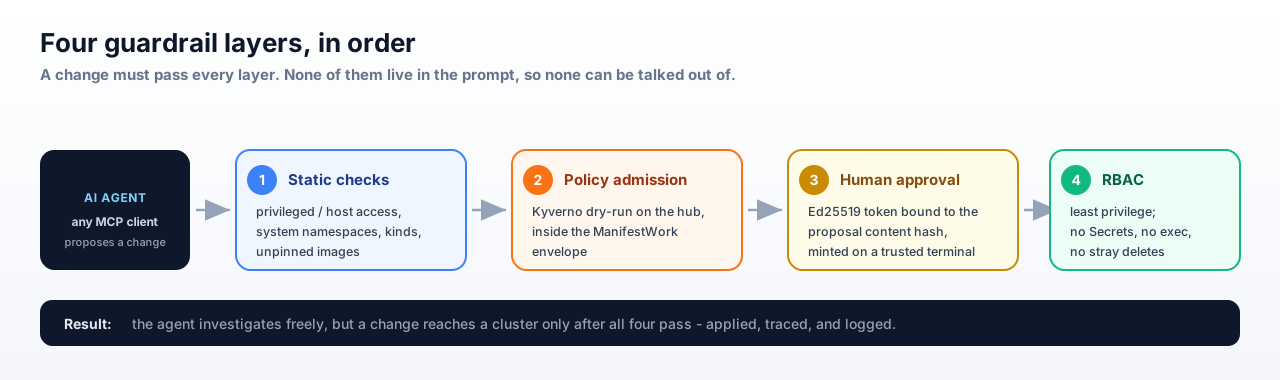
flowchart TD
    P[Agent proposes a change] --> L1
    L1{1. Static checks<br/>in the server} -->|fail| R1[Rejected, reason returned]
    L1 -->|pass| L2
    L2{2. Kyverno dry-run<br/>on the hub} -->|deny| R2[Rejected, policy message]
    L2 -->|allow| L3
    L3{3. Human approval<br/>content-bound token} -->|no token| R3[Waits, never applies]
    L3 -->|valid token| L4
    L4{4. RBAC<br/>on apply} -->|denied| R4[Blocked by Kubernetes]
    L4 -->|allowed| OK[Applied, traced, logged]
    style OK fill:#e6f7e6
    style R1 fill:#ffe6e6
    style R2 fill:#ffe6e6
    style R3 fill:#fff3e0
    style R4 fill:#ffe6e6
Runs in the server before anything else, with no cluster round-trip, so the agent gets instant, specific feedback. Blocks privileged/host settings, protected namespaces, disallowed kinds, and unpinned images. See Implementation for the full list.
The three policies in deploy/policies/ validate the workload inside the
ManifestWork envelope using Kyverno's foreach over
spec.workload.manifests. This matters: normal pod-security policies only see
resources after they land on a cluster. Here we validate on the hub, at propose
time, via server-side dry-run, so bad content is rejected before it is ever
delivered, and the agent gets the policy message to self-correct.
The policies are scoped by the label
app.kubernetes.io/managed-by: ocm-mcp-server, so human platform engineers are
not affected. They ship with an offline CLI test suite
(make policy-test, 12 cases) that runs in CI.
Because it is just Kyverno - a CNCF policy engine whose policies are ordinary Kubernetes resources in YAML and CEL, enforced by the cluster rather than by the prompt - your existing organizational policies apply here too with no extra wiring. And you do not have to write them from scratch: the community library kyverno/policies and the searchable Kyverno Policies catalog are a ready source of validation, Pod Security Standards, and best-practice policies to adopt or adapt.
An HMAC token over the proposal's content hash plus an expiry. It approves
that exact change, not a conversation. Minted only by the ocm-mcp CLI on a
trusted terminal. See How It Works for the token mechanics.
The server's hub identity can read ManagedClusters and create/delete only its own ManifestWorks. It cannot read Secrets, exec, or touch anything else. Even a bug in the server cannot exceed this. This is the backstop that holds when the other three are somehow bypassed.
There is no tool for: reading Secrets, exec/port-forward, deleting arbitrary resources, cluster lifecycle operations, or approving proposals. A capability that does not exist cannot be prompt-injected into use. This is a design choice, not an oversight.
mindmap
  root((Threats))
    Hallucinated/destructive fix
      Layers 1-3 stop it
    Prompt injection
      Rules aren't in the prompt
      Layers 1,2,4
    Approval replay on changed content
      Token binds to content hash
    Stolen token
      TTL + single-proposal binding
    Compromised server host
      RBAC scope, no Secrets/exec to steal
    Audit tampering by agent
      Audit file outside the tool surface
- anything touching etcd, storage classes, or cluster deletion;
- cross-cluster traffic shifting during a live incident;
- auto-approval, even for "safe" change classes.
The rule of thumb, stated once more: automate diagnosis aggressively, mutation conservatively.
Next: Getting Started.